Instant Pot Duo Review 2026: Still Worth Buying?
The company that makes the Instant Pot filed for bankruptcy in 2023. That alone is enough to make a shopper pause before buying one in 2026 — will parts still be available, does the warranty still mean anything, is the company even still making the Duo? At the same time, the Instant Pot Duo remains one of the most-owned kitchen appliances in America, with a decade of accumulated recipes and owner reviews behind it. We pulled apart the corporate history, Consumer Reports’ lab testing, and aggregated owner complaints to answer a narrower question than “is it good” — is the original Duo still a rational purchase in 2026, or has the market moved past it.
As an Amazon Associate, Arekore earns from qualifying purchases. The Amazon product links in this article include our affiliate tracking ID and may earn us a commission if you buy through them, at no additional cost to you. See our Links Policy for details on how we select products and how commissions do not influence our recommendations.
TL;DR / Quick Verdict
- The bankruptcy didn’t interrupt the product line. Instant Brands filed Chapter 11 in June 2023; its appliance division (including Instant Pot) was sold to an affiliate of Centre Lane Partners in November 2023, and the reorganized housewares business emerged from court protection in February 2024. Instant Pot cookers, including the Duo, kept shipping throughout.
- Consumer Reports does not rate the Duo as the best multi-cooker on the market. In its broader multi-cooker testing, CR’s top overall score went to a Zavor model, with Instant Pot’s entries — including the higher-tier Duo Crisp — landing just below the top spot rather than at it.
- The base Duo’s advantage is price and parts availability, not lab-leading performance. At roughly $70–$140 depending on size, it remains one of the cheaper ways into pressure cooking, and replacement seals and inner pots are easy to find years after purchase.
- Seal-ring and lid-locking issues are the most common complaint in aggregated owner reviews — largely a wear-part problem solvable with a $10–$15 replacement ring, not evidence the unit is failing outright.
How We Reached These Conclusions (Methodology)
This is an editorial analysis, not a hands-on review; we did not personally test the products covered here. It synthesizes three kinds of public information: (a) manufacturer specifications and warranty terms published by Instant Pot for the Duo, Duo Plus, and Duo Crisp lines; (b) independent third-party lab testing from Consumer Reports, which has tested dozens of multi-cookers including several Instant Pot models; and (c) aggregated sentiment from long-form owner reviews and complaint-tracking sites covering Instant Pot products broadly. We avoid citing a specific unverified Amazon review count, since exact totals fluctuate. Manufacturer figures (wattage, capacity, program counts) are labeled as such. Prices are amazon.com and manufacturer figures at the time of writing and change frequently, especially around sales events like Prime Day.
Does the 2023 Bankruptcy Change Whether You Should Buy One?
Instant Brands, the parent company that owned Instant Pot alongside Pyrex, Corelle, and CorningWare, filed for Chapter 11 bankruptcy protection in June 2023 while carrying roughly $512 million in debt. That filing did not shut down production. In November 2023, an affiliate of private equity firm Centre Lane Partners acquired the appliances division — the part of the business that makes Instant Pot cookers — in a sale that closed that same month. The broader housewares business, including Pyrex and Corelle, separately emerged from bankruptcy court as a reorganized company in February 2024, with prepetition lenders converting over $390 million in debt into equity.
For a buyer deciding whether to purchase a Duo in 2026, the practical takeaway is narrower than the bankruptcy headlines suggest: the Instant Pot appliance business is now owned by a private equity-affiliated holding structure rather than the founder-led company that launched the brand in 2010, but the product itself did not disappear, warranty claims are still being processed according to aggregated owner reports, and replacement parts (seals, inner pots, lids) remain widely available on Amazon and instantpot.com. The bigger risk from the ownership change is less about whether the Duo works on day one and more about long-run customer service responsiveness — a concern echoed in aggregated complaint sites, which cite slow support response times as a recurring frustration independent of the bankruptcy timeline.
Technical Approach: Duo vs. Duo Plus vs. Duo Crisp
All three tiers share the same core pressure-cooking mechanism — a locking lid, a spring-loaded sealing valve, and an electric heating element controlled by microprocessor-timed programs — but they differ in how much convenience is layered on top.
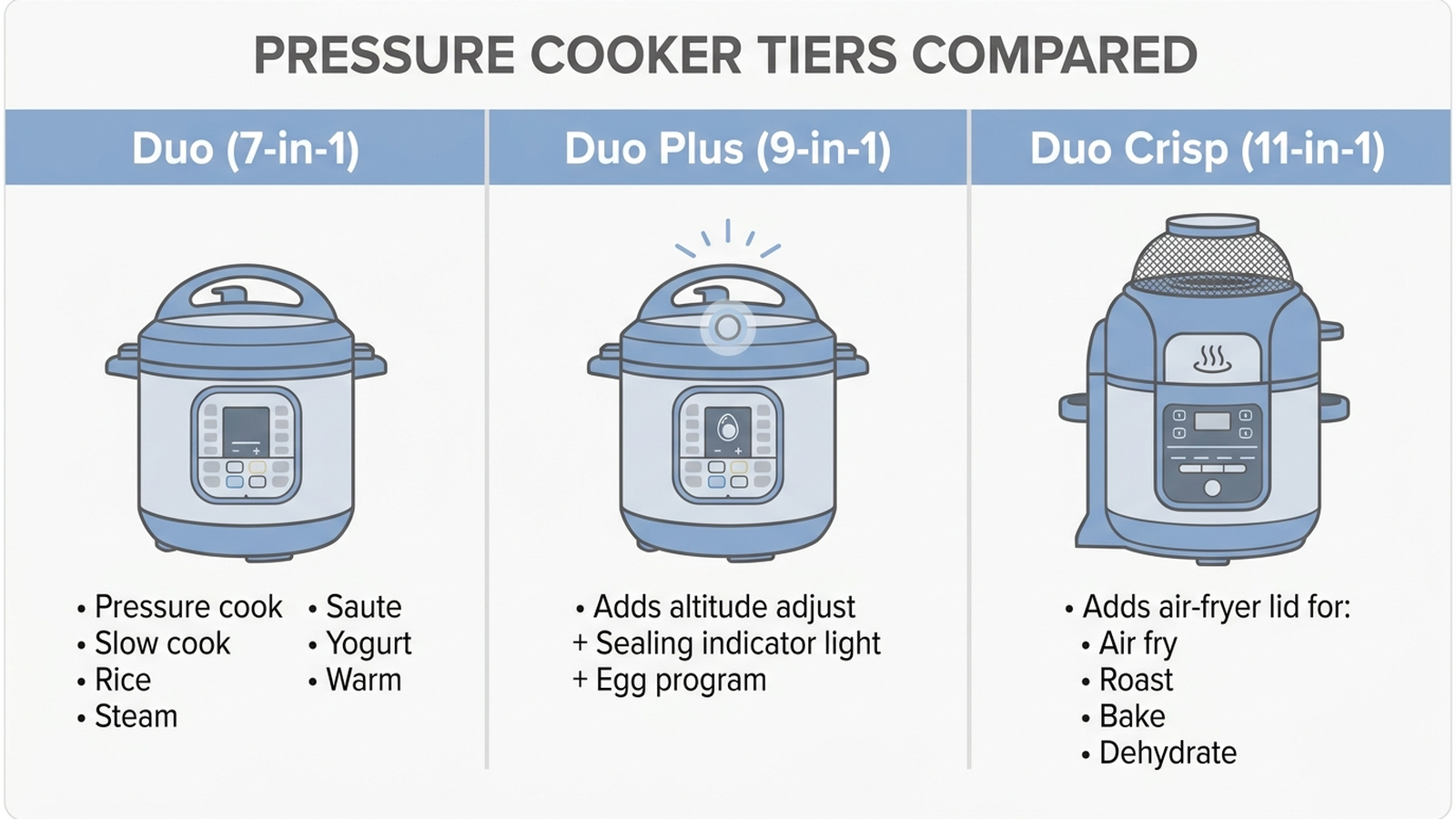
- Instant Pot Duo (7-in-1) is the base tier: pressure cook, slow cook, rice cook, steam, sauté, yogurt, and warm, controlled with a simple button-and-dial interface. It has no altitude-adjustment program and a more basic display than the tiers above it.
- Instant Pot Duo Plus (9-in-1) adds an egg program, a sterilizer function, a sealing-level indicator light that shows whether the lid is fully locked before pressurizing, and an altitude-adjustment setting — aimed at buyers above 3,000 feet where standard pressure-cooking times run short. According to manufacturer specifications, it lists for roughly $30 more than the equivalent-size Duo.
- Instant Pot Duo Crisp (11-in-1 or 13-in-1, depending on kit) adds a second, air-fryer lid on top of the pressure-cooking base, letting one base unit air fry, roast, bake, and dehydrate in addition to pressure cooking. Consumer Reports’ lab testing found the Duo Crisp to be one of the largest and best-performing multi-cookers it tested, excelling at both pressure cooking and slow cooking, with a respectable sauté result — though CR’s overall top score across all 29 tested models went to a Zavor unit, not an Instant Pot.
The practical distinction: buyers who only want the seven core cooking modes gain little from paying more for the Plus or Crisp tiers. Buyers who cook at altitude, want the sealing-indicator light, or want to eliminate a separate air fryer from their counter are the ones the step-up tiers are actually built for.
How to Use an Instant Pot Duo
The core workflow is the same across every Duo-family model; only the number of preset buttons changes with the tier.
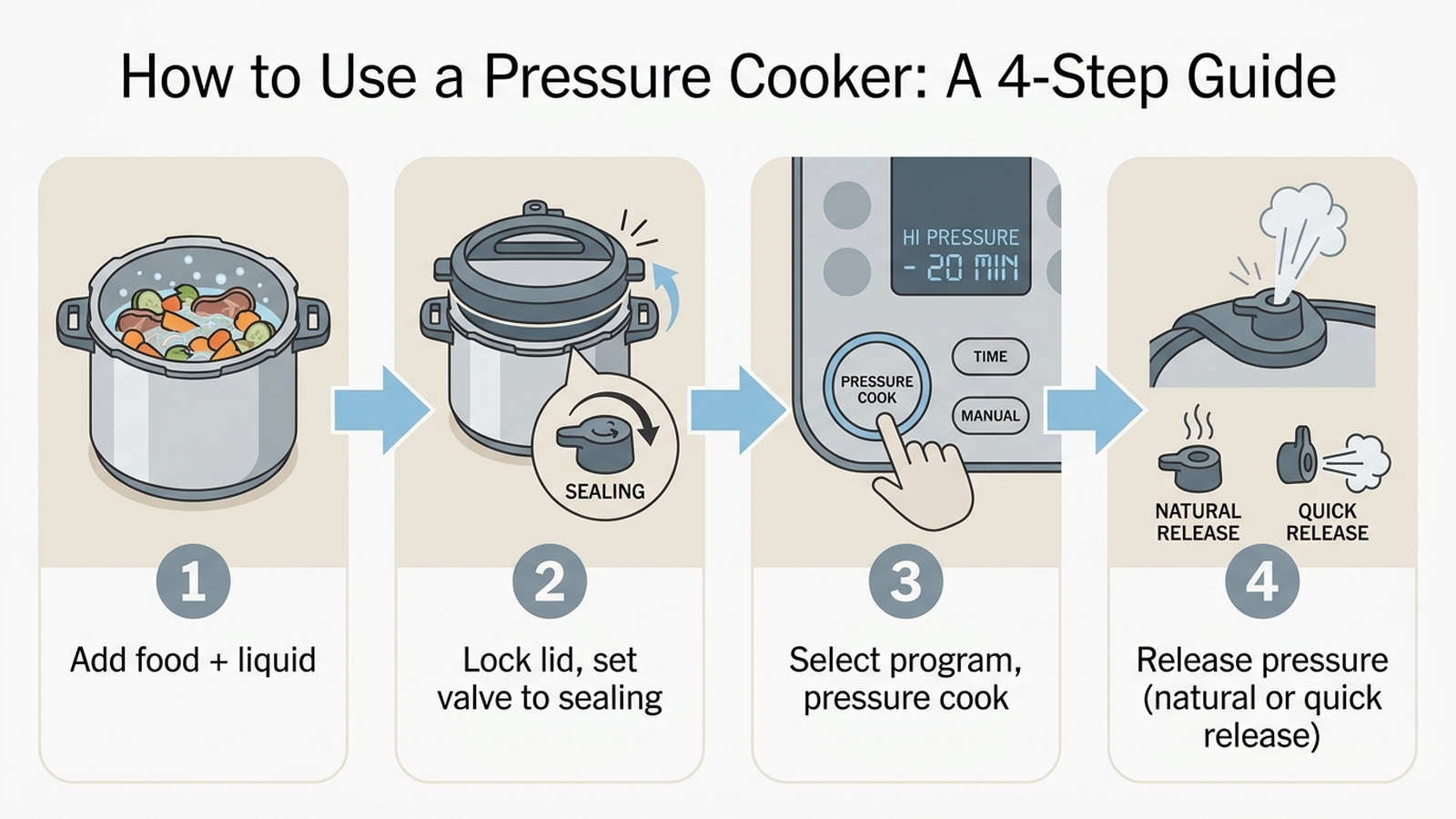
- Add food and at least the minimum required liquid (typically 1 cup, per manufacturer guidance) — pressure cookers need liquid to generate steam, and running one dry can trigger a burn warning or damage the inner pot.
- Lock the lid and turn the steam-release valve to “sealing.” A partially locked lid is the single most common cause of a Duo failing to build pressure, per aggregated owner complaints — a problem the Duo Plus’s sealing-indicator light was specifically designed to reduce.
- Select a cooking program or set manual pressure and time. The unit will take several minutes to come to pressure before the countdown timer starts.
- Release pressure using natural release (letting it depressurize on its own, best for rice, beans, and large cuts of meat) or quick release (manually venting steam through the valve, best for vegetables and foods that overcook easily).
The seal ring — a silicone gasket inside the lid — is the part most frequently blamed for failed seals and steam leaks in aggregated owner reviews. Manufacturer and third-party guidance both recommend replacing it if it smells persistently of previous meals, looks stretched or cracked, or stops holding a consistent seal; replacement rings typically cost $10–$15 and do not require replacing the whole unit.
Comparison Table
Prices as of 2026-09-08. These are list prices seen on amazon.com and manufacturer listings; actual selling prices fluctuate frequently and are commonly discounted well below list, especially around Prime Day and other sales events — always check the current price on the product page.
| Model | ASIN | List price | Capacity | Programs | Best for |
|---|---|---|---|---|---|
| Instant Pot Duo Mini | B06Y1YD5W7 | ~$69.95 | 3 qt | 7-in-1 | Singles, small households, side dishes |
| Instant Pot Duo | B00FLYWNYQ | ~$109.99 | 6 qt | 7-in-1 | Most households, core pressure cooking |
| Instant Pot Duo (large) | B01B1VC13K | ~$139.95 | 8 qt | 7-in-1 | Larger families, batch cooking, meal prep |
| Instant Pot Duo Plus | B01NBKTPTS | ~$139.99 | 6 qt | 9-in-1 | High-altitude cooks, sealing-indicator light |
Editorial Recommendations by Use Case
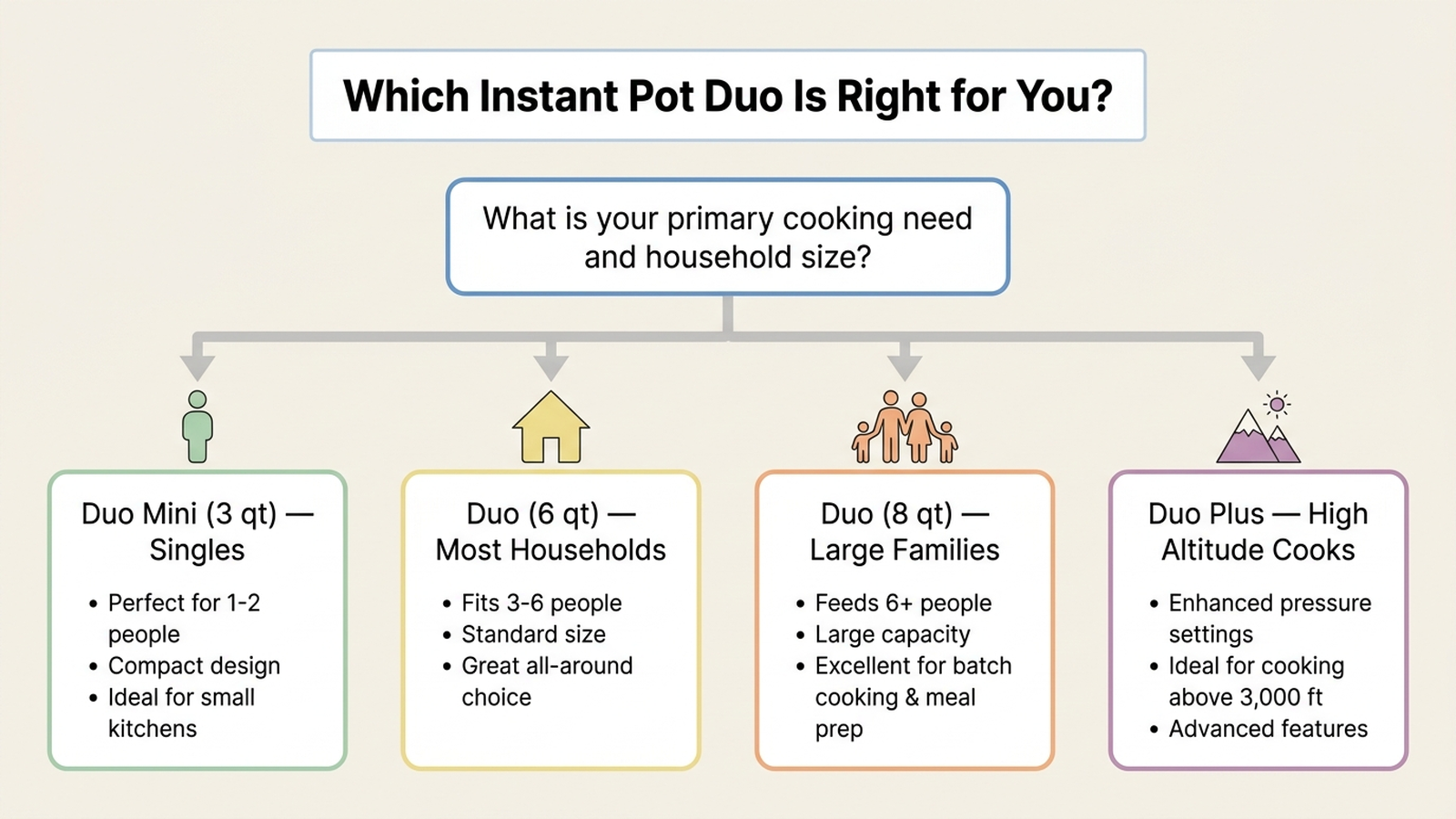
- Best for most households: the 6-quart Instant Pot Duo — the 7-in-1 program set covers pressure cooking, rice, steaming, sautéing, and slow cooking for the lowest price in the lineup, with parts availability that has held up for over a decade. Check the Instant Pot Duo (6 qt) on Amazon
- Best for singles or side-dish duty alongside a full-size cooker: the Duo Mini (3 qt) — small enough for a dorm room or studio kitchen, at the lowest price point in the lineup. Check the Instant Pot Duo Mini on Amazon
- Best for large families or batch cooking: the 8-quart Duo — same 7-in-1 program set with roughly a third more capacity for bulk stocks, batch beans, or big-family meals. Check the Instant Pot Duo (8 qt) on Amazon
- Best for high-altitude kitchens or anyone who wants a sealing-lock warning light: the Duo Plus — the altitude-adjustment program and sealing indicator specifically address the two most common Duo complaints in aggregated reviews. Check the Instant Pot Duo Plus on Amazon
- If lab-leading multi-cooker performance matters more than brand familiarity: Consumer Reports’ own top overall score in its multi-cooker testing went to a Zavor model, not an Instant Pot — worth cross-shopping if you’re optimizing purely for CR’s test scores rather than price or parts availability.
Durability and Warranty
Instant Pot backs the Duo line with a 1-year limited manufacturer warranty covering defects in materials and workmanship, which does not cover damage from misuse, accidents, or normal wear and tear. Instant Pot’s published warranty policy does not name the seal ring specifically, but it likely falls under this general wear-and-tear exclusion once it has degraded from ordinary use, based on how the same exclusion is commonly applied to wear parts on similar appliances. Aggregated complaint-tracking sites report an average customer satisfaction rating around 2.5 out of 5 stars for Instant Pot broadly, with roughly 56% of reviewers on one such site saying they would recommend the brand — driven largely by complaints about slow customer service response times on warranty claims rather than the appliance’s core pressure-cooking function. Confirm current warranty terms on the product page, as coverage details are occasionally updated.
Limitations of This Analysis
This analysis relies on manufacturer specifications, Consumer Reports’ lab testing, and aggregated owner reviews and complaint-tracking data; we did not personally test these products, and individual experience varies with altitude, recipe, and unit-to-unit variance. Complaint-tracking sites like PissedConsumer skew toward dissatisfied customers who sought out a platform to complain, so the 2.5-star average and 56%-recommend figure should be read as a ceiling on how bad sentiment can look rather than a representative cross-section of all owners. Market-size figures for the broader instant-pot-style appliance category — estimated in the $5.7–6.6 billion range in 2025 by industry research firms, projected to grow at roughly an 8% CAGR through the early 2030s — come from third-party research firms whose methodologies differ, so we present them as directional market context rather than precise figures specific to any single Duo model. Prices, ASIN availability, and warranty terms change frequently — always confirm current details on the product page before buying.
The Bottom Line
The 2023 bankruptcy changed who owns Instant Pot, not whether the Duo still does its job. The core product, its parts supply, and its warranty process all continued through the corporate restructuring, and the base 6-quart Duo remains one of the cheapest, most parts-available ways into pressure cooking in 2026 — even though Consumer Reports’ own lab testing puts a Zavor model, not an Instant Pot, at the top of its ratings. For buyers who want the seven core cooking modes at the lowest price, the original Duo is still a rational buy; for buyers optimizing for lab-leading performance or fewer seal complaints, it’s worth cross-shopping the Duo Plus or a competing brand before defaulting to the name recognition. Whichever you lean toward, check the current price and read the most recent reviews before buying — and if you want a second opinion on a specific listing, paste the URL into Arekore and let the AI scan the reviews and price history for you in about five minutes.