Insta360 X5 Review 2026: Is 8K 360 Capture Worth It?

Insta360 now controls roughly 73% of the global 360-degree camera market, and the X5 is the model carrying that lead. TechRadar has rated it the top 360 camera on the market since launch, DJI’s newer Osmo 360 hasn’t dislodged it, and it remains Amazon’s best-selling 360 camera well over a year after release. None of that answers the question a buyer actually has at $549.99: does the sensor and low-light upgrade over the X4 justify the price, or is this a camera built for creators who will use features a casual buyer never will?
As an Amazon Associate, Arekore earns from qualifying purchases. The Amazon product links in this article include our affiliate tracking ID and may earn us a commission if you buy through them, at no additional cost to you. See our Links Policy for details on how we select products and how commissions do not influence our recommendations.
TL;DR
- The Insta360 X5 is an editorial analysis subject, not a hands-on test for this article; we did not personally buy or test the unit.
- TechRadar has called the X5 its “5-star X5” and the top-rated 360 camera on the market, and its testing named the X5 the clear low-light winner against the GoPro Max 2 in direct side-by-side comparison.
- List price is $549.99, though it has repeatedly discounted to roughly $460–$500 on Amazon.
- The two most consistent complaint themes in aggregated amazon.com reviews are 8K battery drain and fiddly lens-replacement mechanics — not image quality.
- Insta360 holds an estimated 73% share of the global 360-camera market as of September 2026, with the X5 as its flagship model.
How We Reached These Conclusions (Methodology)
This is an editorial analysis based on aggregated public data; we have not personally purchased or tested the Insta360 X5. This guide synthesizes (a) independent third-party testing from TechRadar, including its dedicated GoPro Max 2 vs. Insta360 X5 comparison; (b) manufacturer-published specifications from Insta360’s official product pages and support documentation; (c) aggregated amazon.com customer reviews (the listing carries over 1,400 ratings) and complaint patterns reported across multiple independent review outlets; and (d) 360-degree camera market-share and market-size data from industry research firms. We did not have access to a verified per-complaint percentage breakdown for any single ASIN, so recurring themes are reported qualitatively. Manufacturer-claimed figures (battery minutes, sensor size, processing specs) are labeled as such unless independently verified by a third party. Prices are amazon.com figures sampled in November 2026 and fluctuate.
Technical Approach: How the X5 Compares to Its Closest Rivals
The 360-camera category has converged on three competing approaches to the same problem — capturing a full sphere without a seam — and the X5, GoPro Max 2, and DJI Osmo 360 each make a different trade-off between sensor size, frame rate, and bit depth.
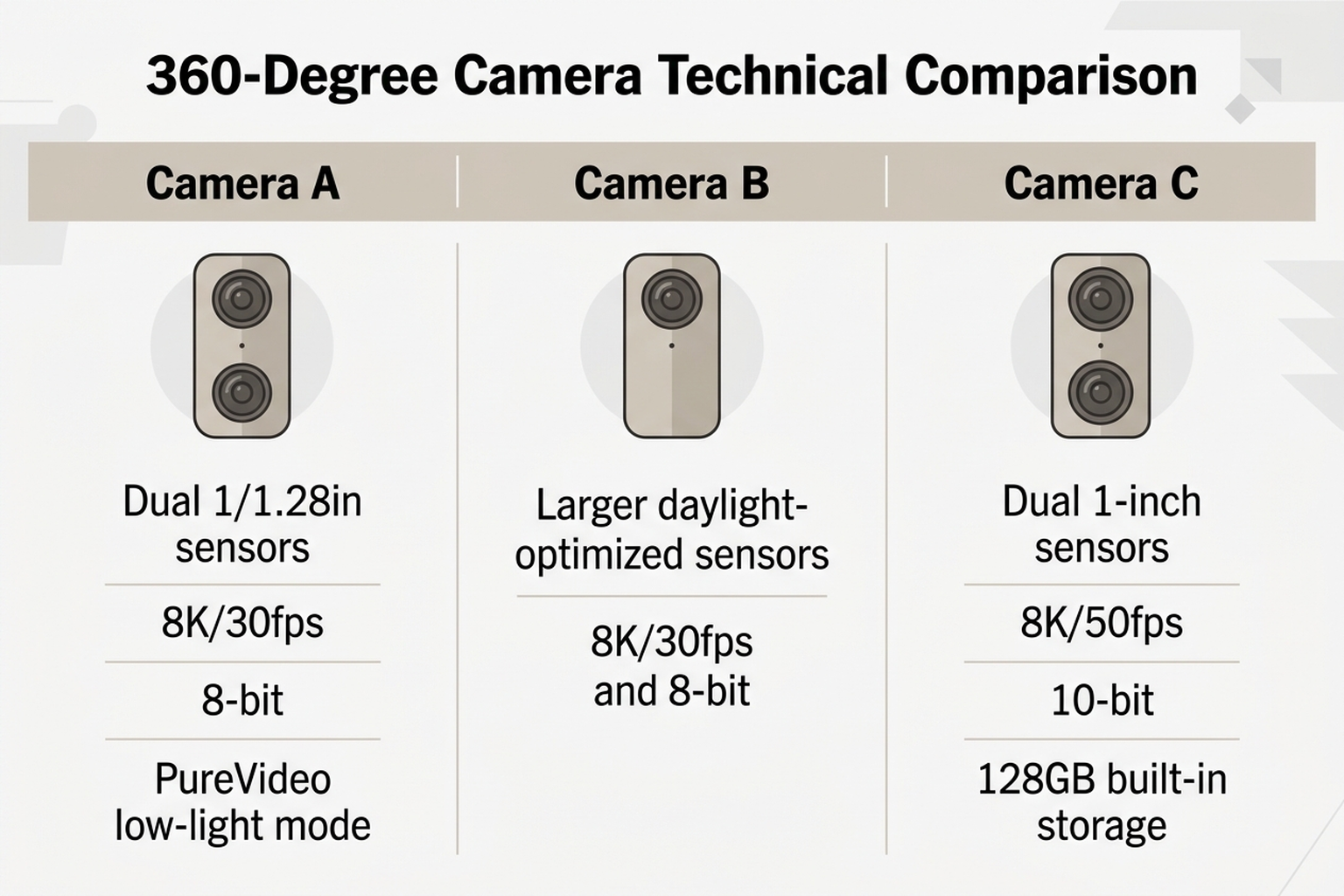
- Insta360 X5: dual 1/1.28-inch sensors (a manufacturer-claimed jump over the X4’s smaller sensors), 8K/30fps and 5.7K/60fps 360 capture, plus a 4K/120fps single-lens mode. Insta360 pairs this with a dedicated PureVideo low-light processing mode.
- GoPro Max 2: TechRadar’s testing found it has the best image quality of the small 360 cameras in ideal, well-lit conditions, but the X5’s PureVideo mode produced visibly cleaner footage around streetlights and illuminated buildings in TechRadar’s direct side-by-side night test.
- DJI Osmo 360: DJI’s published specs claim larger dual 1-inch sensors enabling 8K at a higher 50fps and 10-bit color depth (versus the X5’s 8-bit), plus 128GB of built-in storage the X5 lacks (manufacturer claims). Reviewers who tested both found the Osmo 360 closes the image-quality gap in daylight, while the X5 still leads on waterproofing, lens durability, and software maturity.
The practical read: the X5’s sensor size is a genuine upgrade over its own predecessor, and it currently wins low-light comparisons against GoPro’s flagship. It is not the only camera with 8K capture or the highest bit depth in its class — DJI’s 10-bit Osmo 360 out-specs it on paper in daylight.
Manufacturer Details and Build
Insta360 lists the X5 with a 2400mAh battery rated for up to 208 minutes of recording (manufacturer claim, measured in a reduced-frame-rate Endurance Mode under specific lab conditions, not a general “any mode” figure), scaling down to a manufacturer-claimed 88 minutes at full 8K/30fps and up to 185 minutes in Endurance Mode. Several aggregated reviews and long-term test outlets report real-world 8K battery life closer to 30–45 minutes of continuous shooting, well short of the top-line claim — a gap that’s typical for action-camera battery marketing, which is usually measured under lighter recording settings than full 8K.
The camera’s headline durability feature is user-replaceable lenses: ultra-hard, scratch-resistant glass lenses that owners can swap themselves in the field after a scratch or impact, without sending the unit in for repair. Insta360 backs parts with a 90-day warranty, and self-inflicted damage during a lens swap is covered by one free replacement under that warranty. Beyond the standard warranty, Insta360 sells an optional FlexiCare 2-Year accidental-damage plan (roughly $53–$59 depending on region and retailer) that covers up to four low-cost replacements, each billed at a separate fee in that same range — confirm the current US price on Insta360’s own store before buying.
Check the Insta360 X5 on Amazon
How to Get the Most Out of It
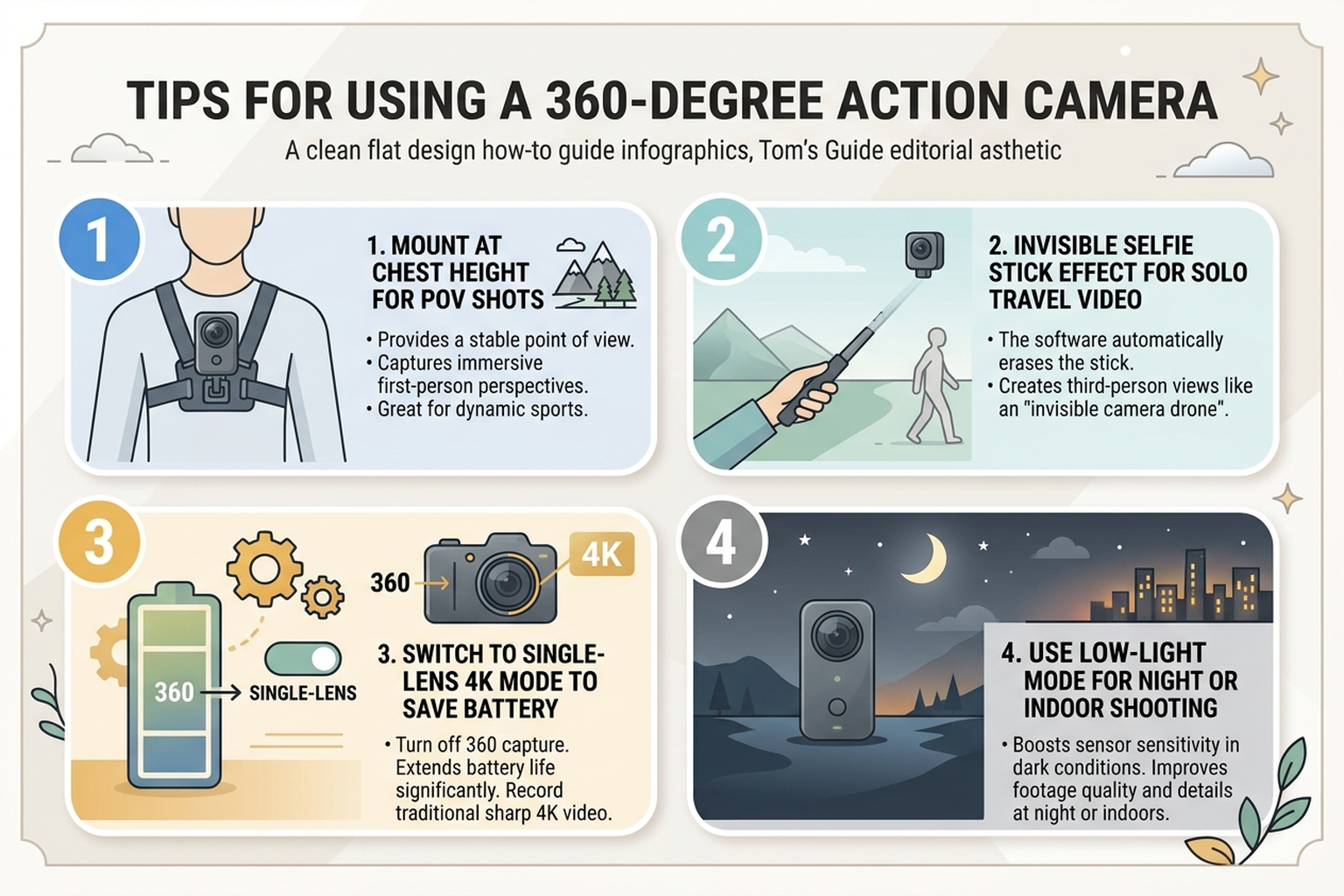
- Mounting height matters for 360 footage. Chest or helmet height keeps the camera’s blind spots (directly above and below the twin lenses) out of frame in a way that’s easy to crop around in post.
- Use the invisible selfie stick effect for solo travel video. Because the X5 captures a full sphere, Insta360’s app can algorithmically remove the selfie stick from the final reframed shot — a signature feature of the category that single-lens action cameras can’t replicate.
- Switch to single-lens 4K/120fps mode to conserve battery and storage when you don’t need the full 360 sphere, since 8K 360 footage is both the heaviest file size and the fastest way to drain the battery.
- Reach for PureVideo mode in low light rather than the standard 8K mode — TechRadar’s testing found this is where the X5 pulls ahead of the GoPro Max 2, not in bright daylight.
- Use InstaFrame mode to capture a ready-to-share flat video alongside the full 360 backup file, which avoids the extra reframing step in the app for footage you plan to post immediately.
Comparison Table
Prices are approximate amazon.com figures as of 2026-11-07 and fluctuate.
| Camera | Max resolution | Sensor | Bit depth | Built-in storage | Approx. price |
|---|---|---|---|---|---|
| Insta360 X5 | 8K/30fps | Dual 1/1.28” | 8-bit (+ Adaptive Tone) | None | ~$465–$550 |
| GoPro Max 2 | 8K/30fps | Larger daylight-optimized sensors | 8-bit | None | ~$500 |
| DJI Osmo 360 | 8K/50fps | Dual 1” | 10-bit | 128GB (105GB usable) | ~$480 |
Which 360 Camera Fits Your Use Case
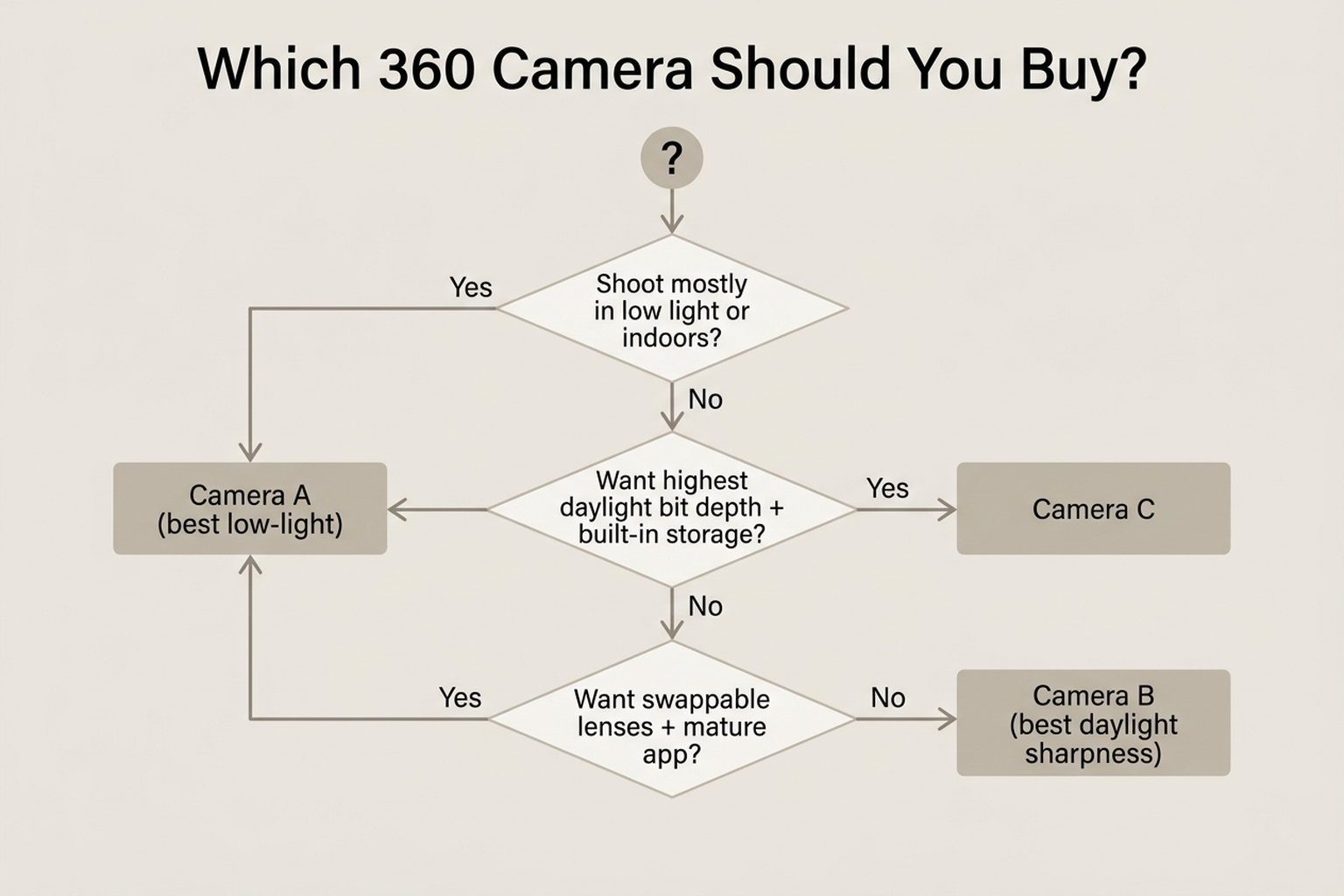
- Shoot mostly indoors, at night, or in mixed lighting? The X5’s PureVideo mode is the independently-tested low-light winner of the three.
- Want the highest on-paper daylight spec and don’t want to buy a memory card? The DJI Osmo 360’s 10-bit color and 128GB built-in storage are the stronger fit.
- Already own Insta360 accessories, or want swappable lenses and the most mature reframing software? The X5’s ecosystem and lens-replacement system are a practical edge over either rival.
- Shooting almost exclusively in bright daylight and prioritizing peak sharpness over everything else? TechRadar’s testing still gives the edge there to the GoPro Max 2.
Warranty and Support Notes
Insta360 covers the X5 with a standard limited manufacturer warranty, and parts (including self-replaced lenses damaged during the swap) carry a 90-day replacement warranty. The optional FlexiCare 2-Year plan (roughly $53–$59 depending on region and retailer) adds up to four accidental-damage replacements at a comparable per-incident fee, which is worth weighing against the cost of a standalone replacement lens kit (roughly $30–$45 depending on retailer) if accidental lens damage is the primary risk you’re insuring against rather than full-unit loss.
Recommendations
- If you shoot primarily indoors, at events, or after dark: the X5’s PureVideo mode is the best-tested option of the three cameras compared here.
- If you want the highest-spec daylight capture and built-in storage without an SD card: the DJI Osmo 360’s 10-bit, 50fps capture and 128GB storage are a stronger fit on paper.
- If 8K battery life for long continuous shoots is your top priority: budget for a spare battery regardless of which camera you choose — aggregated reviews across this entire category report real-world 8K runtime well under manufacturer claims.
- If you’re buying your first 360 camera and want the most mature app ecosystem: the X5’s years of reframing-software refinement is a meaningful advantage that doesn’t show up in a spec sheet.
Limitations
This analysis is based on independent third-party testing (primarily TechRadar’s published reviews and head-to-head comparison), manufacturer specifications, and aggregated customer reviews — not a hands-on test by this publication. Manufacturer battery-life and sensor claims are noted as such and may not reflect real-world performance, which several independent sources report falling well short of the top-line figures under full 8K recording. Market-share and market-size figures vary meaningfully by research firm and methodology; we cite the figures as reported without independently verifying the underlying data. Prices, warranty terms, and the FlexiCare plan’s cost are current as of the time of writing and are subject to change without notice; confirm current terms on the product listing or Insta360’s own site before purchasing.
Bottom Line
The Insta360 X5 earns its market-leading position on the strength of its low-light performance, swappable-lens durability, and the most mature app in the category — not because it wins every spec-sheet comparison. DJI’s Osmo 360 out-specs it on paper in daylight with higher bit depth and built-in storage, and real-world 8K battery life on the X5 runs well short of the manufacturer’s claimed runtime. For a buyer whose shooting happens mostly indoors, at night, or in mixed light — the scenario TechRadar’s testing actually measured a clear winner in — the X5 remains the better-tested choice at its current street price.
Before you buy, paste the product link into Arekore — our AI assistant checks review authenticity, surfaces what the one-star reviews actually complain about, and compares prices, free, in about five minutes.