Insta360 GO 3S Review 2026: Is the Tiny Action Cam Worth It?
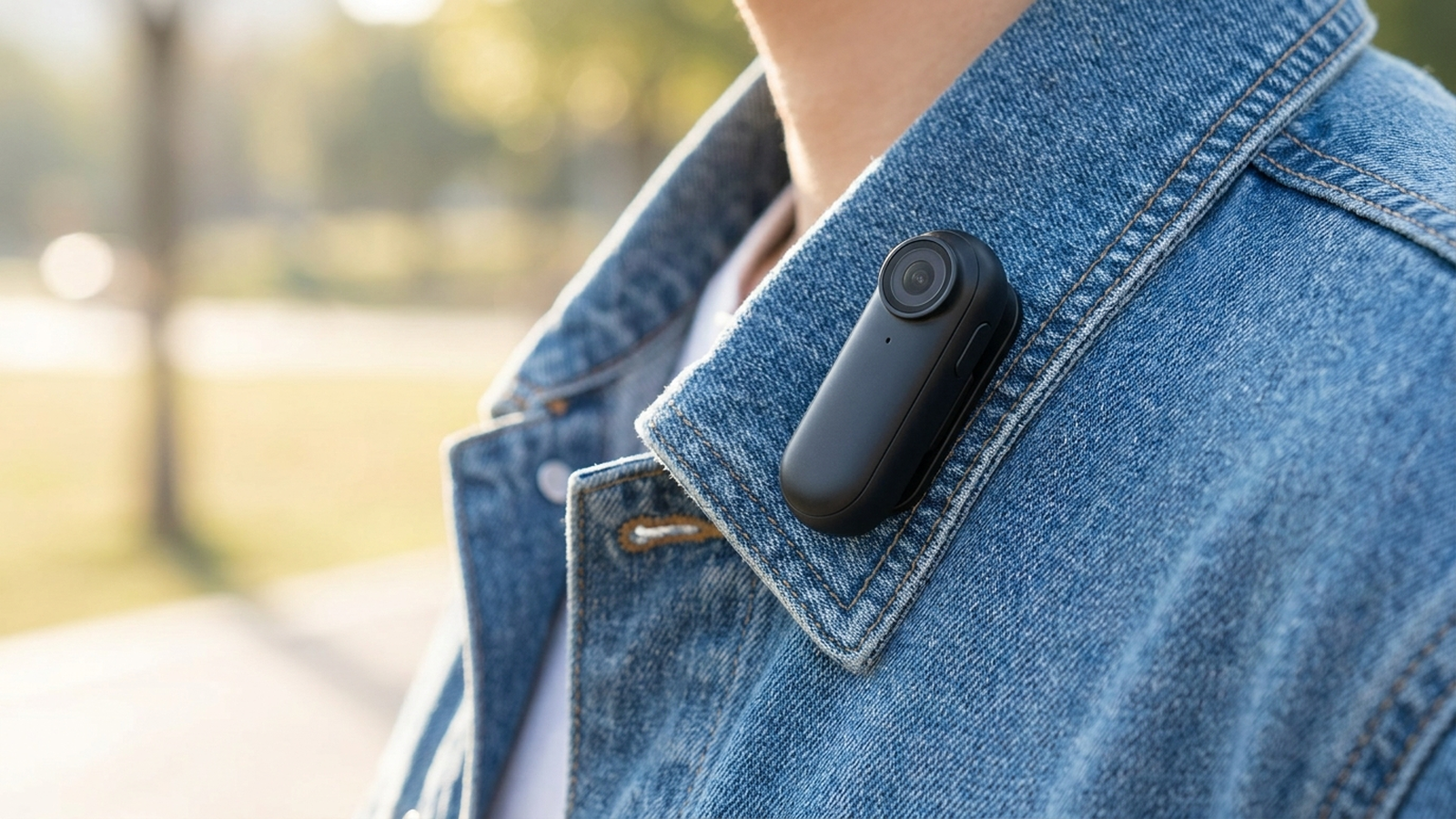
The Insta360 GO 3S is a thumb-sized “capsule” camera built around a simple pitch: a wearable, magnet-mountable action cam small enough to clip to a collar, forget about, and still come away with usable 4K footage. It launched into a crowded field of hands-free and pocket cameras, and independent reviewers have been split on one specific point — whether the jump to 4K was worth a real step backward in battery life. This analysis looks at what changed from the previous GO 3, where testers found genuine improvements, and where the trade-offs are sharp enough to matter before buying.
As an Amazon Associate, Arekore earns from qualifying purchases. The Amazon product links in this article may include our affiliate tracking ID and may earn us a commission if you buy through them, at no additional cost to you. See our Links Policy for details on how we select products and how commissions do not influence our recommendations.
TL;DR / Quick Verdict
- The GO 3S is a clear upgrade in resolution and durability — 4K video (up from the GO 3’s 2.7K ceiling) and waterproofing rated to roughly 33 feet (10 meters), more than double the GO 3’s 16-foot rating, without an external dive case.
- Battery life is the one place testers agree it’s a step backward, not forward. Multiple independent reviews measured shorter standalone recording times than the older GO 3, and the pattern shows up in aggregated owner complaints too.
- FlowState stabilization remains a genuine strength, holding up in independent testing even during handheld, high-motion use — reviewers consistently single this out as the camera’s best feature regardless of the battery complaints.
- The Action Pod attachment meaningfully changes the calculus. It roughly triples usable battery life and adds a flip-up screen for framing, at the cost of turning a pocket-sized capsule into something closer to a small handheld camera.
How We Reached These Conclusions (Methodology)
This is an editorial analysis, not a hands-on review; we did not personally test the products covered here. It synthesizes (a) independent testing and reporting from Tom’s Guide, TechRadar, and Trusted Reviews, (b) Insta360’s published manufacturer specifications for the GO 3S and its Action Pod accessory, and (c) patterns in owner feedback and social-media commentary about battery life as documented in that third-party reporting, including a specific complaint one reviewer noted from a buyer who reported getting only about 15 minutes of recording before the camera shut down. We did not personally test battery life, waterproofing, or stabilization ourselves, and we do not cite a single aggregate Amazon star rating for the GO 3S, since ratings vary by storage capacity, color, and whether the listing bundles the Action Pod or accessories. Prices are amazon.com and Insta360.com figures at the time of writing (September 2026) and change frequently, especially around sales events.
What Changed From the GO 3: Resolution and Waterproofing Up, Battery Down
The GO 3S is best understood as an incremental but uneven upgrade over its predecessor rather than a full redesign. Insta360 kept the same capsule-and-Action-Pod concept, and the core hardware changes cluster around three areas independent reviewers consistently flag.
Video resolution moved from 2.7K to full 4K (3840×2160), which Tom’s Guide called the headline change, noting the GO 3S “takes everything that was great about its predecessor and slaps 4K on top, without charging extra” at launch pricing. Photo resolution is rated at 4000×3000. The camera does not support 4K at 60 frames per second, however, which Tom’s Guide flagged as a limitation for buyers who want smoother slow-motion capture at the highest resolution.
Waterproofing improved substantially. Trusted Reviews measured the jump from the GO 3’s 16-foot (5-meter) rating to the GO 3S’s roughly 33-foot (10-meter) rating without needing a separate dive housing — a meaningful change for anyone shooting near or in water regularly.
Battery life, by contrast, went the wrong direction. This is the trade-off every independent review highlights, and it’s worth walking through in detail because the numbers are specific and consistent across sources.
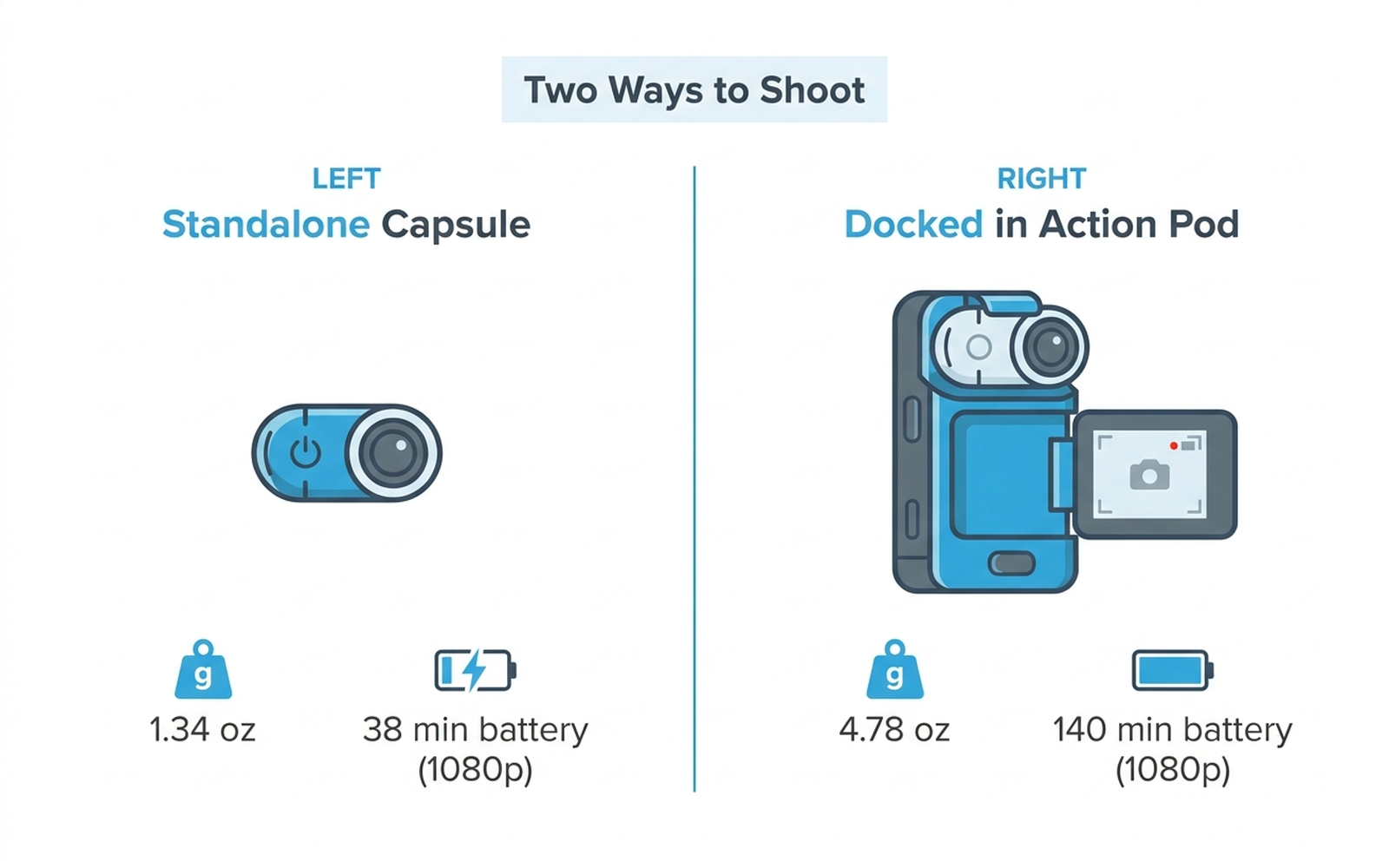
Insta360 rates the standalone GO 3S capsule at 38 minutes of continuous 1080p recording on its built-in 310mAh battery. TechRadar’s real-world testing found that number optimistic in practice — recording stopped closer to 33 minutes in one test, and actual results at 4K or 2.7K resolution (rather than the 1080p the rating is based on) run shorter still, in the range of 20 to 30 minutes per TechRadar’s assessment. That already falls short of the GO 3’s rated 45 minutes at the same 1080p setting. Docking the capsule in the Action Pod accessory extends battery life to a manufacturer-rated 140 minutes at 1080p, but even that is a step down from the GO 3’s 170-minute Action Pod rating. Trusted Reviews summarized the overall verdict as “a clearcut upgrade across the board,” with “one notable trade-off… in the device’s battery life.” Social-media commentary reviewed by TechRadar included at least one buyer reporting real-world battery life as short as 15 minutes and stating they planned to return the camera over it — an extreme outlier relative to the manufacturer rating, but indicative of how variable results can be depending on resolution, temperature, and Wi-Fi/Bluetooth activity during a shoot.
Stabilization is the one area with no reported trade-off. Trusted Reviews found “stabilisation is still outstanding, even when filming handheld,” and TechRadar’s independent testing similarly credited Insta360’s FlowState system with smooth, gimbal-like output during high-motion use. Across all three reviews we synthesized, this is the single most consistently praised feature of the GO 3S, unaffected by the battery complaints.
Buying Options: Standalone Capsule vs. Action Pod Bundles
Insta360 sells the GO 3S in several configurations that differ mainly in storage capacity and whether the Action Pod accessory is included, not in core camera hardware.
Standalone capsule only (64GB or 128GB). The bare capsule without an Action Pod, at a lower manufacturer list price of roughly $239.99 (64GB) or $269.99 (128GB). This is the pure hands-free, wearable configuration — smallest footprint, shortest battery life, no built-in screen.
Capsule + Action Pod bundle (64GB or 128GB). Adds the Action Pod dock, which houses a flip-up touchscreen for framing shots, roughly triples usable battery life per the manufacturer’s own 1080p figures, and gives the capsule a sturdier grip for handheld use. Manufacturer list pricing is roughly $399.99 (64GB) or $429.99 (128GB).
Both configurations use the identical capsule hardware and sensor, so image quality and stabilization performance don’t differ between them — the decision is purely about whether the added weight, size, and cost of the Action Pod are worth the extended runtime and screen.
How to Use It: Setup and Mounting Guide
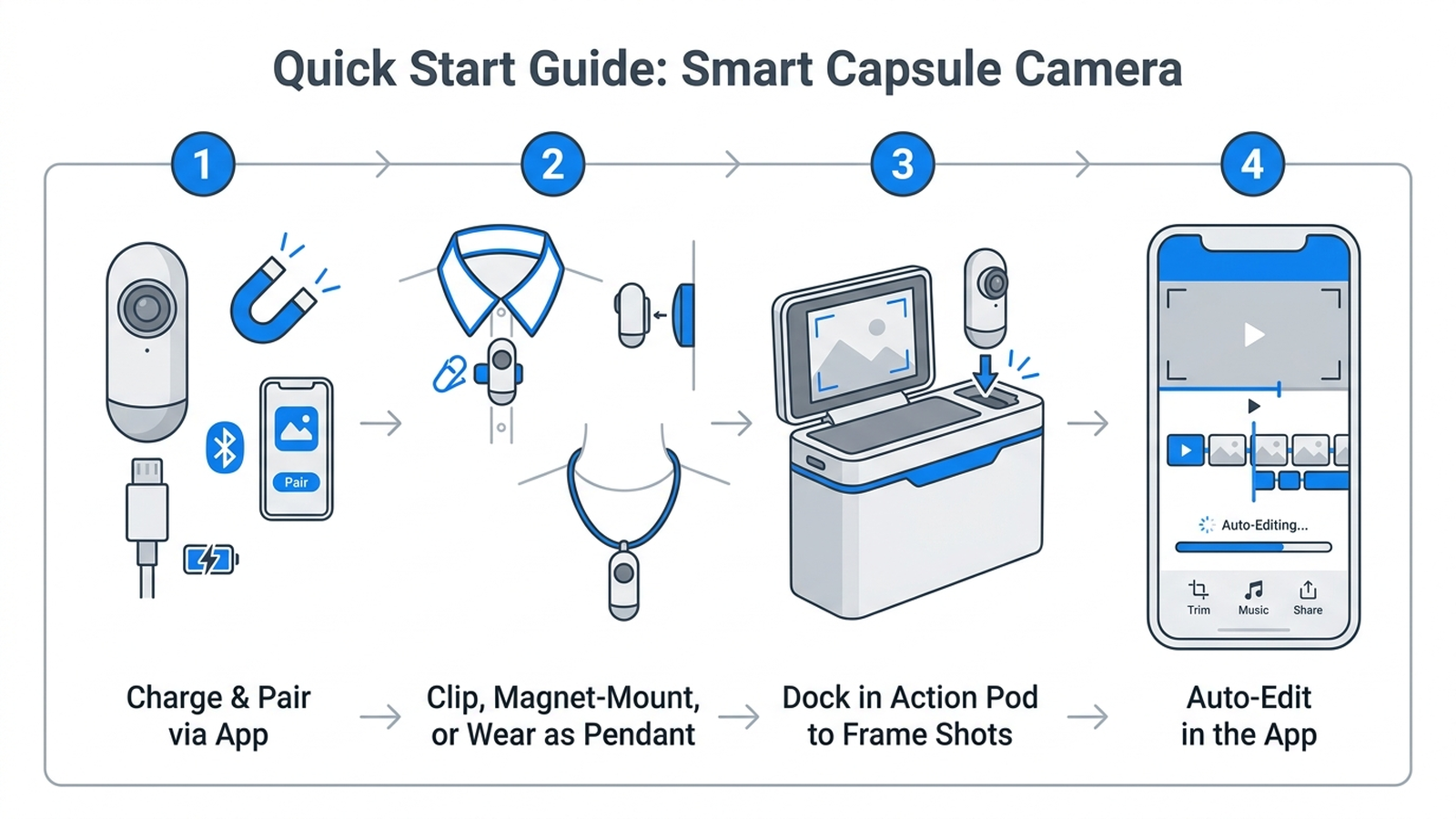
The GO 3S’s core appeal is how many ways it can be worn or mounted without extra hardware. The capsule ships with a magnetic pendant mount, a standard clip, and a small magnetic base that adheres to most flat surfaces; Insta360 also sells accessory mounts for helmets, pet harnesses, and bike handlebars separately. Setup follows the same basic pattern regardless of mounting choice:
- Charge the capsule and pair it with the Insta360 app over Bluetooth before first use.
- Choose a mount — clip it to a collar or strap, use the magnetic pendant for a hands-free necklace-style wear, or attach it to a surface with the magnetic base.
- Dock it in the Action Pod when you need to frame a shot using the flip-up screen, then pop it back out for hands-free wear.
- Use the app’s automatic editing feature afterward, which Insta360 markets as a way to turn raw hands-free footage into an edited highlight reel without manual timeline work.
A few practical notes independent reviews and manufacturer documentation both flag:
- Recording time budgets need to account for actual resolution, not the 1080p rating. If you plan to shoot in 4K — the camera’s main selling point over the GO 3 — plan on real-world runtime closer to 20–30 minutes per charge without the Action Pod, per TechRadar’s testing.
- Extra capsules or the Action Pod extend a day’s shooting more than a bigger single battery would, since the design doesn’t support hot-swappable batteries in the standalone capsule the way some competing action cameras do.
- The photo-capture delay is a specific, documented complaint. Search-aggregated user feedback describes a lag between pressing the shutter and the photo actually being captured, leading some users to put the camera down too early and miss the shot — worth testing in the app before relying on the capsule for fast candid photos.
Comparison Table
Prices are amazon.com and Insta360.com figures at the time of writing (September 2026) and fluctuate around sales events.
| Configuration | ASIN | Resolution | Waterproof rating | Mfr.-rated battery (1080p/24fps) | Mfr. list price | Best for |
|---|---|---|---|---|---|---|
| GO 3S Standalone, 128GB | B0D9PKMFHW | 4K | ~33 ft. (10m) | ~38 min (capsule only) | ~$269.99 | Lightest hands-free wear, sports and pet POV |
| GO 3S + Action Pod, 64GB | B0F328DJTL | 4K | ~33 ft. (10m) | ~140 min (with pod) | ~$399.99 | Vlogging with a flip screen, longer runtime |
| GO 3S + Action Pod, 128GB | B0D1SHQVL7 | 4K | ~33 ft. (10m) | ~140 min (with pod) | ~$429.99 | Same as above, more onboard storage |
| DJI Osmo Pocket 3 (alternative) | B0DPC4C6MX | 4K/120fps | Not rated for submersion | ~166 min (Wi-Fi/screen off) | ~$519.99 | Best image quality from a 1-inch sensor, willing to hold a larger camera |
Check the Insta360 GO 3S Standalone on Amazon · Check the GO 3S + Action Pod (64GB) on Amazon · Check the GO 3S + Action Pod (128GB) on Amazon · Check the DJI Osmo Pocket 3 on Amazon
Decision Guide: Which Configuration (If Any) Fits Your Use Case
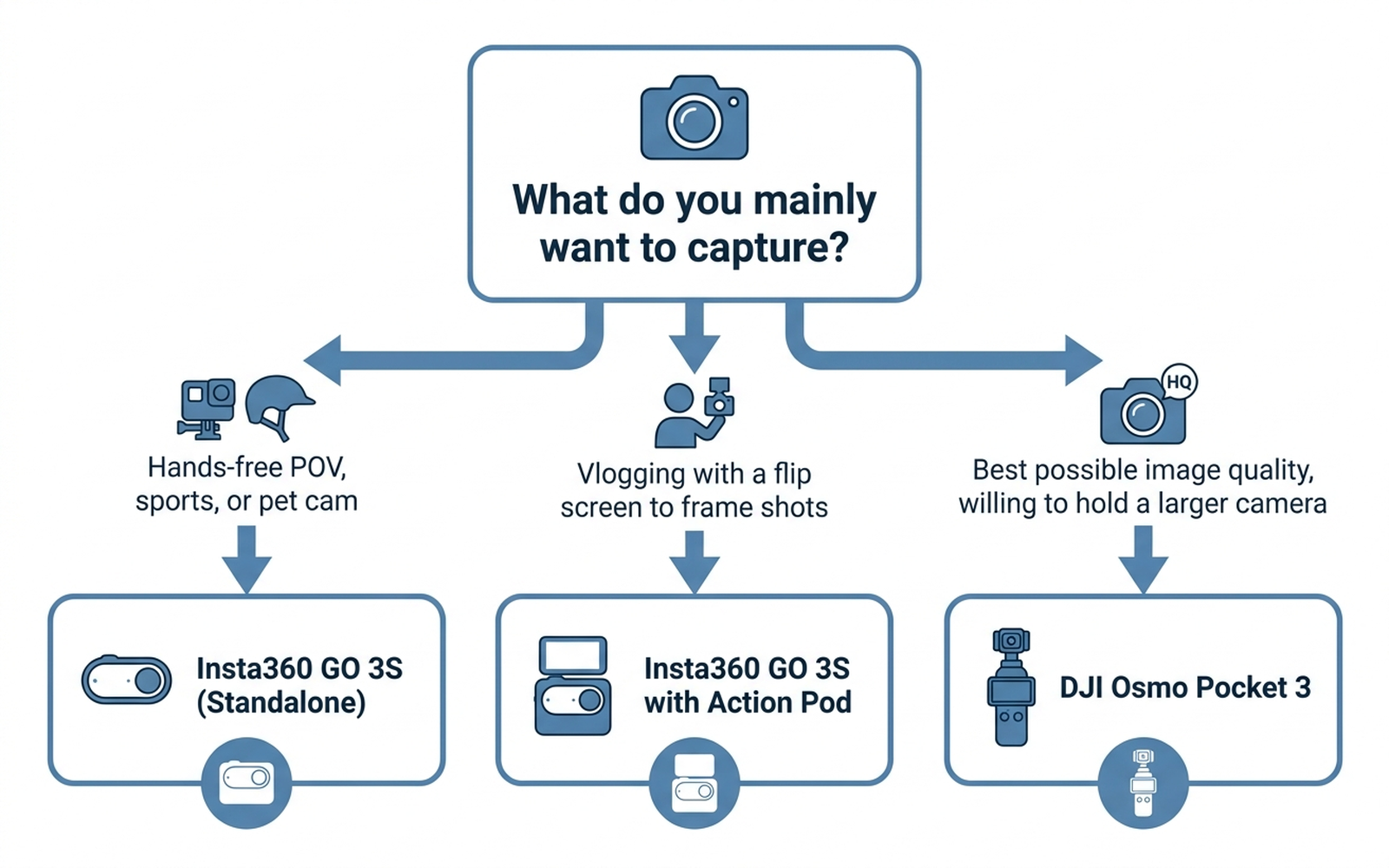
- You mainly want hands-free POV footage — sports, pet cams, or wearing it as a discreet pendant: the standalone capsule is the point of the product; carrying a spare charged capsule matters more here than choosing a bigger single battery.
- You want to frame shots on a screen and shoot for longer stretches, like vlogging: the Action Pod bundle’s roughly 140-minute runtime and flip screen address the standalone capsule’s main limitations, at the cost of losing some of the pocket-sized discretion.
- Battery-life consistency and top image quality matter more to you than wearability: per independent comparisons, the DJI Osmo Pocket 3’s larger 1-inch sensor and gimbal-based stabilization produce different (and in some testing, sharper) results than the GO 3S’s smaller sensor, though it can’t be clipped to clothing or worn as a pendant the way the GO 3S can.
- You already own a GO 3 and are satisfied with 2.7K footage: independent reviews frame the GO 3S primarily as a resolution and waterproofing upgrade rather than a must-have replacement, especially given the battery-life regression.
Warranty Considerations
Insta360 backs the GO 3S with its standard limited manufacturer warranty; given the documented battery-life shortfall relative to the manufacturer’s own rated figures, it’s worth testing real-world recording time at your intended resolution soon after purchase, while still within the return window, rather than discovering the shortfall later. Amazon listings commonly offer optional extended protection plans at checkout — check current terms and length on the specific listing before buying, since coverage is updated periodically.
Editorial Recommendation
- Best for hands-free wearable use: Insta360 GO 3S Standalone — the lightest, most pocketable configuration, accepting the shortest battery life as the trade-off for size.
- Best for vloggers who want to frame shots and shoot longer: Insta360 GO 3S + Action Pod — the flip screen and roughly tripled runtime address the standalone unit’s two biggest limitations.
- Best for buyers prioritizing image quality and consistent battery life over wearability: DJI Osmo Pocket 3 — a fundamentally different form factor with a larger sensor, at a higher price and without the GO 3S’s clip-anywhere versatility.
- Best for existing GO 3 owners: stick with the GO 3 unless 4K resolution or deeper waterproofing specifically matters for your use case, given the battery-life step backward independent testing consistently documents.
Limitations of This Analysis
This analysis relies on independent testing and reporting from Tom’s Guide, TechRadar, and Trusted Reviews, Insta360’s published manufacturer specifications, and patterns in owner and social-media feedback as documented in that third-party reporting; we did not personally test any of the configurations covered here. We deliberately avoided citing a single aggregate Amazon star rating, since ratings differ across specific storage capacities, colors, and bundle listings. The photo-capture-delay complaint and the specific 15-minute battery-life anecdote are drawn from individual pieces of reporting and social-media commentary rather than a comprehensive count of all owner experiences, and unit-to-unit variance, ambient temperature, and Wi-Fi/Bluetooth activity during recording can all affect actual battery runtime. The global action camera market was estimated in the roughly $7.5–9 billion range for 2025–2026 by various industry research firms, with the broader wearable camera category estimated near $9.4 billion in 2026, growing toward the mid-$30 billion range by the mid-2030s; these are directional market-size estimates from research firms whose methodologies differ, not figures specific to any single product line. Prices, ASIN availability, and warranty terms change frequently — always confirm current details on the product page before buying.
The Bottom Line
The Insta360 GO 3S delivers a real upgrade in resolution and waterproofing over the GO 3, and its FlowState stabilization remains, by every independent account we reviewed, best-in-class for a camera this small. What keeps it from being an unambiguous win is battery life: both the standalone capsule and the Action Pod-equipped configuration measure shorter than their GO 3 predecessors, and real-world 4K recording time can fall well short of the manufacturer’s 1080p-based rating. Whether that trade-off is worth it depends on whether 4K footage and deeper waterproofing matter enough to your use case to outweigh carrying a spare capsule or charger. Check the current price and recent reviews on the specific listing before buying, and if you want a second opinion, paste the URL into Arekore and let the AI scan the reviews and price history for you in about five minutes.