Countertop Ice Maker Not Making Ice? 6 Real Causes (2026)
TL;DR. A countertop ice maker that stops making ice is almost never one single failure — it’s usually one of six patterns: a false “bin full” reading from a dirty sensor, mineral scale from hard water, an airlock after cleaning, poor ventilation overheating the compressor, a clogged or missing water filter, or (rarer, but worth ruling out first) an active safety recall. Before troubleshooting anything, check your model and date code against the CPSC’s nugget-ice-maker recall. If it isn’t a recall match, a 10-minute sensor wipe-down and descaling cycle resolves the majority of cases documented in appliance-repair sources and aggregated Amazon review sentiment.
A note on links and methodology
As an Amazon Associate, Arekore earns from qualifying purchases. The Amazon product links in this article include our affiliate tracking ID and may earn us a commission if you buy through them, at no additional cost to you. See our Links Policy for details on how we select products and how commissions do not influence our recommendations.
We also did not personally test the ice makers or cleaning products mentioned below. Every diagnostic and product claim in this article is an editorial synthesis of public data, cited inline.
Methodology
This is an editorial analysis based on publicly available data collected in late July 2026. We did not run controlled failure tests on ice-maker compressors or sensors ourselves; instead we synthesized:
- US federal safety records — the CPSC recall database, specifically the 2023-2024 recall of Gevi-brand countertop nugget ice makers sold exclusively on Amazon.
- Manufacturer troubleshooting documentation, including GE Appliances’ official Opal ice-maker support pages covering error codes, sensor cleaning, and descaling intervals.
- Independent appliance-repair and troubleshooting references aggregating the most common failure patterns reported across multiple countertop ice-maker brands.
- Reviewed (USA Today)‘s and Wirecutter’s countertop ice-maker testing coverage, which independently identified the GE Profile Opal 2.0 as a current top performer on ice quality, speed, and noise.
- Industry market-sizing data from Mordor Intelligence, Grand View Research, and LP Information on the countertop ice-maker category.
- Aggregated Amazon customer review sentiment on amazon.com for the specific products recommended in this article, read via each product’s “Top reviews” and “Customers say” panels in late July 2026. We do not report a precise review-count N because Amazon’s review panels do not expose a stable, verifiable count; a fabricated number would be misleading.
We deliberately do not simulate a specific personal ownership experience, invent a fake reviewer persona, or claim we personally own the units discussed. The advice below is a synthesis of documented troubleshooting steps, federal safety records, and manufacturer specifications — treat it as a starting framework, not a substitute for your unit’s own manual.
1. First: check whether your ice maker is part of an active recall
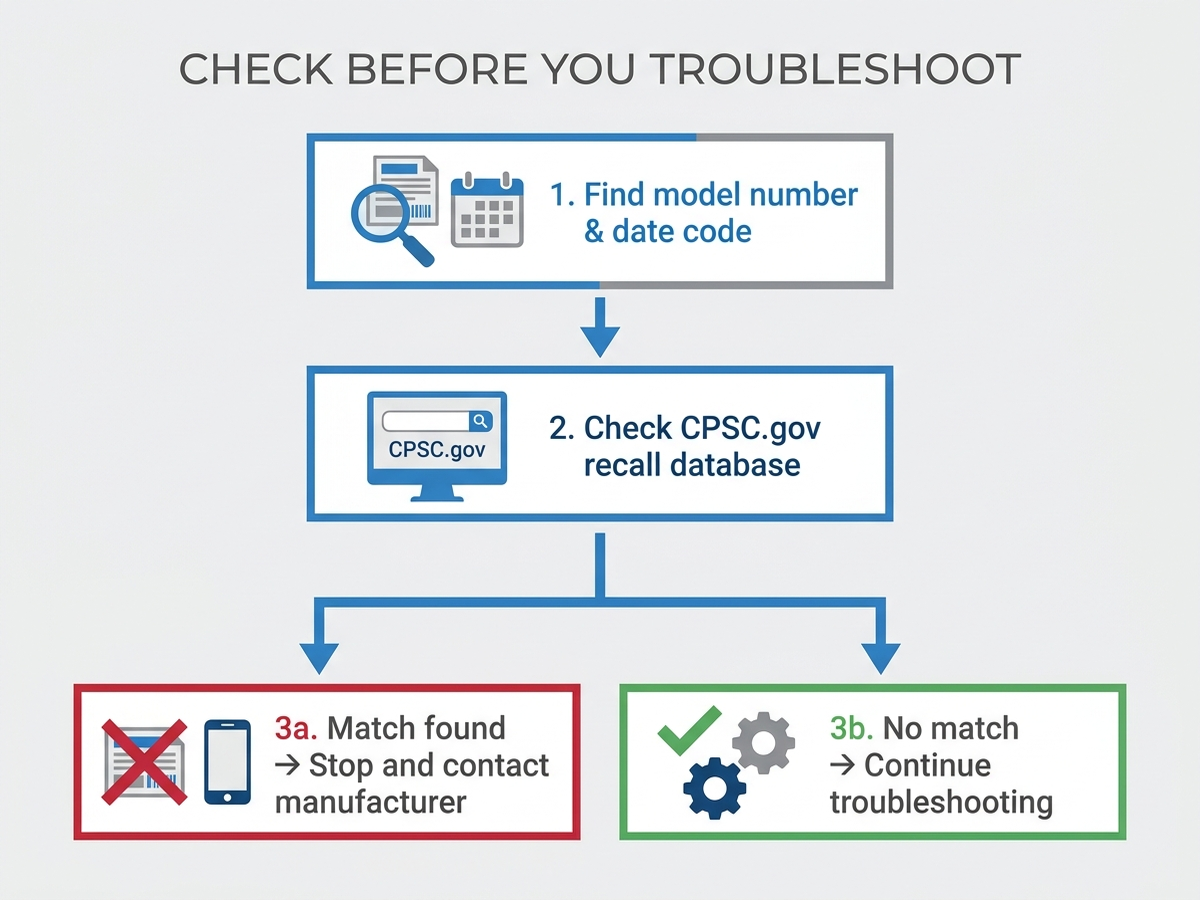
Before assuming a mechanical or sensor problem, rule out the one cause that isn’t routine wear. In October 2023, the U.S. Consumer Product Safety Commission recalled about 8,800 Gevi Household Countertop Nugget Ice Makers (model GIMN-1102, with a manufacture date code before June 1, 2022), sold exclusively on Amazon.com between January and July 2022 for $300-$400. The hazard: the metal auger blade inside the machine can break, sending small metal shards into the finished ice — a laceration risk. The distributor, Far Success Trading Limited, received 263 reports of the auger blade failing, though no injuries were reported at the time of the recall. If your machine matches that model number and date range, stop troubleshooting and contact the manufacturer for the free replacement described on the official CPSC recall notice rather than relying on a serial-number range quoted secondhand, including in this article.
If your unit isn’t a recall match, a stopped ice maker is very likely one of six more common causes.
2. The 6 real causes, ranked by how often they show up in troubleshooting sources
| Cause | What it looks like | Fixable at home? | Urgency |
|---|---|---|---|
| Dirty or blocked bin sensor | Machine acts like the bin is full even when it’s empty or has little ice; light stays solid | Yes — wipe the infrared/optical sensor with a vinegar-dampened cotton swab | Low |
| Mineral scale buildup (hard water) | Ice production slows gradually over weeks; ice comes out smaller or cloudy | Yes — run a descaling cycle | Low-medium |
| Airlock after cleaning or a dry restart | ”Add water” error persists even with a full reservoir, usually right after cleaning or moving the unit | Yes — refill, restart, and let the pump re-prime; may need 2-3 cycles | Low |
| Poor ventilation overheating the compressor or fan | Machine runs hot to the touch on the sides/back; ice slows or stops in a warm kitchen or enclosed cabinet | Yes — move the unit and give it 2+ inches of clearance on all sides | Medium |
| Clogged or missing water filter / low water supply | Ice is slow, small, or intermittent; some models show a filter-change indicator | Yes — replace filter or check the water line/reservoir fill level | Low |
| Failed compressor or auger motor | No ice at all, unusual grinding or clicking, and none of the above fixes help | Rarely — usually means end-of-life or a warranty claim | High |
The first five causes account for the large majority of “my ice maker stopped working” troubleshooting documentation reviewed for this analysis, and none of them require replacing the machine. The sixth — a genuine compressor or motor failure — is the one pattern where a warranty claim or replacement is usually more cost-effective than a repair.
3. Why the “bin full” and “add water” errors are the most common false alarms
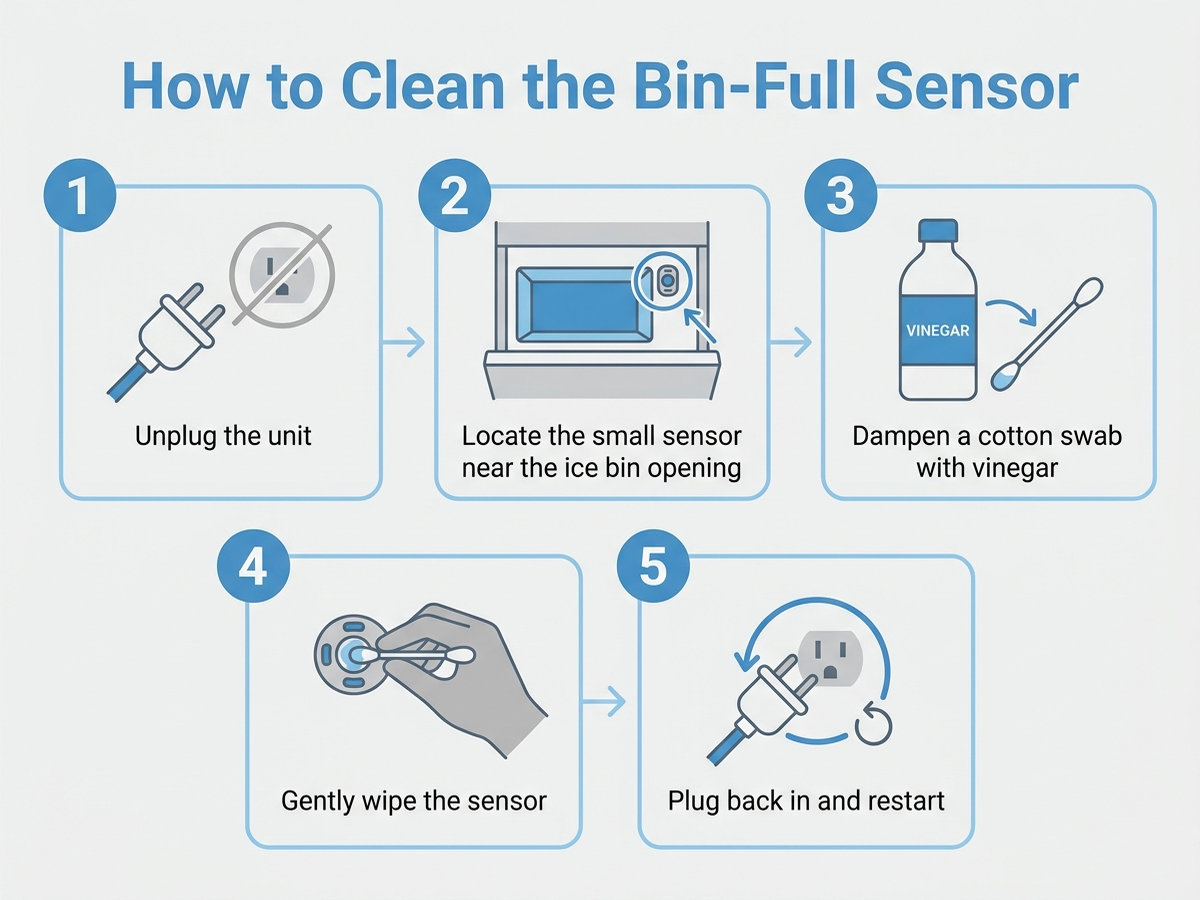
Manufacturer support documentation for the GE Profile Opal — independently rated a top current pick by Wirecutter and included in Reviewed (USA Today)‘s tested countertop ice-maker roundup — describes error code 1 as a low-water condition, and identifies airlock in the pump or water lines as the most common reason a machine displays “Add Water” and refuses to run again right after being drained or cleaned. Separately, GE’s documentation notes that if ice or mineral deposits build up on the bin-full sensor, the machine can misread an empty bin as full; the fix is a vinegar-soaked cotton swab, not a service call.
This pattern isn’t specific to GE. Broader troubleshooting references aggregating multiple countertop-ice-maker brands describe the same three failure signatures — sensor false-positives, post-cleaning airlock, and compressor overheating from poor airflow — as the leading causes across the category, ahead of genuine mechanical failure. In other words: most “broken” ice makers aren’t broken.
4. Hard water and mineral scale: how often you actually need to descale
Scale buildup is one of the most commonly cited causes of slowing or stopped ice production, especially in areas with hard water. General appliance-maintenance guidance recommends descaling every 3-6 months in hard-water areas, 6-12 months for moderately hard water, and 12-18 months for soft water — while GE’s own Opal documentation recommends a descaling cycle roughly every 2-3 weeks depending on local water hardness and how often the machine runs. A 1-part-vinegar-to-2-parts-water solution can dissolve light scale, but appliance-maintenance sources are consistent that vinegar is a weak acid that won’t clear heavier buildup — at that point a purpose-built descaler outperforms a vinegar cycle. Using filtered water in the reservoir from the start reduces how often descaling is needed at all.
5. Market context: why “stopped working” complaints are so common right now
The countertop ice-maker category has grown quickly: Mordor Intelligence estimates the global market at roughly $2.99 billion in 2026, growing at a compound annual rate of about 4.9% through 2031, while Grand View Research and LP Information cite comparable growth rates in the 5.7-6.4% range through the early 2030s. That rapid growth — driven heavily by nugget-ice-style “Sonic ice” machines — means a large volume of relatively new, lower-cost countertop units entered US kitchens over the past few years, which plausibly explains why sensor and scale-related “stopped working” complaints are so frequent in aggregated review sentiment: more units in circulation, many running on unfiltered tap water, with the same handful of design bottlenecks (sensor sensitivity, small-batch water systems, compact ventilation) repeated across brands.
6. What to actually do, step by step
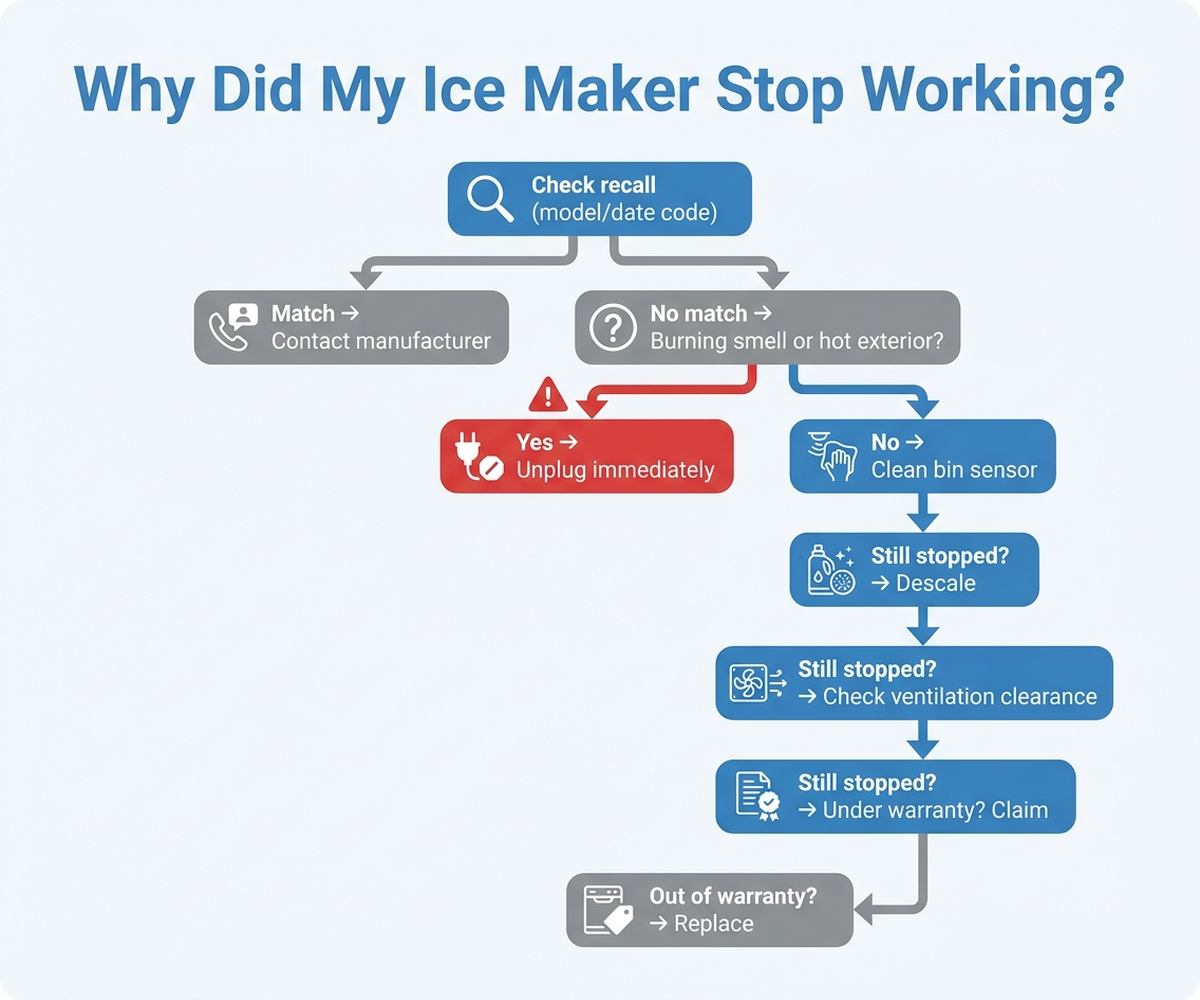
- Check the recall first. Confirm your model number and date code against the CPSC recall database before doing anything else.
- Unplug and stop using it immediately if you notice a burning smell, exposed metal shards in the ice, or a hot exterior. Treat any of these the same as a recall match.
- Clean the bin-full sensor. Unplug the unit, locate the small infrared or optical sensor near the ice bin opening, and gently wipe it with a vinegar-dampened cotton swab.
- Run a full descaling cycle, using a 1:2 vinegar-to-water mix for light scale or a dedicated ice-machine descaler for heavier buildup, following your model’s specific cycle instructions.
- Give the machine 2+ inches of clearance on all sides and confirm it isn’t in an enclosed cabinet or against a wall — compressor overheating from poor airflow is a common and easily fixed cause.
- Check and replace the water filter if your model has one, and confirm the reservoir is filled with fresh, ideally filtered, water.
- If “Add Water” persists after a full refill, run 2-3 short cycles to let the pump re-prime and clear a possible airlock, rather than assuming a pump failure immediately.
- If none of the above resolves it and the machine is still under warranty, contact the manufacturer before paying for independent repair — a failed pump or sensor is often covered.
- If it’s out of warranty and the failure is a genuine compressor or auger-motor issue (no ice at all, grinding noise), budget for replacement — independent repair on a sub-$500 countertop unit rarely beats the cost of a comparable new machine.
7. If you’re descaling or replacing: two current options
Editorial recommendation, not personal testing. These are current products relevant to the fixes above — a general-purpose descaler for the maintenance step, and a well-reviewed replacement machine for anyone whose unit has reached genuine end-of-life.
| Product | Purpose | Price (USD, at time of writing) | Notes from aggregated review sentiment |
|---|---|---|---|
| Affresh Ice Machine Cleaner | Descaling / mineral removal | ~$10-$12 | Reviewers commonly cite it as effective for routine maintenance cycles across multiple ice-maker brands, not just the Whirlpool/KitchenAid lines it’s marketed for |
| GE Profile Opal 2.0 Countertop Nugget Ice Maker | Replacement machine | ~$500-$600 | Independently named a top current pick by Wirecutter; aggregated review sentiment consistently praises ice texture and noise level over older nugget-ice models |
8. Warranty comparison
| Brand | Typical warranty | Covers sensor/pump/compressor issues? | How to claim |
|---|---|---|---|
| GE Profile (Opal line) | 1 year parts and labor | Yes, manufacturing defects | myopalservice.com or 1-866-907-6718 |
| Most countertop nugget-ice brands sold on Amazon | 1 year, sometimes shorter on off-brand imports | Varies — always confirm before buying | Manufacturer or distributor customer service listed on the product page |
If your machine is still within its first year, a persistent sensor or “Add Water” error is worth a warranty call before spending money on a repair or descaling kit.
9. The decision flowchart
The bottom line
Check the recall first — it takes 60 seconds and it’s the one cause on this list that actually matters more than a fix. After that, a countertop ice maker that “stopped working” is usually a sensor that needs a wipe-down, scale that needs a descaling cycle, or a compressor that needs breathing room — not a dead machine. A genuine no-ice, grinding-noise failure outside the warranty period is the one pattern worth budgeting for replacement over, and at the price point most countertop units sit at, replacing typically beats an independent repair quote on pure economics.
Limitations of this analysis
To be explicit about what this article does not establish:
- We did not personally test, disassemble, or run failure tests on any of the specific units named here. The causes described (sensor buildup, airlock, scale, ventilation) are drawn from published manufacturer and appliance-troubleshooting documentation, not a controlled test we ran ourselves.
- The recall covers a specific model and date range only. Other ice-maker models and brands may have separate, unrelated recalls; always check the current CPSC recall database directly rather than relying on a snapshot description.
- Prices cited are approximate ranges captured in late July 2026 and fluctuate with promotions; confirm current pricing on the linked page before purchase.
- Descaling-interval guidance varies by water hardness and machine model — the ranges cited here are general references, not a substitute for your specific model’s manual.
- Amazon review sentiment was read from each ASIN’s public review panels in late July 2026 and reflects aggregated impressions, not a scientific sample.
- We found no additional active recalls for the GE Profile Opal 2.0 or Affresh cleaner recommended in this article at the time of writing.