5 Holiday Shopping Mistakes Our AI Assistant Catches

The National Retail Federation expects 2026 holiday-season retail sales to grow 2.6–3.5% over last year, with e-commerce specifically up 6.6–8% — a lot of carts filling up fast, often under deal-banner pressure. At the same time, the FTC has been actively enforcing its Consumer Review Rule against companies that game ratings with fake or incentivized reviews, Amazon says it detected more than 15 million counterfeit products worldwide in 2025, and independent price-tracking studies keep finding that a meaningful share of “Black Friday” discounts are measured against an inflated price set just weeks earlier. Arekore’s assistant runs three checks on any product link a shopper pastes in — price-history consistency, review-authenticity scoring, and complaint-pattern scanning — specifically because these are the places holiday deals most often don’t hold up. Below are five mistakes those checks catch every single year, each illustrated with a real, current Amazon listing.
As an Amazon Associate, Arekore earns from qualifying purchases. The Amazon product links in this article may include our affiliate tracking ID and may earn us a commission if you buy through them, at no additional cost to you. See our Links Policy for details on how we select products and how commissions do not influence our recommendations.
TL;DR / Quick Verdict
- A meaningful share of “Black Friday” discounts are measured against a price that was quietly raised in the weeks beforehand — one price-tracking study of 65 products found 29% saw increases averaging $51 right before being “slashed” for the sale.
- A high star rating isn’t proof of quality on its own: a 2022 Which? investigation found 9 of 10 top-rated Bluetooth headphones on Amazon had been boosted by thousands of reviews that had nothing to do with headphones, and the FTC has sent formal warning letters over fake-review practices during the 2025 holiday season — the underlying manipulation tactic hasn’t gone away just because that specific study predates this year.
- Counterfeits spike specifically around Black Friday and Cyber Monday, concentrated on exactly the hot-gift categories (AirPods, designer-adjacent accessories) shoppers rush to buy cheap.
- Amazon’s extended holiday return window (purchases Oct 1–Dec 31, 2026 returnable through Jan 31, 2027) applies to items sold or fulfilled by Amazon — third-party sellers set their own terms, and holiday-gift surveys consistently find “wrong size” and “didn’t need it” among the top return reasons.
- None of the five examples below are hands-on-tested picks; this is an editorial synthesis of aggregated public data, the same standard we hold every Arekore analysis article to.
How We Reached This List (Methodology)
This is an editorial analysis, not a hands-on test; our editorial team did not personally buy the five example products named below. Each mistake was selected by cross-referencing (a) consumer-research findings on holiday-shopping deception — NRF’s 2026 holiday forecast, FTC Consumer Review Rule enforcement actions and penalty figures, Amazon’s own counterfeit-detection disclosures, and the Which? Bluetooth-headphone review-manipulation investigation — against (b) a real, currently-listed amazon.com product illustrating each pattern, verified to exist via live search in October 2026, and (c) aggregated amazon.com customer-review sentiment and manufacturer specifications for each example product, also sampled in October 2026. We did not have access to Amazon’s internal sales-rank, return-rate, or price-history API for any of these ASINs; price-history claims below are sourced from third-party tracking tools and published studies, cited individually. Prices are approximate amazon.com figures as of 2026-10-12 and fluctuate.
The 5 Mistakes
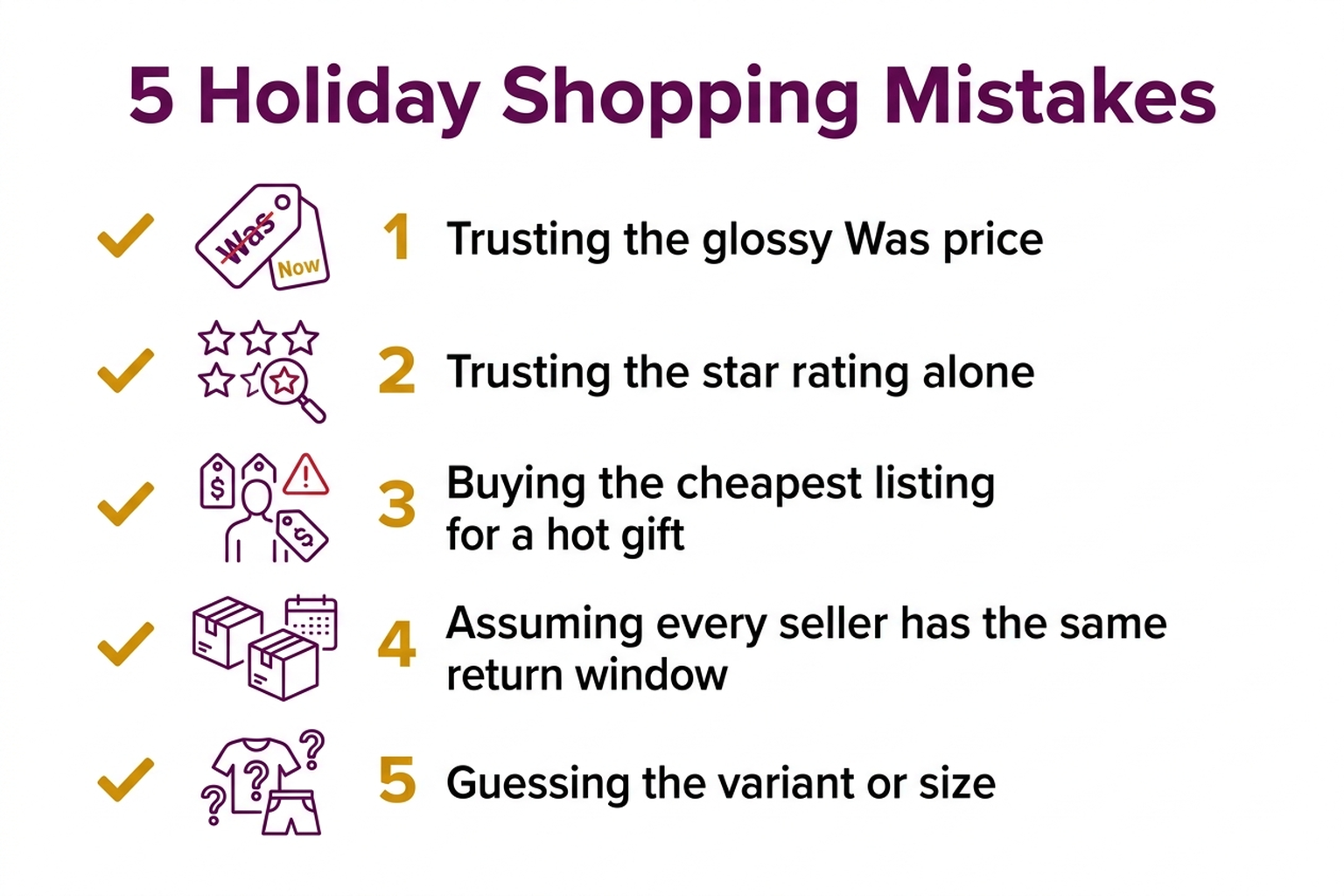
1. Trusting the “Was” Price
The classic doorbuster math — “list price, now X% off!” — only tells you something useful if the list price was real. A KnownHost study tracking 65 products found 29% saw price increases averaging $51 in the days leading up to Black Friday, before being “slashed” back down for the sale; separately, Which?’s six-month tracking of 175 products across eight UK retailers found 83% were the same price or cheaper at some other point outside the Black Friday window. The FTC’s own guidance on former-price comparisons calls a discount illegal advertising if the reference price was “artificial” and set specifically to make the markdown look bigger. A concrete example: a Dyson V8 Plus Cordless Vacuum lists at $539.99, but the same listing has repeatedly been advertised at $279.99–$349.99 in sale periods throughout 2026 — a swing wide enough that a shopper who only sees “X% off the list price” on a single day has no way to tell whether that day’s price is a genuine low or just one point on a listing that cycles between those two numbers regularly. Pulling up the actual price history (not just the day’s banner) is the only way to tell the difference.
Check the Dyson V8 Plus Cordless Vacuum on Amazon
What to do instead: check a free price-history tool (CamelCamelCamel, Keepa, or Arekore’s own price-history check) before trusting any “was” price — it takes under a minute and shows the actual multi-month trend, not the banner’s framing of it.
2. Trusting the Star Rating Alone
A 4.7-star rating with 20,000+ reviews looks unambiguous, but the number alone doesn’t tell you whether those reviews are about the product you’re looking at. A 2022 Which? investigation into Amazon’s top-rated Bluetooth headphones found 9 of the 10 best-sellers had been artificially boosted by thousands of unrelated reviews — comments about extension cables, jigsaw puzzles, and cuddly toys, none mentioning headphones at all — inflating the aggregate score; this was a snapshot of that specific category at that time, not a claim about today’s marketplace overall, but the FTC’s Consumer Review Rule, in enforcement since December 2025, shows the same underlying tactic (buying positive reviews, review-gating, undisclosed insider reviews) is still being pursued, with penalties reported up to roughly $53,088 per violation and warning letters sent to companies heading into the 2025 holiday season. This doesn’t mean every well-reviewed product is suspect — the JBL Flip 6, for instance, holds a 4.7-star rating across more than 20,000 reviews and is independently bench-tested by RTINGS, a result that lines up with the aggregate rating rather than contradicting it.
Check the JBL Flip 6 Portable Bluetooth Speaker on Amazon
What to do instead: the rating alone isn’t the signal — read a sample of the actual 1- and 2-star reviews to see if they’re specific to the product, and check whether an independent lab (RTINGS, Wirecutter, Consumer Reports) has tested the category. A rating that holds up under both checks, like the Flip 6’s, is a meaningfully different situation than one that only holds up under the first.
3. Buying the Cheapest Listing for a Hot Gift
Counterfeit products spike specifically around Black Friday and Cyber Monday, concentrated on exactly the categories everyone rushes to buy as gifts — Amazon reported detecting more than 15 million counterfeit items worldwide in 2025 alone. AirPods are a widely-cited target for this pattern: shoppers have repeatedly reported buying what turned out to be fake AirPods through third-party marketplace listings, discovering the problem only once an Apple Store or authorized repair shop examined the unit. The genuine Apple AirPods Pro 2 (USB-C) is sold directly by Apple and by Amazon itself, which is the version to look for — a dramatically cheaper price on a similarly-titled listing from an unfamiliar third-party seller, especially one with few or generic-sounding reviews, is the single biggest red flag in this category.
Check the Apple AirPods Pro 2 (USB-C) on Amazon
What to do instead: for brand-name electronics and accessories, check who the listing is actually sold by (not just “fulfilled by Amazon,” which third-party sellers can also use) and be skeptical of a price meaningfully below every other listing for the same item — that’s the complaint-pattern signal a cheap, too-good listing usually carries once you read what recent one-star reviewers describe receiving.
4. Assuming Every Seller Has the Same Return Window
Amazon’s extended holiday return policy is real: most items purchased between October 1 and December 31, 2026, are returnable for a full refund through January 31, 2027. But that policy applies to items sold or fulfilled by Amazon — a product bought from a third-party seller who ships it themselves sets its own return terms, and Amazon’s own seller guidance only “strongly advises” matching the standard window rather than requiring it. Holiday-gift return surveys consistently find this matters in practice: Shorr Packaging’s 2025–2026 national consumer survey found wrong size (44%), damaged goods (31%), and mismatched descriptions (11%) among the top return reasons, and that same survey found 65% of respondents have returned a holiday gift at some point, with 40% planning to do so again this season — exactly the volume where an unexpectedly short or seller-specific return window becomes a real problem.
What to do instead: before buying a gift from a listing, check whether it’s “Ships from and sold by Amazon.com” versus a third-party seller name, and read that seller’s specific return policy on the listing page rather than assuming the site-wide holiday extension automatically applies.
5. Guessing the Variant or Size
The listing photo shows the product you want, the price looks right, and it’s easy to add to cart without noticing it’s the wrong size, capacity, or model variant — one of the most common and most avoidable holiday-return reasons. Instant Pot sells near-identical-looking Duo pressure cookers in 3-, 6-, and 8-quart sizes with, per Instant Pot’s published specs, meaningfully different wattage (700W, 1,000W, and 1,200W respectively) and recommended household sizes (the 6-quart line, Amazon’s #1 best seller in electric pressure cookers with 100,000+ ratings, is sized for roughly 4–6 servings; the 3-quart’s practical fill line only comfortably serves one or two light eaters). Buying the wrong one isn’t a defect — the product works exactly as designed — but it’s a mismatch that shows up immediately at the first holiday dinner.
Check the Instant Pot Duo 6 Qt 7-in-1 on Amazon
What to do instead: before buying, re-read the title and bullet specs specifically for size/capacity/color/model-number language, not just the hero photo — and if the listing has multiple similarly-named variants (as Instant Pot, Bissell, and many kitchen and tool brands do), confirm you’re looking at the exact variant the reviews and comparisons you read were actually describing.
Price-History: What a Fake Discount Pattern Looks Like
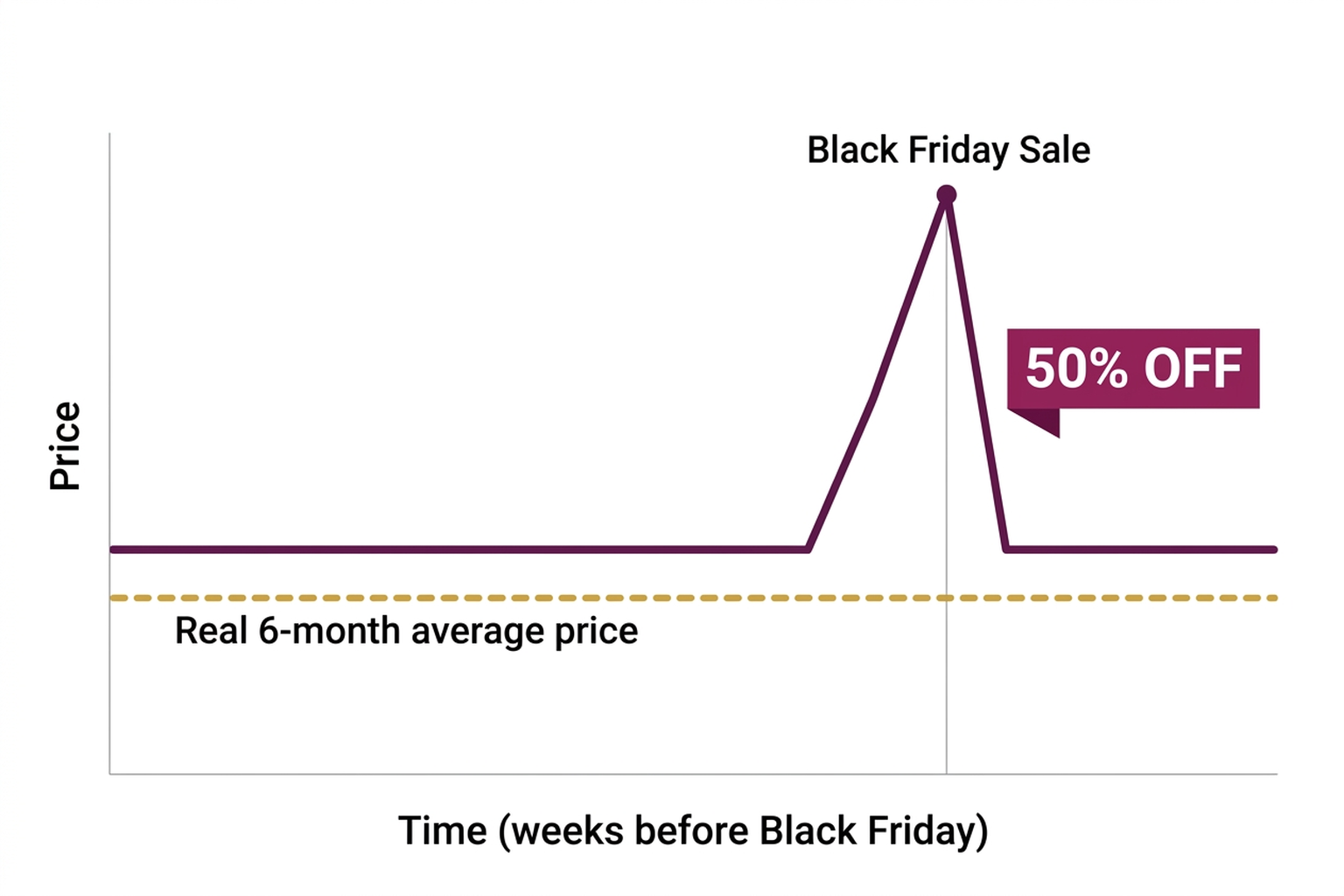
The shape in this chart is the pattern price-tracking studies keep finding: a price that holds steady for months, spikes shortly before the sale date, then drops back down roughly to where it started — at which point a “50% off” banner is measuring the discount against the artificial spike, not against what the item has actually cost most of the year. A genuine discount shows up as a dip below that flat historical average line, not just below a recent spike.
Comparison Table
Prices are approximate amazon.com figures as of 2026-10-12 and fluctuate.
| Mistake | Example product | ASIN | What the check catches |
|---|---|---|---|
| Trusting the “Was” price | Dyson V8 Plus Cordless Vacuum | B0CT9552BL | List price vs. actual multi-month average street price |
| Trusting the star rating alone | JBL Flip 6 Bluetooth Speaker | B09GJJJ8YW | Whether the rating is backed by on-topic reviews and independent lab data |
| Buying the cheapest listing for a hot gift | Apple AirPods Pro 2 (USB-C) | B0CHWRXH8B | Seller identity and price gap vs. every other listing of the same item |
| Assuming the same return window everywhere | — (seller-dependent) | — | Whether the listing is sold/fulfilled by Amazon or a third-party seller |
| Guessing the variant or size | Instant Pot Duo 6 Qt 7-in-1 | B00FLYWNYQ | Exact capacity/model match against household size needs |
Before You Click Buy
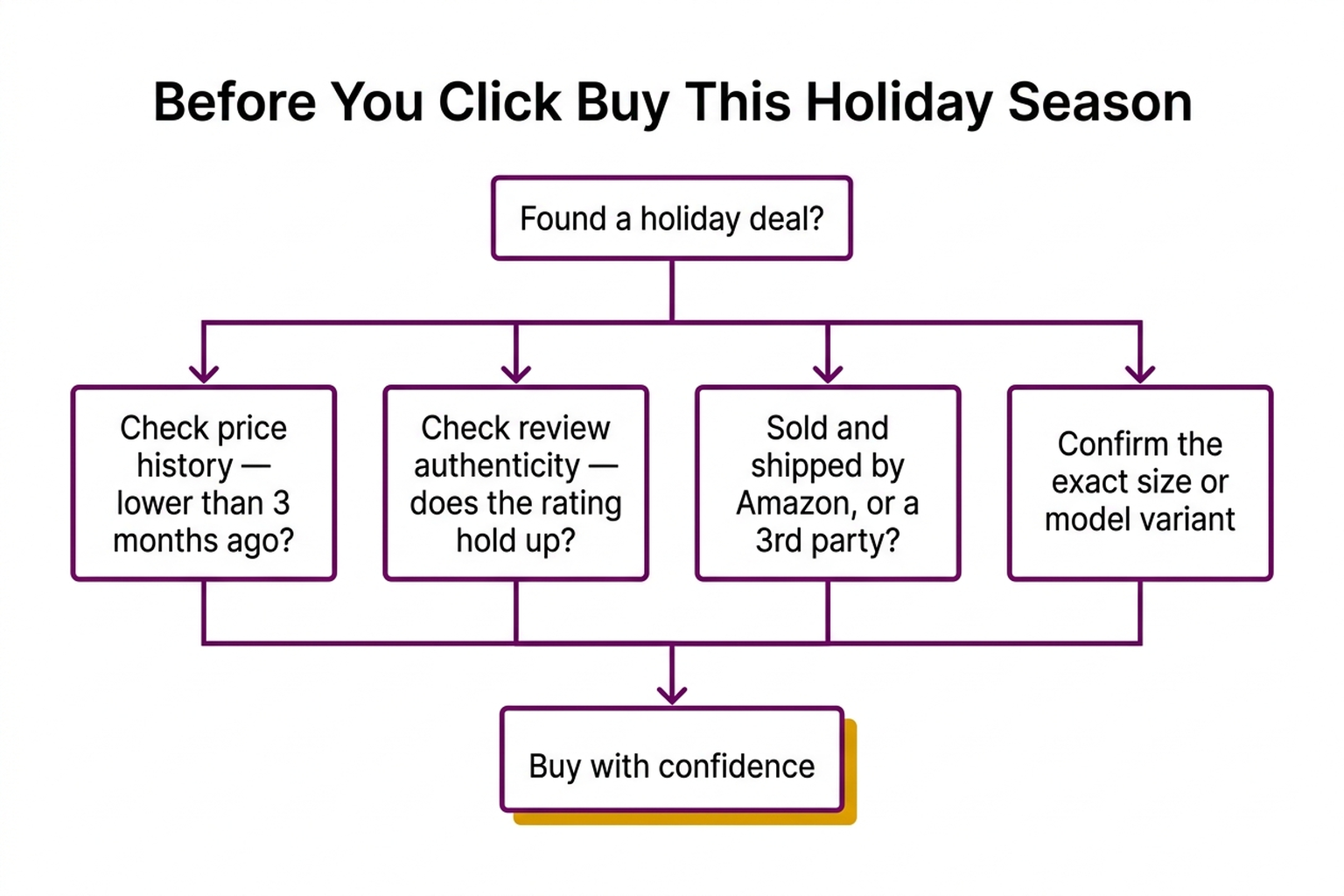
- See a big discount percentage? Pull up the price history before trusting the banner — a genuine deal shows a dip below the long-run average, not just below a price that spiked days earlier.
- See a high star rating on a product you don’t recognize? Skim a handful of 1- and 2-star reviews for specificity, and check whether an independent lab has tested the category.
- Buying a popular electronics or accessory gift at a price well below every other listing? Confirm who actually sells and ships it before adding to cart.
- Buying from anyone other than “Ships from and sold by Amazon.com”? Read that seller’s own return policy — don’t assume the holiday extension applies.
- Buying a product that comes in multiple sizes or models? Re-read the title and bullets for the exact variant, not just the photo.
Recommendations
- If you only do one of these checks before buying: check the price history. It’s the fastest, catches the most common manipulation (a price spike timed to a sale date), and takes under a minute with a free tool.
- If you’re buying a hot-ticket electronics gift (headphones, earbuds, smart devices): prioritize seller verification over price — a counterfeit at half the “real” price is a worse outcome than paying full price for the genuine item.
- If a gift has multiple similarly-named variants (sizes, capacities, color-coded models): cross-check the exact model number against any review or comparison you read, since online write-ups don’t always specify which variant they tested.
Limitations
This analysis reflects aggregated public consumer research, regulatory enforcement data, and independent price- and review-manipulation studies, not proprietary Amazon sales, return, or price-history data, and not hands-on testing of the five example products by our editorial team. The price-inflation statistics cited (29% of 65 tracked products, 83% of 175 UK-retailer products) come from studies of general retail pricing patterns around Black Friday, not from price-tracking the Dyson V8 Plus ASIN specifically, though the swing between that listing’s $539.99 list price and its repeated $279.99–$349.99 sale pricing illustrates the same pattern. The Which? headphone-review-manipulation findings are from a 2022 investigation into Amazon’s Bluetooth-headphone category broadly, not a current or 2026 finding and not an allegation against the JBL Flip 6 specifically, which is cited here as a contrasting example of a rating that holds up under independent testing. Return-policy terms, prices, and review counts shown are current as of the time of writing and are subject to change; always confirm a specific listing’s current seller, price history, and return terms before buying.
Bottom Line
None of these five mistakes require being careless — they’re easy to make precisely because the listing, the banner, and the star rating are all designed to look trustworthy at a glance. The fix for each one is a specific, fast check: price history instead of the “was” price, a skim of actual complaint text instead of the aggregate rating, seller identity instead of the lowest number, the seller’s own return terms instead of an assumption, and the exact model number instead of the hero photo. Running through all five takes a few minutes and avoids the January return-line wait that “wrong size” and “didn’t need it” purchases create every year.
Before you buy anything this holiday season, paste the product link into Arekore — our AI assistant checks review authenticity, surfaces what the one-star reviews actually complain about, and compares prices, free, in about five minutes.