Halloween Candy Buying Guide 2026: How Much to Actually Buy
TL;DR / Quick Verdict
- Quiet suburban street (20–40 trick-or-treaters): one 2 lb bulk variety bag is enough at 2 pieces per kid, with some left over.
- Busy street or subdivision (100–200 trick-or-treaters): plan on 4–8 lbs of candy, split across two bulk bags so you don’t run out mid-evening.
- Halloween candy prices are up roughly 78% since 2020, so buying one larger bulk bag is now consistently cheaper per piece than two smaller bags of the same brand.
Methodology
This analysis synthesizes (a) trick-or-treater volume formulas published by Omnicalculator and Food Republic, (b) Halloween candy spending and pricing data from the National Confectioners Association (NCA) and the FinanceBuzz 2025 candy-price survey, (c) an independent candy-bar blind taste test from Reviewed (USA Today), and (d) publicly listed weights, piece counts, and customer ratings for bulk variety packs on Amazon US. We did not personally purchase or count out every bag referenced here. Where we cite a per-piece or per-bag price, it is drawn from the NCA/FinanceBuzz survey data cited below rather than a live Amazon price check, since bulk-candy pricing on Amazon fluctuates frequently in the weeks before Halloween.
The Math: How Much Candy Do You Actually Need?
Most people either buy far too little candy (and run out of Halloween by 7:30 PM) or buy far too much (and eat the leftovers through November). Omnicalculator’s trick-or-treat formula and Food Republic’s simplified version both come down to the same three inputs: how many kids will show up, how many pieces you give each one, and how many hours you’ll keep the lights on.
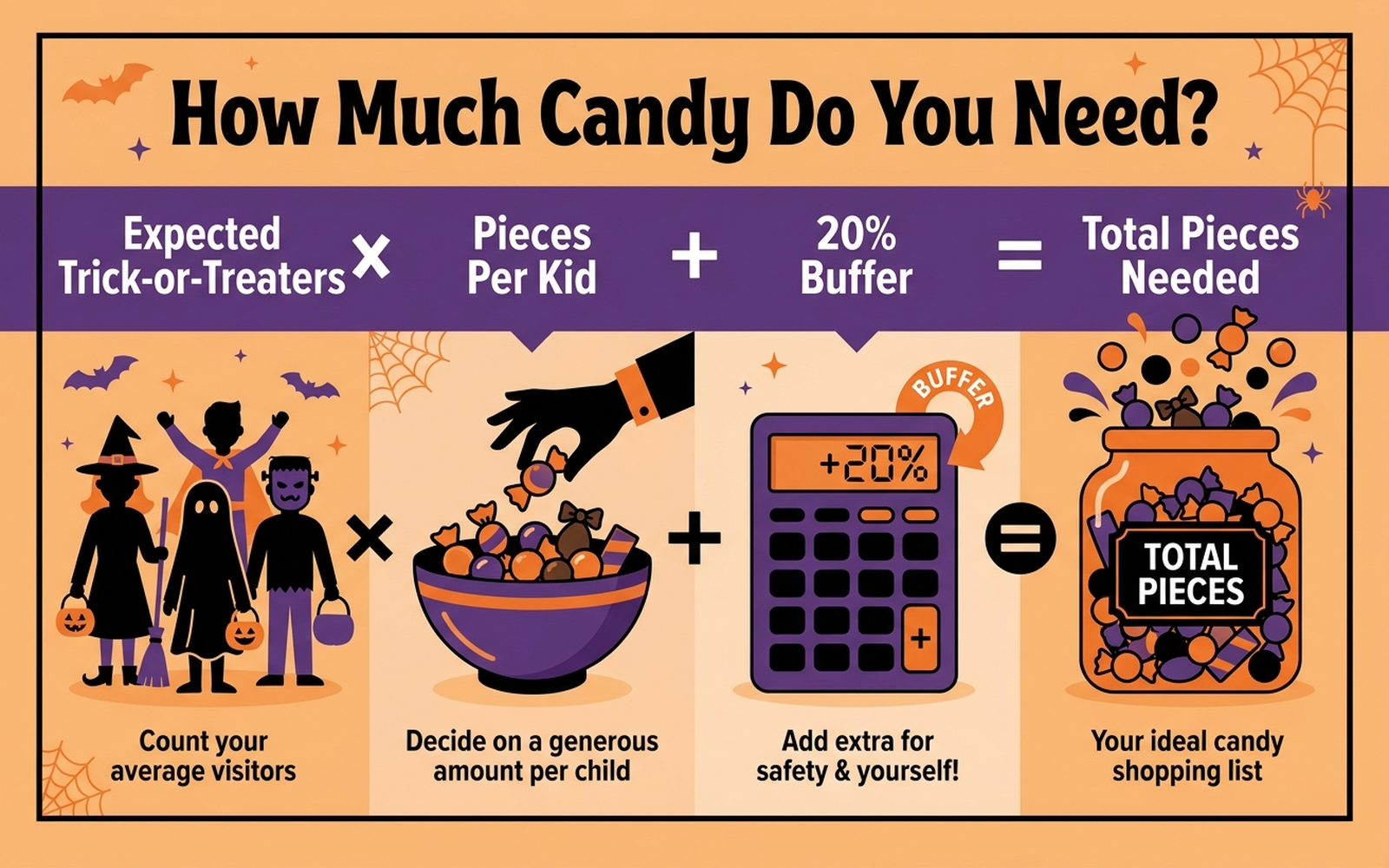
The simplified version: multiply your expected number of trick-or-treaters by the pieces you plan to give each one, then add roughly 15–20% as a buffer. A quiet residential street might see 20–40 callers over a two-to-three-hour window; a busy street with visible decorations, or a neighborhood known as a trick-or-treat destination, can see 150–300 or more. Weather matters too — light rain historically cuts turnout by roughly a third, so neighborhoods with a history of Halloween rain may want to buy slightly less than a dry-weather estimate suggests.
Converting kids into pounds of candy
Bulk bags are sold by weight, not piece count, so the useful conversion is pieces-to-pounds. Fun-size chocolate bars and individually wrapped hard candies average roughly 45–65 pieces per pound, depending on the brand and candy type (chocolate bars run heavier per piece than hard candy or gummies). Using the midpoint of about 50 pieces per pound as a rough planning number:
| Expected trick-or-treaters | Pieces at 2 per kid | Approx. pounds needed |
|---|---|---|
| 20 (quiet street) | ~40 | ~1 lb |
| 40 (typical suburban block) | ~80 | ~1.5–2 lbs |
| 100 (busy street) | ~200 | ~4 lbs |
| 200+ (subdivision destination) | ~400+ | ~8 lbs |
This table is a planning estimate, not a guarantee — actual piece counts per pound vary by brand, and a specific listing’s stated piece count (see the comparison table below) is more accurate than the 50-per-pound midpoint if you know which product you’re buying.
What the Data Says About Candy Choice
Chocolate remains the dominant Halloween category: NCA survey data shows 84% of households handing out treats say they’ll include chocolate or candy in the mix, and 94% of Americans mark Halloween with chocolate or candy in some form. Reviewed (USA Today) ran a blind taste test of 16 popular candy bars and found Take 5 topped the bracket, beating Kit Kat in the final round. That kind of chocolate-and-caramel combination tends to be the first thing to disappear from a mixed bowl, based on the anecdotal “candy bowl leftovers” pattern many households report — older-style chewy candies are more often the pieces left over on November 1.
For buyers who want to hedge instead of guessing one brand, a mixed bulk bag spreads that risk — a 265-piece Hershey’s/Reese’s/Kit Kat assortment gives trick-or-treaters a choice, versus committing an entire budget to a single brand that might not be anyone’s favorite this year.
Comparison Table: Bulk Variety Packs on Amazon US
Weights and piece counts are as published on each product’s Amazon US listing as of 2026-09-12; bulk-candy prices fluctuate frequently in the weeks before Halloween, so check the live listing before buying.
| Product | Weight | Piece count | Approx. price per piece* | Best for |
|---|---|---|---|---|
| Candied Treasures 2 lb Chocolate Variety Pack | 2 lb | ~65–75 pieces | Lower-mid | Quiet street, small gathering |
| Hershey’s Assorted Chocolate Bulk Variety Pack, 35.93 oz | 35.93 oz | 115 pieces | Mid | Typical suburban block |
| Candied Treasures 4 lb Chocolate Variety Pack | 4 lb | ~150–175 pieces | Lower (bulk discount) | Busy street |
| Hershey’s, Kit Kat & Reese’s Assorted Bulk Variety Bag, 80.32 oz | 80.32 oz | 265 pieces | Lower (bulk discount) | Busy street, brand-name mix |
| Candied Treasures 8 lb Chocolate Variety Pack | 8 lb | ~300–350 pieces | Lowest per piece | Subdivision destination street |
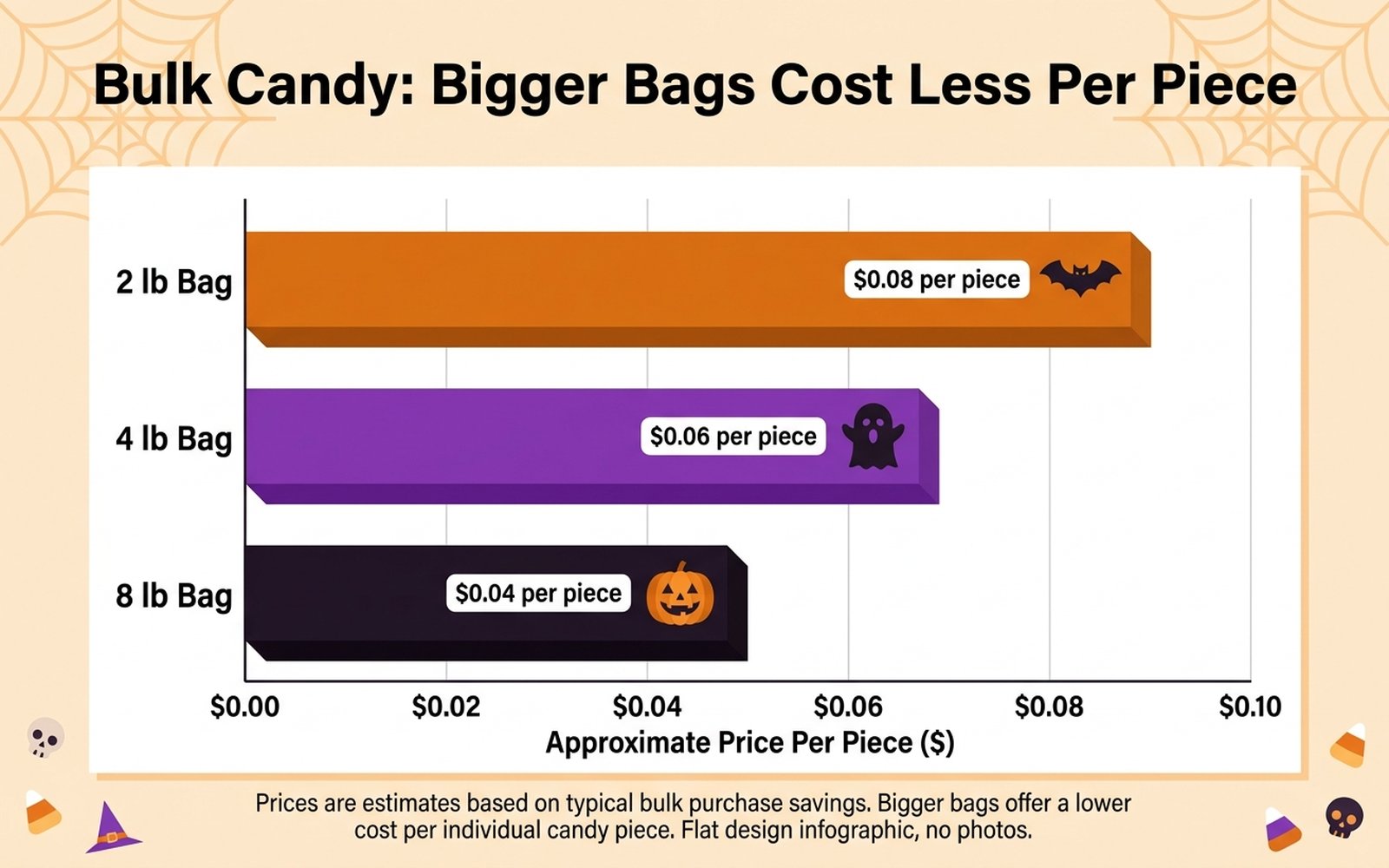
*Per-piece pricing is a relative comparison, not an absolute dollar figure — per the FinanceBuzz 2025 survey, a 100-piece assorted bag averaged $16.39 (roughly $0.16/piece) nationally, up from about $9 five years earlier, and prices climb further at name-brand bags like Reese’s (one 55-piece Reese’s bag was surveyed at $29, or about $0.53/piece). Larger bulk bags of the same brand consistently price lower per piece than smaller bags, which is the main argument for buying one bigger bag over two smaller ones.
Editorial Recommendation by Situation
- Best for a quiet street (20–40 visitors): a 2 lb variety bag — buying smaller here avoids paying a premium for volume you won’t use, and mixed chocolate assortments cover the widest range of preferences.
- Best for a typical suburban block (40–100 visitors): a mid-size, name-brand bulk bag like the 265-piece Hershey’s/Kit Kat/Reese’s assortment — brand recognition plus a large enough count to avoid running out mid-evening.
- Best for a busy street or known trick-or-treat destination (150+ visitors): the largest bulk bag you can find in a trusted brand, split into two bowls so a helper can refill while the first bowl runs low.
- Best for allergy-inclusive giving: pair any candy bowl with a second, teal-marked bowl of non-food items (stickers, glow sticks, small toys) as recommended by FARE’s Teal Pumpkin Project — food allergies affect roughly 1 in 13 children, and a teal pumpkin signals a non-food option is available without requiring a family to inspect every wrapper on your porch.
Decision Flowchart: Which Bag Size Fits Your Street?
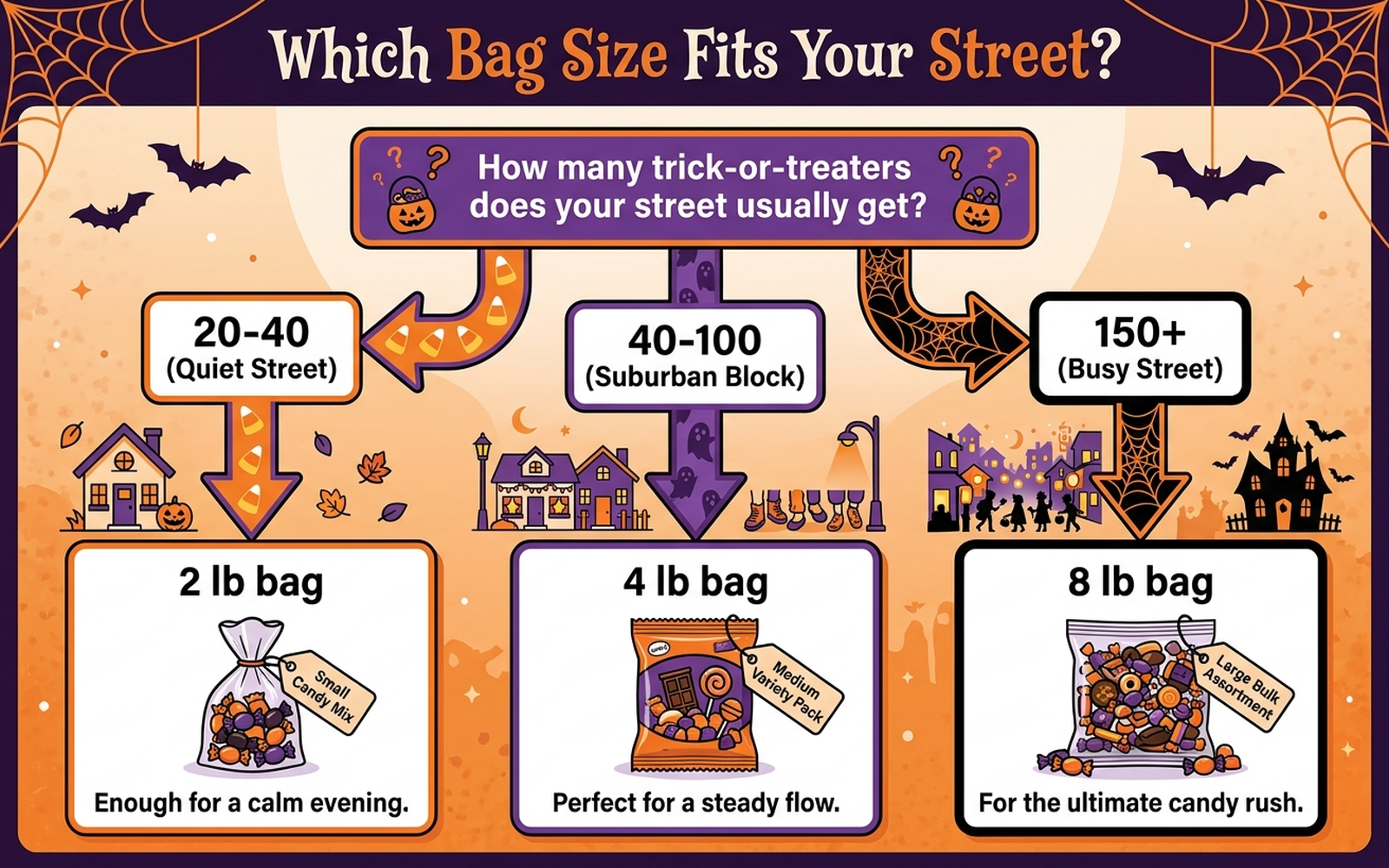
Start with your street’s typical turnout from last year (ask neighbors or check your own porch-light count from last Halloween if you kept track). If this is your first Halloween at the address, err toward the smaller end of your neighborhood-type estimate — grocery and drugstore chains widely restock discounted bulk candy in the days immediately after Halloween, so a modest shortfall on the day is a much smaller cost than a large, hard-to-use surplus.
Buying Timing
Bulk candy pricing is seasonal even within October: FinanceBuzz and CNBC’s reporting both note that chocolate-specific costs have risen sharply due to cocoa prices and tariffs, and that per-store discounts vary widely in the two weeks before Halloween. Buying earlier in October generally means less picked-over stock and more brand variety, at the cost of missing last-minute clearance pricing; buying in the final days before Halloween can catch discounts but risks specific brands or sizes selling out. For most buyers, aiming for the second or third week of October is a reasonable middle ground.
Limitations
This analysis relies on publicly listed Amazon US product weights and piece counts, published industry survey data from the NCA and FinanceBuzz, and one independent taste-test source (Reviewed); we did not personally purchase, weigh, or count the products referenced here. Piece counts and per-pound conversions vary by candy type and manufacturer, so the pounds-needed table above is a planning estimate, not an exact figure for every product. Regional turnout, weather, and neighborhood-specific trick-or-treating customs (some areas trick-or-treat earlier or later than the traditional evening window) can shift actual demand well outside the ranges cited here. Bulk-candy prices are highly seasonal and promotional; the per-piece figures cited from the FinanceBuzz survey reflect a national average at the time of that survey, not a live price check on any specific listing today.
As an Amazon Associate, Arekore earns from qualifying purchases. The Amazon product links in this article include our affiliate tracking ID and may earn us a commission if you buy through them, at no additional cost to you. See our Links Policy for details on how we select products and how commissions do not influence our recommendations.
- Candied Treasures 2 lb Halloween Candy Bulk Chocolate Variety Pack
- Hershey’s Assorted Chocolate Halloween Candy Bulk Variety Pack, 35.93 oz
- Candied Treasures 4 lb Halloween Candy Bulk Chocolate Variety Pack
- Hershey’s, Kit Kat & Reese’s Assorted Chocolate Candy Bag, 80.32 oz
- Candied Treasures 8 lb Halloween Candy Bulk Chocolate Variety Pack
Visit Arekore to verify current pricing and availability on any product mentioned here before buying.