Best Smart Light Bulbs in 2026: Govee vs Philips Hue

Philips Hue has been the default answer to “which smart bulb should I buy” for close to a decade, and it still is: Wirecutter, CNET, PCMag, TechRadar, and Tom’s Guide have independently named a Hue model their top overall pick for five consecutive years. Govee has spent that time building a different kind of following — not by beating Hue on reliability, but by selling more bulb, more color, and more lighting effects per dollar, with no mesh hub required. This guide compares what each brand actually sells, what an independent lab says about build quality, and what aggregated owner reviews report, so you can match the bulb to what you’re actually trying to do with your lighting.
As an Amazon Associate, Arekore earns from qualifying purchases. The Amazon product links in this article include our affiliate tracking ID and may earn us a commission if you buy through them, at no additional cost to you. See our Links Policy for details on how we select products and how commissions do not influence our recommendations.
TL;DR / Quick Verdict
- These two brands are not solving the same problem. Philips Hue sells a reliable whole-home lighting system built around a Zigbee hub; Govee sells colorful, effects-heavy bulbs that pair directly over Wi-Fi or Bluetooth with no hub at all. Pick based on which problem you have, not on price alone.
- Best for a reliable whole-home system: the Philips Hue Essential Starter Kit (Bridge + 4 bulbs) — the only smart-lamp system that convinced independent German testing lab Stiftung Warentest in its January 2024 comparative smart-lighting test, cited for stepless dimming with no flicker.
- Best value for color and effects on a budget: the Govee A19 Smart Bulbs (8-pack) — no hub required, Matter-compatible, and recently discounted to roughly $25 from a $40 list price, with over 3,000 units purchased in a single recent month on Amazon.
- Best way to try either brand for under $20: a single Philips Hue Bluetooth bulb (no hub) or a Govee 4-pack without a hub — neither requires buying into a full ecosystem up front.
- The factor buyers underweight: app quality. Reviewers across TechRadar and Android Police describe the Hue app as polished and instant-responding, while Govee’s app has been called sluggish and “creepy bad” for multicolor control by some reviewers — even though Govee’s hardware itself tests well for brightness and color accuracy.
How We Reached These Conclusions (Methodology)
This is an editorial analysis, not a hands-on review; we did not personally test the products covered here. This guide synthesizes three kinds of public information: (a) aggregated amazon.com customer review data and purchase-volume indicators sampled in October 2026; (b) independent testing, including Stiftung Warentest’s comparative smart-lamp evaluation and reviewer coverage from TechRadar, Tom’s Guide, and Android Police; and (c) manufacturer specifications for lumens, color range, and connectivity protocol. Where we cite a manufacturer figure — lumen output, color count, or a “works with Matter” claim — we label it as a manufacturer claim rather than an independently verified result. Prices are amazon.com figures at the time of writing and fluctuate, sometimes significantly, with frequent promotions on both brands.
Technical Approach: Hub-Based Mesh vs. Wi-Fi Direct
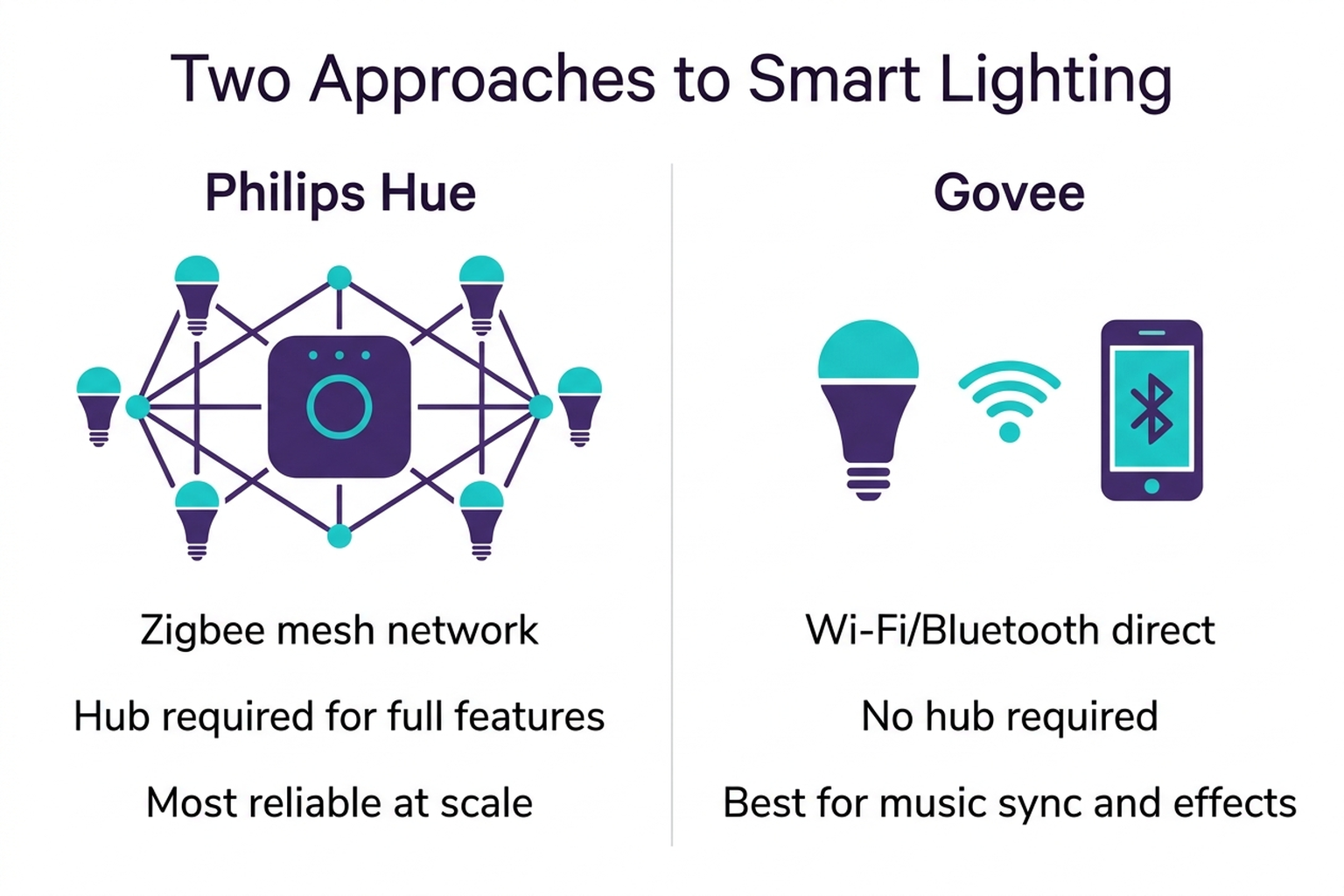
The two brands are built on genuinely different network architectures, and that difference explains most of what reviewers praise and criticize about each.
- Philips Hue’s approach uses Zigbee, a low-power mesh protocol where every bulb also acts as a signal repeater for its neighbors. That requires a physical Hue Bridge ($60+ when bought separately, included in starter kits), but it’s also why independent reviewers and Stiftung Warentest’s testing describe Hue as the most reliable system at scale — a 20-bulb Hue setup tends to stay just as responsive as a 4-bulb one, because the mesh gets stronger as you add bulbs. Hue bulbs also support Bluetooth directly for small single-room setups without a bridge, at the cost of losing scheduling automation and the Hue Bridge’s broader smart-home integrations.
- Govee’s approach skips the mesh hub entirely: bulbs connect straight to your home Wi-Fi (and Bluetooth for initial setup), each one talking directly to Govee’s cloud and app rather than to each other. That’s simpler to set up for a handful of bulbs and avoids an extra $60 hardware purchase, but it also means every bulb adds its own load to your home Wi-Fi router rather than offloading to a separate mesh — a tradeoff reviewers point to when explaining why larger all-Govee installations report more occasional disconnects than comparable Hue setups.
- Matter support, a newer cross-platform standard meant to make smart-home devices work interchangeably across Alexa, Google Home, and Apple Home, is now a stated feature on current-generation Govee A19 bulbs and on Hue’s newer Bridge Pro hardware. Matter/Thread adoption is the fastest-growing connectivity category in the smart-lighting market, according to industry trend data, specifically because it removes the “which ecosystem do I commit to” hesitation that long kept some buyers on the fence.
- Color and effects. Govee leans harder into entertainment features: music-sync algorithms that pulse color to audio, dozens of preset dynamic scenes, and millions of selectable DIY colors are core to its product pitch. Hue supports color and scenes too, but its engineering priority is consistent, flicker-free dimming and whole-home automation rather than party-mode effects.
Head-to-Head: Try-It Tier (Single Bulb, No Hub, Under $20)
Philips Hue White and Color Ambiance A19 (single bulb, Bluetooth, hub optional) is Hue’s lowest-commitment entry point: screw it in, pair over Bluetooth from the Hue app, and you get Hue’s full color range and dimming quality without buying a Bridge. The tradeoff is that Bluetooth-only Hue bulbs lose some automation features — like being controlled from outside Bluetooth range or synced with third-party smart-home routines — that only unlock once you add the Bridge.
Check the Philips Hue single bulb (Bluetooth, no hub) on Amazon
Govee A19 Smart Bulbs (1000LM, 4-pack, no hub required) gets you four color-changing bulbs, each independently controllable from the Govee app over Wi-Fi, for roughly the price of one single Hue bulb. It’s the cheaper way to light an entire small room in color, with the understanding that you’re buying into Govee’s generally less-polished app experience from the start.
Check the Govee A19 Smart Bulbs (4-pack) on Amazon
Verdict at this tier: if you want to test Hue’s dimming quality and app polish on a single bulb before committing to a Bridge, the single Hue bulb is the right trial. If you want to light a whole small room in color for the lowest possible price, the Govee 4-pack covers more bulbs per dollar.
Head-to-Head: Whole-Home Tier (Hue Starter Kit ~$100–$140 vs. Govee 8-Pack ~$25–$40)
Philips Hue Essential Starter Kit (Bridge + 4 E26 smart bulbs) is the current entry point into Hue’s full ecosystem: one Hue Bridge plus four White and Color Ambiance bulbs, compatible with Alexa, Google Assistant, Apple Home, and Samsung SmartThings. Amazon purchase-volume data shows 500+ units bought in a recent month, and it’s the type of configuration Stiftung Warentest’s lab tested in its January 2024 comparison of seven smart-lamp systems with base stations — Hue was the only one to earn a positive recommendation, cited for stepless dimming with no flicker and a “good” rating for setup of the bulbs, bridge, and accessories together.
Check the Philips Hue Essential Starter Kit (Bridge + 4 bulbs) on Amazon
Govee A19 Smart Bulbs (8-pack, Matter-compatible) is Govee’s answer at a comparable bulb count: eight Wi-Fi/Bluetooth color-changing bulbs with music sync, dozens of dynamic scenes, and Matter compatibility, no separate hub purchase required. It’s seen frequent promotional pricing — recently discounted to about $25 from a $40 list price — and Amazon purchase-volume data shows over 3,000 units bought in a recent month, among the more popular configurations in Govee’s smart-bulb lineup.
Check the Govee A19 Smart Bulbs (8-pack) on Amazon
Verdict at this tier: per-bulb, Govee’s 8-pack is dramatically cheaper than the 4-bulb Hue kit, and you get twice as many bulbs. But you’re paying for different things — Hue’s kit is a tested, independently validated system with a mesh network that scales cleanly as you add more bulbs and rooms; Govee’s pack is a larger quantity of independently networked bulbs with richer color effects, at the cost of the mesh reliability and app polish reviewers consistently credit to Hue.
Side-by-Side Comparison
| Model | ASIN | Tier | Hub required | Lumens | Approx. price (as of 2026-10-26) |
|---|---|---|---|---|---|
| Philips Hue single bulb (Bluetooth) | B07QWB3H1Q | Try-it | No (optional) | 800 lm | ~$18–$25 |
| Govee A19 Smart Bulbs (4-pack) | B0C3TSTG69 | Try-it | No | 1,000 lm | ~$26–$40 |
| Philips Hue Essential Starter Kit (Bridge + 4 bulbs) | B0FMGR8TGB | Whole-home | Yes (included) | 800 lm/bulb | ~$100–$140 |
| Govee A19 Smart Bulbs (8-pack, Matter) | B0BQJD48RV | Whole-home | No | 800 lm/bulb | ~$25–$40 |
Lumen figures are manufacturer specifications. Prices fluctuate significantly with sales on both brands — verify the current amazon.com price before buying.
Customer Sentiment Synthesis
- Philips Hue owners, per aggregated reviewer coverage, most frequently cite instant app responsiveness, flicker-free dimming, and the absence of random disconnects even in larger multi-room installations — reviewers comparing Hue against budget alternatives consistently describe it as the more stable, glitch-free system of the two.
- Govee owners most commonly praise brightness, color accuracy, and the sheer number of lighting effects and DIY color combinations available, along with the lower entry price relative to Hue for an equivalent bulb count.
- The most common Govee complaint centers on the companion app: reviewers at Tom’s Guide and other outlets describe occasional Wi-Fi disconnects and a less responsive, sometimes confusing interface for multicolor control compared with Hue’s app — though at least one reviewer reported the opposite experience in daily use, suggesting outcomes vary by home Wi-Fi setup and router congestion.
- The most common Hue complaint is cost: a comparable bulb count costs meaningfully more with Hue once you factor in the Bridge, and some reviewers who switched to a budget alternative reported regretting how long they’d waited, given how capable cheaper options have become for basic color-changing use.
Setting Up Either Brand for the First Time
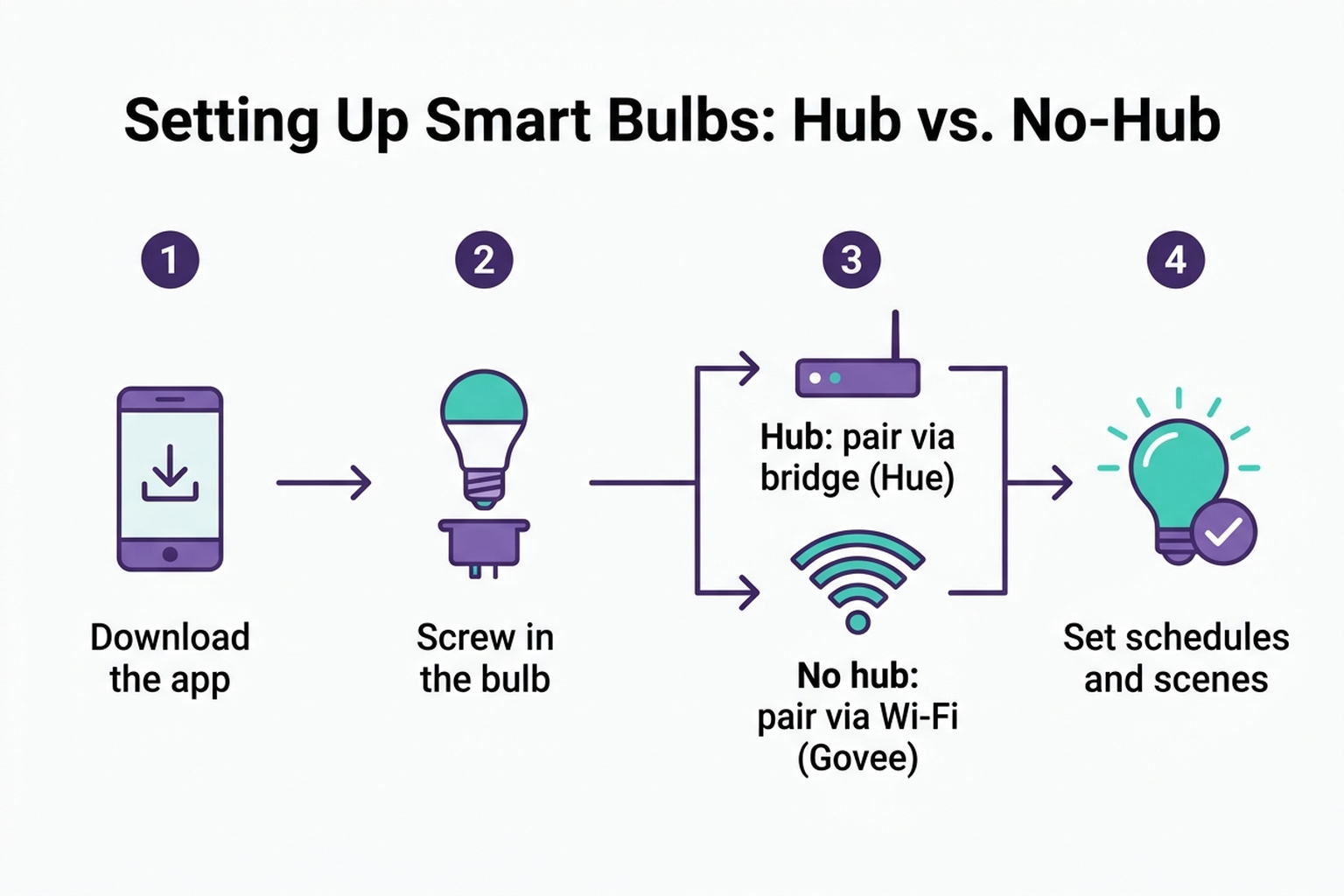
Both brands follow the same basic first two steps — download the brand’s app and screw in the bulb — before the setup paths diverge. Hue bulbs bought as part of a starter kit pair through the Bridge, which you plug into your router with an included Ethernet cable; Bluetooth-only Hue bulbs skip that step and pair directly from the app, with the tradeoff noted above. Govee bulbs pair directly to your home Wi-Fi network from the app, with Bluetooth used only for the brief initial handshake — there’s no separate hardware to plug into your router. Once paired, both apps let you set schedules, group bulbs into rooms, and build scenes; Hue’s automation options (geofencing, routines tied to other Hue accessories) go deeper if you add the Bridge, while Govee’s scene options lean toward music sync and preset color effects.
Market Context: A Growing Category Still Splitting by Use Case
The global smart bulb market was worth an estimated $4.86 billion in 2026 and is projected to grow at a compound annual rate of roughly 14% to reach $9.37 billion by 2031, according to industry market-research estimates — part of a broader smart lighting market that multiple research firms separately size between roughly $27 billion and $34 billion in 2026, depending on how each firm defines the category. Within that growth, Zigbee-based lighting — the protocol underlying Hue’s mesh — is separately estimated at around $4.2 billion in 2026, while Matter and Thread adoption is described as the fastest-growing connectivity category industry-wide, driven by buyers who want a bulb that works across Alexa, Google, and Apple ecosystems without picking a side up front. That split mirrors what this comparison found at the product level: Hue continues to win on tested reliability for buyers building a long-term whole-home system, while Govee and similar Wi-Fi-direct brands are capturing buyers who want color and effects without an up-front hub purchase.
How to Decide
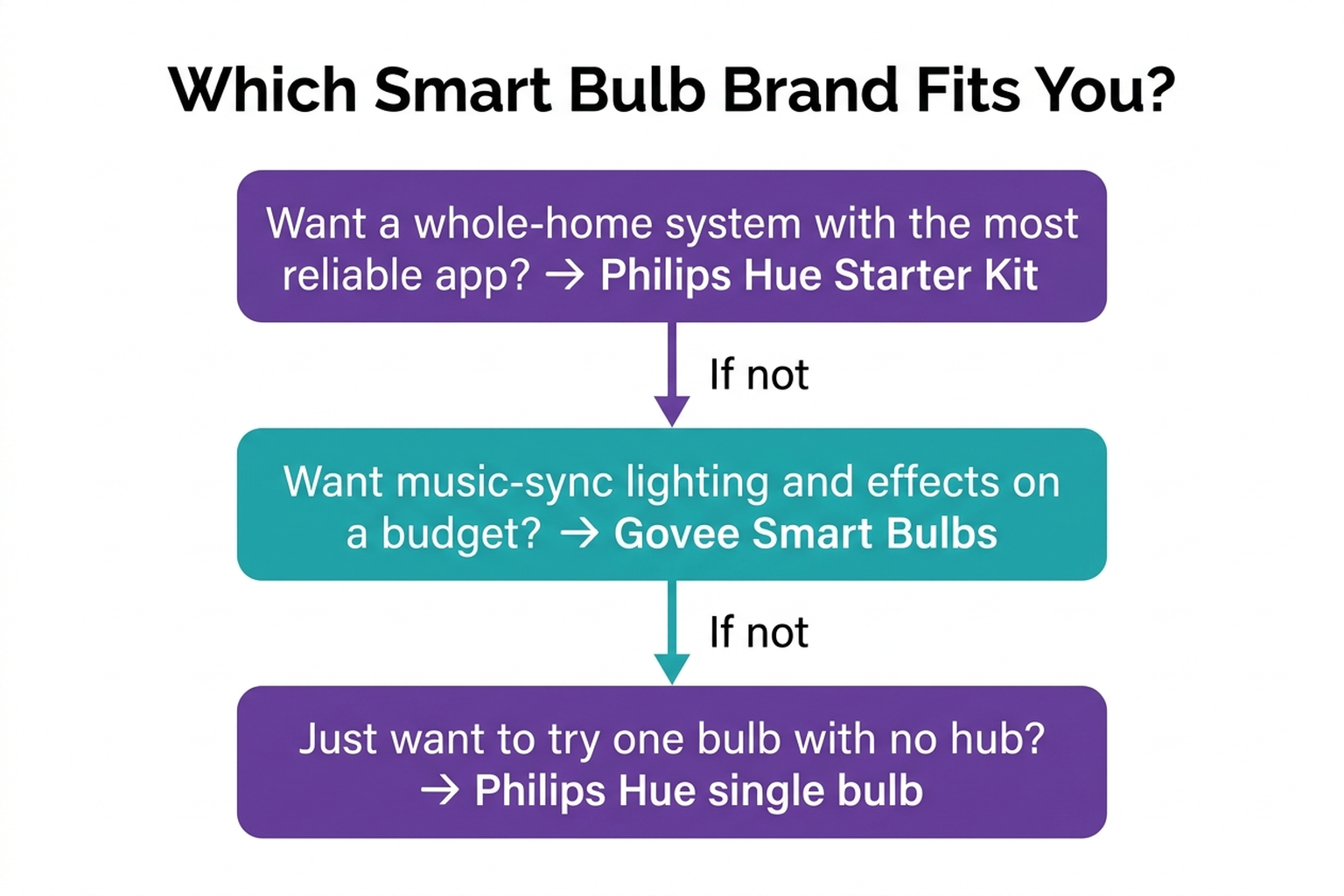
Start with how much of your home you’re trying to light and how much you care about near-perfect reliability. If you want a whole-home system that an independent lab has specifically validated for dimming quality and consistent performance as you scale up, the Philips Hue Essential Starter Kit is worth the higher per-bulb cost. If your priority is covering more rooms in vivid color and lighting effects without spending on a hub, the Govee 8-pack gets you there for a fraction of the price, with the understanding that the app experience and large-install reliability won’t quite match Hue’s. If you’re not ready to commit either way, a single no-hub bulb from either brand — Hue’s Bluetooth single bulb or Govee’s 4-pack — lets you test the experience for under $25 before buying a full kit.
Editorial Recommendation by Use Case
- You want the most reliable whole-home system, validated by independent testing: the Philips Hue Essential Starter Kit, the only system in Stiftung Warentest’s comparative test to earn a clear recommendation.
- You want the most color and lighting effects per dollar: the Govee A19 Smart Bulbs (8-pack), recently available for about $25 with no hub purchase required.
- You just want to try one bulb before committing: the Philips Hue single Bluetooth bulb if app polish matters most to you, or the Govee 4-pack if price per bulb matters most.
- You’re building a large, multi-room automated home: the Philips Hue ecosystem, whose Zigbee mesh is specifically engineered to stay reliable as bulb count grows, unlike Wi-Fi-direct systems that add load to your router with every additional bulb.
Limitations
This analysis relies on publicly available Amazon review and purchase-volume data, Stiftung Warentest’s published test summary, and manufacturer specifications; we did not independently lab-test these bulbs for lumen output, color accuracy, or long-term Wi-Fi/Zigbee reliability. Lumen counts, color ranges, and “works with Matter” claims are manufacturer specifications unless explicitly attributed to Stiftung Warentest or a named reviewer outlet, and individual performance can vary with home Wi-Fi congestion, router placement, and the number of bulbs installed. Amazon review sentiment and purchase-volume figures reflect aggregated public data at the time of writing and can shift as new reviews accumulate or as newer SKUs replace the ones covered here. Prices and availability were accurate to our research at the time of writing and change frequently, often significantly during sales events — verify current specs and pricing on the product page before buying.
Before you buy either brand’s bulbs, it pays to check whether a listing’s reviews are genuine and whether a sale price is a real discount or an inflated “was” price. That is exactly what Arekore does: paste the Amazon URL and our AI analyzes review authenticity, surfaces the most useful low-star feedback, and compares pricing in about five minutes — so you end up with the lighting setup that actually fits your home, not just the one with the most dynamic scenes on the box.