GoPro vs Insta360: Best Action Camera in 2026?
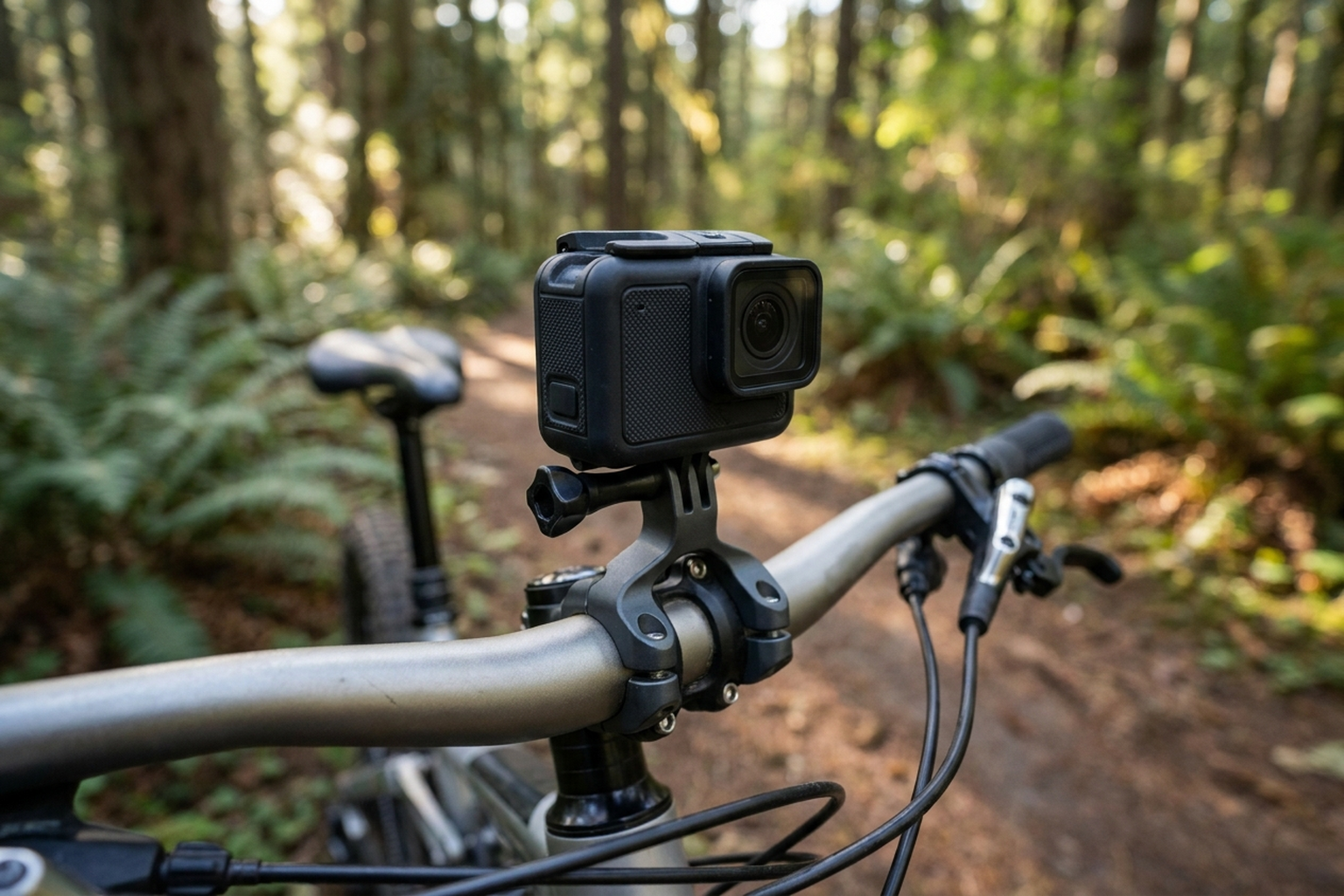
For most of the 2010s, “action camera” was basically synonymous with GoPro. That’s no longer true. Global handheld-camera shipment data for Q1 2026 puts GoPro’s market share below 6%, while DJI and Insta360 together account for roughly 87% of units shipped — a near-total reversal from GoPro’s 84% share in 2022. This guide compares GoPro’s current flagship, the HERO13 Black, against Insta360’s two leading models — the flip-screen Ace Pro 2 and the dual-lens, fully 360-degree X5 — using aggregated Amazon customer data, independent test coverage, and manufacturer specifications.
As an Amazon Associate, Arekore earns from qualifying purchases. The Amazon product links in this article may include our affiliate tracking ID and may earn us a commission if you buy through them, at no additional cost to you. See our Links Policy for details on how we select products and how commissions do not influence our recommendations.
TL;DR / Quick Verdict
- Best for traditional point-of-view footage and the widest accessory ecosystem: the GoPro HERO13 Black ($399.99) — still the most widely reviewed and most mount-compatible camera here, even as its market share shrinks.
- Best all-around hybrid for vlogging and low light: the Insta360 Ace Pro 2 ($449.99) — an 8K, 1/1.3” Leica co-engineered sensor, a flip-up touchscreen, and a dedicated AI chip for auto-framing and editing.
- Best for immersive, reframe-later footage: the Insta360 X5 ($549.99 standalone, bundles vary) — true 360-degree dual-lens capture that lets you choose your shot angle after recording, at the highest price of the three.
- The context most “which is better” takes skip: this isn’t a close popularity contest anymore. DJI and Insta360 combined now ship roughly 14x more handheld cameras than GoPro by volume (Q1 2026 data) — GoPro’s advantage today is brand recognition and third-party accessory compatibility, not market momentum or, per most independent reviewers, outright image quality.
Methodology
This is an editorial analysis, not a hands-on review; we did not personally test the cameras covered here. This guide synthesizes (a) aggregated amazon.com customer reviews for the GoPro HERO13 Black, Insta360 Ace Pro 2, and Insta360 X5, sampled in October 2026; (b) independent test coverage and comparison testing from RTINGS, Tom’s Guide, TechRadar, Amateur Photographer, and Digital Camera World; (c) manufacturer-published specifications from GoPro and Insta360; and (d) third-party market-share reporting on handheld camera shipments (BigGo Finance, citing IDC-style shipment tracking) for Q1 2026. Where we cite a manufacturer figure — recording time, sensor size, waterproof depth — we label it as a manufacturer claim rather than an independently verified result. Prices reflect standalone-camera Amazon listings as of October 2026; bundle pricing (extra batteries, cases, SD cards) varies by listing.
The Context Most Comparisons Skip: GoPro’s Market Collapse
Most “GoPro vs. Insta360” articles frame this as a two-horse race between comparably sized competitors. The shipment data says otherwise. GoPro held roughly 84% of the action-camera market in 2022; by Q1 2026, global handheld smart-camera shipments reached an estimated 4.14 million units, with DJI capturing about 65% (2.7 million units) and Insta360 about 22% (900,000 units), while GoPro’s shipments fell 33% year-over-year to roughly 300,000 units — a market share below 6%. GoPro reported an $80.82 million net loss in that same quarter. This matters for a buying decision because it changes what “safe choice” means: GoPro is no longer the default by volume, and the companies gaining share — DJI and Insta360 — are the ones now setting the pace on sensor size, AI features, and price-to-spec ratio. We focus this comparison on GoPro vs. Insta360 specifically (rather than including DJI) because Insta360 remains the most direct like-for-like competitor across both traditional POV and 360-degree formats.
Technical Approach: Sensor, Lens, and Format
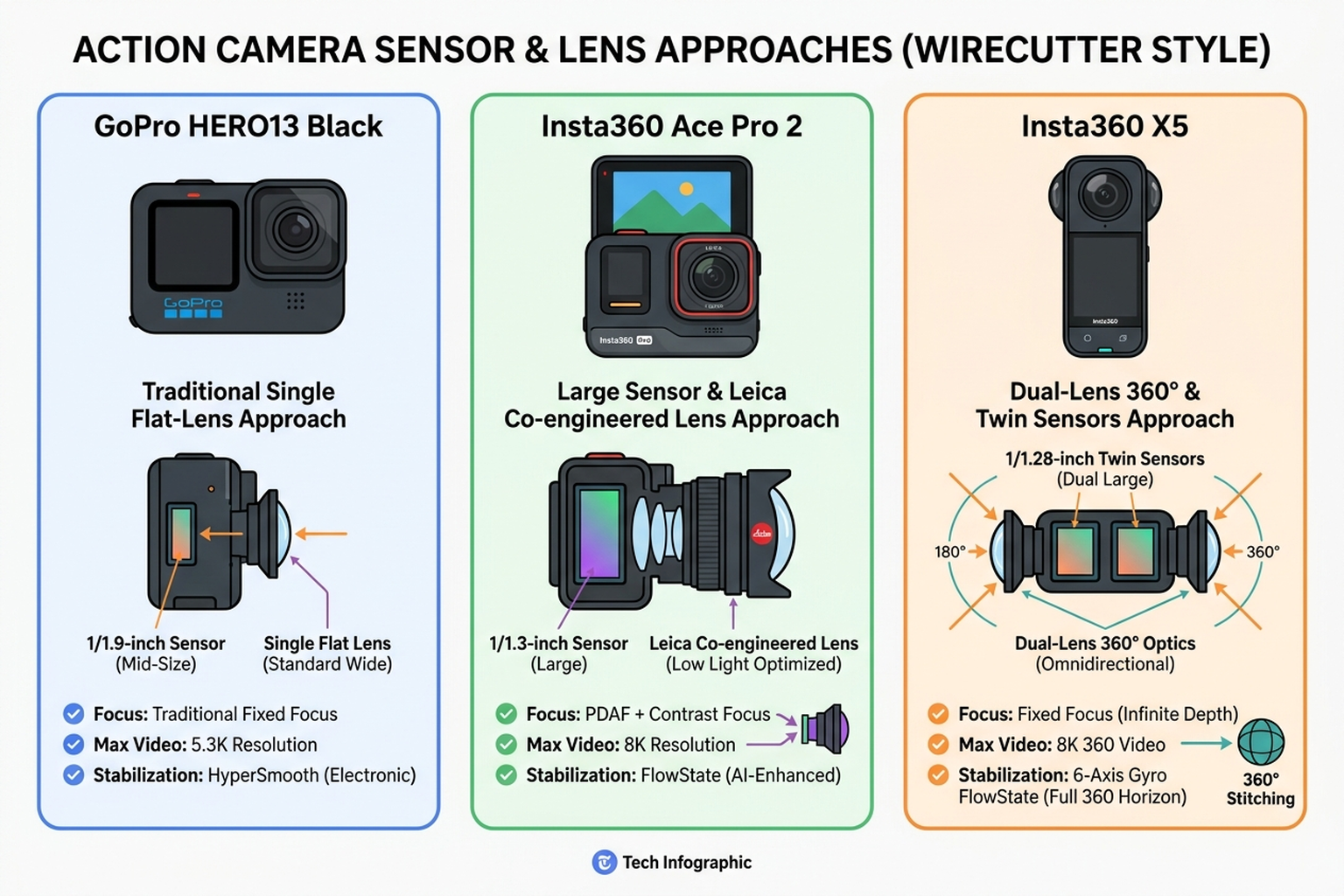
- GoPro HERO13 Black uses a traditional single flat lens and a 1/1.9” sensor, topping out at 5.3K60 video and 27MP photos. This is the smallest sensor of the three cameras compared here, and independent reviewers consistently note it struggles more in low light than either Insta360 model.
- Insta360 Ace Pro 2 also uses a single flat lens but steps up to a larger 1/1.3” sensor — co-engineered with Leica — paired with an f/2.6 aperture, 8K30 video, and 50MP photos. The larger sensor is the main reason reviewers rate its low-light and dynamic-range performance above the HERO13 Black’s.
- Insta360 X5 is a fundamentally different format: dual 1/1.28” sensors on opposite sides of the body capture a full 360 degrees simultaneously, stitched into 8K 360 footage. This lets you pick your framing, angle, and horizon level after recording instead of committing to one point of view at capture time — useful for action sports where you can’t predict the best angle in advance, but it also means every X5 clip needs an editing pass before it looks like normal POV footage.
- AI processing. The Ace Pro 2 includes a dedicated AI chip (manufacturer claim: 5nm) powering AI subject tracking, auto-framing, AI Highlights auto-editing, and a “selfie stick eraser” effect. The HERO13 Black has no dedicated AI chip; its standout automation feature, HindSight, continuously buffers 15–30 seconds of footage before you press record, so you can capture a moment that already happened.
Head-to-Head: GoPro HERO13 Black vs. Insta360 Ace Pro 2
The GoPro HERO13 Black ships with GoPro’s 1950mAh Enduro battery, rated by GoPro at roughly 150 minutes of recording time, and is waterproof to 10m (33ft) without a housing, extendable to 60m (196ft) with GoPro’s optional Protective Housing. Its headline new feature versus prior HERO models is a magnetic accessory mount that accepts interchangeable HB-series lenses (an ultra-wide “Max Lens” option and an anamorphic lens), extending versatility without buying a new camera body. Amazon customer reviews and independent testers (including Tom’s Guide and itsbetterontheroad.com) describe footage quality as excellent in daylight and consistent across GoPro’s long-running accessory ecosystem — mounts, cages, and third-party grips from a decade of GoPro models still fit — but a recurring complaint is overheating and automatic thermal shutdown at the camera’s highest settings. Reviewers report shutdowns around the 45-minute mark when recording 5.3K60 in an unventilated environment above roughly 100°F ambient temperature; dropping to 2.7K or a lower frame rate substantially extends usable recording time.
Check the GoPro HERO13 Black on Amazon
The Insta360 Ace Pro 2 uses a slightly smaller 1800mAh battery but is rated for roughly 30 minutes more recording time than the HERO13 Black at comparable settings (a manufacturer claim, not independently lab-verified in the sources we reviewed), and charges to 80% in about 20 minutes — notably faster than GoPro’s charging time in reviewer testing. It’s waterproof to 12m (39ft) out of the box, deeper than the HERO13 Black’s unhoused rating, and extends to 60m (197ft) with Insta360’s optional Dive Case. Its flip-up touchscreen can tilt through a 180-degree range, including a full 90-degree upward tilt for low-angle shooting — a physical design advantage neither the HERO13 Black nor the X5 offers, since both of those use fixed rear screens. Reviewers at TechRadar and thetechnologyman.com describe the Ace Pro 2’s low-light footage as a clear step above the HERO13 Black’s, attributable to its larger sensor, and praise the AI auto-framing and editing tools for creators who don’t want to edit raw 4K footage by hand.
Check the Insta360 Ace Pro 2 on Amazon
Verdict at this tier: independent reviewers reach a fairly consistent conclusion: the Ace Pro 2 wins on resolution, low-light performance, screen versatility, and runtime, while the HERO13 Black’s case rests on its accessory ecosystem (a decade of compatible mounts and third-party gear) and interchangeable-lens system that the Ace Pro 2 doesn’t match. If you’re starting from zero with no existing GoPro mounts, several outlets we reviewed (Synced, TrustedReviews) call the Ace Pro 2 the stronger overall buy at a roughly $50 premium.
Head-to-Head: Traditional POV vs. Insta360 X5’s 360-Degree Format
The Insta360 X5 is not a direct spec-for-spec rival to either single-lens camera above — it’s a different capture format. Its dual 1/1.28” sensors (Insta360’s largest in this lineup) shoot simultaneous 360-degree footage at up to 8K30, or can be cropped to a single-lens 4K60fps “flat” view in-app. Its 2400mAh battery is rated for up to 185 minutes at 5.7K24 — the longest runtime of the three cameras compared here — though reviewers at droneandcam.com and gear4greatness.com note that pushing the X5 to full 8K or its highest frame rates drops real-world battery life to roughly 50–70 minutes. It’s rated waterproof to 15m (49ft), deeper than either single-lens camera’s unhoused rating, though its two bulbous lenses are a documented durability tradeoff: reviewers flag them as more exposed to scratches than a flat lens design, despite Insta360’s toughened-glass coating. FlowState stabilization with 360-degree horizon lock means footage stays level even through crashes, flips, or a camera mounted at an odd angle — arguably the X5’s single biggest practical advantage for unpredictable action sports.
Check the Insta360 X5 on Amazon
Verdict at this tier: the X5 is the right choice specifically when you can’t predict your best camera angle in advance — mountain biking through unknown terrain, a ski run, a skate trick — because you choose the framing after the fact rather than committing to one point of view during the ride. It is not the right choice if you want footage that’s immediately shareable without an editing pass; both the HERO13 Black and Ace Pro 2 produce normal, ready-to-post video straight off the camera.
Customer Sentiment and Common Issues
- GoPro HERO13 Black: the most consistent complaint across Amazon reviews and independent long-term coverage is thermal shutdown during extended high-resolution recording, typically after 45 minutes to an hour at 5.3K60 in warm or unventilated conditions. Battery life at max settings is also a recurring theme in critical reviews, with several reviewers recommending GoPro’s dual-battery charging accessory as a near-mandatory add-on for all-day shoots.
- Insta360 Ace Pro 2: customer sentiment skews positive on image quality and low-light performance; the most common critical feedback relates to the learning curve of Insta360’s companion app and AI editing tools compared to GoPro’s simpler Quik app workflow.
- Insta360 X5: reviewers and buyers generally praise stabilization and low-light performance for a 360 camera, but the dual-lens design draws recurring concern about lens scratch vulnerability, and several reviewers note that 360 footage requires meaningfully more post-production time than single-lens cameras — a workflow cost that doesn’t show up in spec sheets.
- Net read: none of the three cameras is complaint-free. GoPro’s issues are thermal and battery-related; Insta360’s issues are software-learning-curve (Ace Pro 2) and physical lens durability (X5) rather than core image-quality complaints.
Subscription and Total Cost of Ownership
GoPro sells two optional annual subscription tiers: GoPro Premium at $49.99/year (unlimited cloud backup for GoPro footage specifically, plus guaranteed camera replacement if yours is lost, stolen, or damaged while backing up) and GoPro Premium+ at $99.99/year (adds up to 500GB of cloud storage that accepts footage from any camera, not just GoPro’s). Both tiers include accessory discounts and a trade-in credit toward a new camera at renewal. Insta360 does not bundle an equivalent software subscription into its core ownership cost — its AI editing and cloud features are included with camera ownership — but both Insta360 cameras discussed here carry a standard 1-year manufacturer warranty, extendable to 2 years for an additional fee through Insta360’s Care program, matching GoPro’s standard 1-year warranty (extendable via the Premium subscription’s camera-replacement benefit rather than a traditional repair warranty).
Decision Guide
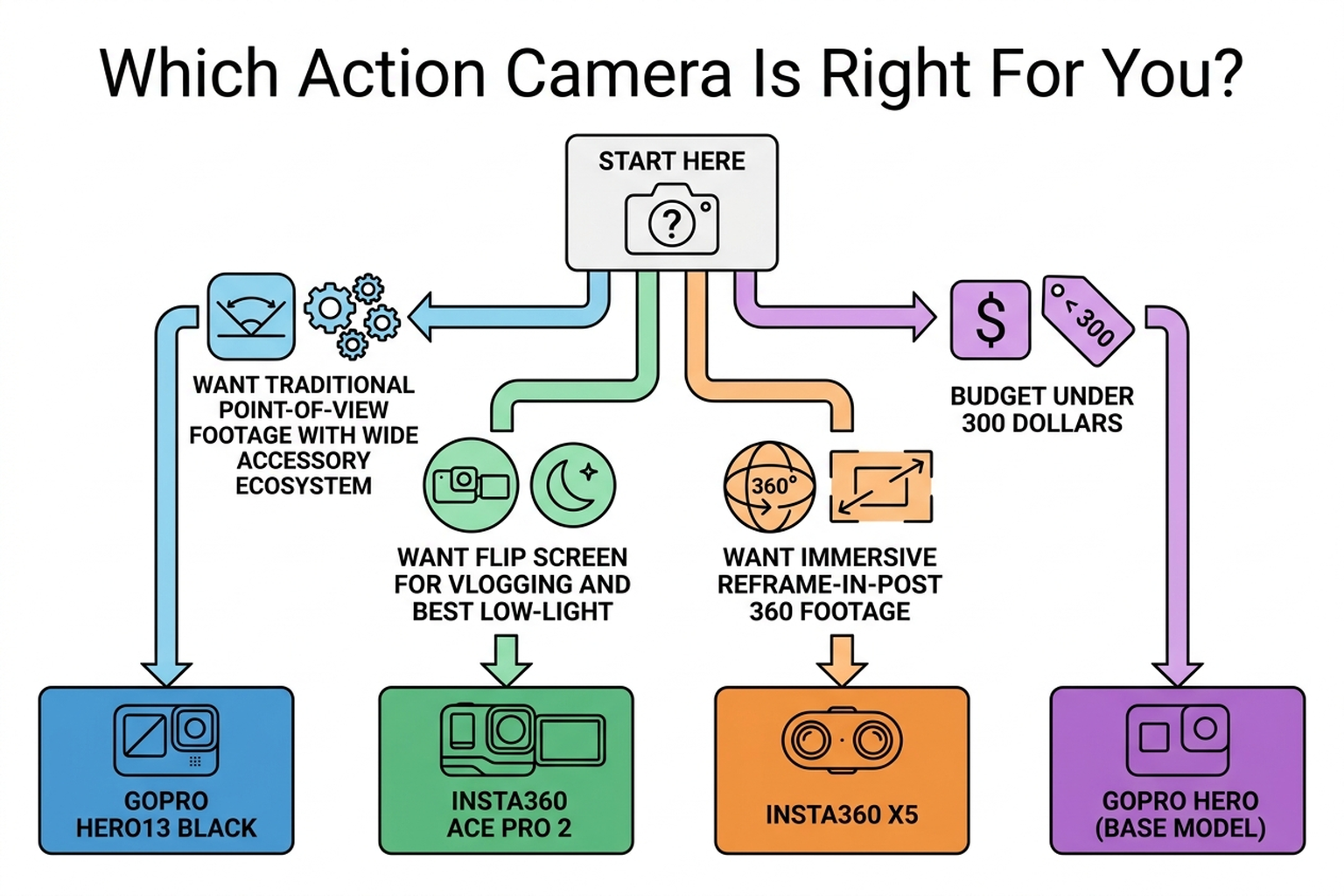
- Already own GoPro mounts and accessories, or want the widest third-party accessory ecosystem: GoPro HERO13 Black.
- Want the best low-light image quality and a flip screen for vlogging, starting from zero: Insta360 Ace Pro 2.
- Can’t predict your best camera angle in advance and want to reframe footage after the fact: Insta360 X5.
- Tightest budget: GoPro’s base HERO model (non-Black, $199.99 MSRP) offers simplified, lower-resolution capture at the lowest price of any current GoPro, though it’s a step down in specs from all three cameras compared in depth here.
- Want guaranteed camera replacement if you lose or damage the unit: GoPro’s Premium subscription is the only one of these ecosystems with that benefit built in.
Side-by-Side Comparison
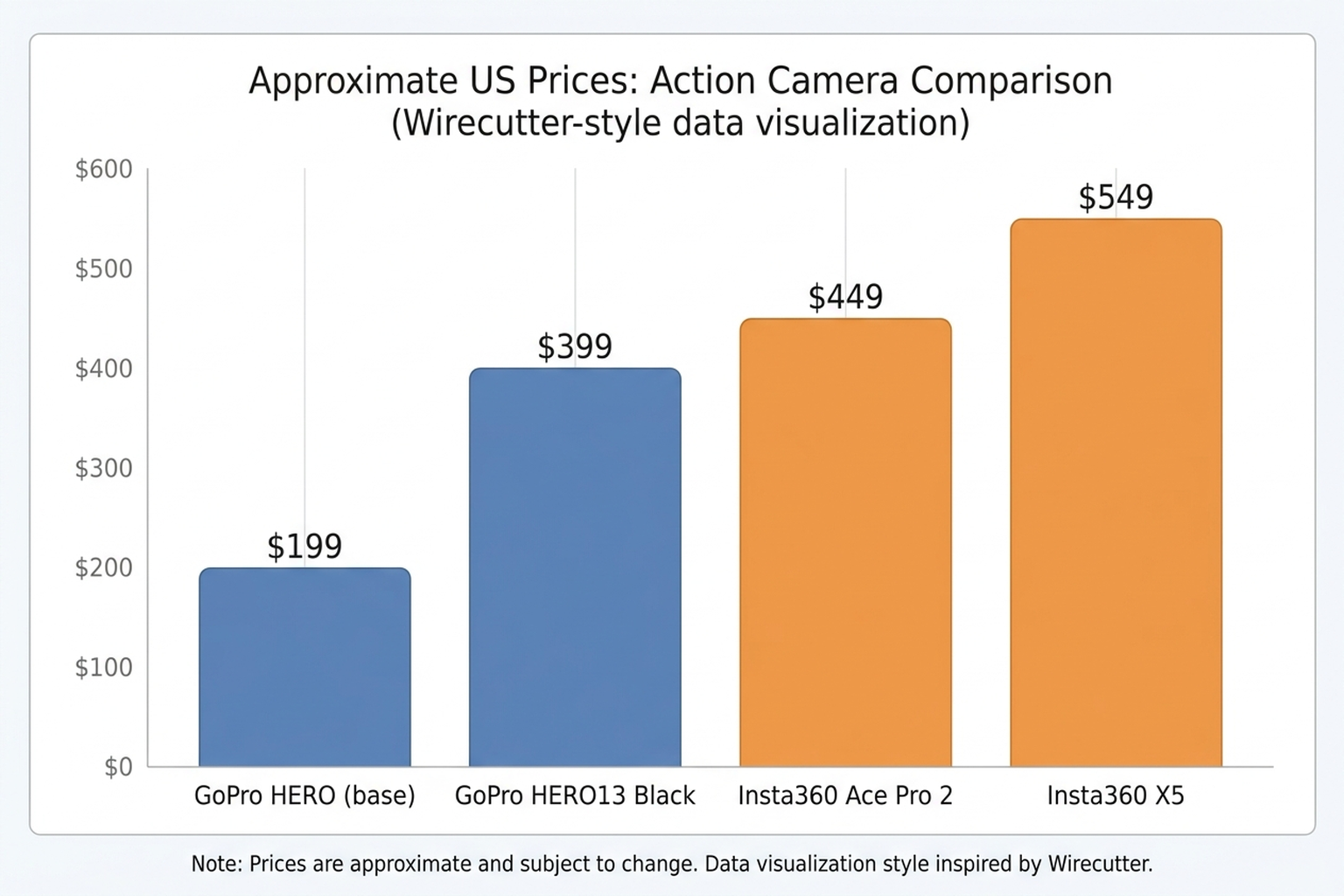
Prices as of 2026-10-05 — Amazon frequently runs short-term discounts on all three cameras; check the live listing before buying.
| Model | Sensor | Max Video | Waterproof (unhoused) | Battery Life (mfr. claim) | Warranty | Approx. price |
|---|---|---|---|---|---|---|
| GoPro HERO13 Black | 1/1.9” single lens | 5.3K60 | 10m / 33ft | ~150 min | 1 year (Premium adds replacement) | $399.99 |
| Insta360 Ace Pro 2 | 1/1.3” single lens (Leica) | 8K30 | 12m / 39ft | ~180 min | 1 year (2-year extension available) | $449.99 |
| Insta360 X5 | Dual 1/1.28” (360°) | 8K30 (360°) | 15m / 49ft | ~185 min at 5.7K24 | 1 year (2-year extension available) | $549.99 |
| GoPro HERO (base) | Smaller sensor, fixed lens | Lower resolution tier | 5m / 16ft (unhoused) | Shorter (mfr. claim) | 1 year | $199.99 |
Warranty and Support
GoPro’s standard warranty is 1 year from purchase, covering manufacturing defects; its Premium and Premium+ subscriptions add a separate camera-replacement benefit (not a traditional repair warranty) if the camera is lost, stolen, or damaged while actively backing up footage to GoPro’s cloud. Insta360 also offers a standard 1-year warranty on both the Ace Pro 2 and X5, with an optional extended-warranty purchase (Insta360 Care) that doubles coverage to 2 years and includes unlimited free returns or replacements for defects during that window. Neither company’s standard warranty covers accidental damage from drops or crashes outside of GoPro’s subscription-gated replacement benefit — a relevant distinction for action-sports buyers who are statistically more likely to crash a camera than to lose it.
Editorial Recommendation
- Best overall value if starting from zero, no existing GoPro gear: Insta360 Ace Pro 2 — independent reviewers consistently rate its image quality and low-light performance above the HERO13 Black’s, at a roughly $50 premium.
- Best if you already own GoPro mounts or want the broadest third-party accessory market: GoPro HERO13 Black — still the most widely supported mount standard, even as GoPro’s overall market share has fallen below 6%.
- Best for unpredictable action angles and post-production flexibility: Insta360 X5 — the only true 360-degree option here, at the highest price.
- Everyone: budget for a spare battery and, if choosing GoPro, factor in the real-world ~45-minute thermal-shutdown ceiling at the camera’s highest resolution settings before committing to all-day shoots without a backup plan.
Limitations
This analysis relies on aggregated Amazon customer reviews, independent test and comparison coverage from RTINGS, Tom’s Guide, TechRadar, Amateur Photographer, and Digital Camera World, manufacturer specifications and press materials, and third-party shipment/market-share reporting; we did not independently lab-test battery runtime, waterproof depth, or sensor performance. Battery-life and waterproof-depth figures are manufacturer claims unless otherwise attributed to an independent tester. Market-share figures for Q1 2026 come from third-party shipment-tracking reports we did not independently audit; shipment volume does not necessarily track one-to-one with active installed base, since cameras ship once but can remain in use for years. Complaint patterns drawn from owner reviews reflect a self-selected group of people motivated to post about problems or successes, not a statistically representative sample of all buyers. Prices are approximate figures as of 2026-10-05 and change frequently with promotions; confirm current pricing and availability on the live Amazon listing before buying.
Before you buy any action camera, it pays to check whether a listed “sale” price is an actual discount against its real price history. That is exactly what Arekore does: paste the Amazon URL and our AI analyzes review authenticity, surfaces the most useful critical feedback, and compares pricing in about five minutes — so you end up with the camera that fits how you actually shoot, not just the one with the flashiest spec sheet.