Generator vs. Power Station: Best Blackout Backup 2026
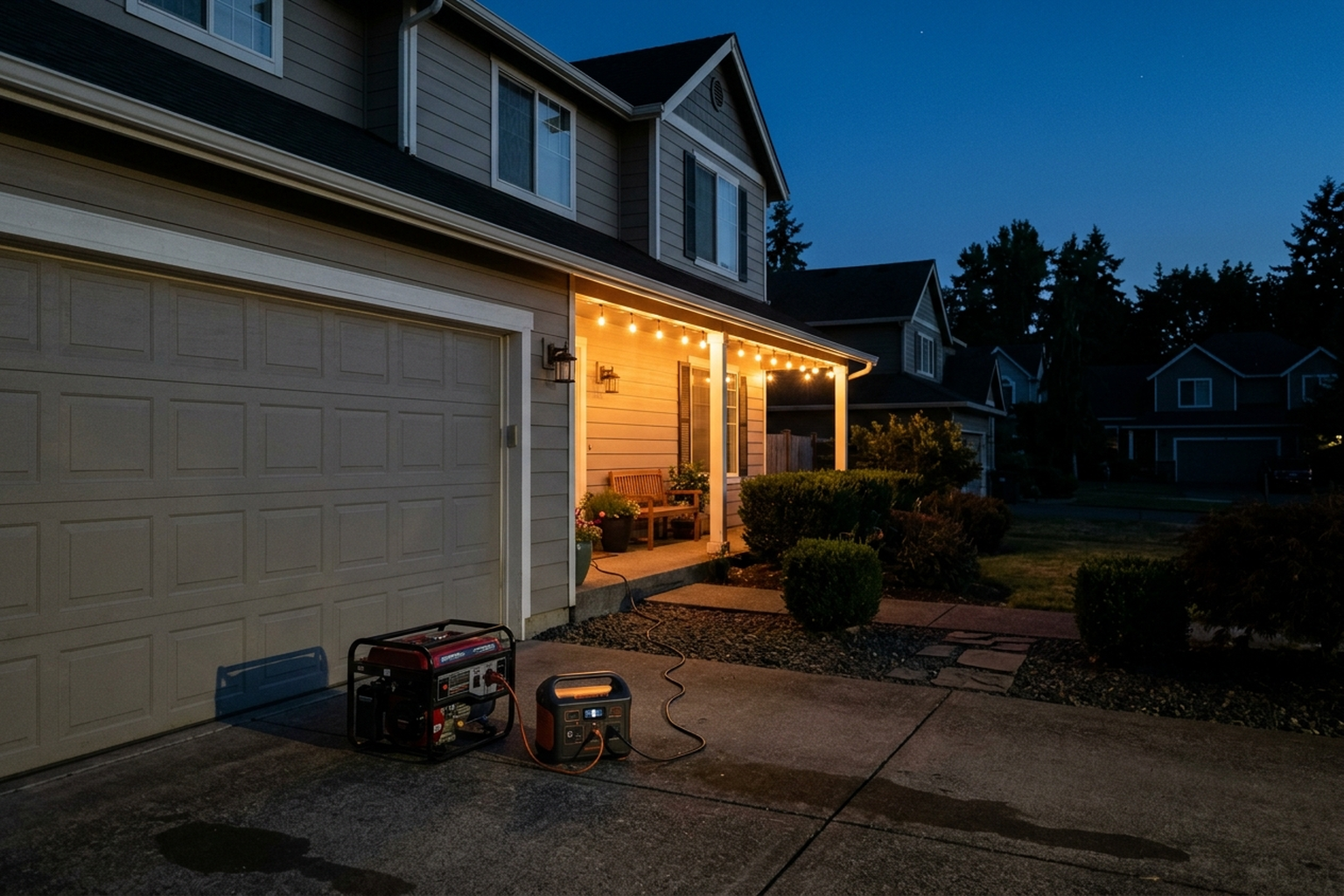
TL;DR. A gas-powered inverter generator (Generac, Champion) and a battery power station (Jackery, EcoFlow) both keep the lights on during an outage, but they solve the problem in opposite ways: a generator burns fuel to make power indefinitely but produces carbon monoxide and roughly 50-60 dBA of noise, while a power station stores a fixed amount of energy silently and safely but runs out and needs hours to recharge. For outages measured in days, a generator is cheaper per watt-hour and the only realistic choice; for outages measured in hours, or for running sensitive electronics indoors, a power station is safer and requires zero maintenance.
A note on links and methodology
As an Amazon Associate, Arekore earns from qualifying purchases. The Amazon product links in this article include our affiliate tracking ID and may earn us a commission if you buy through them, at no additional cost to you. See our Links Policy for details on how we select products and how commissions do not influence our recommendations.
We did not personally own or test the units named below. Every spec, runtime figure, and complaint pattern in this article is an editorial synthesis of manufacturer documentation, independent testing, and aggregated customer review sentiment, cited inline.
Methodology
This is an editorial analysis based on publicly available data collected in October 2026. We synthesized:
- Consumer Reports’ lab-tested generator and power station reviews, which evaluate portable generators and portable power stations separately and note that power stations “do not pose a CO safety risk” but a comparably sized generator “will power your essentials longer and also be less expensive” for sustained use.
- Manufacturer specifications for Generac’s GP3500iO and iQ3500 inverter generators, Champion’s 3400-Watt Dual Fuel inverter generator, Jackery’s Explorer 2000 v2 and 1000 v2 power stations, and EcoFlow’s DELTA Pro 3.
- CPSC (Consumer Product Safety Commission) carbon monoxide fatality data, which attributes close to 100 US deaths per year to portable generator CO poisoning.
- Aggregated amazon.com customer review sentiment for the specific models named below, read via each listing’s star rating and “Top reviews” in October 2026. We do not report a fabricated review-count N where a listing’s summary panel does not expose one.
- US and global portable power station market sizing from industry research trackers, cited for category-growth context only.
We do not simulate a specific personal ownership story or invent a reviewer persona. Treat this as a framework for choosing between the two backup-power categories, not a substitute for reading a specific model’s current reviews before buying.
1. Two technical approaches to the same problem
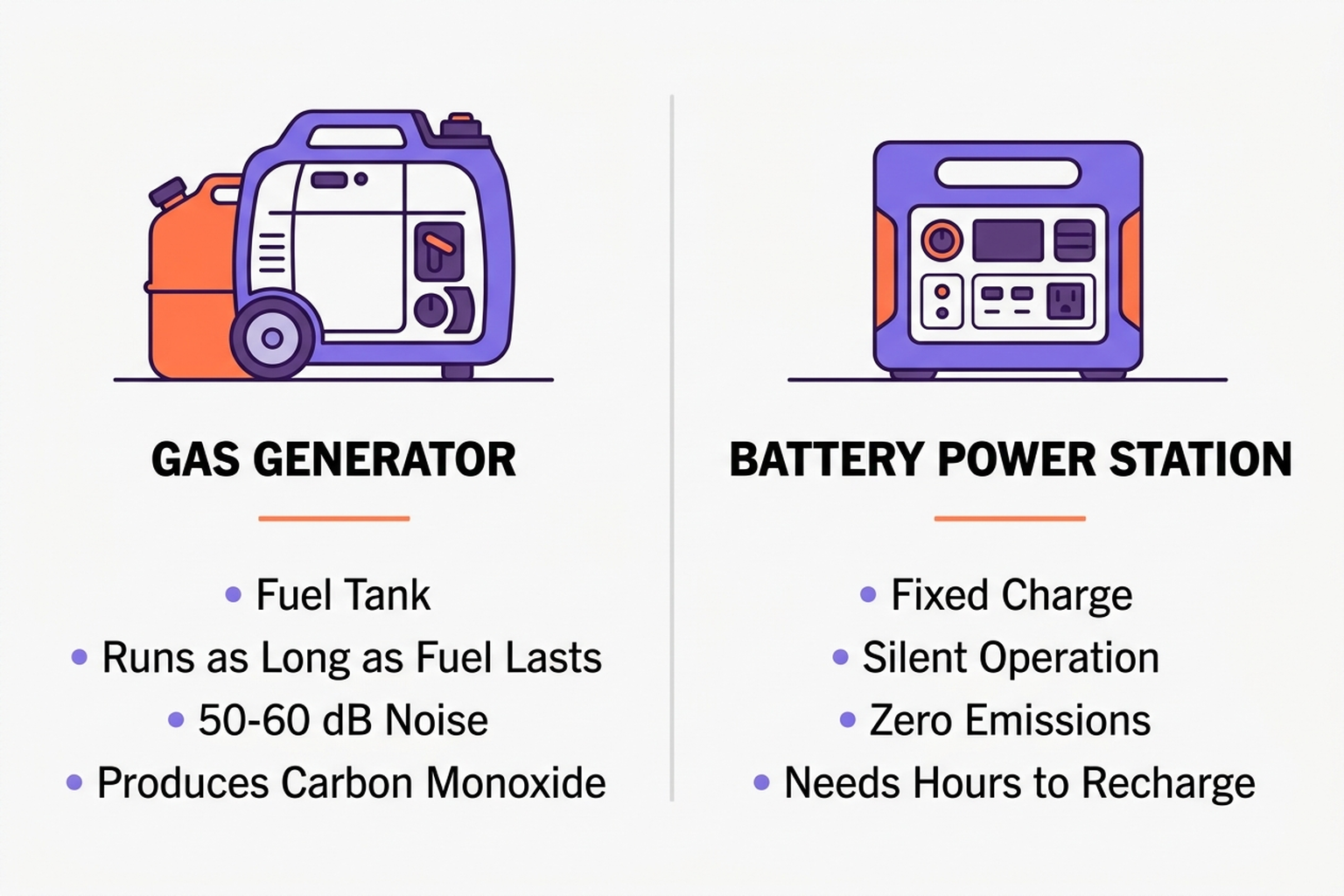
A gas inverter generator burns gasoline (or propane, on dual-fuel models) in a small engine to spin an alternator, then uses onboard electronics to “clean” the raw AC output into the stable sine wave sensitive electronics need. As long as fuel keeps going in, power keeps coming out — a 2.37-gallon tank on a mid-size unit like the Generac GP3500iO is good for roughly 8 hours at half load, and a 5-gallon jug on hand effectively doubles that without recharge downtime. The trade-off is mechanical: a running engine produces carbon monoxide, which is lethal in enclosed or semi-enclosed spaces, and it produces noise in the 47-64 dBA range depending on model and load, loud enough to need distance from windows and neighbors.
A battery power station stores a fixed amount of energy in a lithium iron phosphate (LFP) pack and releases it through an inverter with no combustion, no exhaust, and no moving parts beyond an internal cooling fan. That makes it silent and safe to run indoors, including next to a sleeping household or a CPAP machine, and most current models include a sub-20-millisecond switchover that functions as a true uninterruptible power supply (UPS) for routers and computers. The trade-off is capacity: a 2,042Wh unit like the Jackery Explorer 2000 v2 can run a mini-fridge-and-router load for roughly 12-29 hours depending on wattage, then needs 2.5+ hours plugged into wall power (longer from a solar panel) before it can do it again — there’s no equivalent of “pour in more gas” mid-outage unless you own a spare battery or a generator to recharge it.
Consumer Reports’ own framing of the trade-off is the simplest version: power stations don’t carry a CO risk and are handy for shorter outages, but “a comparably sized generator will power your essentials longer and also be less expensive” for sustained multi-day use.
2. Generators: Generac vs. Champion
Generac’s inverter lineup splits into two tiers that matter for a backup-power buyer. The GP3500iO is the budget-friendly open-frame option: a 212cc engine producing 3,500 peak watts, an 8-hour runtime at half load, and a lighter, quieter design than Generac’s older GP-series generators, at a street price generally under $900-1,250. The iQ3500 is the quieter, more refined tier aimed at RV and near-home use: 3,200 running watts, an 8.5-hour runtime at 25% load, and a noise rating Generac advertises as low as 47 dBA in Eco Mode (independent measurements put real-world noise closer to 50-64 dBA depending on distance and load), at a price generally in the $1,250-1,500 range. Owner reviews for Generac’s inverter line consistently praise the PowerRush surge-handling technology for starting motor-driven loads like a sump pump or window AC without stalling, which is the single feature most often cited as the reason to pick Generac over a cheaper conventional generator.
Champion’s 3400-Watt Dual Fuel inverter generator competes directly on price and adds a feature Generac’s comparable tier doesn’t: the ability to run on propane as well as gasoline from the same unit, trading roughly 10% peak output (3,060 propane-starting watts vs. 3,400 on gasoline) for a fuel that stores indefinitely without going stale — a meaningful advantage for a generator that might sit in a garage for a year between outages. Champion rates the unit at 59 dBA and roughly 7.5 hours of runtime at 25% load on gasoline, stretching to about 14.5 hours on propane at the same load. Amazon customer reviews for Champion’s inverter and dual-fuel generators run strongly positive (above 4.5 stars across thousands of ratings for comparable models in the line), with the most common praise citing quiet operation for the price tier and reliable RV air-conditioner startup; the most common complaint in the category overall (not specific to Champion) is cold-weather starting difficulty, which Champion addresses with a Cold Start Technology feature on its electric-start models.
3. Power stations: Jackery vs. EcoFlow
Jackery’s Explorer 2000 v2 is the mid-capacity unit most frequently recommended for whole-household blackout backup without whole-home ambitions: 2,042Wh of LFP storage, 2,200W continuous output with a 4,400W surge rating (enough to start a refrigerator’s compressor), a 2.5-hour full recharge from a wall outlet, and a sub-20ms UPS-grade switchover. At roughly 39.5 lbs, it’s light enough for one person to move between rooms, unlike most generators. For buyers on a tighter budget or with a smaller essential-device list, the Explorer 1000 v2 halves the capacity (1,070Wh) and the output ceiling (1,500W, 3,000W surge) at roughly half the price, and recharges from empty in about an hour on Jackery’s fast-charge spec.
EcoFlow’s DELTA Pro 3 sits a tier above both Jackery units in scale: 4,096Wh of capacity and 4,000W of continuous AC output out of the box, with the ability to chain additional battery packs to scale a single unit up toward 48kWh for closer-to-whole-home coverage — a capability Jackery’s consumer line doesn’t match without buying multiple separate units. EcoFlow markets the DELTA Pro 3 as the option for households that want a single power station to approximate what a small generator does, and the company states users can save “at least 5×” the lifetime cost of a gas generator — a manufacturer claim based on EcoFlow’s own fuel-cost modeling, not an independently audited figure, and one that assumes enough charge cycles to amortize the unit’s higher upfront price. Reviewers who have tested the DELTA Pro line describe it as the most complete home-backup power station currently sold, citing the expandability and 120/240V output as the differentiators over single-unit competitors like Jackery’s Explorer 2000 v2.
4. Sizing your backup power correctly
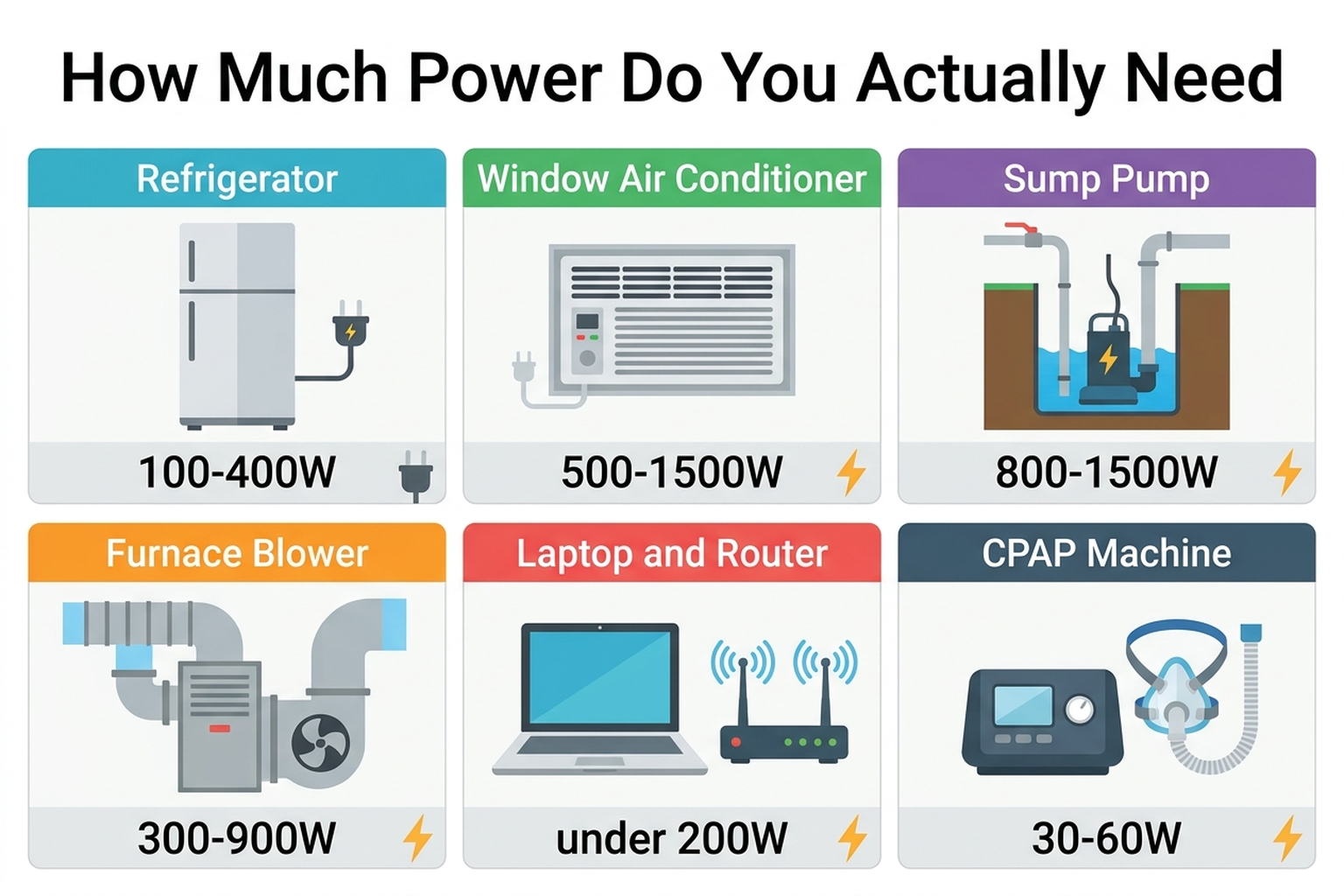
Both categories are sized the same way: add up the running watts of everything you want powered at once, then check that the unit’s surge watts cover the single largest motor-driven appliance starting up (a refrigerator compressor or sump pump can briefly draw 2-3x its running wattage on startup). A rough household starting-point list: a refrigerator runs 100-400W continuous with a 600-1,200W surge; a window air conditioner runs 500-1,500W depending on size; a sump pump runs 800-1,500W with a high surge; a furnace blower (gas furnace, not the burner) runs 300-900W; a laptop, router, and a few lamps together run under 200W; a CPAP machine runs 30-60W.
A generator in the 3,000-3,500W class (Generac GP3500iO, Champion 3400W) comfortably covers a fridge, a sump pump, and lighting simultaneously, with runway for hours as long as fuel is available. A 2,000Wh-class power station (Jackery Explorer 2000 v2) comfortably covers a fridge and electronics for a workday-length outage but will struggle to also run a window AC or sump pump for long without draining in a few hours; a 4,000Wh+-class unit (EcoFlow DELTA Pro 3) closes most of that gap at a significantly higher price.
5. Specs and price compared
Prices as of 2026-10-30; amazon.com listings fluctuate frequently and should be checked before buying.
| Product | Approx. price (USD) | Capacity / output | Runtime (typical load) | Noise |
|---|---|---|---|---|
| Champion 3400W Dual Fuel Inverter Generator | ~$600 | 3,400W starting / 3,100W running | ~7.5 hrs gas, ~14.5 hrs propane at 25% load | 59 dBA |
| Generac GP3500iO Open-Frame Inverter Generator | ~$870-$1,250 | 3,500W peak | ~8 hrs at 1/2 load | Not independently rated; Generac markets as quieter than prior GP-series |
| Jackery Explorer 1000 v2 Power Station | ~$600 | 1,070Wh / 1,500W (3,000W surge) | A few hours of mixed electronics load; ~1 hr full recharge | Silent (fan noise only) |
| Jackery Explorer 2000 v2 Power Station | ~$899-$999 | 2,042Wh / 2,200W (4,400W surge) | ~12 hrs at 150W, ~29 hrs at 60W; 2.5 hr full recharge | Silent (fan noise only) |
| EcoFlow DELTA Pro 3 Power Station | ~$2,799 (was $3,299) | 4,096Wh / 4,000W, expandable to 48kWh | Hours to a day-plus depending on load and added batteries | Silent (fan noise only) |
6. Carbon monoxide: the risk that doesn’t apply to power stations
The CPSC attributes close to 100 US deaths per year to carbon monoxide poisoning from portable generators, with 892 deaths tied to generators since 2012 in the agency’s tracking. CO from a running generator can build to lethal concentration quickly enough that a person can lose consciousness before noticing the classic symptoms of nausea, dizziness, or weakness — the agency’s primary safety guidance is to run a generator at least 20 feet from the home or any structure someone could enter, never in a garage even with the door open. Every generator in this article’s comparison table includes a CO shutoff sensor as a modern baseline safety feature, but the exhaust risk is inherent to the technology, not something any model fully eliminates. A battery power station has no combustion and no exhaust, which is the single clearest safety argument for choosing one over a generator for indoor or near-window use, independent of runtime or price.
7. Warranty and support context
Generac’s inverter generators (GP3500iO, iQ3500) carry a limited warranty generally covering parts and labor for residential use, with engine-specific wear items (spark plugs, oil, air filters) excluded as routine maintenance rather than defects — skipping scheduled oil changes is a common reason owners report warranty claims being denied. Champion’s dual-fuel inverter line carries a comparable limited warranty, with the dual-fuel carburetor system specifically requiring the recommended fuel-system maintenance to stay covered. Jackery’s power stations carry a multi-year limited warranty on the unit, with the LFP battery pack itself rated for a service life described by Jackery as up to 10 years or roughly 4,000 charge cycles before capacity noticeably degrades — degradation from normal use isn’t a defect under most lithium-battery warranty terms. EcoFlow’s DELTA Pro 3 carries a comparable multi-year warranty structure; because the unit is modular, replacement battery packs are sold and warrantied as separate line items from the base unit.
8. Editorial recommendation by use case
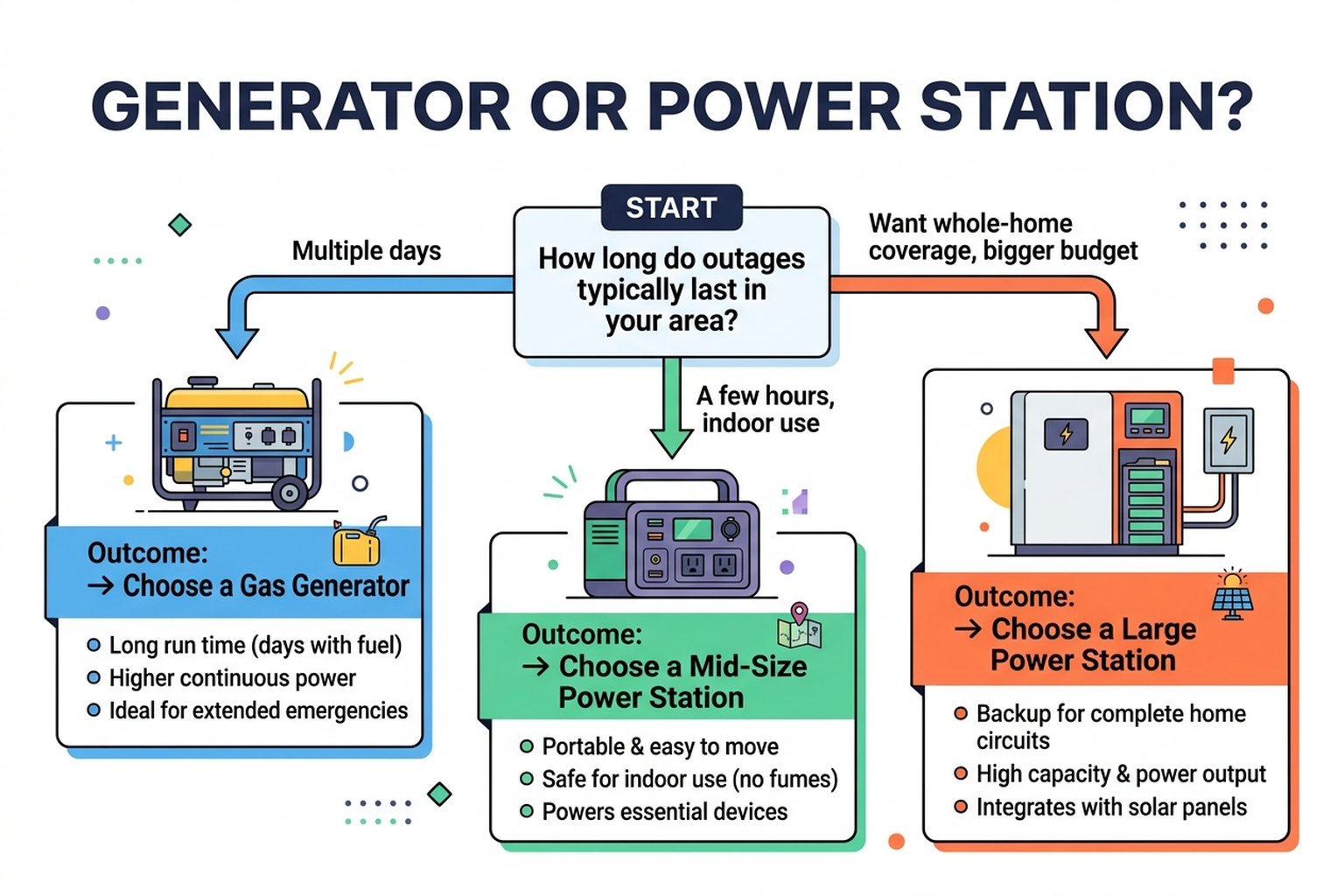
Outages that regularly run multiple days (rural areas, storm-prone regions): A generator (Champion 3400W Dual Fuel or Generac GP3500iO) is the more practical and far cheaper choice per hour of runtime, as long as it’s run outdoors at a safe distance from the home every time, with no exceptions.
Outages that are typically a few hours, in a denser neighborhood, or indoor/near-window use: A mid-size power station (Jackery Explorer 2000 v2) covers a fridge, Wi-Fi, and phone charging safely and silently, with the recharge-time limitation being a non-issue for short outages.
Tight budget, small device list (phones, a router, a CPAP machine): The Jackery Explorer 1000 v2 covers that load at roughly half the price of the 2000 v2, with the trade-off being a shorter runtime if the outage runs long.
Want one unit that approximates whole-home coverage, and have the budget: The EcoFlow DELTA Pro 3’s expandable capacity closes most of the gap with a generator for households unwilling to deal with fuel storage, carbon monoxide risk, or engine noise, at a price several times higher than either generator in this comparison.
Own a generator already and want a sensible add-on: A lower-cost power station (Explorer 1000 v2 tier) is a reasonable complement for silent overnight device charging, letting the generator stay off (and quiet) during sleeping hours.
Limitations
This analysis relies on manufacturer specifications, Consumer Reports’ published generator and power station testing, CPSC safety data, and aggregated amazon.com customer review sentiment; we did not personally test the units named here under outage conditions. Runtime figures are manufacturer-published and vary with ambient temperature, altitude, actual load mix, and unit-to-unit variance; EcoFlow’s “5x” lifetime savings claim is the company’s own modeling and has not been independently audited. Pricing reflects approximate amazon.com listings at time of writing and changes frequently, especially around seasonal storm events — verify current price and specific model number before buying.
Weighing a generator against a power station for your household? Visit Arekore to compare current options and verify pricing before you buy.