GE Profile vs Samsung: Best Air Fry Ovens in 2026
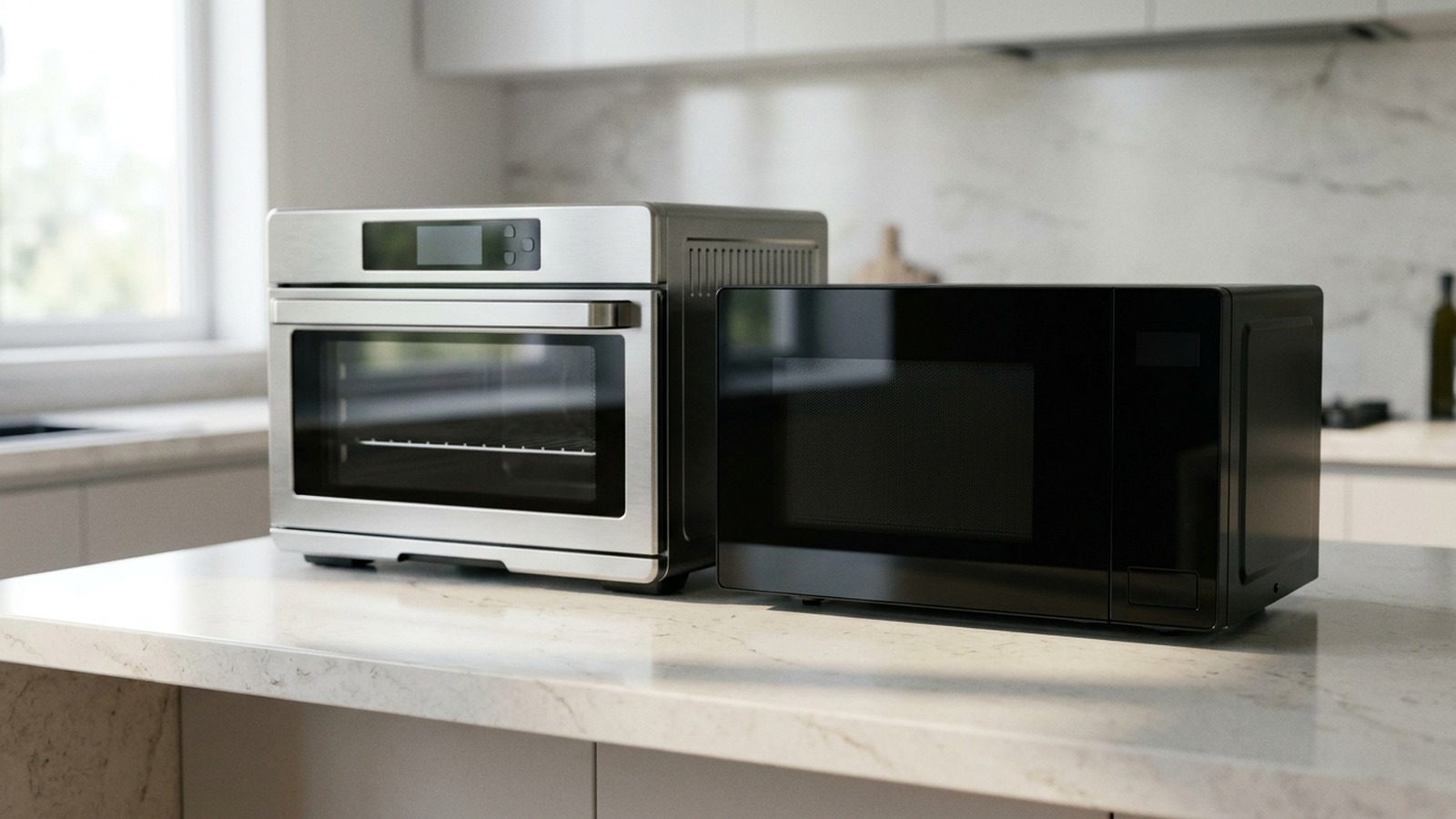
Ninja, Cosori, and Instant Brands dominate the basket-style air fryer shelf, and we have already covered that matchup. GE Profile and Samsung are playing a different game entirely: instead of a countertop basket, both companies build air-fry function into larger appliances — a dedicated no-preheat convection oven from GE Profile, and a microwave-plus-air-fry combo from Samsung. Neither brand cracks the top of most “best air fryer” market share lists, but both show up constantly in searches from shoppers who already own a kitchen full of counter clutter and want one fewer single-purpose gadget. This guide compares what each brand actually sells on amazon.com, at what price, and how their approaches differ.
As an Amazon Associate, Arekore earns from qualifying purchases. The Amazon product links in this article include our affiliate tracking ID and may earn us a commission if you buy through them, at no additional cost to you. See our Links Policy for details on how we select products and how commissions do not influence our recommendations.
TL;DR / Quick Verdict
- These are not basket air fryers. GE Profile sells dedicated countertop ovens with an air-fry mode; Samsung sells a countertop microwave with an air-fry mode. Compare them on that basis, not against a Ninja or Cosori basket.
- Best all-around pick: the GE Profile UltraFast Smart Oven — a dedicated 11-in-1 countertop oven that claims to skip preheat entirely, praised by HowToGeek for its Wi-Fi control and speed, though Reviewed’s own test found the no-preheat claim did not hold up consistently. Typically priced around $299–$449.
- Best budget GE pick: the GE Digital Air Fry 8-in-1 Toaster Oven — Consumer Reports has tested this exact model, and it typically runs $220–$260, less than half the UltraFast’s usual price.
- Best pick if you need a microwave anyway: the Samsung MC12DB8700CKAA countertop microwave with Power Convection and air fry — the only standalone Samsung option in this category, priced meaningfully higher at roughly $599–$649.
- The factor buyers underweight: these three appliances solve different problems. If you already own a microwave, a GE Profile oven adds a genuinely new function. If you need to replace an aging microwave anyway, the Samsung folds air fry into a purchase you were making regardless.
How We Reached These Conclusions (Methodology)
This is an editorial analysis, not a hands-on review; we did not personally test the products covered here. This guide synthesizes three kinds of public information: (a) aggregated amazon.com and retailer customer reviews sampled in September 2026; (b) independent third-party testing and reporting from Reviewed (USA Today Network), HowToGeek, Consumer Reports, and TopTenReviews; and (c) manufacturer specifications for capacity, wattage, and cook modes. Where we cite a manufacturer figure — wattage, capacity, cook-mode count — we label it as a manufacturer claim rather than an independently verified result. Prices are amazon.com figures at the time of writing and change frequently.
Technical Approach: Dedicated Oven vs. Microwave Combo
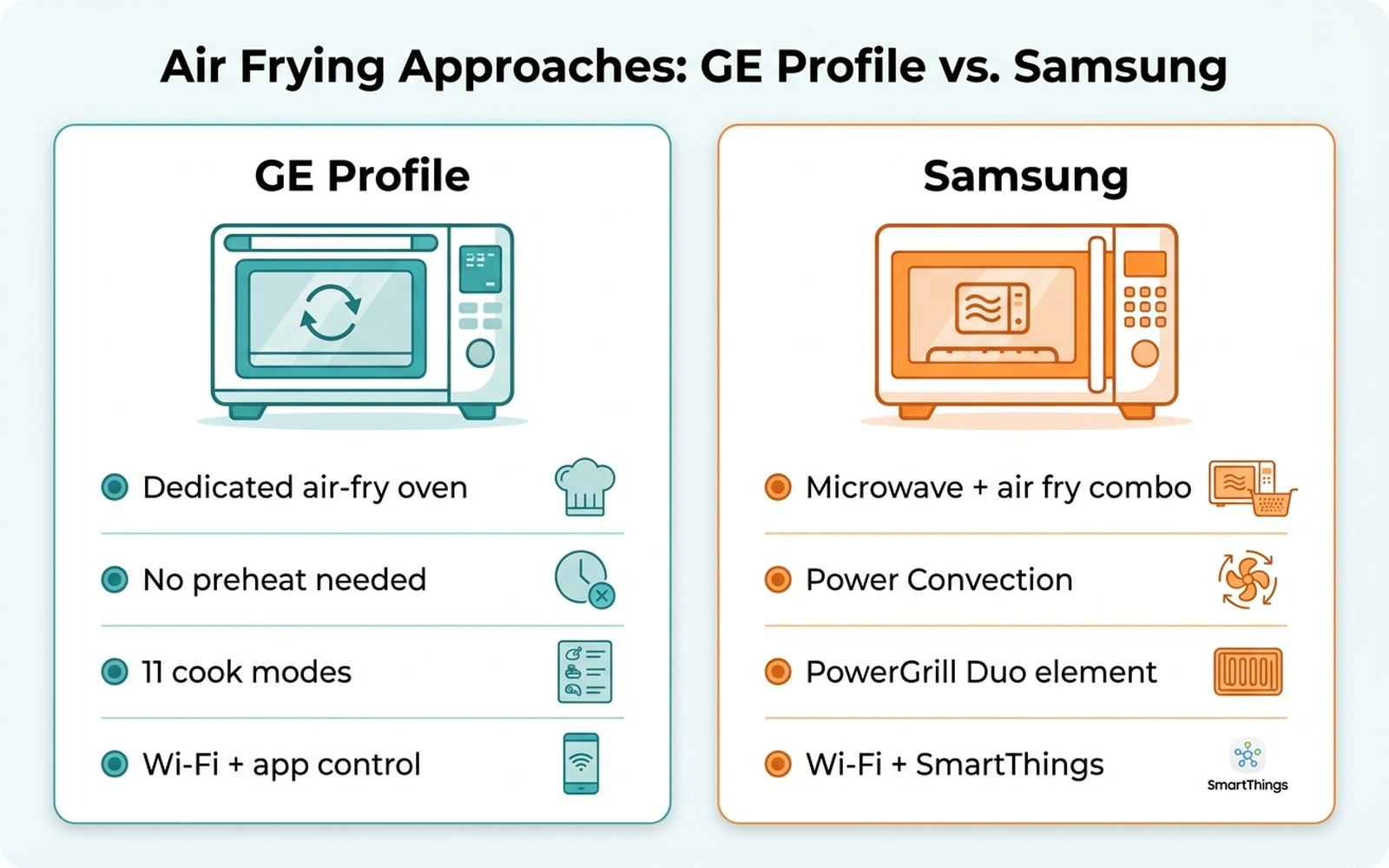
The two brands are not really competing for the same purchase decision, which is easy to miss if you only look at price.
- GE Profile’s approach is a dedicated countertop oven built around “no preheat” air frying: the UltraFast Smart Oven claims it can skip the preheat step entirely across all 11 cook modes (manufacturer claim), reaching up to 500°F for pizza and high-heat roasting. It does not replace a microwave — it replaces (or supplements) a toaster oven.
- GE’s budget tier, the Digital Air Fry 8-in-1 Toaster Oven, uses a more conventional preheat-required convection design with 8 cook modes and a temperature range of 180–450°F (manufacturer claim), without Wi-Fi or app connectivity.
- Samsung’s approach is a microwave-first design: the MC12DB8700CKAA is a 1.2-cubic-foot countertop microwave with “Power Convection” (claimed to cook up to 30% faster than a standard convection microwave — manufacturer claim) and a “PowerGrill Duo” heating element that browns and crisps food, layered on top of standard microwave functions. Air fry here is one mode among several, not the headline feature of a single-purpose appliance.
- Connectivity. All three connect to a companion app; the GE Profile and Samsung models add Wi-Fi and voice-assistant compatibility (SmartHQ for GE, SmartThings plus Alexa/Google Assistant for Samsung), while the budget GE Digital model uses simple digital controls with no app.
Head-to-Head: Budget Tier (~$220–$260)
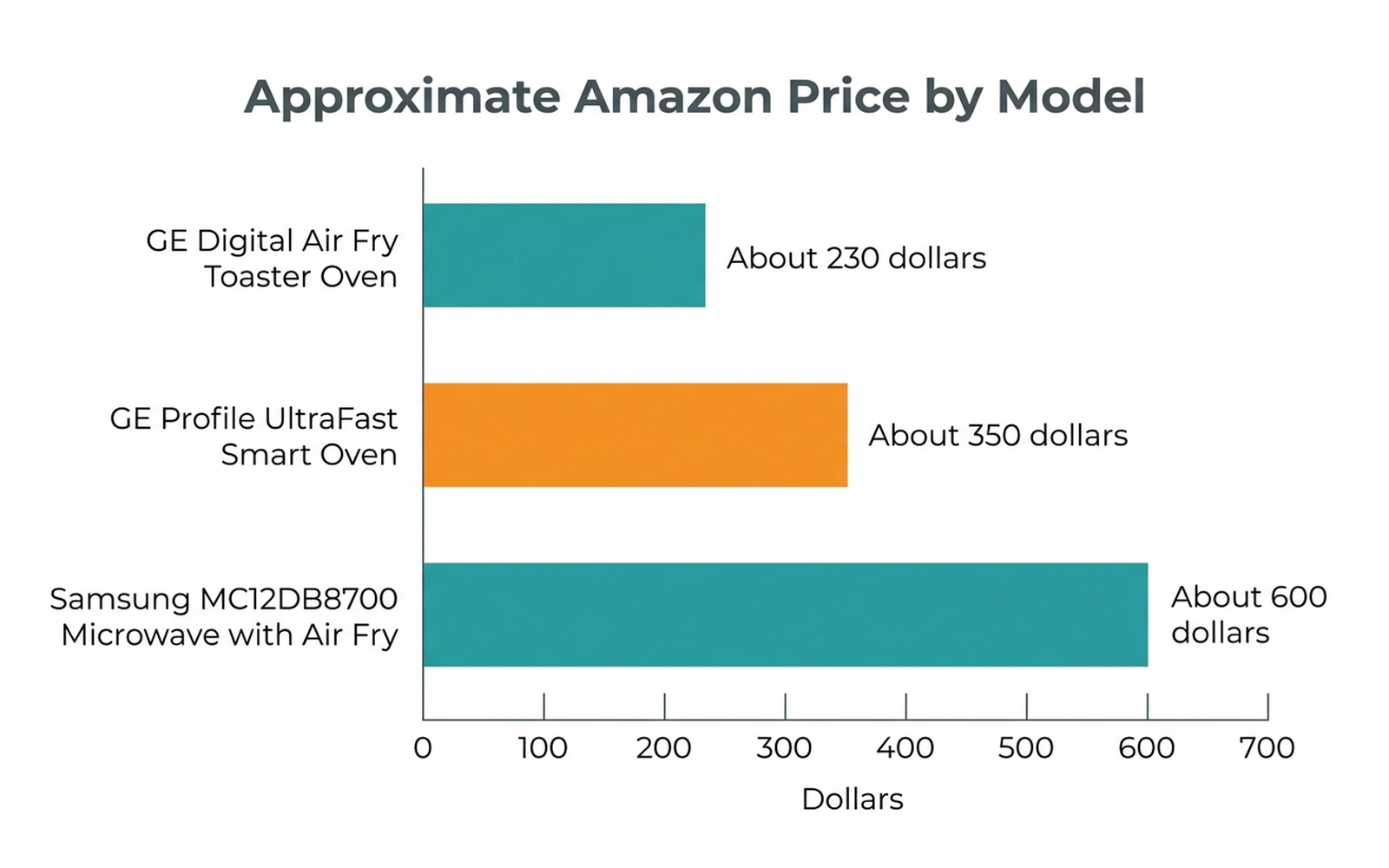
GE Digital Air Fry 8-in-1 Toaster Oven (G9OAAASSPSS) is GE’s entry point into countertop air frying: a stainless-steel convection toaster oven with 8 cook modes (air fry, bake, broil, toast, keep warm, roast, convection, and reheat), a 180–450°F range, and enough interior space to fit a 12-inch pizza. Consumer Reports has tested this exact model in its toaster-oven-with-air-fry category, giving reviewers a genuinely independent lab data point rather than only aggregated owner sentiment. Best Buy reviewers frequently praise it as one of the more capable combination units they have owned, while Reviewed’s independent hands-on test flagged the control dials as confusing at first and noted the unit has no interior light, making it harder to check food without opening the door. It typically runs $220–$260 on Amazon (as of 2026-09-28).
Check the GE Digital Air Fry Toaster Oven on Amazon
Samsung does not currently sell a comparable budget-tier standalone air-fry appliance — its only countertop air-fry option sits in the premium tier below. That gap is itself informative: Samsung’s air-fry strategy in the U.S. market runs almost entirely through mid-to-high-end microwaves, ranges, and wall ovens rather than an entry-level countertop unit.
Verdict at this tier: the GE Digital model is the only real budget option between these two brands, and Consumer Reports’ independent testing makes it a reasonably low-risk pick for buyers who mainly want the price, not the smart features.
Head-to-Head: Premium Tier (~$300–$650)
GE Profile UltraFast Smart Oven is GE’s flagship countertop air-fry appliance: 11 cook modes (air fry, bake, toast, broil, roast, pastry, reheat, pizza, cookies, bagel, and warm), a claimed no-preheat design across every mode, Wi-Fi with SmartHQ app control, and a 500°F max temperature. HowToGeek’s review calls it “a clever Wi-Fi-connected appliance” and credits the no-preheat design with meaningfully cutting total cook time versus a conventional toaster oven, while Reviewed’s independent test was considerably more critical: it found food frequently emerged undercooked when relying on the no-preheat claim, and noted the accessories are not dishwasher-safe and the interior heating elements are awkward to clean. Amazon listings for this model have ranged from roughly $249 during sales up to a $449 list price, with street pricing commonly landing around $299–$349 (as of 2026-09-28).
Check the GE Profile UltraFast Smart Oven on Amazon
Samsung 1.2 cu. ft. Countertop Convection Microwave with Air Fry (MC12DB8700CKAA) takes the opposite bet: instead of a dedicated air-fry oven, it is a full-featured microwave — Power Convection, a PowerGrill Duo heating element, sensor cooking, Wi-Fi with SmartThings, and voice control via Bixby, Alexa, or Google Assistant — with air fry as one of several modes. TopTenReviews’ hands-on test found it genuinely capable across microwave, convection-bake, grill, and air-fry functions, with the caveat that air frying and grilling in this unit take longer than a dedicated air fryer or basket model would. It lists around $599–$649 on Samsung’s own site, with some appliance retailers discounting it into the $540–$599 range (as of 2026-09-28); Amazon pricing has tracked close to Samsung’s own list price.
Check the Samsung MC12DB8700CKAA on Amazon
Verdict at this tier: the GE Profile UltraFast wins decisively on price-to-air-fry-performance if a microwave is not part of the decision. The Samsung only makes sense as “your next microwave that happens to air fry,” not as a standalone air-fryer purchase — its price only looks reasonable once you stop comparing it to a $300 oven and start comparing it to buying a separate premium microwave and a separate air fryer.
Customer Sentiment Synthesis
- GE Digital Air Fry Toaster Oven owners, per aggregated retailer reviews, most often cite strong everyday performance for the price and capacity to fit a full-size pizza. Reviewed’s independent test echoes a theme visible in owner reviews too: the dial-based controls take some getting used to, and the lack of an interior light makes it harder to check progress mid-cook.
- GE Profile UltraFast Smart Oven owners frequently highlight the Wi-Fi control and speed as standout features; Reviewed’s independent testing found the headline no-preheat claim did not hold up consistently, with food sometimes emerging undercooked — a more critical finding than aggregated owner-review sentiment alone would suggest, and worth weighing against HowToGeek’s more favorable take.
- Samsung MC12DB8700CKAA owners, per aggregated feedback and TopTenReviews’ hands-on test, describe it as a capable “does everything reasonably well” appliance, with the most common critique being that air fry and grill modes take noticeably longer than a purpose-built air fryer or grill.
- Net read: none of these three appliances draws the kind of one-star pile-on common to cheap basket air fryers with weak nonstick coatings; complaints skew toward “this specific mode is slower than a dedicated single-purpose appliance,” which is an honest tradeoff of multi-function design rather than a defect.
Side-by-Side Comparison
| Model | ASIN | Tier | Cook modes | Wi-Fi / app | Approx. price (as of 2026-09-28) |
|---|---|---|---|---|---|
| GE Digital Air Fry 8-in-1 Toaster Oven | B08SWMFSB6 | Budget | 8 | No | $220–$260 |
| GE Profile UltraFast Smart Oven | B0BWK75DC3 | Premium | 11 | Yes (SmartHQ) | $299–$449 |
| Samsung MC12DB8700CKAA Microwave with Air Fry | B0D9WS7LZ3 | Premium | Microwave + convection/grill/air fry | Yes (SmartThings) | $599–$649 |
Cook-mode counts and connectivity are manufacturer specifications; the Consumer Reports and TopTenReviews test findings cited above are independently sourced. Prices fluctuate — verify the current amazon.com price before buying.
Market Context: Why Neither Brand Leads the Basket Category
The global air fryer market was valued at roughly $9.4 billion in 2025 and is projected to reach about $10.5 billion in 2026, according to Fortune Business Insights and market.us market research, with the countertop segment alone forecast to grow at a compound annual rate of roughly 9.07%. Within that market, drawer/basket-style models still led with about 51.1% of category revenue in 2025, while oven-style multi-function units — the category GE Profile and Samsung’s countertop microwave both belong to — are the fastest-growing product type, forecast at roughly 6.92% CAGR. U.S. household air fryer penetration sits at an estimated 60–70% as of 2026, meaning much of the remaining growth comes from upgraders and multi-function converts rather than first-time buyers — exactly the audience GE Profile’s “replace your toaster oven” pitch and Samsung’s “replace your microwave” pitch are built for. Neither GE nor Samsung typically appears alongside Philips, Ninja, Cosori, Instant Brands, or Tefal on lists of the top air-fryer-by-volume brands, which reflects their different go-to-market: they are appliance generalists adding air fry to existing product lines, not air-fryer specialists.
How to Decide
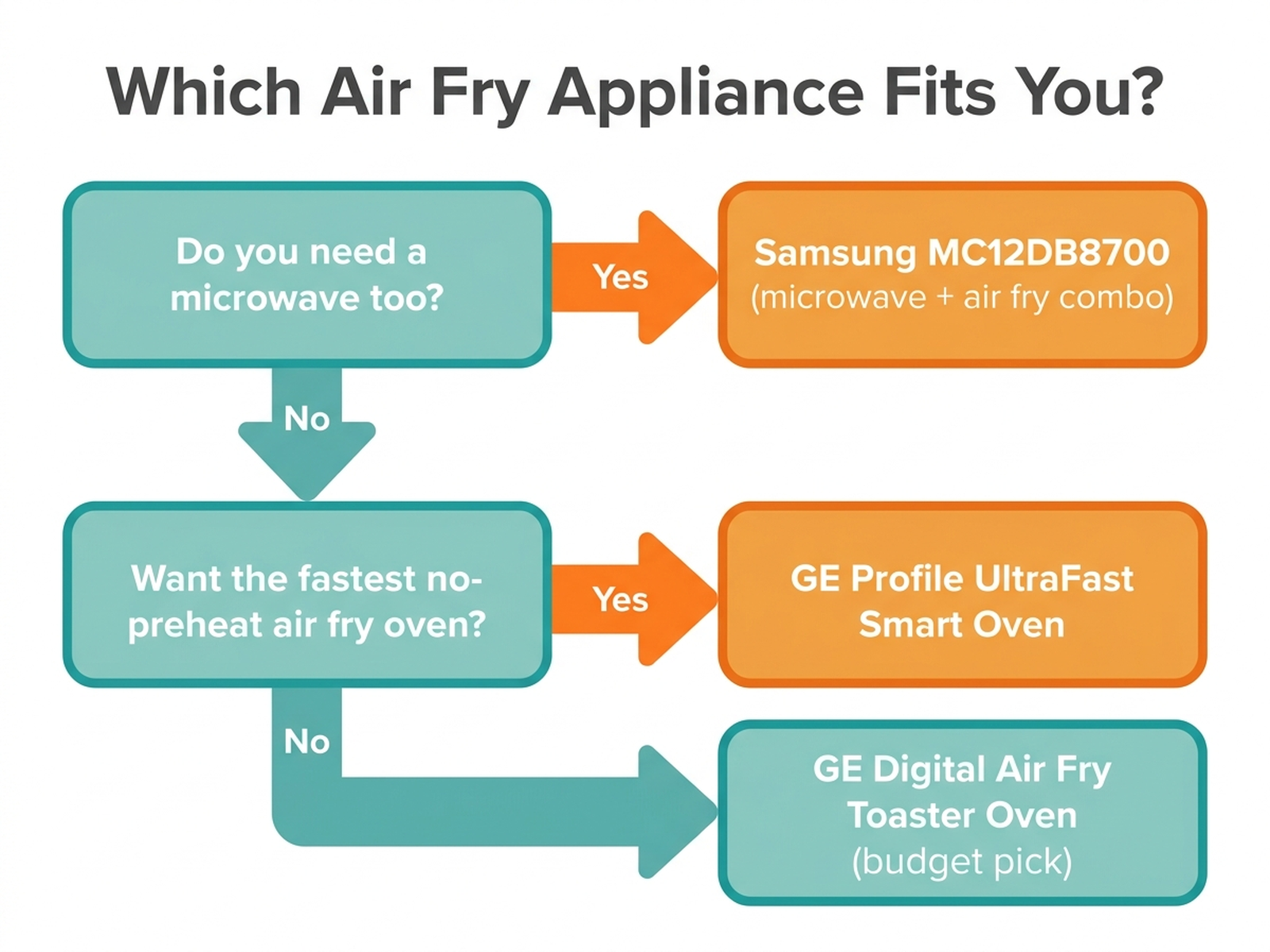
Start by asking whether you need a new microwave at all. If your current microwave is fine and you simply want a better toaster-oven-style air fryer, the GE Profile UltraFast Smart Oven or its cheaper GE Digital sibling are the more direct fit — you are adding one new appliance function, not replacing an unrelated one. If your microwave is actually due for replacement, the Samsung MC12DB8700CKAA lets that purchase double as an air fryer, which changes its price-to-value math considerably compared with buying a $300 oven and keeping an old microwave. Within the GE lineup, the deciding factor is usually speed and connectivity versus price: pay the premium for the UltraFast’s no-preheat design and app control, or save more than $100 with the Digital model’s more conventional preheat-required convection.
Editorial Recommendation by Use Case
- You want the best air-fry performance for the money and already have a microwave: the GE Profile UltraFast Smart Oven.
- You want GE’s air fry function on the tightest budget: the GE Digital Air Fry 8-in-1 Toaster Oven, the only model in this comparison independently tested by Consumer Reports.
- Your microwave needs replacing anyway and you want air fry bundled in: the Samsung MC12DB8700CKAA — expensive as a standalone air fryer, reasonable as a microwave-plus-air-fryer combo.
- You mainly want fast, high-volume basket-style air frying: neither of these appliances is the right fit — see our separate coverage of Ninja, Cosori, and Instant basket air fryers instead.
Limitations
This analysis relies on publicly available reviews, third-party test reporting, and manufacturer specifications; we did not independently lab-test these units. Wattage, cook-mode counts, and the “no preheat” claim are manufacturer specifications and are not directly comparable to independent lab measurements of real-world cook time and crispness. Amazon and retailer review sentiment reflects aggregated public feedback at the time of writing and can shift as new reviews accumulate. Prices and availability were accurate to our research at the time of writing and change frequently — verify current specs and pricing on the product page before buying.
Before you buy either brand’s appliance, it pays to check that a listing’s reviews are genuine and that a sale price is an actual discount rather than an inflated “was” price. That is exactly what Arekore does: paste the Amazon URL and our AI analyzes review authenticity, surfaces the most useful low-star feedback, and compares pricing in about five minutes — so you end up with the appliance that actually fits your kitchen, not just the one with the most cook-mode buttons on the panel.