Gas Grill Won't Light? 5 Real Causes (2026)
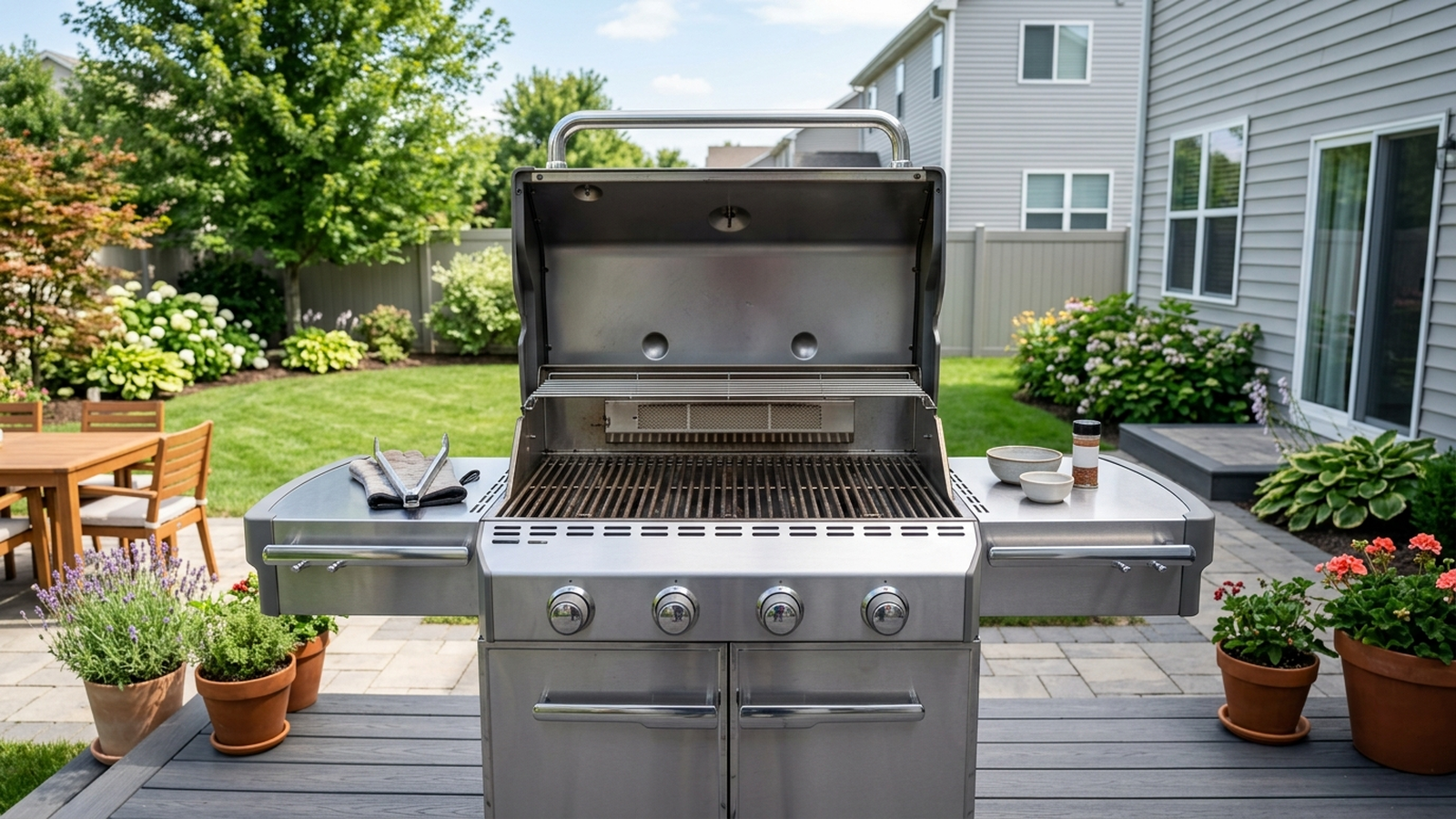
TL;DR. A gas grill that won’t light is almost never a dead grill. The five most documented causes are a propane regulator stuck in “bypass mode” after a fast tank-valve turn, burner ports clogged by spider webs or grease, a dead igniter battery, a loose or corroded igniter wire connection, and — least common — a closed or empty tank valve. Resetting the regulator, clearing the burner tubes, and swapping the igniter battery resolves the large majority of documented cases without replacing any part.
A note on links and methodology
As an Amazon Associate, Arekore earns from qualifying purchases. The Amazon product links in this article include our affiliate tracking ID and may earn us a commission if you buy through them, at no additional cost to you. See our Links Policy for details on how we select products and how commissions do not influence our recommendations.
We also did not personally test the specific grills named below. Every cause and fix in this article is an editorial synthesis of manufacturer support documentation, independent safety-agency guidance, and aggregated public troubleshooting reports, cited inline.
Methodology
This is an editorial analysis based on publicly available data collected in October 2026. We did not run a controlled test ourselves; instead we synthesized:
- Manufacturer support documentation — Weber’s own “Why Is My Igniter Not Working?” and “Why Won’t Your Gas Grill Get Hot? It’s Probably in Bypass Mode” support articles, and Char-Broil’s official FAQ on why a gas grill won’t light.
- Consumer product safety guidance — the U.S. Consumer Product Safety Commission’s advisories on gas grill fire risk, which specifically warn that spiders and insects nesting in burner tubes is a documented cause of blocked gas flow and flashback fires, and recommend checking burner tubes for blockage at least once a season.
- Owner troubleshooting Q&A archives — JustAnswer threads specific to Char-Broil units with no gas flow or no spark, and repair-parts guidance from SearsPartsDirect on burners that won’t light.
- Aggregated Amazon customer review sentiment for the accessories referenced below, read via each product’s public “Customers say” panel on amazon.com in October 2026. We do not report a precise review-count N because Amazon’s review panels do not expose a stable, verifiable count; a fabricated number would be misleading.
- Market and category data — per industry market research on the US barbecue grill category, roughly 70% of US households now own at least one grill or smoker, up from 64% in 2019, with gas grills accounting for the majority of that ownership, underscoring how common this troubleshooting question is likely to be in US households.
We deliberately do not simulate a specific personal repair story or invent a fake reviewer persona. The advice below is a synthesis of manufacturer documentation, CPSC safety guidance, and aggregated troubleshooting patterns — treat it as a starting framework, not a substitute for your specific model’s manual.
1. Five reasons a gas grill won’t light
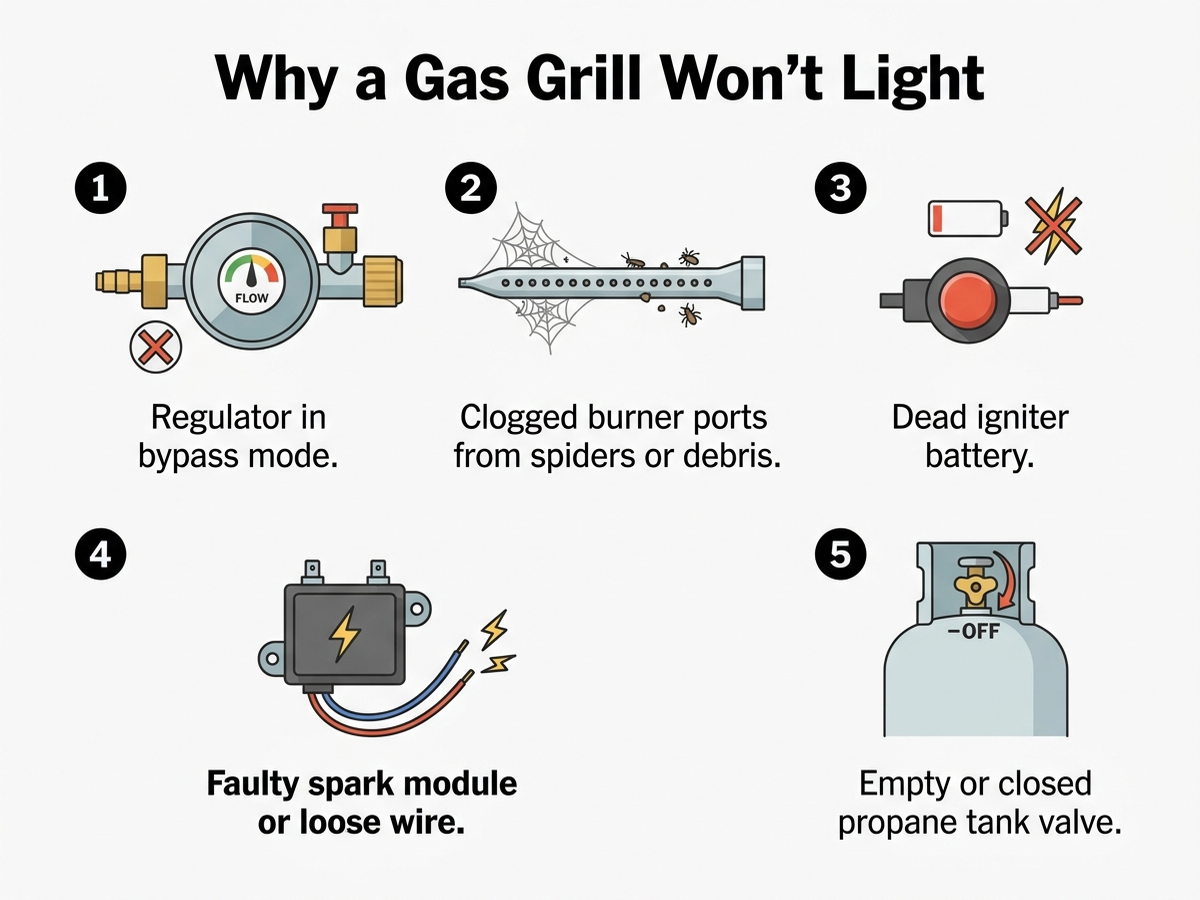
Before assuming the grill itself is broken, it helps to know that most “won’t light” reports trace back to one of five causes, and none of them require replacing the grill:
| Cause | What it looks like | Fixable at home? |
|---|---|---|
| Regulator in bypass mode | Burners light but flame stays weak and low, or won’t light at all; hissing at low volume | Yes — reset the regulator |
| Clogged burner ports (spiders/debris) | Weak, uneven flame, or popping/hissing sound at the control panel instead of the burner | Yes — clean with a pipe cleaner |
| Dead igniter battery | A clicking sound is heard, but no visible spark | Yes — replace the AA battery |
| Loose or corroded igniter wire | No clicking sound at all, or spark works on some burners but not others | Yes — reseat or replace the wire |
| Closed or empty tank valve | No gas smell, no hissing, nothing happens at all | Yes — open the valve or swap tanks |
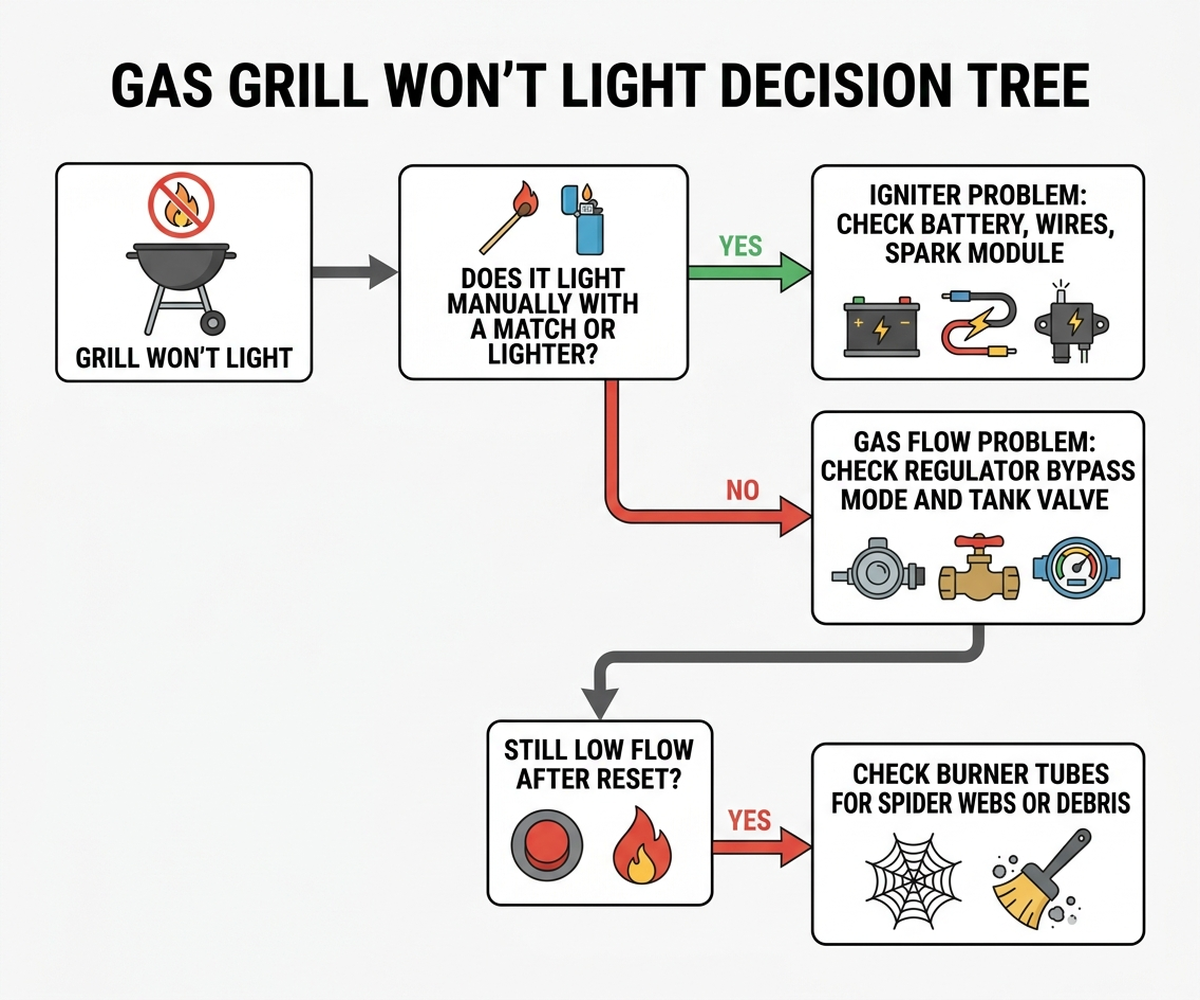
According to Weber’s own troubleshooting guidance, the first diagnostic step is to try lighting the grill manually with a long-handled lighter or match while the gas is on: if it lights manually but not with the igniter, the problem is the ignition system, not gas flow. If it won’t light manually either, the problem is upstream — the regulator or the tank.
2. Why the regulator “bypass mode” trips so easily
Every propane grill regulator sold in the US includes a built-in “excess flow” or “Overfill Protection Device” (OPD) safety valve. If it senses what it interprets as a sudden gas leak — which can be triggered by something as simple as turning the burner control knobs on before opening the tank valve — it throttles gas flow down to roughly 10% of normal volume or less as a safety measure. Weber’s support content confirms this directly: bypass mode is a safety feature tripping, not a hardware failure, and it’s one of the most frequently cited reasons a grill “won’t get hot” even when the igniter is clicking normally.
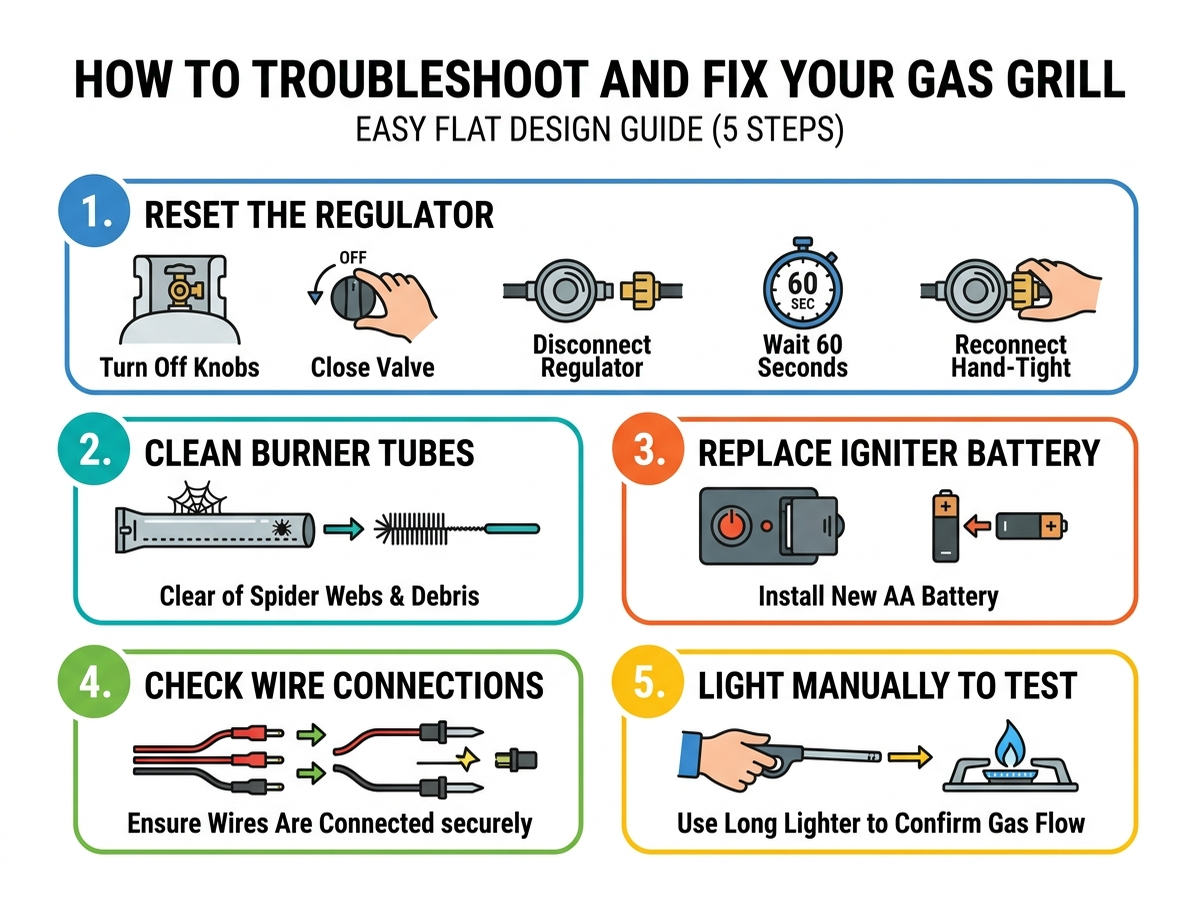
The fix doesn’t require tools. The regulator reset sequence documented across manufacturer and repair-parts guidance is consistent: turn all burner knobs off, close the propane tank valve completely, disconnect the regulator from the tank, wait roughly 30–60 seconds for the internal valve to release, reconnect the regulator hand-tight, then open the tank valve slowly — a quarter turn, pause, then the rest of the way. Opening the valve quickly is one of the most commonly cited ways bypass mode gets triggered in the first place, so the slow re-open step matters as much as the reset itself.
3. The cause most owners don’t expect: insects in the burner tubes
The CPSC has issued specific consumer guidance on this exact failure mode: spiders and small insects build nests inside the venturi tubes that carry gas from the control valve to the burner, and the webbing — even when very small — is strong enough to restrict or fully block gas flow. When that happens, gas that should reach the burner instead builds up behind the control panel, which the CPSC identifies as a “flashback” fire risk, not just an inconvenience.
This is why manufacturer manuals, including Char-Broil’s, specifically call out spider and insect nesting as a natural hazard to check for, particularly in late summer and early fall when spider activity peaks. The CPSC’s own guidance recommends checking burner tubes for blockage from insects, spiders, or food grease before each grilling season and clearing any blockage with a pipe cleaner or thin wire brush rather than disassembling the burner.
4. What to actually do, in order
- Try lighting manually first. With the burner knob on, hold a long-handled lighter or match near the burner (not the control knob). If it lights, the problem is in the ignition system (steps 3–4 below), not gas flow.
- Reset the regulator. Turn off all burner knobs, close the tank valve, disconnect the regulator, wait about a minute, reconnect hand-tight, then reopen the tank valve slowly in stages rather than all at once.
- Check the igniter battery. Most push-button igniters use a single AA battery; a weak or dead battery is one of the most commonly cited causes of a clicking-but-not-sparking igniter, and Weber’s own guidance recommends trying the battery both ways in case polarity is unclear.
- Inspect and reseat the igniter wires. Disconnect and reconnect each wire at both the module and electrode ends — corrosion or a loose connection can stop the spark on one or more burners while others still work.
- Clear the burner tubes. Remove the burners per the manual and run a pipe cleaner or thin wire brush through each venturi tube to clear spider webs, nests, or grease buildup, following CPSC and manufacturer guidance on seasonal maintenance.
- Confirm the tank. Check that the tank valve is fully open and the tank isn’t empty — an easy thing to overlook when troubleshooting focuses on the grill itself.
5. If it’s a worn part: current options
Editorial recommendation, not personal testing. Several of the causes above are quick, inexpensive parts swaps rather than a reason to replace the whole grill.
- SHINESTAR 2 FT Propane Regulator and Hose, Universal Replacement — a direct regulator-and-hose replacement for Weber, Char-Broil, and most QCC1-fitting propane grills, for cases where the regulator itself has failed rather than just tripped into bypass mode.
- Grimate Universal 2-Outlet Grill Igniter Kit — a replacement push-button igniter and wire set for Char-Broil, Expert Grill, Dyna-Glo, Kenmore, and other common 2-burner grills, for cases where the battery and wire checks above don’t restore a spark.
- FryOilSaver Gas Grill Venturi Tube Cleaner Brush — a bendable spring-stem brush designed specifically for clearing venturi tubes, the maintenance task the CPSC recommends ahead of each grilling season.
6. The decision flowchart
7. The bottom line
A gas grill that won’t light is, in the large majority of documented cases, responding correctly to a tripped regulator safety valve, a blocked burner tube, or a dead battery — not a failed grill. Working through the manual-light test, regulator reset, and igniter checks in order resolves most reported cases with no parts purchase at all, and the parts that do fail most often (regulator, igniter kit) are inexpensive, widely available replacements rather than a reason to buy a new grill. If the grill still won’t light after clearing the burner tubes and confirming the tank is open and full, a failed gas valve or a cracked manifold is a realistic possibility, and that’s the point where contacting manufacturer support or a qualified repair technician makes more sense than continuing to troubleshoot.
Limitations of this analysis
To be explicit about what this article does not establish:
- We did not personally reproduce this issue on the specific grills named here. The causes and fixes described are drawn from manufacturer support documentation, CPSC safety guidance, and aggregated troubleshooting-thread patterns, not from a controlled test we ran ourselves.
- Regulator bypass behavior varies slightly by manufacturer and regulator design. The roughly 10%-of-normal-flow figure cited above is a commonly cited general description in manufacturer and repair-parts guidance, not a universal spec for every regulator model.
- Spider and insect nesting risk is seasonal and regional and may be more or less relevant depending on where the grill is stored and used.
- Amazon review sentiment was read from each ASIN’s public review panels in October 2026 and reflects aggregated impressions, not a scientific sample.
- Market and ownership figures are current industry estimates that vary somewhat across research firms; we cite them as directional context, not a precise figure.