Fall Semester Reset 2026: What to Restock in Your Dorm
Move-in checklists get all the attention, but the National Retail Federation projects college students and their families will spend a record $103.5 billion on back-to-school shopping in 2026 — the first time that figure has topped $100 billion — and a meaningful share of it happens after move-in, not during it. The items that fail first aren’t the big furniture purchases; they’re the small, high-use consumables and adhesives that quietly wear out around week 4 to week 6 of the semester, right as midterms hit. This is an editorial analysis of what aggregated customer reviews and manufacturer specifications say actually needs restocking first, and what to buy instead of just re-buying the same thing.
As an Amazon Associate, Arekore earns from qualifying purchases. The Amazon product links in this article may include our affiliate tracking ID and may earn us a commission if you buy through them, at no additional cost to you. See our Links Policy for details on how we select products and how commissions do not influence our recommendations.
TL;DR / Quick Verdict
- Adhesive wall strips fail first, not last. Aggregated reviews for Command-brand strips consistently describe a working life of roughly one semester before heavier items start sagging, especially in un-air-conditioned dorms where summer humidity carries into September.
- Cheap portable chargers degrade faster than students expect. A 10,000mAh power bank charged daily loses meaningful capacity after a few hundred cycles — for a semester of nightly charging, that decline shows up by October, not senior year.
- Crumbs and snack mess accumulate faster than a shared vacuum schedule can keep up with. A small handheld vacuum, not a full-size one, is the aggregated-review consensus fix for dorm-specific mess.
- First aid kits get raided piece by piece, not used up as a kit. The bandages and pain relievers disappear first while the kit itself looks untouched — restocking supplies, not just keeping the box, is the actual fix.
- Laundry pods run out faster than a syllabus predicts once a student is doing their own laundry for the first time; a smaller tub that fits a shared closet shelf outperforms a bulk box that doesn’t fit dorm storage.
How We Reached These Conclusions (Methodology)
This is an editorial analysis, not a hands-on review. We did not personally test the products covered here. This guide synthesizes (a) aggregated amazon.com customer ratings and the substance of both positive and low-star reviews for adhesive wall hooks, portable chargers, handheld vacuums, first aid kits, and laundry pods, sampled in August 2026; (b) manufacturer specifications for capacity, charge-cycle counts, and adhesive weight limits; and (c) the National Retail Federation’s 2026 back-to-school spending survey for market-level spending context. Where we cite a manufacturer figure — a charge-cycle count or an adhesive weight rating — we label it as a manufacturer claim rather than an independently verified result. Prices are amazon.com figures at the time of writing and fluctuate.
Why the Failure Point Lands at Week 4-6, Not Move-In Day
Move-in day gets the checklist treatment because it’s a single, predictable event: everyone buys bedding, storage bins, and a mini fridge in the same two-week window. What doesn’t get a checklist is the slower failure curve that starts once daily use actually begins — an adhesive strip holding weight it wasn’t rated for, a power bank cycling through its first few hundred charges, a first aid kit getting opened one bandage at a time until it’s quietly empty. None of those show up as a single dramatic failure; they show up as a string of small annoyances spread across the first six to eight weeks of class, right when midterms make a trip to buy a replacement least convenient.
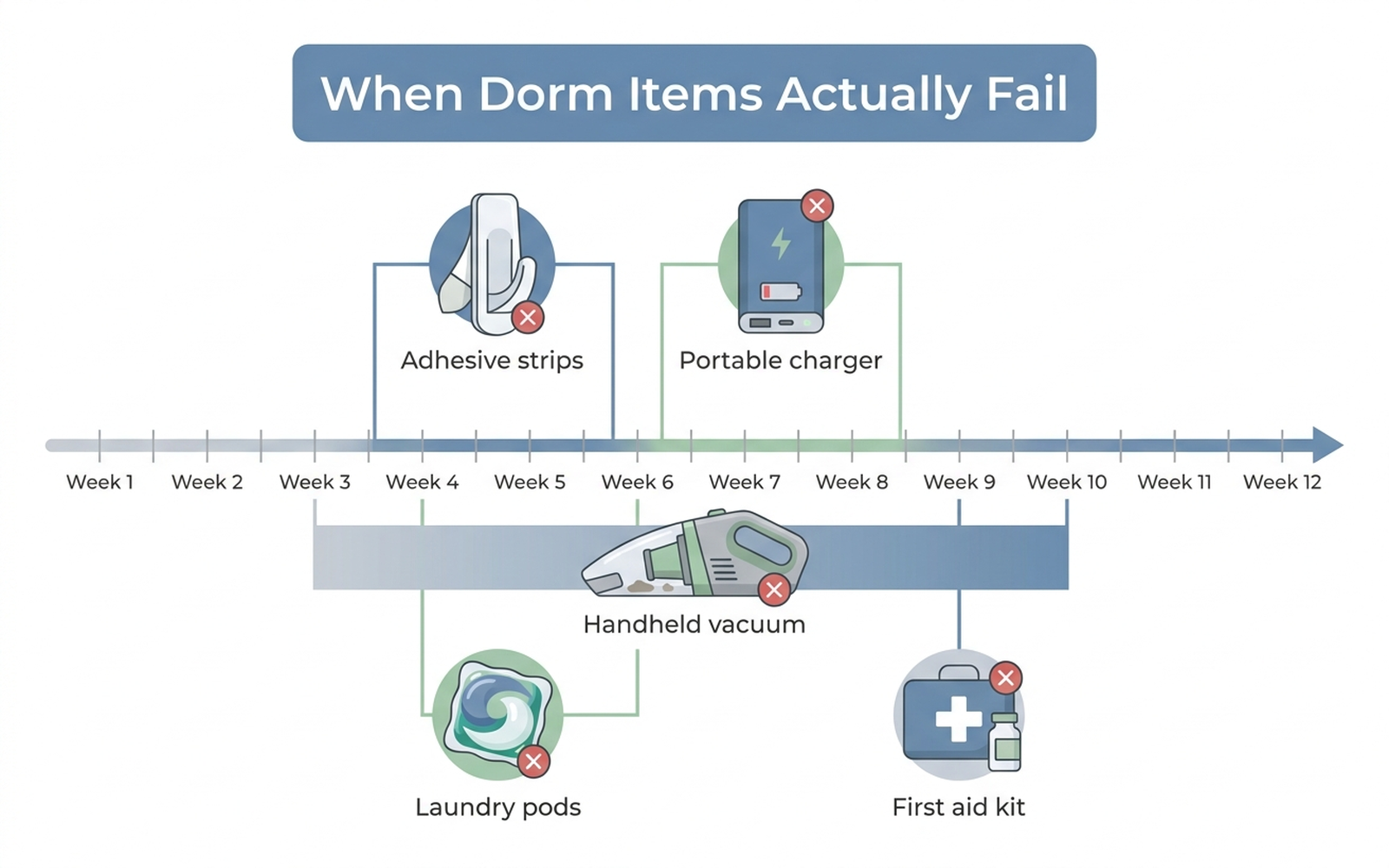
Aggregated review timestamps for each category line up with that pattern more than with a single seasonal spike. Command-strip reviews that mention a hook failing tend to cluster around the one-to-three-month mark after purchase, not immediately and not a full year later. Portable-charger reviews describing reduced runtime cluster in a similar window when the charger is used nightly rather than occasionally. That timing gap — not move-in day, but four to six weeks into consistent daily use — is the actual planning window this article is built around.
Comparison Table
Prices are approximate amazon.com figures at the time of writing (August 2026) and fluctuate.
| Item | ASIN | Approx. price | Key spec (mfr.) | Restock trigger |
|---|---|---|---|---|
| Command Large Utility Hooks, 7-Hooks/12-Strips | B0753NHZVQ | ~$11–$15 | Holds up to 5 lb per hook | Strips holding heavier items (mirrors, storage bins) after ~1 semester |
| Anker Power Bank, 10,000mAh 30W USB-C | B0CZ9M6X8Q | ~$26–$32 | 30W fast charging, USB-C in/out | Noticeably shorter runtime after nightly charging for 6-8 weeks |
| BLACK+DECKER dustbuster Portable Vacuum (HHVK515J00FF) | B07T17TDLR | ~$34–$40 | 20V lithium-ion, cordless | Visible crumb buildup between weekly cleanings |
| BAND-AID Brand All-Purpose First Aid Kit, 160-Piece | B09NWH8553 | ~$14–$18 | 160 pieces, portable case | Bandages and pain relievers running low, not the case itself wearing out |
| Tide PODS Laundry Detergent Pacs, Original, 42 Count | B0747ZC625 | ~$12–$16 | 3-in-1 pacs, HE compatible | Small dorm-shelf tub emptying faster than a bulk box would suggest |
1. Command Large Utility Hooks — The Adhesive That Was Never Rated for What’s Hanging on It
The most common failure mode in aggregated Command-strip reviews isn’t a manufacturing defect — it’s a mismatch between what the strip is rated to hold and what actually ends up hanging from it by October. Command Large Utility Hooks are rated by the manufacturer to hold up to 5 lb per hook, a spec that comfortably covers a lightweight mirror or a canvas tote bag but starts to fail once a fully loaded storage caddy or a heavier over-the-door organizer gets added mid-semester without a second hook to share the load.
Aggregated reviews are positive on the no-tools, no-damage removal that makes these strips a dorm-policy-friendly choice in the first place, and most describe the included strips holding for a full semester under a reasonable load. The most frequent low-star complaint is a hook giving way after several weeks specifically when it’s holding more weight than the rating allows, or when it’s applied to a textured cinder-block wall rather than the smooth painted surface the adhesive is designed for — both fixable by checking the weight rating before hanging anything new, not a sign the product itself failed.
Check Command Large Utility Hooks on Amazon
2. Anker 10,000mAh Power Bank — Why the Charger That Worked in August Feels Slower by October
A power bank charged and discharged nightly runs through its usable charge cycles far faster than one used occasionally on trips, and manufacturer lithium-ion specifications generally describe a meaningful capacity drop after a few hundred full cycles — for a student charging a phone and earbuds every night, that threshold arrives well within a single semester, not years later. The Anker 10,000mAh 30W USB-C Power Bank is a reasonably priced, widely reviewed option in this exact use case, offering roughly two full phone charges per manufacturer specification with USB-C input and output for faster charging than older micro-USB models.
Aggregated reviews are strongly positive on build quality and charging speed for the first several months of ownership, with recurring praise for the compact size fitting easily in a backpack pocket. The most common low-star note, appearing later in a product’s review timeline, describes a charger holding noticeably less charge than it did when new — consistent with expected lithium-ion capacity fade under daily use rather than a defect, and a signal that a nightly-use charger is a once-a-semester replacement item for heavy users, not a one-time purchase.
Check the Anker 10,000mAh Power Bank on Amazon
3. BLACK+DECKER dustbuster Handheld Vacuum — Sized for Crumbs, Not for a Full Room
CNN Underscored’s editors have tested a field of handheld vacuums and praised BLACK+DECKER’s dustbuster line as among the easiest to use, charge, and empty of the models in that line — a fit for the specific, small-scale mess a dorm room generates rather than the whole-room cleaning a full-size vacuum is built for. (CNN Underscored’s testing centered on a different dustbuster model than the one linked below; we cite it here as evidence for the dustbuster line generally, not as a direct test of this specific SKU.) The BLACK+DECKER dustbuster Portable Vacuum (HHVK515J00FF), a dorm-marketed model in the same line, runs on a 20V lithium-ion battery (manufacturer specification) and is sized to live in a desk drawer rather than a closet.
Aggregated reviews consistently cite the quick emptying process and cordless convenience as the reason buyers replace a full-size vacuum with a handheld one for dorm use specifically, where shared hallway closets often don’t have room for bulkier cleaning equipment anyway. The most frequent low-star complaint involves suction weakening noticeably as the small canister fills, which most reviewers resolve by emptying it more often rather than waiting for a full canister — a maintenance habit, not a design flaw.
Check the BLACK+DECKER dustbuster Handheld Vacuum on Amazon
4. BAND-AID Brand All-Purpose First Aid Kit — Restocking Contents, Not Replacing the Box
A first aid kit is one of the only dorm items that fails by depletion rather than by wearing out — the case itself can last years, but the bandages, antiseptic wipes, and pain relievers inside get pulled out one at a time by roommates and hallmates until the box is quietly empty. The BAND-AID Brand All-Purpose First Aid Kit ships with 160 pieces (manufacturer count) across bandages, gauze, and basic wound care, giving a new dorm resident enough of a buffer to last well past the first cold-and-flu wave that typically arrives with the first cooler weeks of the semester.
Aggregated reviews describe the kit as a practical, low-cost buy specifically for a first semester away from home, with the organized case format cited as easier to keep track of than loose supplies bought individually. The most common low-star note is that a few specialty items — certain ointments or larger bandage sizes — run out faster than the bulkier gauze rolls, which is consistent with how these kits get used in practice and points to restocking the fast-depleting items individually rather than buying a whole new kit.
Check the BAND-AID Brand First Aid Kit on Amazon
5. Tide PODS Laundry Detergent Pacs (42 Count) — Sized for a Dorm Shelf, Not a Garage Shelf
Laundry is one of the more common “first time doing this myself” tasks of freshman year, and the National Retail Federation’s spending survey notes college households spend measurably more on everyday household consumables than K-12 families do, in part because nobody is restocking the closet for them. A bulk detergent box sized for a family laundry room doesn’t fit the shelf space a shared dorm closet actually offers, which is where a smaller-format tub like Tide PODS Original, 42 Count, becomes the more practical buy over a big-box multipack, even at a slightly higher per-load price.
Aggregated reviews for the smaller-count tub are positive specifically on the compact size fitting dorm storage and the pre-measured pacs removing the guesswork of liquid detergent dosing for someone new to doing their own wash. The most frequent low-star complaint is the per-load cost running higher than a bulk box, which is an expected trade-off for the smaller format rather than a product defect, and one most reviewers say is worth it simply for the storage space saved.
Check Tide PODS Laundry Detergent Pacs on Amazon
Building a Fall Restock Kit, Step by Step
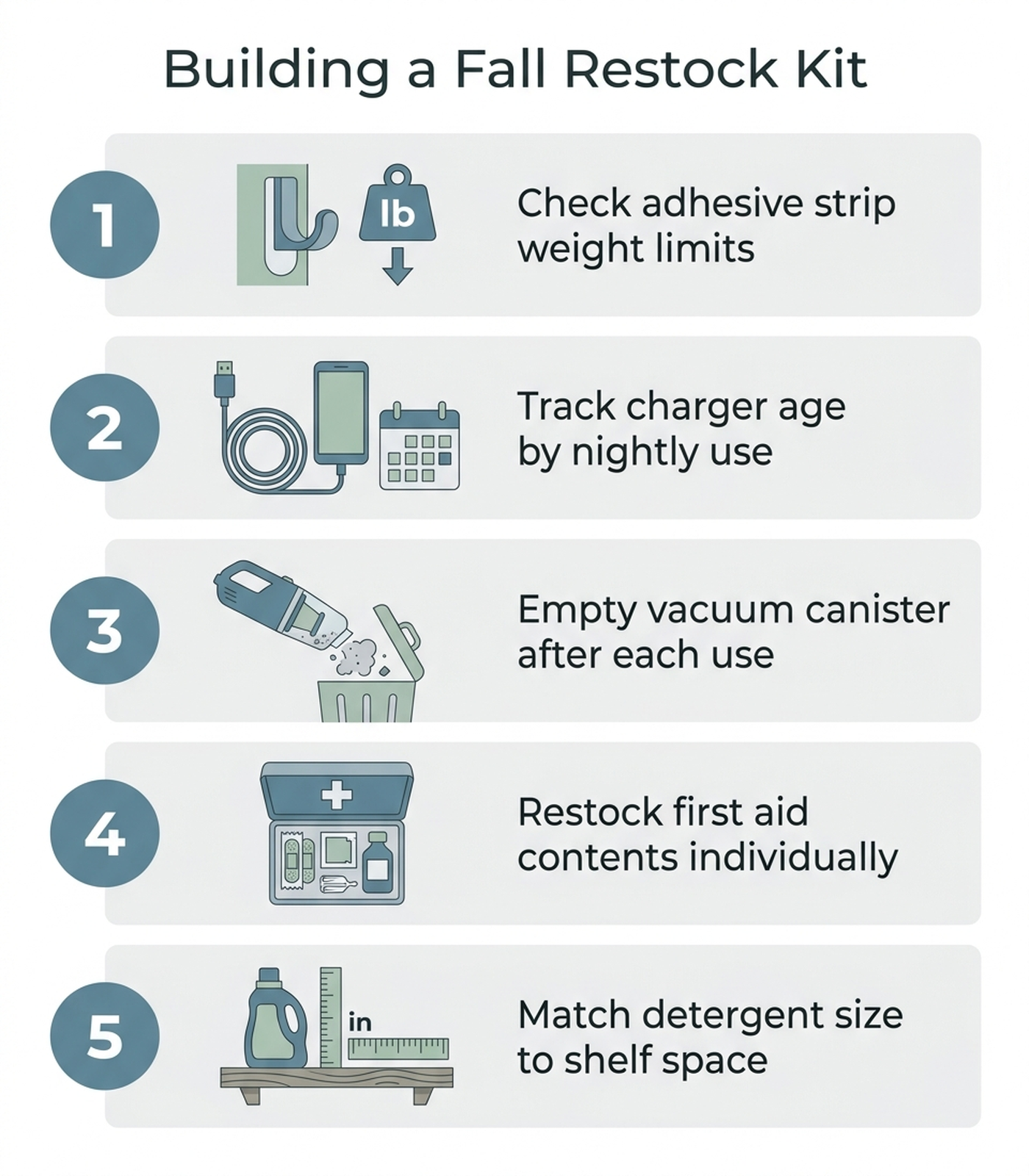
- Step 1: Check adhesive strips before adding weight, not after something falls. If a storage bin or mirror is heavier than the hook’s rated capacity, add a second hook rather than testing the limit.
- Step 2: Track charger age against nightly use, not calendar time. A power bank charged every night for two months has been through more cycles than one used twice a week for a year.
- Step 3: Empty a handheld vacuum’s canister after every use, not when it’s full. Suction drops off well before the canister looks full.
- Step 4: Restock first aid contents individually, not the whole kit. Check bandages, antiseptic wipes, and pain relievers separately — they deplete at different rates.
- Step 5: Match detergent format to actual shelf space, not to the lowest per-load price, if storage is the real constraint.
When Should You Actually Restock? A Decision Flowchart
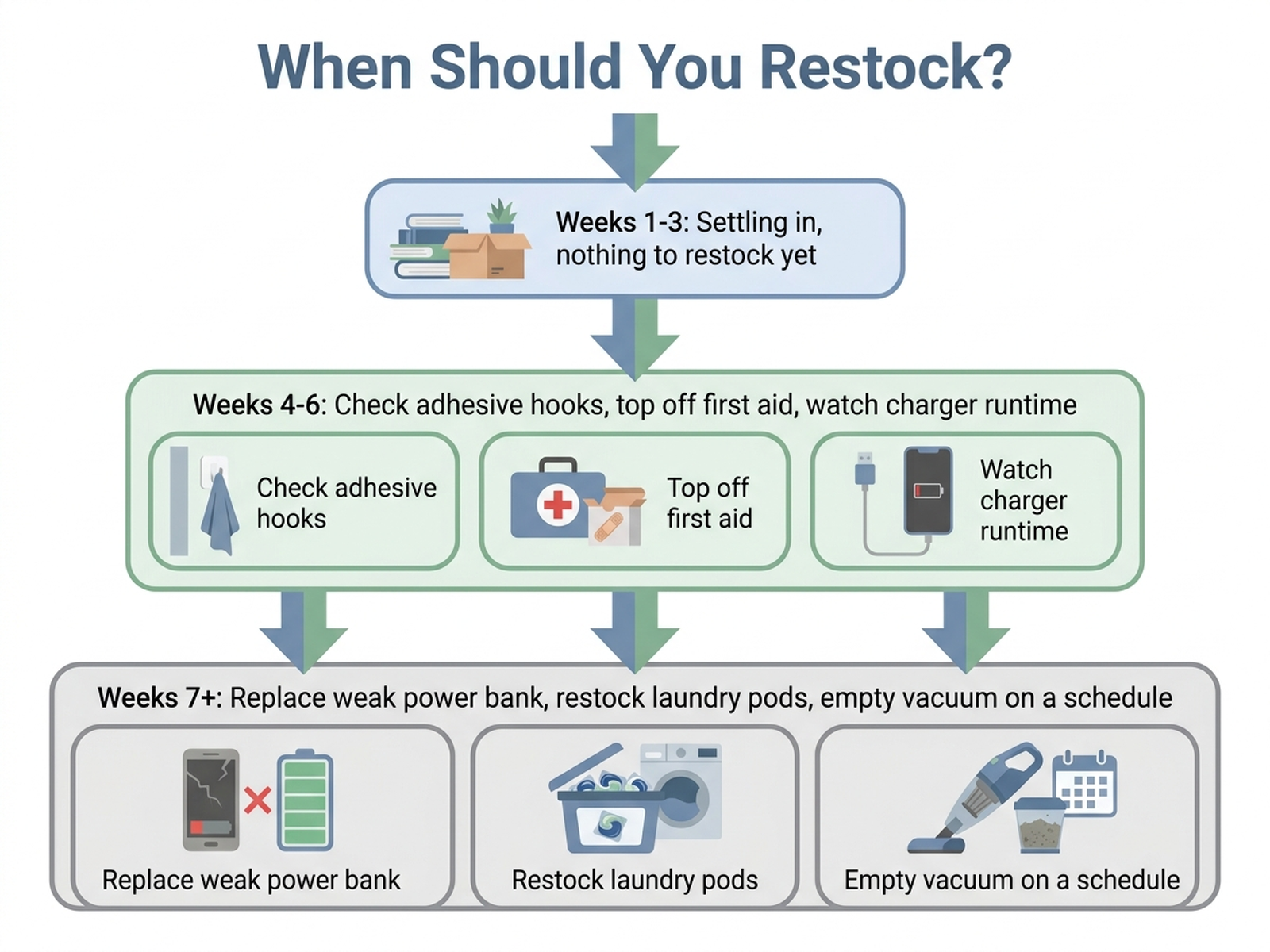
- Weeks 1-3 (move-in through settling in): Nothing needs restocking yet. Focus on getting the initial setup right rather than pre-buying replacements.
- Weeks 4-6 (midterm approach): Check adhesive hooks under load, top off first aid supplies before cold-and-flu season, and note whether a nightly-charged power bank feels noticeably weaker.
- Weeks 7+ (deep into the semester): Replace a power bank if runtime has dropped noticeably, restock laundry pods if the smaller tub is running low, and empty the vacuum canister on a fixed schedule rather than waiting for visible buildup.
Editorial Recommendations by Use Case
- Best overall for adhesive-strip reliability: Command Large Utility Hooks, paired with a second hook for anything heavier than a lightweight decoration.
- Best power bank for nightly use: the Anker 10,000mAh 30W USB-C Power Bank, with the expectation that heavy nightly users may want a replacement by the following fall.
- Best cleanup tool for dorm-specific mess: the BLACK+DECKER dustbuster Handheld Vacuum, sized appropriately for a single room rather than a full apartment.
- Most overlooked restock: first aid kit contents, not the kit itself — check bandage and pain-reliever supply specifically before the first cold-and-flu wave.
- Best laundry format for limited storage: the smaller Tide PODS 42-Count tub, when shelf space is the binding constraint rather than per-load cost.
Limitations of This Analysis
This analysis relies on publicly available reviews and manufacturer specifications; we did not personally test these products, and individual wear timelines depend on usage intensity, dorm humidity and wall material, and how heavily a given item is shared among roommates. Manufacturer figures — weight ratings, charge-cycle behavior, piece counts — are provided by the manufacturer and may not reflect every unit. National Retail Federation spending statistics describe aggregate market trends, not a per-student prediction. Prices and ASIN availability change frequently; confirm the current listing before buying.
The Bottom Line
The dorm items that fail first aren’t the big move-in purchases — they’re the adhesives, batteries, and consumables that wear down quietly over the first six to eight weeks of daily use, right as midterms make a replacement trip inconvenient. Based on aggregated review data, the fix isn’t buying more at move-in; it’s checking these five categories specifically around week 4 to 6 and restocking before something fails during finals season instead of after. Whichever product you choose, verify the exact size and current price before checkout — and if you want a second opinion on a specific listing, paste the URL into Arekore and let the AI scan the reviews and price history for you in about five minutes.