How to Make an Espresso Machine Last Longer
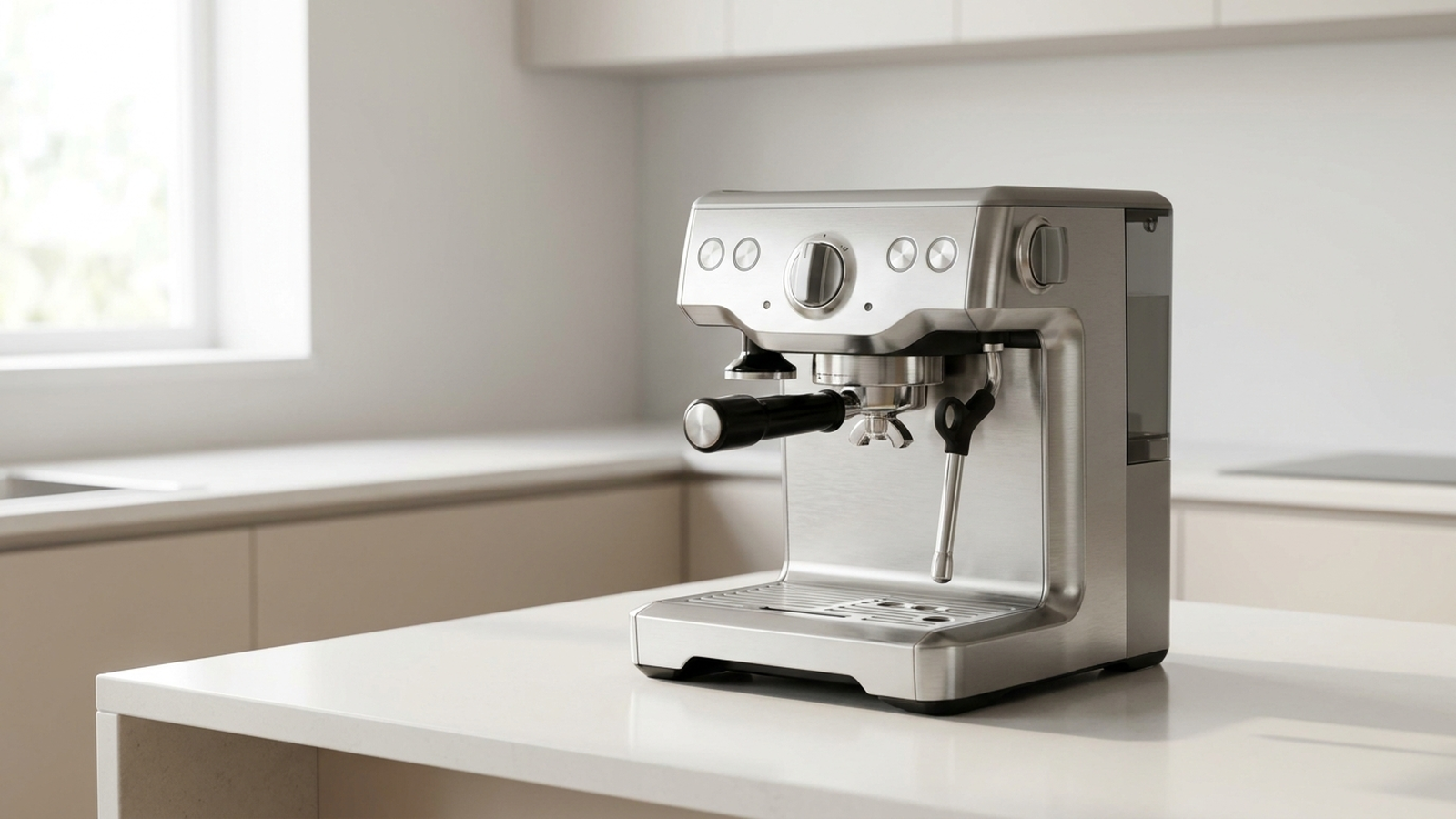
The home espresso machine has become a fixture of the US kitchen — the North American home espresso machine market grew from an estimated $982 million in 2021 to roughly $1.3 billion in 2026, according to industry market research, as more households moved away from single-serve pods toward semi-automatic and automatic machines. But a $300–$1,500 countertop appliance is only as good as its maintenance schedule. The single biggest factor separating a machine that lasts ten years from one that needs a repair or replacement inside of two is whether mineral scale ever gets a foothold inside the boiler and lines.
As an Amazon Associate, Arekore earns from qualifying purchases. The Amazon product links in this article may include our affiliate tracking ID and may earn us a commission if you buy through them, at no additional cost to you. See our Links Policy for details on how we select products and how commissions do not influence our recommendations.
TL;DR / Quick Verdict
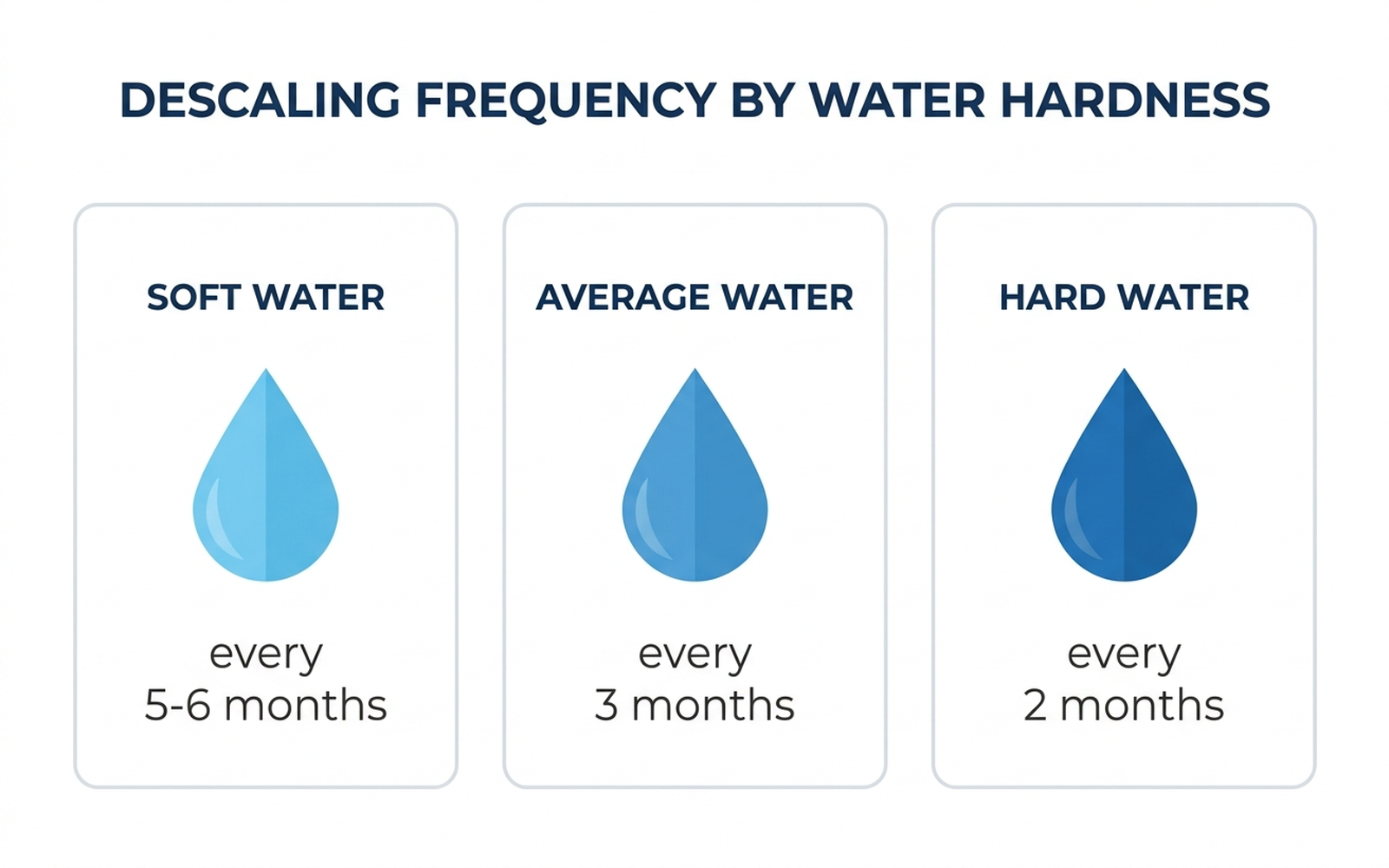
- Descale on a schedule tied to your water hardness, not just when a light comes on. Hard water areas need descaling roughly every 2 months; average water every 3 months; soft or filtered water every 5–6 months, according to manufacturer and industry maintenance guides.
- Backflush the group head weekly with a detergent made for espresso machines (not just plain water) to clear coffee oils before they harden into residue that affects both taste and internal seals.
- Skip vinegar. Citric-acid-based or manufacturer-branded descalers are the consensus recommendation; vinegar can degrade rubber gaskets over repeated use and leaves a smell that lingers in some machines.
- A well-maintained fully automatic espresso machine has a life expectancy of around 10 years, according to coffee-equipment repair sources — but neglected descaling is widely cited as the leading cause of premature pump and boiler failure well before that point.
- Most manufacturer warranties only cover 1–2 years, so maintenance habits — not the warranty period — determine whether the machine survives into its second decade.
How We Reached These Conclusions (Methodology)
This is an editorial analysis, not a hands-on test. We did not personally test the products covered here. This guide synthesizes (a) manufacturer maintenance and descaling documentation from Breville and De’Longhi; (b) independent commentary from Tom’s Guide, which interviewed a Seattle Coffee Gear customer-experience specialist about the most common home-barista maintenance mistakes; (c) Wirecutter’s published testing notes on espresso-machine durability and long-term reliability; (d) aggregated amazon.com customer-review sentiment on best-selling espresso machines and descaling products, sampled in September 2026, focused on complaints about pump failure, descale-light behavior, and machine longevity; and (e) industry market-size and category data. We did not conduct a formal review-mining study and cannot report a precise sample size (N) for the aggregated review sentiment described below; those observations reflect a qualitative read of top review threads on best-selling listings, not a statistically sampled dataset. Warranty terms and lifespan figures are manufacturer-published and industry-standard estimates, not independently verified lab results for any single model. Prices are amazon.com figures at the time of writing and fluctuate.
Why Mineral Scale Is the Real Threat to an Espresso Machine
Every espresso machine heats water to a precise, repeatable temperature, and that heating process is exactly what turns dissolved minerals in tap water into limescale. As water boils and re-boils inside the machine, calcium and magnesium deposits build up on the heating element, inside the boiler, and along the narrow internal tubing that carries water to the group head. Left unaddressed, scale buildup is widely cited by coffee-equipment maintenance guides as the number one cause of premature equipment failure — it restricts water flow, forces the pump to work harder, and can eventually damage heating elements that were never designed to run through a layer of mineral crust.
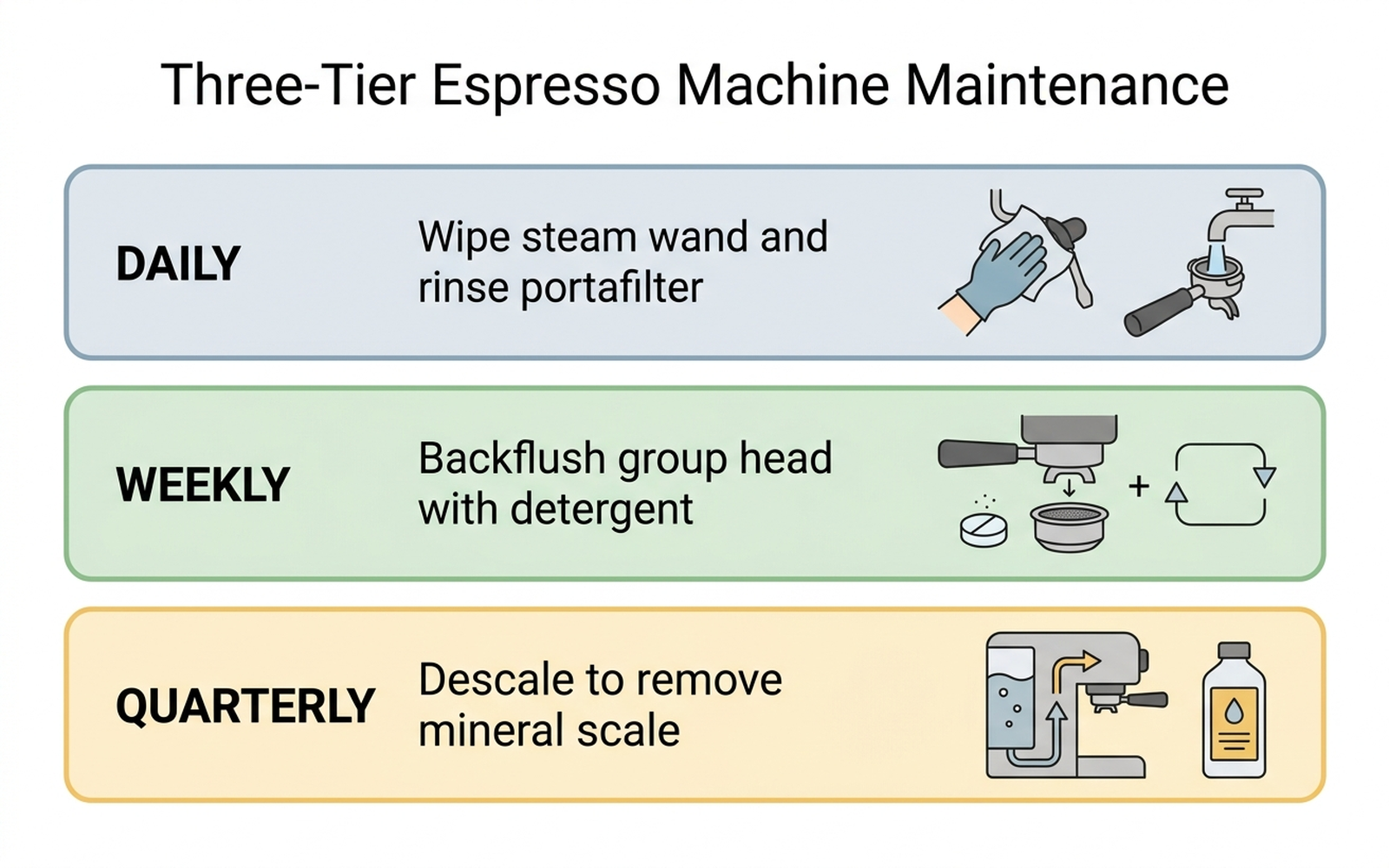
Maintenance guides converge on a three-tier routine that separates cosmetic cleaning from the internal descaling that actually protects the machine’s mechanical parts:
- Daily: Wipe down the steam wand immediately after steaming milk (dried milk residue clogs the wand tip and harbors bacteria) and rinse the portafilter and basket after each shot.
- Weekly: Backflush the group head with a purpose-made detergent — not just water — to dissolve coffee oils before they harden into a residue that affects both taste and, over time, the rubber gasket that seals the portafilter.
- Quarterly (or on a water-hardness schedule): Descale the internal boiler and lines to remove mineral scale before it restricts flow or damages the heating element and pump.
Manufacturer Guidance, Brand by Brand
- Breville: Machines like the Barista Express and Bambino Plus include a built-in descale alert triggered by a fixed brew count — typically in the range of 200–300 cycles — rather than by measuring actual mineral content, so the alert is a rough proxy, not a precise reading of scale buildup. Breville sells its own branded descaling solution and recommends against relying on vinegar as a substitute. Breville’s standard warranty for most household espresso machines runs 1–2 years depending on the model.
- De’Longhi: De’Longhi’s EcoDecalk descaler is formulated specifically for the company’s aluminum boiler components and includes a corrosion inhibitor that De’Longhi recommends over citric acid or vinegar for its own machines. Support documentation for models like the Dedica outlines a similar descale-and-clean cycle. De’Longhi’s standard warranty is typically one year, extendable to two years with product registration.
- Other brands (Gaggia, Cuisinart, and similar): Manufacturer support pages for this tier converge on the same core guidance — use a manufacturer-approved or citric-acid-based descaler, avoid vinegar, and follow a schedule tied to local water hardness rather than a fixed calendar date.
What Independent Experts and Testers Say
Tom’s Guide interviewed John Holmquist, a customer-experience specialist at Seattle Coffee Gear with more than a decade of specialty-coffee experience, who identified inconsistent maintenance — skipping regular descaling and backflushing — as the single most common and most damaging mistake home baristas make, ahead of extraction technique errors. Holmquist also specifically flagged vinegar as a poor substitute for a proper descaling solution, noting it can be harder on internal seals over repeated use even though it does dissolve scale.
Wirecutter’s testing process for espresso machines runs for weeks and includes pulling shots and steaming milk repeatedly while evaluating construction materials, component accessibility, and long-term reliability — not just day-one extraction quality. Its reviewers note that machines built with more accessible internal components, where a home user or repair technician can reach the boiler and pump without disassembling the entire chassis, tend to hold up better for long-term ownership, since easier access makes routine descaling and eventual part replacement more likely to actually happen rather than get postponed.
What Aggregated Amazon Reviews Actually Say
Reading through review threads on best-selling espresso machines and descaling products surfaces a consistent pattern, even without a formal review-mining study:
- A recurring complaint pattern describes weak pressure, slow brewing, or a “grinding” pump noise developing after a year or more of use — symptoms that match manufacturer troubleshooting guides’ description of scale-related restricted flow rather than a factory defect.
- Reviewers who mention descaling on a regular schedule report fewer of these symptoms over multi-year ownership periods, based on a qualitative read of longer-tenure reviews, though this is not a controlled comparison.
- Descaling solution listings for Breville and De’Longhi draw largely positive reviews when used as directed, with several reviewers specifically noting improved water flow and quieter operation after a descale cycle on a machine that had been showing warning signs.
- A recurring false alarm in reviews: some owners report a “broken” machine that turned out to be a clogged group head screen or a scaled-up single-cup filter basket — a five-minute cleaning fix rather than a mechanical failure — which several manufacturer troubleshooting pages list as a first check before assuming pump failure.
Comparison Table
Prices are approximate amazon.com figures at the time of writing (September 2026) and fluctuate.
| Product | ASIN | Type | Best for | Approx. price |
|---|---|---|---|---|
| Breville Descaler (BES007), 4-pack | B079DDC829 | Manufacturer-branded descaling solution | Breville machines under manufacturer warranty | ~$15–$20 |
| De’Longhi EcoDecalk Descaler, 2-pack (10 uses) | B08VJJ1V19 | Manufacturer-branded descaling solution | De’Longhi machines with aluminum boilers | ~$18–$25 |
| Urnex Cafiza Espresso Machine Cleaning Tablets, 100-count | B004L8RTEM | Group-head backflush detergent | Weekly backflushing on any brand | ~$18–$24 |
Editorial Recommendation by Household Type
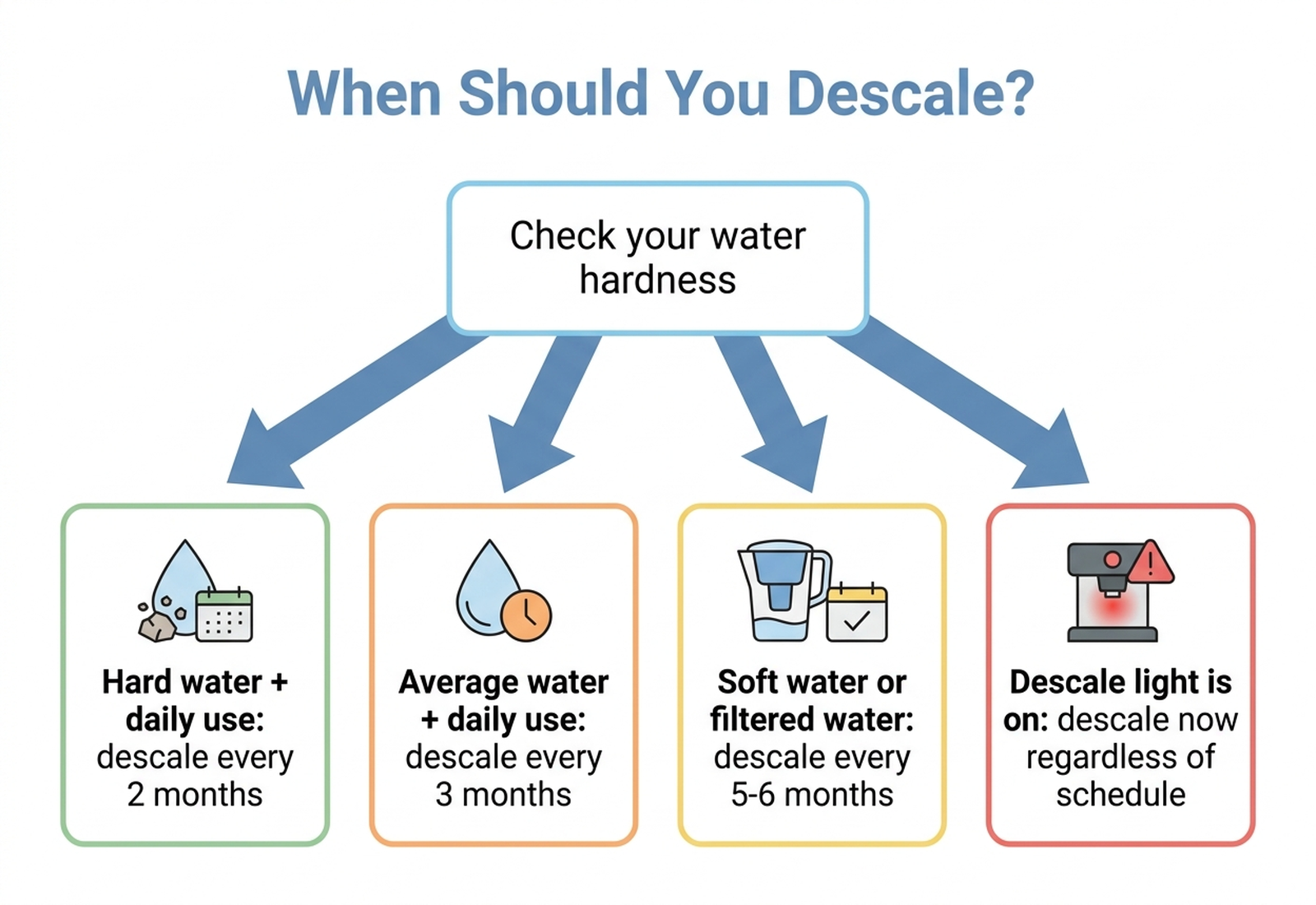
- Hard water area, daily use: Descale roughly every 2 months regardless of what the built-in alert says, since the fixed brew-count trigger doesn’t account for unusually mineral-heavy tap water. Consider a water filter or filtered pitcher for the machine’s reservoir to slow scale buildup between cycles.
- Average water hardness, daily use: A 3-month descaling cadence, paired with weekly backflushing, matches most manufacturer guidance and should keep a machine well within its expected 10-year lifespan.
- Soft or already-filtered water, moderate use: Every 5–6 months is typically sufficient, but don’t skip descaling entirely just because the machine seems to be working fine — scale accumulates gradually and is easier to prevent than to reverse.
- Any household where the descale alert is already on: Descale immediately rather than waiting for a more convenient time. The alert is a lagging indicator of accumulated brew cycles, not an early warning, so machines that ignore it for weeks or months are the ones most likely to show pump strain afterward.
Buying the Right Maintenance Products
Manufacturer-branded descalers are formulated for that brand’s specific boiler material — Breville’s for stainless steel components, De’Longhi’s EcoDecalk for aluminum boilers with an added corrosion inhibitor — so matching the descaler to the machine brand is worth the small price premium over a generic universal descaler. A dedicated backflush detergent like Cafiza, used weekly, addresses coffee-oil buildup that descaling solutions aren’t designed to dissolve; the two products solve different problems and both belong in a full maintenance routine.
Check the Breville Descaler (BES007) on Amazon
Check the De’Longhi EcoDecalk Descaler on Amazon
Check Urnex Cafiza Cleaning Tablets on Amazon
Limitations
This analysis relies on manufacturer maintenance documentation, Tom’s Guide expert commentary, Wirecutter’s published testing notes, and aggregated amazon.com customer-review sentiment rather than our own instrumented, long-term testing of machine lifespan. The “10-year” life expectancy figure is an industry-standard estimate for well-maintained fully automatic machines, not a controlled study result, and actual lifespan varies significantly with water hardness, usage frequency, and how consistently a household follows a descaling and backflushing routine. Individual experience may vary based on use case and unit-to-unit variance.
Bottom Line
An espresso machine doesn’t fail from age so much as from what accumulates inside it. Mineral scale from tap water is the primary threat, coffee oils in the group head are the secondary one, and both are fully preventable with a routine that costs a few dollars a month and about ten minutes a week. Match your descaling schedule to your water hardness rather than waiting for the built-in alert, use a brand-matched descaler instead of vinegar, and a well-maintained machine should comfortably clear the decade mark that industry lifespan estimates describe.
Before you buy a descaling solution or a new espresso machine, paste the product link into Arekore — our AI assistant checks review authenticity, surfaces what the one-star reviews actually complain about, and compares prices, free, in about five minutes.