How to Make a Cordless Vacuum Battery Last Longer
TL;DR
Cordless vacuum batteries are lithium-ion packs, and the two habits that shorten their life the fastest are leaving them on the charging dock at 100% for long stretches and running them on Max/Boost mode constantly. Most packs are rated for roughly 300–500 full charge cycles before capacity noticeably drops, which in typical household use works out to about 2–3 years — but unplugging after a full charge and avoiding heat can meaningfully extend that window. When a pack does fade, a replacement battery is almost always cheaper than a new vacuum.
Methodology
This analysis synthesizes manufacturer battery specifications for Dyson, Shark, and Tineco cordless vacuums, lithium-ion degradation research summarized by independent battery-health publications, and testing-methodology notes from Consumer Reports’ stick-vacuum coverage. We also reviewed publicly visible Amazon customer Q&A and forum discussion threads describing common battery-failure patterns, and manufacturer/retailer replacement-battery listings to compare pricing and capacity across brands. We did not run a controlled lab test ourselves and did not personally purchase or age-test the vacuums covered here; recommendations are based on aggregated public information, not first-hand use.
Why Cordless Vacuum Batteries Fade
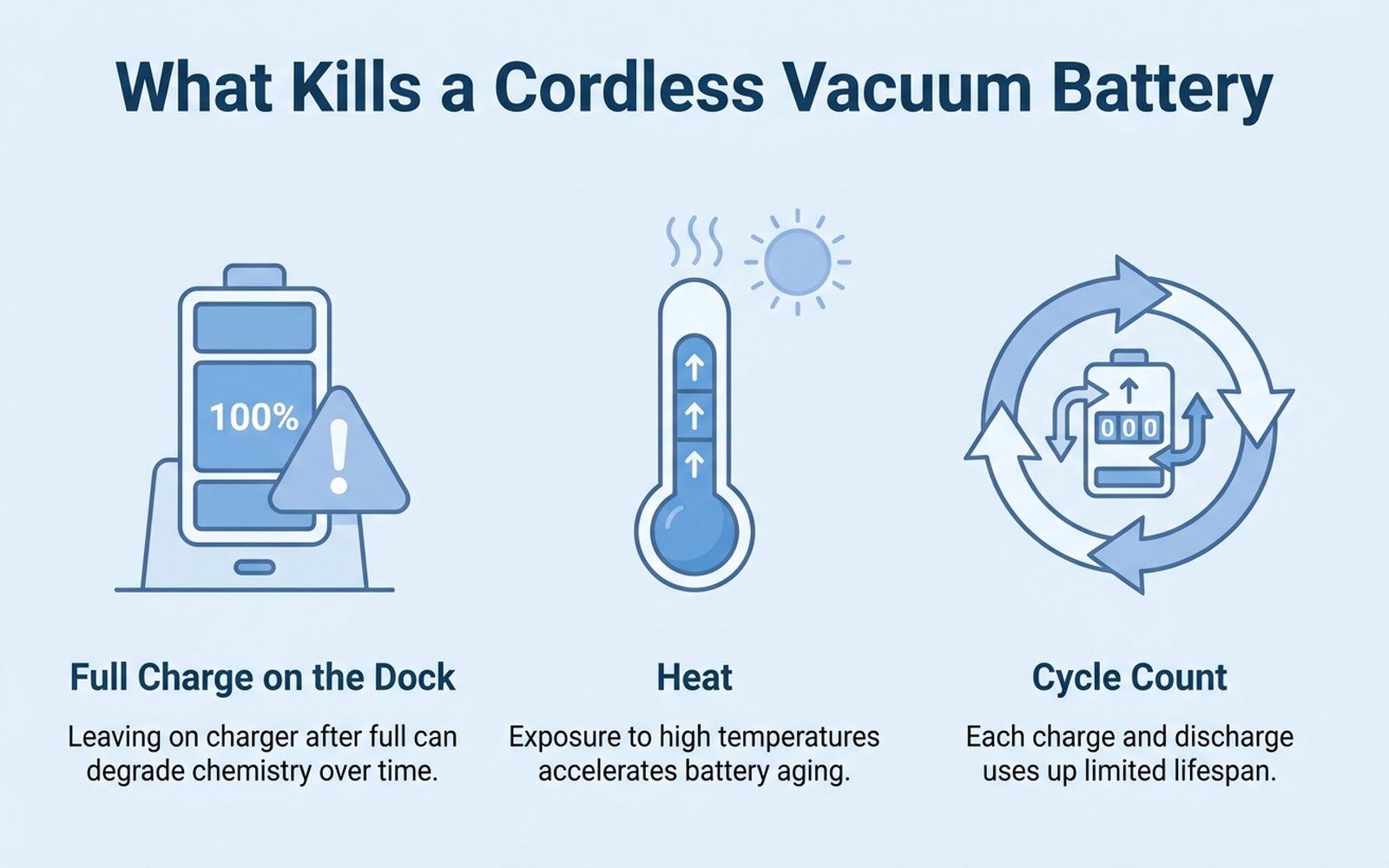
Every cordless stick vacuum on the market — Dyson’s V-series, Shark’s ION and Stratos lines, and Tineco’s Pure ONE and A-series — runs on a sealed or semi-sealed lithium-ion pack. Lithium-ion chemistry doesn’t fail suddenly; it loses capacity gradually with every charge cycle, and that loss compounds faster under three specific conditions:
- Staying at 100% charge for long periods. Most cordless vacuums live on a wall dock between uses, and that dock keeps the pack topped off continuously. This is a well-documented lithium-ion characteristic, not specific to vacuums — cell manufacturers and battery-health outlets such as Chargie note that continuous full-charge storage is one of the most common reasons owners report a “dead after 18 months” battery, well short of the 2–3 years a well-managed pack should deliver.
- Heat. Running a vacuum on its highest suction setting for extended periods, or leaving it in a hot garage or sunlit closet, accelerates the same chemical breakdown that ages any lithium-ion cell — the practical temperature range commonly cited for lithium-ion storage is roughly 64–82°F (18–28°C).
- Cycle count. Lithium-ion packs are generally rated for 300–500 full charge-discharge cycles before capacity drops to a level users notice as reduced runtime. A pack charged nightly reaches that count in roughly 1–2 years; one charged only after full depletion lasts longer in cycle-count terms, though deep discharges carry their own small stress cost.
Brand engineering differs somewhat: Dyson’s packs are largely sealed and non-user-serviceable outside of a dedicated battery-swap part, prioritizing peak suction power in a way that can run cells harder. Shark and Tineco both sell modular, user-swappable battery packs for most of their current cordless lines, and some Tineco models add active thermal management that engineering explanations describe as reducing heat buildup during high-power use — though we have not seen this validated against Dyson in a shared independent lab test.
Five Things You Can Actually Do
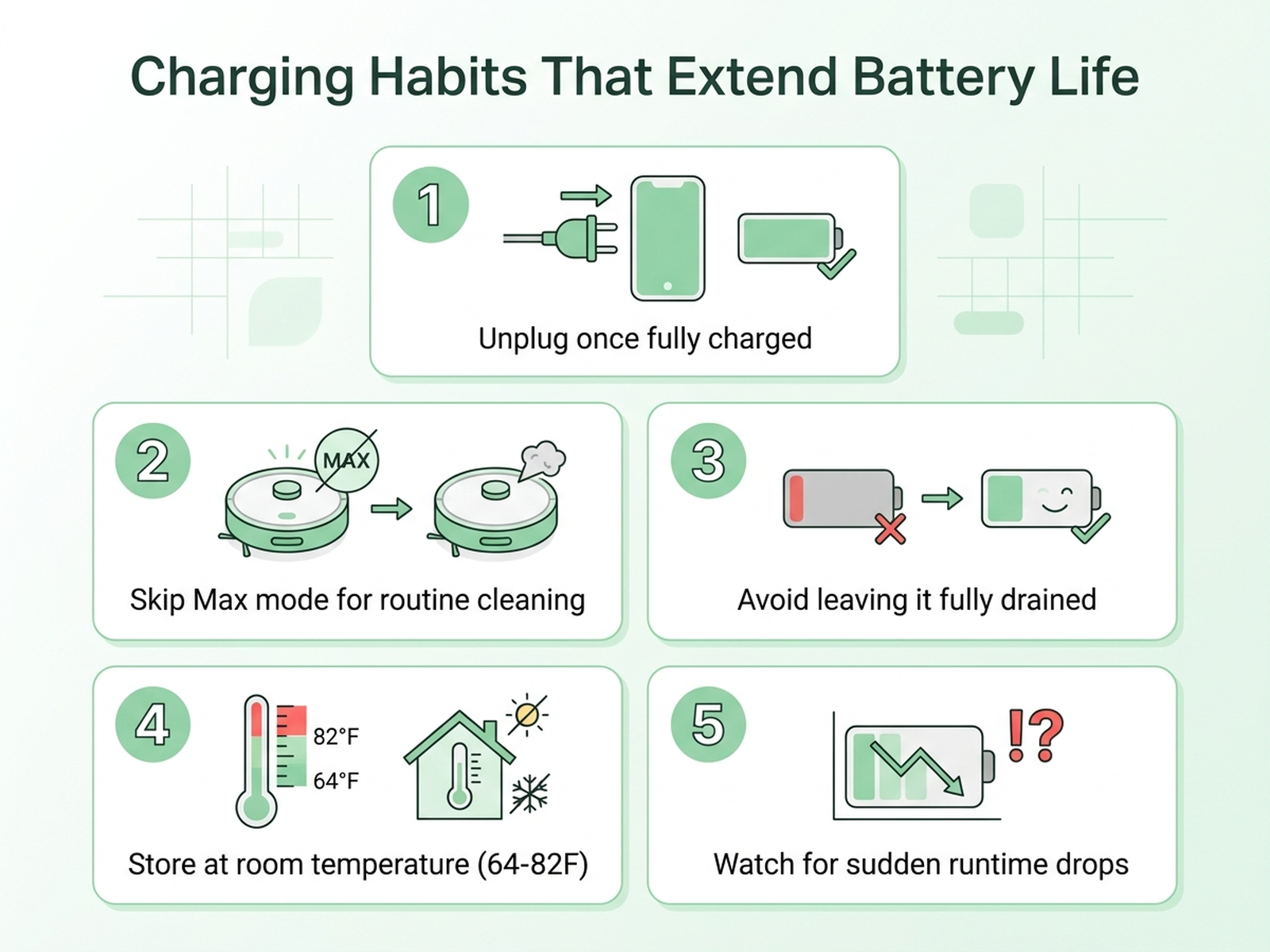
- Unplug after it’s full. Don’t leave the vacuum parked on the dock for days at a time. If your model has an indicator light, charge it, then move it to a shelf once the light signals full.
- Skip Max/Boost mode for routine cleaning. Reserve the highest power setting for stairs or deep-clean sessions; everyday floors don’t need it, and lower power modes draw less current and generate less heat.
- Avoid parking it fully drained. Running the pack to zero and leaving it there for weeks is harder on the cells than storing it partially charged.
- Store at room temperature. Skip the garage, attic, or a sunlit closet if you’re storing the vacuum for more than a few weeks — heat is the single biggest accelerant of lithium-ion capacity loss.
- Watch for the early warning sign. A sudden, sharp drop in runtime (rather than a slow decline) often signals a cell going bad rather than normal aging, and is worth checking against your warranty before buying a replacement pack.
Replacement Battery Options by Brand
Prices are static listings, not a live feed — treat them as a directional range and check the current price before buying. Prices as of 2026-08-27.
| Brand / compatible models | Capacity | Type | Approx. price range |
|---|---|---|---|
| Dyson V8 (Animal/Absolute/Motorhead/SV10) | 8,000 mAh (third-party) | Third-party | ~$35–$60 |
| Dyson V11 / V15 Detect (click-in, SV15–SV22) | 4,000–4,500 mAh | Third-party | ~$45–$80 |
| Shark ION Rocket / IONFlex (XBAT200) | 2,400 mAh | OEM-compatible | ~$70–$85 |
| Shark Apex Pro/X2, Vertex Pro (XBATR725-type) | 2,000 mAh | Third-party high-capacity | ~$40–$70 |
| Tineco A11 Hero / A11 Tango (A11-07 type) | 2,500–3,000 mAh | OEM / third-party | ~$34–$70 |
| Tineco A30S | 2,500 mAh | OEM-compatible | ~$45–$65 |
| Tineco Pure ONE S15 series | Not disclosed by all listings | OEM-compatible | ~$40–$65 |
Third-party packs typically run 40–50% cheaper than searching for a brand-original part, but they vary more in quality control; sticking to listings with a UL or equivalent safety certification called out in the listing is worth the extra scrutiny for a lithium-ion product that sits inside your home.
Editorial Recommendation by Use Case
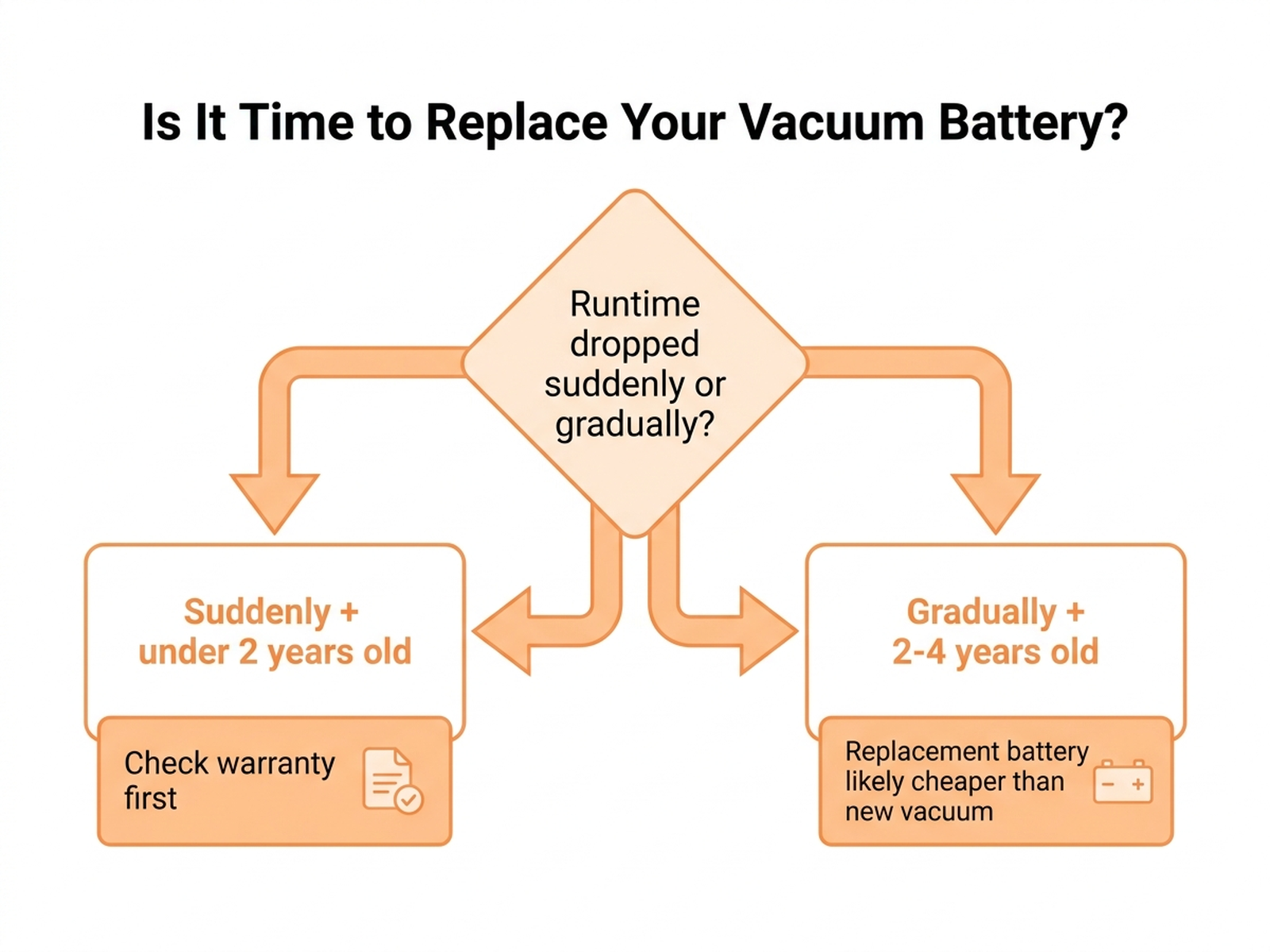
- If your vacuum is under 2 years old and runtime just dropped suddenly: check the warranty first — most cordless vacuum brands cover the battery for 1–2 years, and a sharp, sudden drop is more consistent with a warranty-eligible defect than normal wear.
- If it’s 2–4 years old and runtime has faded gradually: a replacement battery is very likely cheaper than a new vacuum, especially for Shark and Tineco models designed around swappable packs.
- If you’re shopping for a new cordless vacuum and battery longevity matters to you: favor models with a user-swappable pack and a charge-limiting or “smart” dock feature over specs alone. Independent stick-vacuum test labs generally measure runtime with the motorized brush head running continuously on a single power mode, which tends to land well below the manufacturer’s advertised number — that figure is usually measured on the lowest power setting with no brush head engaged, so treat the box number as a ceiling, not a real-world estimate.
Limitations
This analysis relies on publicly available manufacturer specifications, battery-science explainers, and Amazon marketplace listings rather than a controlled side-by-side battery-aging test we ran ourselves. Battery lifespan in practice depends heavily on individual charging habits, climate, and how often Max/Boost mode is used, so any single household’s experience can vary from the ranges cited here. Replacement-battery pricing on Amazon changes frequently and third-party sellers rotate in and out of stock; treat the price ranges above as directional rather than current-to-the-minute.
As an Amazon Associate, Arekore earns from qualifying purchases. The Amazon product links in this article include our affiliate tracking ID and may earn us a commission if you buy through them, at no additional cost to you. See our Links Policy for details on how we select products and how commissions do not influence our recommendations.
Replacement Batteries We Found on Amazon
- Dyson V8-compatible replacement battery, 8,000 mAh
- Dyson V11/V15 Detect-compatible replacement battery
- Shark ION Rocket/IONFlex XBAT200 replacement battery
- Shark Apex Pro/X2, Vertex Pro compatible replacement battery
- Tineco A11 Hero/Tango replacement battery
- Tineco A30S replacement battery
- Tineco Pure ONE S15 series replacement battery
Before buying any replacement pack, double-check the exact model number printed on your vacuum’s battery compartment — cordless vacuum lines share body designs across sub-models with different battery connectors, and Arekore recommends verifying compatibility on the product listing yourself before purchasing.