Eufy vs Wyze: Which Budget Security Camera Wins in 2026?
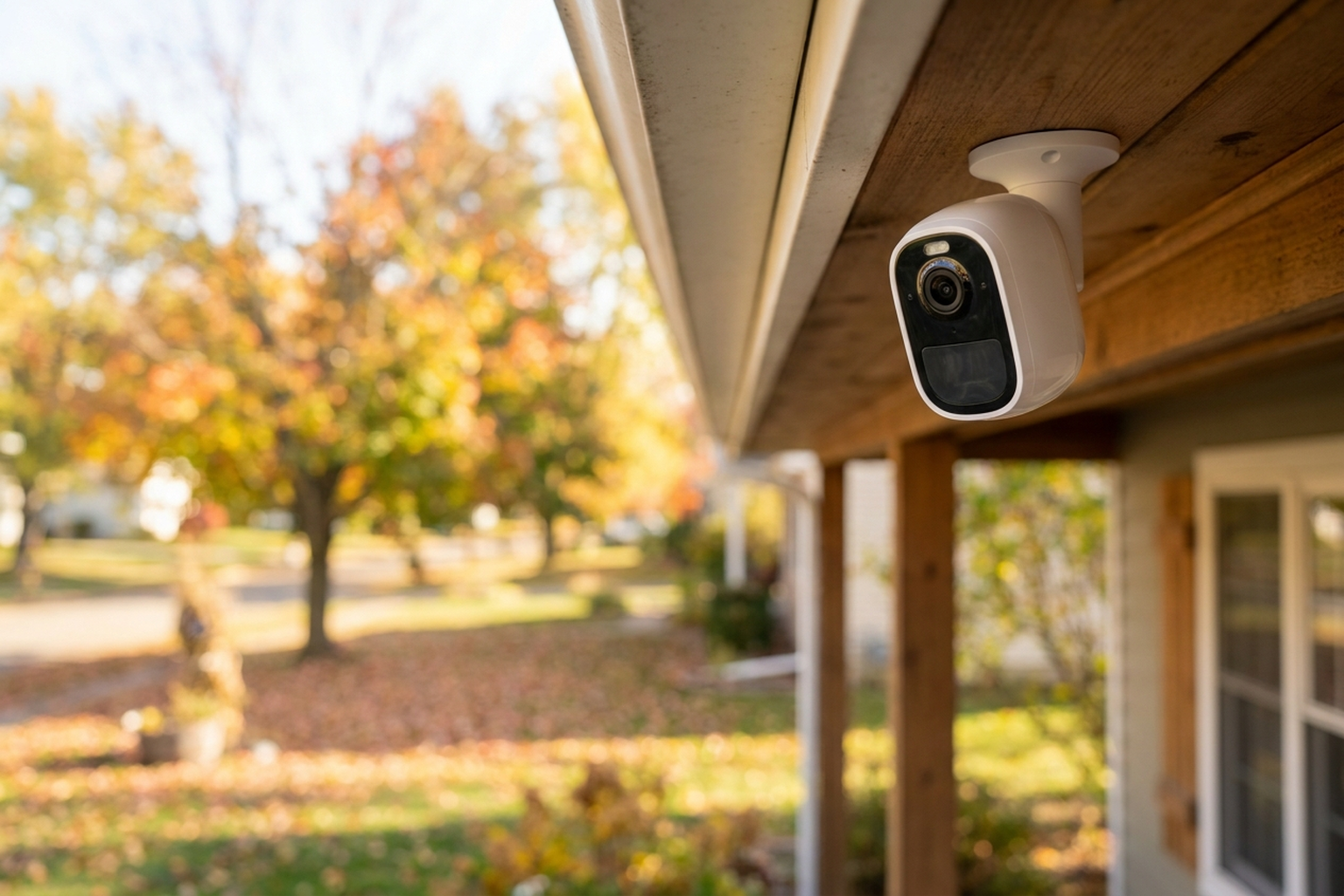
Eufy and Wyze built their entire reputations on the same pitch: security-camera features that used to cost $200+ from Nest or Arlo, for a third of the price. Both brands have also, at different times, had a real security failure that undercut that pitch — Wyze with a 2024 cross-account footage leak, Eufy with a 2022 admission that its “local-only” cameras were quietly sending data to the cloud. Neither incident is ancient history, and both matter when you’re deciding which brand to trust on your front door. This guide compares what each brand actually sells today across three price tiers, what independent reviewers and the incident record say, and what aggregated owner reviews report.
As an Amazon Associate, Arekore earns from qualifying purchases. The Amazon product links in this article include our affiliate tracking ID and may earn us a commission if you buy through them, at no additional cost to you. See our Links Policy for details on how we select products and how commissions do not influence our recommendations.
TL;DR / Quick Verdict
- Compare within a use case, not brand-to-brand. Eufy and Wyze both span indoor, outdoor, and doorbell cameras at different price points — match the product to where it’s going before you pick a brand.
- Best indoor pick for most people: the Wyze Cam v4 (2.5K, ~$36–$40) — a 4.4-star rating across more than 6,600 Amazon reviews and Tom’s Guide’s pick for best budget security camera.
- Best for zero recurring cost outdoors: the Eufy SoloCam S340 (3K dual-lens, solar) — local storage with no mandatory subscription, a 4.3-star Amazon rating across 6,000+ reviews, and an IP67 weatherproof rating.
- Best budget doorbell: the Wyze Video Doorbell v2 (~$45–$60 wired) — roughly a third of the price of Eufy’s comparable doorbell, if you’re fine paying a small annual fee for cloud clips.
- The factor both brands’ marketing pages downplay: Wyze disclosed a 2024 glitch that let roughly 13,000 customers glimpse other users’ camera thumbnails, and Eufy admitted in 2022 that cameras marketed as “no cloud, 100% local storage” were in fact uploading thumbnails and face data to AWS servers without clear disclosure. Wyze says it has added new safeguards against a repeat; Eufy committed to end-to-end encryption going forward, though the 2022 incident has continued to generate class-action litigation and regulatory scrutiny into 2026. Neither failure should be weighed as equivalent to a one-star hardware complaint.
How We Reached These Conclusions (Methodology)
This is an editorial analysis, not a hands-on review; we did not personally test the products covered here. This guide synthesizes three kinds of public information: (a) aggregated amazon.com customer reviews and star ratings sampled in September and October 2026; (b) independent reporting and lab testing from Tom’s Guide, TechGearLab, and incident coverage from outlets including The Washington Post, CNN, 9to5Mac, and Gizmodo; and (c) manufacturer specifications for resolution, field of view, and storage. Where we cite a manufacturer figure — infrared range, field of view, or weatherproof rating — we label it as a manufacturer claim rather than an independently verified result. Prices are amazon.com figures at the time of writing and fluctuate, sometimes significantly, with frequent lightning deals on both brands.
Technical Approach: Eufy’s Local-First Pitch vs. Wyze’s Price-First Pitch
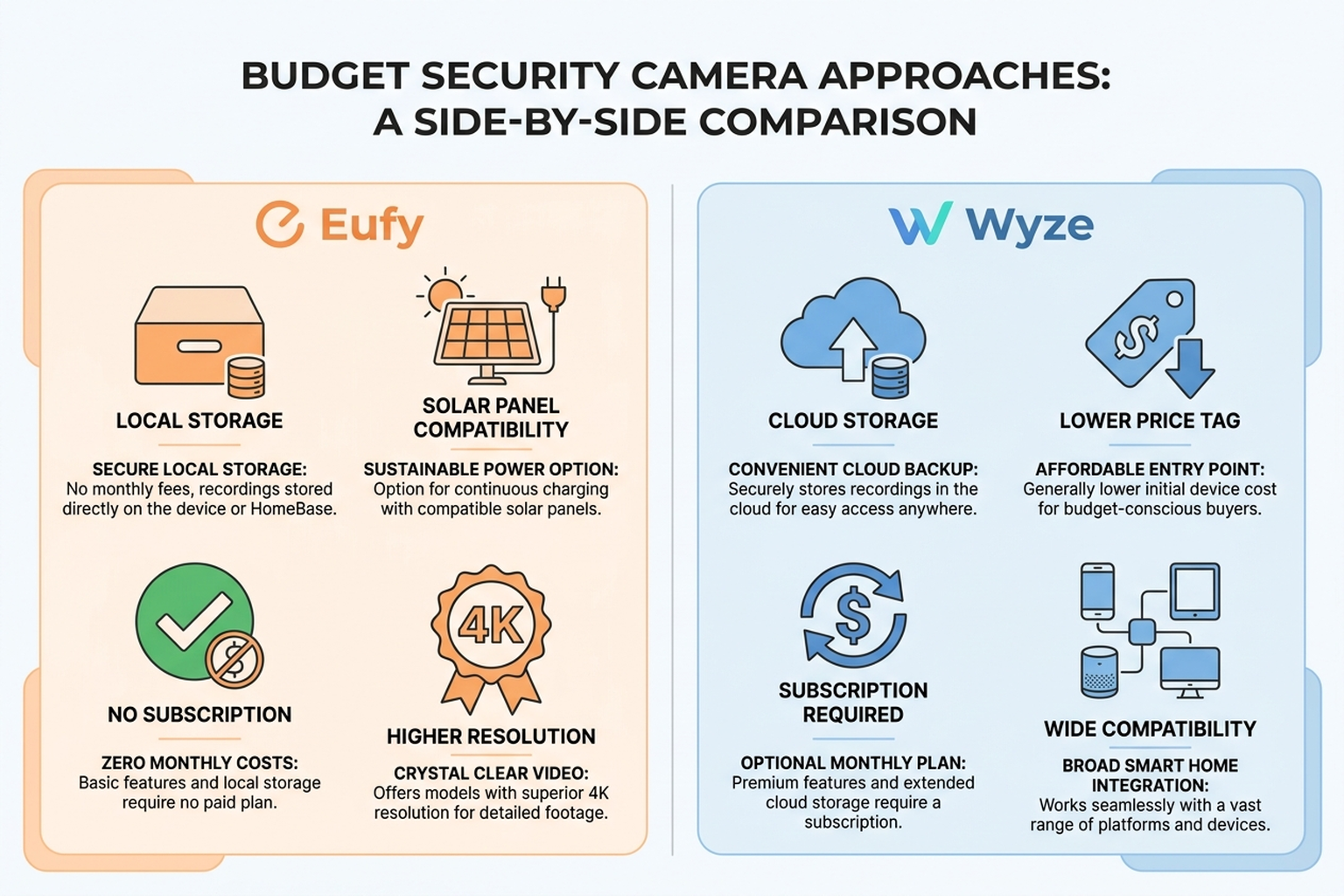
The two brands compete on different axes, and that shapes which one fits a given buyer.
- Eufy’s approach centers on local storage with no mandatory monthly fee: footage records to an on-device microSD card or a HomeBase hub with expandable storage (up to 16TB on some kits), and on-device AI handles human/pet/package detection for free rather than gating it behind a subscription. Eufy’s outdoor line also leans on solar charging — the SoloCam series ships with a detachable solar panel designed to keep the battery topped off indefinitely in most US climates.
- Wyze’s approach competes primarily on sticker price and ecosystem breadth. A single Wyze Cam v4 costs roughly a third of an equivalent-resolution Eufy indoor camera, and Wyze’s catalog spans cameras, a video doorbell, a robot vacuum, and smart plugs under one app. The tradeoff: Wyze’s free tier only stores 12-second motion clips for 14 days, and features like person/pet detection and longer clip length require a Cam Plus subscription (roughly $2.99/month per camera, or $29.99/year as of the March 2026 price increase).
- Resolution and field of view. Eufy’s current outdoor flagship (SoloCam S340) shoots 3K dual-lens video with a reported 25-foot infrared range; Wyze’s Cam v4 tops out at 2.5K with a roughly 20-foot infrared range and a slightly wider 130-degree field of view versus Eufy’s 125-degree spec on comparable models. Both figures are manufacturer claims.
- Smart home integration. Both work with Alexa and Google Home. Eufy has broader native Apple HomeKit support across its current lineup; Wyze’s HomeKit support is more limited.
Head-to-Head: Indoor Camera Tier (~$36–$70)
Wyze Cam v4 (2.5K QHD) is Wyze’s current flagship indoor/outdoor camera: a Starlight sensor for color night vision, an integrated spotlight and 100dB siren, and a microSD slot for subscription-free local recording. Tom’s Guide named it its pick for best budget security camera, and it carries a 4.4 out of 5 star rating across more than 6,600 Amazon reviews. It typically lists between $36 and $40.
Check the Wyze Cam v4 (2.5K) on Amazon
Eufy Indoor Cam E30 (4K UHD) costs close to double the Wyze at $69.99, but adds true 4K resolution, 360-degree pan-and-tilt coverage, and on-device human/pet/audio AI detection with no subscription required for any of it — a meaningful difference from Wyze’s subscription-gated smart detection. Its reported night vision range is shorter at the color end (16.4 ft color, 32.8 ft IR) than its daytime field of view would suggest, and like all pan-tilt cameras it needs continuous power rather than running on battery.
Check the Eufy Indoor Cam E30 (4K) on Amazon
Verdict at this tier: the Wyze Cam v4 is the better pick if you mainly want motion clips and don’t mind a smaller field of view; the Eufy E30 is the better pick if you want free on-device AI detection and pan-and-tilt coverage and are willing to pay roughly 2x upfront to avoid Wyze’s subscription entirely.
Head-to-Head: Outdoor/Battery Camera Tier (~$60–$120)
Wyze Cam Outdoor (wire-free battery) is Wyze’s standalone battery camera, rated for roughly six months of use per charge on its dual 2,600mAh batteries before needing a recharge. It typically lists in the $60–$90 range and uses the same Cam Plus subscription model as Wyze’s indoor line for extended clip length and AI detection.
Check the Wyze Cam Outdoor on Amazon
Eufy SoloCam S340 (3K dual-lens, solar) pairs a wide-angle and zoom lens for 360-degree pan-and-tilt coverage with a detachable solar panel, 8GB of built-in onboard storage, and an IP67 weatherproof rating (versus Wyze’s IP65 on comparable models — a higher number means better protection against dust and water ingress). It carries a 4.3 out of 5 star Amazon rating across more than 6,000 reviews. Typical pricing runs $100–$120 for a single camera, though multi-camera kits with a HomeBase hub bring the per-unit cost down.
Check the Eufy SoloCam S340 on Amazon
Verdict at this tier: the Eufy SoloCam S340 costs more upfront but eliminates both the battery-swap chore (solar charging) and the recurring subscription cost that Wyze’s outdoor camera depends on for full functionality — the better total-cost-of-ownership pick if you’re keeping the camera for several years. The Wyze Cam Outdoor is the cheaper entry point if you mainly want basic motion alerts and don’t need pan-and-tilt coverage.
Head-to-Head: Video Doorbell Tier (~$45–$180)
Wyze Video Doorbell v2 (wired, 2K) is a single-camera wired doorbell that typically lists between $45 and $60. It covers the basics — 2K video, color night vision, two-way audio — but, like Wyze’s other cameras, gates extended clip storage and smart detection behind the Cam Plus subscription.
Check the Wyze Video Doorbell v2 on Amazon
Eufy Video Doorbell E340 (dual-camera, battery or wired) lists around $179.99 — roughly three to four times the Wyze price — but adds a second, downward-angled camera that captures packages left at your feet (not just faces at eye level), 8GB of built-in local storage, and on-device AI package/person detection with no subscription required.
Check the Eufy Video Doorbell E340 on Amazon
Verdict at this tier: this is the widest price gap in the comparison, and it tracks a real feature gap — the Eufy E340’s second camera and subscription-free AI are genuinely different capabilities, not just a premium badge. Budget-conscious buyers who mainly want to see who rang the bell are well served by the Wyze v2; buyers who care about package theft specifically should weigh the E340’s downward camera against its higher price.
Customer Sentiment Synthesis
- Wyze Cam v4 owners, per aggregated Amazon review data, most frequently cite the combination of 2.5K resolution and color night vision at a sub-$40 price point as the standout value, with the built-in spotlight and siren called out repeatedly as useful deterrents.
- Eufy SoloCam S340 and Indoor Cam E30 owners most commonly praise the absence of any recurring fee for AI detection, with several reviews specifically contrasting this against a previous Wyze or Ring camera that required a subscription to get the same feature.
- The most common Wyze complaint, where it appears, is the subscription requirement for meaningful smart detection on the free tier — several reviewers describe the free tier’s 12-second clip limit as too short to capture a full event. The most common Eufy complaint, per third-party reviews including HowToGeek’s SoloCam S340 review, is inconsistent or delayed motion alerts on certain firmware versions, which the brand has addressed with periodic app updates.
- Neither brand’s current mainstream lineup shows the kind of sustained one-star pile-on tied to the specific incidents discussed below — that feedback is concentrated in dedicated news coverage from the time of each incident rather than spread across today’s product listings.
Setting Up Either Camera for Best Results
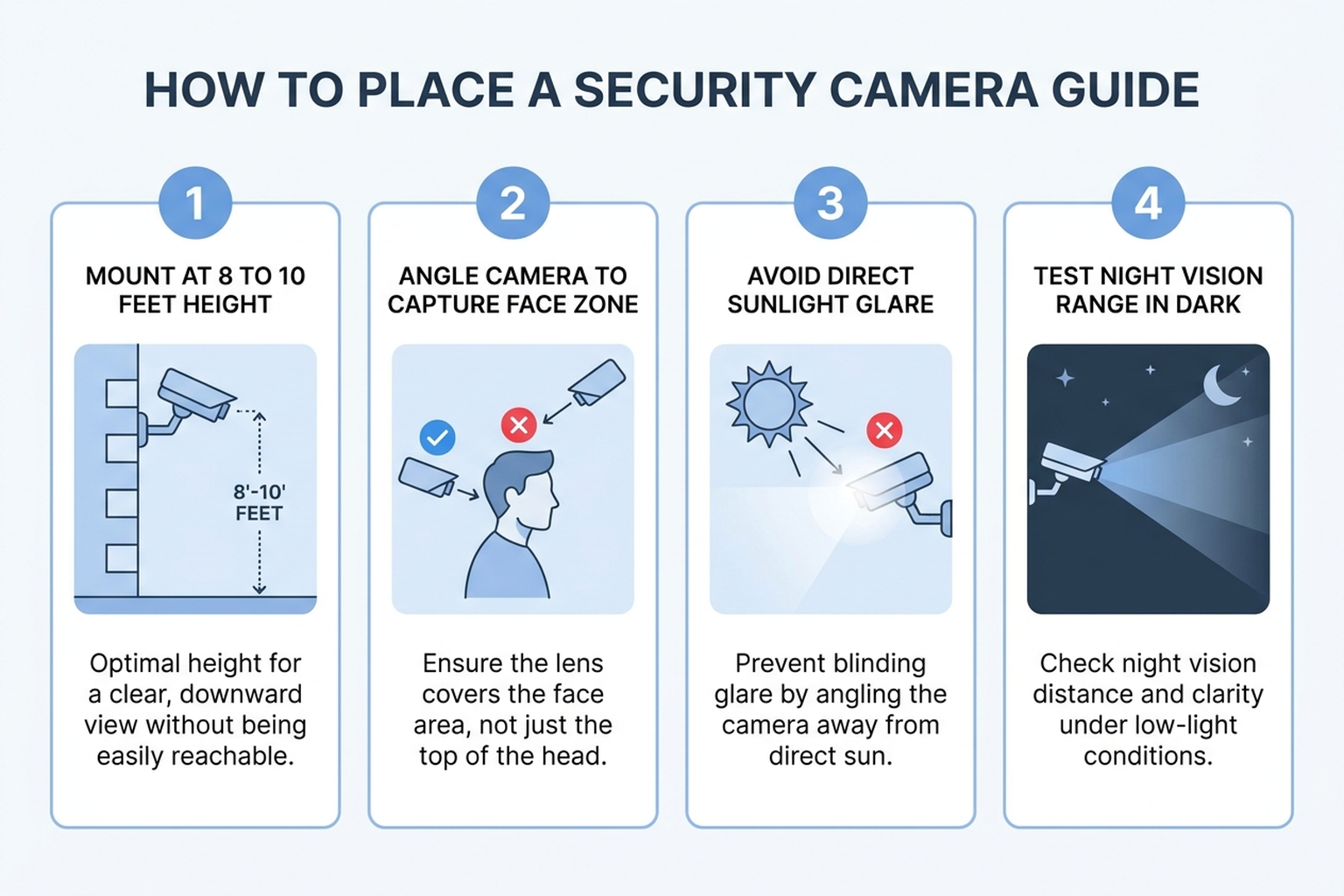
A few placement habits apply regardless of brand. Mount the camera 8 to 10 feet high — high enough to deter tampering, low enough that faces are still identifiable rather than just the tops of heads, which is the single most common placement mistake reviewers flag on both brands. Angle the lens to avoid pointing directly into the rising or setting sun; both IR and color night-vision sensors can wash out or flare when sunlight hits the lens at a low angle. Test night vision range in actual darkness before relying on it — manufacturer-claimed IR ranges (20–25 feet on these models) are measured in ideal lab conditions and often perform shorter in real backyards with ambient light pollution. And whichever brand you choose, change the default app password and enable two-factor authentication on the account — both incidents discussed below were company-side failures, but a weak or reused account password remains the more common real-world point of compromise for any connected camera.
Safety and Privacy Record: What Each Incident Actually Covers
Both brands have a documented security incident serious enough to warrant disclosure here, and treating them as equivalent footnotes undersells what’s different about each. Wyze’s February 2024 incident, confirmed by the company and covered by CNN, The Washington Post, and 9to5Mac, exposed camera thumbnails to roughly 13,000 customers after a third-party caching library mixed up device and account IDs during a surge in traffic following an AWS-related outage; Wyze said about 1,500 users actually clicked through to view another user’s footage, and the company added a new verification layer to prevent a repeat. Eufy’s incident, which came to light in November 2022 via security researcher Paul Moore and was covered by Gizmodo and 9to5Mac, was different in kind: Eufy had marketed its cameras as “no cloud, local storage only,” but researchers found footage and facial-recognition thumbnails were in fact being uploaded to AWS servers, in some cases viewable without authentication via a standard media player, and protected by a hardcoded encryption key. Anker (Eufy’s parent company) admitted the gap in February 2023 and committed to end-to-end encryption via WebRTC going forward; the incident has nonetheless continued to draw class-action litigation and regulatory attention into 2026, so it is not a fully closed chapter the way Wyze’s single 2024 outage is. The practical takeaway: Wyze’s incident was an infrastructure bug affecting a subset of users for a period of hours; Eufy’s was a marketing claim that didn’t match actual product behavior for an extended period, with legal fallout still working through the system. Both are worth knowing before you decide which company’s servers — or marketing claims — you’re trusting with footage from inside your home.
Side-by-Side Comparison
| Model | ASIN | Tier | Resolution | Storage | Subscription required for AI detection | Amazon rating | Approx. price (as of 2026-10-02) |
|---|---|---|---|---|---|---|---|
| Wyze Cam v4 | B0CJ9Z22L5 | Indoor/outdoor | 2.5K | microSD, no fee | Yes (Cam Plus) | 4.4★ (6,600+ reviews) | $36–$40 |
| Eufy Indoor Cam E30 | B0DJVGZQW7 | Indoor | 4K | microSD/local, no fee | No | Not separately disclosed | $69.99 |
| Wyze Cam Outdoor | B08FFK9ZYR | Outdoor battery | 1080p | Cloud (free tier limited) | Yes (Cam Plus) | Not separately disclosed | $60–$90 |
| Eufy SoloCam S340 | B0CCYP6KFM | Outdoor solar | 3K dual-lens | 8GB onboard, no fee | No | 4.3★ (6,000+ reviews) | $100–$120 |
| Wyze Video Doorbell v2 | B0C896D28H | Doorbell | 2K | Cloud (free tier limited) | Yes (Cam Plus) | Not separately disclosed | $45–$60 |
| Eufy Video Doorbell E340 | B0CD7NT4Y9 | Doorbell, dual-cam | 2K FHD | 8GB onboard, no fee | No | Not separately disclosed | $179.99 |
Resolution, storage capacity, and weatherproof ratings are manufacturer specifications; Amazon ratings reflect aggregated customer review data at the time of writing where individually disclosed. Prices fluctuate significantly with sales — verify the current amazon.com price before buying.
Market Context: A Category Still Splitting Between Subscription and Local Storage
The U.S. smart home security camera market is estimated at roughly $9.2–$10.5 billion in 2026, split between hardware sales and a growing cloud-subscription services segment, according to multiple industry research estimates (figures vary by firm from $7.3 billion to $27.4 billion globally depending on how each report defines the category). Subscription revenue is a meaningful part of that growth — rival brand Arlo alone reported $257.3 million in annual recurring subscription revenue across 4.6 million cumulative paid accounts for full-year 2024, per its SEC filings. That backdrop is part of why Eufy’s no-subscription local-storage pitch resonates with a specific buyer segment: it’s a direct bet against the industry’s broader shift toward recurring fees, while Wyze’s lower hardware price banks on enough buyers accepting (or not noticing) the subscription upsell for advanced features.
How to Decide
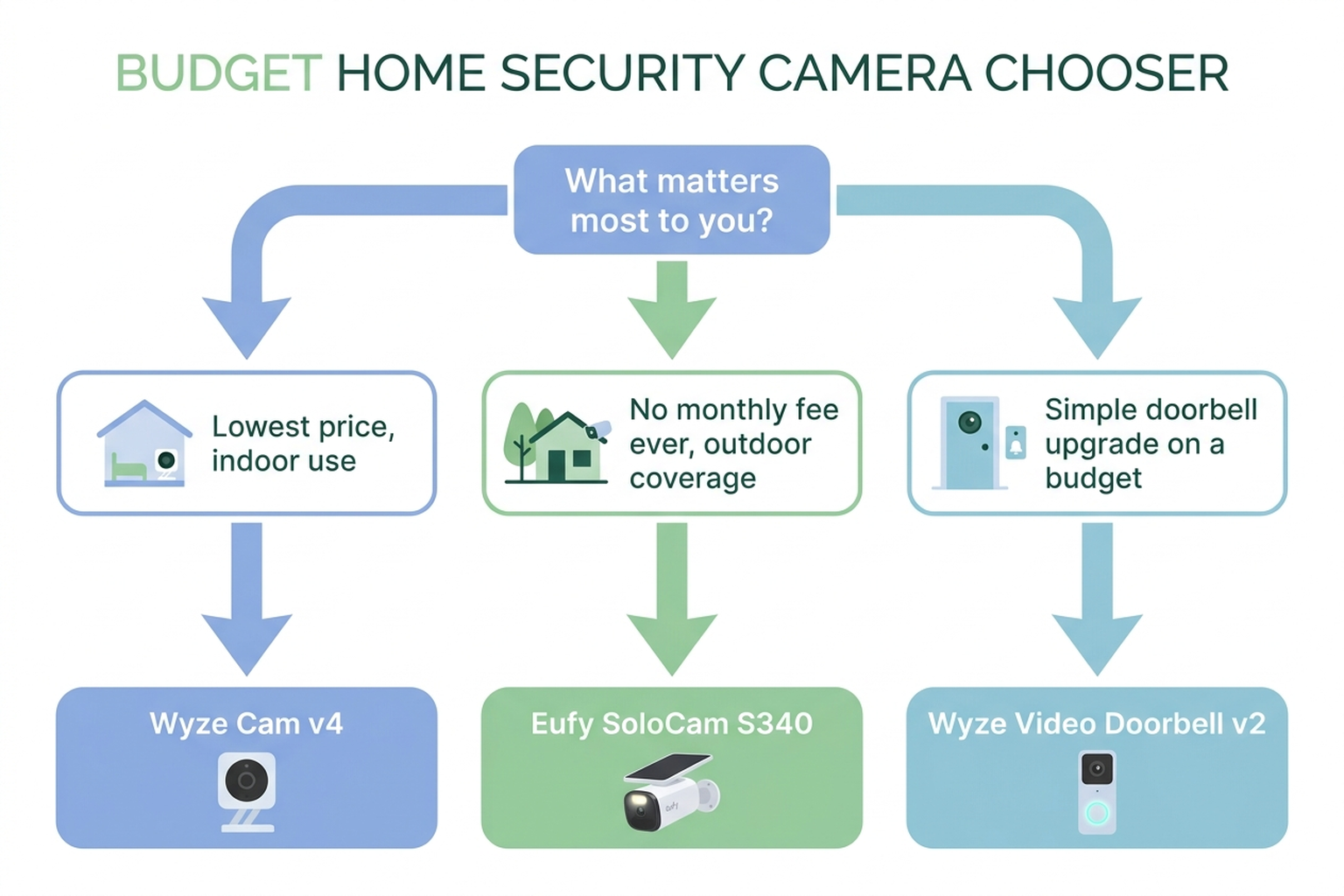
Start with where the camera is going and how you feel about a recurring fee. For a single indoor room or small apartment where you mainly want to check in occasionally, the Wyze Cam v4’s sub-$40 price and 2.5K resolution covers the basics, and you can skip the subscription if 12-second free-tier clips are enough for your needs. For outdoor coverage you want to set up once and forget — no battery swaps, no monthly bill — the Eufy SoloCam S340’s solar charging and local storage justify the higher upfront cost over a multi-year ownership period. For a doorbell, decide whether package theft at your feet (not just who rang the bell) is a real risk at your address: if it is, the Eufy E340’s second downward camera is worth the premium; if you just want to see visitors, the Wyze v2 covers that at a fraction of the price.
Editorial Recommendation by Use Case
- You want the cheapest decent indoor camera: the Wyze Cam v4, backed by a 4.4-star rating across 6,600+ reviews and Tom’s Guide’s budget pick.
- You never want to think about a monthly camera bill again: the Eufy SoloCam S340 or Indoor Cam E30, both of which include AI detection with no subscription.
- You’re watching a porch for package theft specifically: the Eufy Video Doorbell E340, the only doorbell here with a second, downward-facing camera.
- You want a basic doorbell on the smallest possible budget: the Wyze Video Doorbell v2, roughly a third of the Eufy E340’s price.
Limitations
This analysis relies on publicly available Amazon review data, independent reviewer coverage, incident reporting from mainstream news outlets, and manufacturer specifications; we did not independently lab-test these units for actual night-vision range, battery life, or AI detection accuracy. Resolution, field-of-view, and weatherproof-rating figures are manufacturer specifications unless explicitly attributed to a named reviewer or outlet, and individual unit performance can vary with Wi-Fi signal strength, placement, and firmware version. Amazon review sentiment reflects aggregated public feedback at the time of writing and can shift as new reviews accumulate or as newer SKUs replace the ones covered here. Prices and availability were accurate to our research at the time of writing and change frequently, often significantly during sales events — verify current specs and pricing on the product page before buying.
Before you buy either brand’s camera, it pays to check whether a listing’s reviews are genuine and whether a sale price is a real discount or an inflated “was” price. That is exactly what Arekore does: paste the Amazon URL and our AI analyzes review authenticity, surfaces the most useful low-star feedback, and compares pricing in about five minutes — so you end up with the camera that actually fits your home, not just the one with the biggest resolution number on the box.