Espresso Machine Steam Wands 2026: The Feature Buyers Skip
TL;DR. A steam wand is the single hardest part of a home espresso machine to learn, and it’s also the part most buyers stop using first. Aggregated customer feedback and independent reviews point to the same pattern: people who wanted lattes and cappuccinos, not straight espresso, often abandon the wand within weeks and either drink black espresso or buy a separate frother. If you already know you won’t practice steaming milk, a cheaper machine plus a $15-$40 standalone frother usually serves you better than paying $300-$700 for steam-wand hardware that sits dry.
A note on links and methodology
The product links in this article go to amazon.com without any affiliate tracking — we have not yet been accepted into the Amazon Associates US program (application pending). See our Links Policy for details.
We did not personally buy or test the machines discussed below. Every claim about the frequency of unused steam wands, machine specs, and frother performance is an editorial synthesis of public data, cited inline.
Methodology
This is an editorial analysis based on publicly available data collected in August 2026. We did not run our own usage study; instead we synthesized:
- Independent test and buying-guide coverage of home espresso machines and milk frothers from Wirecutter (NYT), Reviewed (USA Today), Tom’s Guide, and TechGearLab, including hands-on notes on steam-wand learning curves for specific models.
- Community and forum discussion on home-barista.com and coffee-focused blogs, where owners describe steam wands they rarely touch, cited as directional sentiment rather than a statistically representative sample.
- Aggregated Amazon customer review sentiment on amazon.com for the specific machines and frothers named below, read via each product’s “Top reviews” and “Customers say” summary panels in August 2026. We do not report a precise review-count N for individual listings because Amazon’s summary panels do not expose a stable, independently verifiable count, and a fabricated figure would be misleading.
- Manufacturer specifications and support pages for Breville, Gaggia, De’Longhi, Nespresso, and Zulay.
- Market-size and growth data from Mordor Intelligence’s US household coffee machine market report.
- TechRadar’s deal and best-seller coverage of the Breville Barista Express, cited for its Amazon ranking and rating history.
We deliberately do not simulate a specific personal ownership story or invent a fake reviewer persona. The analysis below synthesizes documented product design, aggregated sentiment, and independent test findings — treat it as a framework for deciding what to buy, not a substitute for trying a machine yourself before a large purchase.
1. Why the steam wand is the part people quit on
A manual steam wand is, mechanically, the cheapest frothing method to build into a machine — it’s just a valve and a nozzle drawing on the boiler’s steam. That’s why it appears on nearly every semi-automatic espresso machine from $150 up. It is also, by a wide margin, the hardest part of espresso to learn. Getting silky microfoam instead of large bubbles or scorched milk requires controlling wand depth, pitcher angle, and timing simultaneously — a skill independent buying guides consistently describe as having a real learning curve, distinct from pulling a shot, which most machines now automate almost entirely.
That gap between “easy to buy” and “hard to master” is where the unused-wand pattern comes from. Community discussion on home-barista.com — a long-running enthusiast forum, not a representative sample, but a useful window into real ownership experience — includes owners who describe a wand they “never use” despite otherwise liking the machine. The pattern lines up with what coffee-industry buying guides say about the broader frothing-method landscape: milk frothers are described as easier to use than steam wands, explicitly recommended for beginners who don’t want to learn the wand’s technique, while handheld frothers are positioned as the cheapest, easiest-to-clean option for people in small kitchens who just want foam without a learning curve.
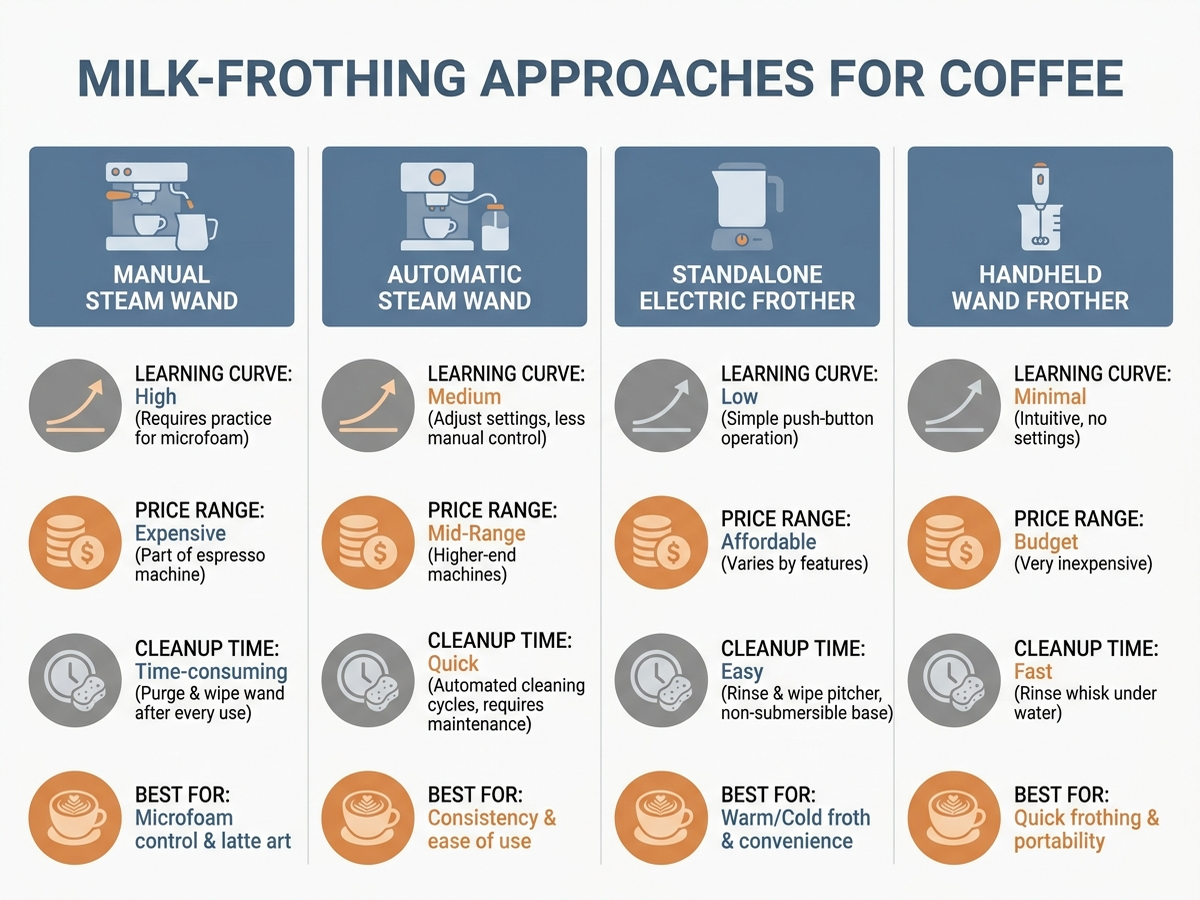
Four distinct frothing approaches now compete for the same buyer, and they trade off learning curve against convenience:
- Manual steam wand (most semi-automatic machines): Cheapest to manufacture, best ceiling for quality once mastered, steepest learning curve.
- Automatic steam wand (Breville Barista Touch Impress, De’Longhi La Specialista Touch and similar): A sensor or preset controls temperature and texture, removing most of the manual technique — manufacturers market this explicitly as a fix for the manual wand’s learning curve.
- Standalone electric frother (Nespresso Aeroccino, similar countertop units): A separate $70-$100 appliance that heats and froths milk in one step, no espresso machine required.
- Handheld wand frother (Zulay and similar battery-powered whisks): A $10-$25 stick you spin in a mug of already-hot milk — the least capable in foam quality, but effectively zero learning curve and near-zero cost.
2. Manufacturer- and product-specific patterns
Breville Barista Express (BES870XL). Amazon’s long-running best-seller in the semi-automatic category, rated 4.5 stars, per TechRadar’s coverage of its repeated deal cycles. It ships with a manual steam wand and no automatic assist — the grinder and shot-pulling side are largely automated, but frothing is left entirely to the owner. This split is a plausible contributor to the unused-wand pattern: buyers are drawn in by how automated the espresso side is, then discover the milk side isn’t automated at all.
Gaggia Classic Evo Pro (RI9380 series). An enthusiast-favorite entry-level machine built around a commercial-style two-hole steam wand. TechGearLab’s hands-on review reported that the wand’s microfoam results were inconsistent and took longer than expected, noting the wand “loses pressure during the steaming process, which is not ideal for producing rich microfoam” — useful context for buyers whose main goal is latte-quality microfoam, since even a well-regarded wand has real limits by drink type.
De’Longhi La Specialista line. De’Longhi sells both manual-wand (Arte, Prestigio) and automatic-wand (Touch) versions of the same core machine. The Touch’s automatic wand adjusts across five froth levels and four temperature presets with a manual override still available — a direct manufacturer acknowledgment that a meaningful share of buyers want the espresso-machine format without committing to manual steam-wand technique.
Nespresso Aeroccino (3, 4, XL). A standalone electric frother sold both bundled with Nespresso machines and separately. It removes the steam wand entirely: milk goes in, a button is pressed, froth comes out in roughly a minute, no technique required. For buyers who want café-style milk drinks without ever learning wand technique, this is the manufacturer-endorsed path — buy the pod machine for espresso, buy the Aeroccino for milk, skip the wand question entirely.
Zulay handheld frothers. A stainless-steel, battery-powered whisk under $25, backed by a lifetime guarantee per the manufacturer. Zulay’s Pro version specifies a 13,000 RPM motor (a manufacturer claim, not independently verified). This is the cheapest fallback in the category: it produces looser foam than a wand or Aeroccino, but it costs less than a bag of coffee beans and needs zero practice.
3. Cost and capability compared
| Product | Price (USD, at time of writing) | Frothing method | Learning curve | Foam quality ceiling |
|---|---|---|---|---|
| Breville Barista Express BES870XL | ~$700 | Manual steam wand | Steep | High, once mastered |
| Gaggia Classic Evo Pro RI9380/46 | ~$450 | Manual 2-hole steam wand | Steep | High for cappuccino foam; limited for fine microfoam per TechGearLab |
| De’Longhi La Specialista Touch | ~$900 | Automatic steam wand (manual override) | Low | Medium-high |
| Nespresso Aeroccino 3 | ~$70 | Standalone electric frother | Very low | Medium |
| Zulay Pro Handheld Frother | ~$20 | Handheld battery whisk | Near zero | Low-medium |
If you already own a steam-wand machine and mostly leave it alone, adding a $20-$70 standalone frother is a far smaller expense than an unused wand implies you’ve already spent — the sunk cost of the machine doesn’t need to compound into avoiding milk drinks altogether.
4. Learning the wand, if you want to keep trying
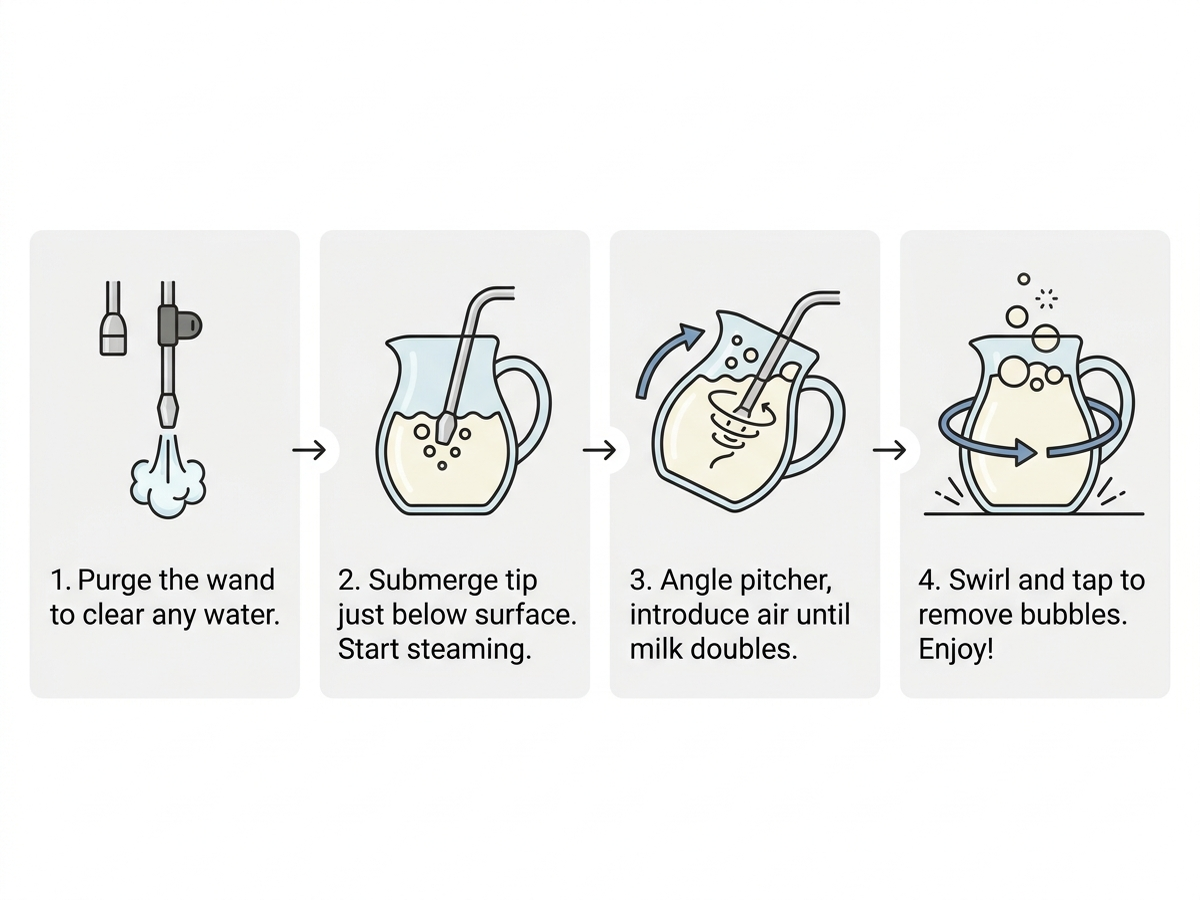
If the goal is to actually use the wand you already have rather than replace it, the core technique independent guides describe consistently comes down to four steps: purge the wand briefly to clear condensation, submerge the tip just below the milk’s surface to introduce air (“stretching”), then lower the pitcher slightly to fully submerge the tip and spin the milk into a smooth vortex (“texturing”) until it roughly doubles in volume, and finally swirl and tap the pitcher on the counter to knock out large bubbles before pouring. Independent buying guides describe this as a skill that rewards repeated practice more than any single tip — expect several attempts before the technique clicks, and expect some wasted milk along the way.
5. Warranty and support context
Espresso-machine warranties typically run one year for the full machine in the US, standard across Breville, Gaggia, and De’Longhi’s mainstream lines, though exact terms vary by retailer and registration. A wand that clogs from dried milk (the most common wand-specific failure) is generally considered normal-wear maintenance rather than a warranty-covered defect — manufacturers universally instruct owners to purge and wipe the wand immediately after each use specifically to prevent this. Standalone frothers like the Aeroccino and handheld units carry their own separate, typically shorter, one- to two-year warranties, and Zulay specifically markets a lifetime guarantee on its handheld line per the manufacturer’s product listing.
6. Editorial recommendation by use case
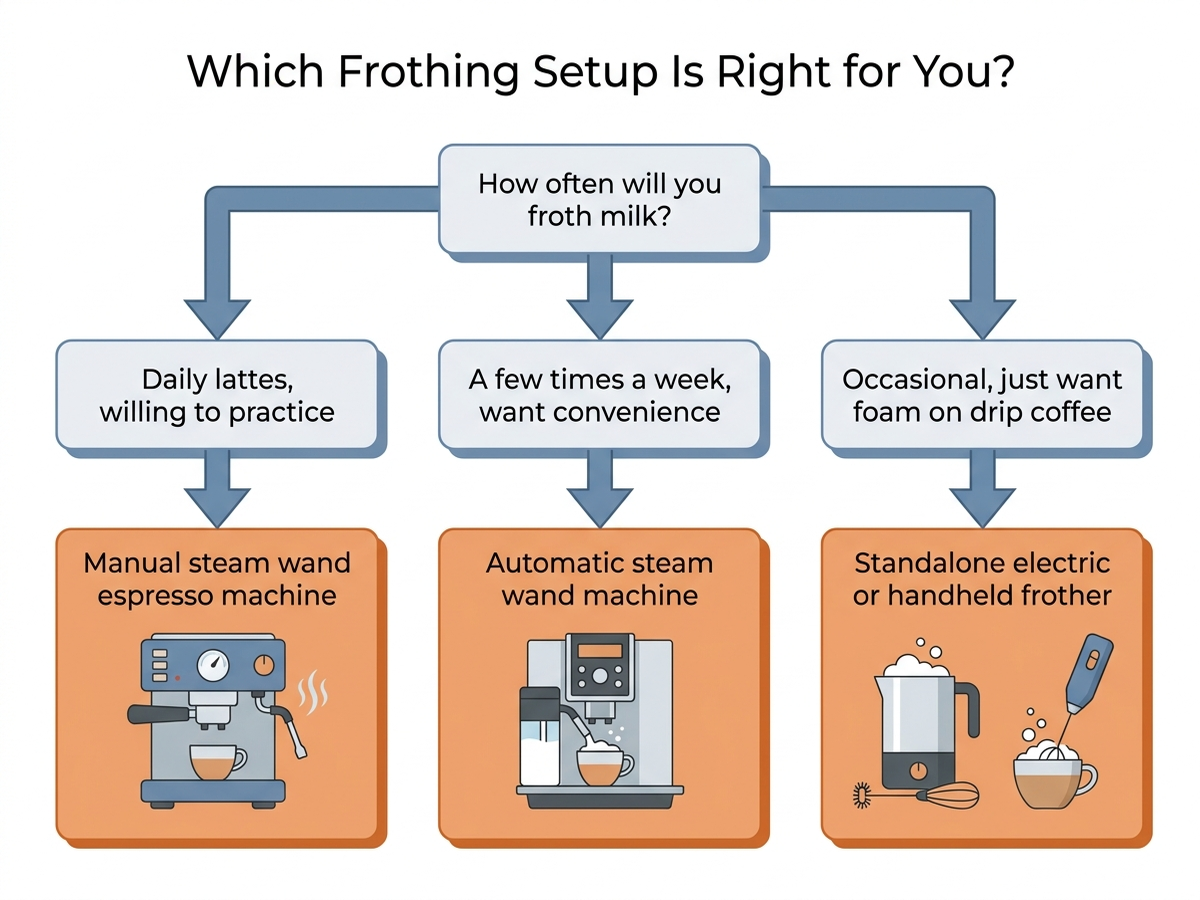
Daily lattes or cappuccinos, willing to practice: A manual-steam-wand machine like the Breville Barista Express or Gaggia Classic Evo Pro remains the best value once the technique is learned — the foam-quality ceiling is highest, and the cost per drink over years of use is lowest.
Want café-style milk drinks without the practice: An automatic-wand machine like the De’Longhi La Specialista Touch, or a manual-wand machine paired with a standalone Aeroccino-style frother, better matches a buyer who has already tried and abandoned wand technique once.
Espresso most days, milk drinks occasionally: Keep the manual-wand machine for the espresso side, and add a $15-$25 handheld frother for the rare latte — cheaper and lower-commitment than upgrading the whole machine.
Mostly drip coffee, want foam sometimes: Skip the espresso machine question entirely; a standalone frother or handheld whisk solves milk texture on its own.
Limitations
This analysis relies on publicly available reviews, forum discussion, manufacturer specifications, and third-party test data; we did not personally test the products covered. Community forum sentiment (home-barista.com) is directional, not a statistically representative survey, and individual experience with any steam wand varies based on milk type, practice time, and unit-to-unit variance. Pricing reflects amazon.com listings at time of writing and may change.
Have questions about which espresso setup fits your routine? Visit Arekore to compare products and verify current pricing before you buy.