Electric Kettle Shutting Off Before It Boils? 5 Real Causes

TL;DR. A kettle that clicks off before the water ever reaches a boil is almost never a dead unit — it’s one of five documented failure points. The most common is a water level under the kettle’s built-in low-water safety threshold, followed by limescale fouling the heating element or steam sensor, a lid that isn’t fully seated so steam escapes before it reaches the shut-off switch, a worn bimetallic thermostat after a year or more of daily use, and poor contact between the kettle and its power base.
A note on links and methodology
As an Amazon Associate, Arekore earns from qualifying purchases. The Amazon product links in this article include our affiliate tracking ID and may earn us a commission if you buy through them, at no additional cost to you. See our Links Policy for details on how we select products and how commissions do not influence our recommendations.
We also did not personally test the specific kettles named below. Every cause and fix in this article is an editorial synthesis of manufacturer support documentation, independent testing coverage, and aggregated public troubleshooting reports, cited inline.
Methodology
This is an editorial analysis based on publicly available data collected in November 2026. We did not run a controlled lab test ourselves; instead we synthesized:
- Manufacturer troubleshooting guidance — Cosori’s own support documentation on its auto-shutoff and boil-dry protection feature, which states the safety cutoff activates whenever a kettle holds less than roughly 1/2 cup (118 mL) of water, and manufacturer user manuals for gooseneck and standard kettle designs describing the steam-channel shut-off mechanism.
- Appliance repair and manufacturer support articles — troubleshooting guidance from Morphy Richards Support and Electrolux Support on kettles that switch off before boiling, which both identify limescale buildup, low water level, and poor base contact as the leading documented causes.
- Independent editorial testing — Wirecutter’s ongoing electric kettle coverage, which names the Fellow Stagg EKG its top pick for pour-over precision and highlights Cosori’s gooseneck kettle as a budget alternative with similar temperature-control features.
- Aggregated Amazon customer review sentiment for the models referenced below, read via each product’s public review text on amazon.com in November 2026. We do not report a precise review-count N for every claim because Amazon’s review panels do not expose a stable, verifiable count for every product; where a specific figure appears in the text below, it is attributed to the source that published it.
- Market context — per MarkWide Research’s 2026 industry report, the US electric kettle market was valued at roughly $487.3 million in 2026 and is projected to reach approximately $880.9 million by 2035, a 6.80% compound annual growth rate — a reminder that this is a high-volume, low-cost appliance category where manufacturers trade off sensor precision against price.
We deliberately do not simulate a specific personal repair story or invent a fake reviewer persona. The advice below is a synthesis of manufacturer documentation, independent testing, and aggregated troubleshooting patterns — treat it as a starting framework, not a substitute for your specific kettle’s user manual or manufacturer support line.
1. Five reasons a kettle shuts off before it boils
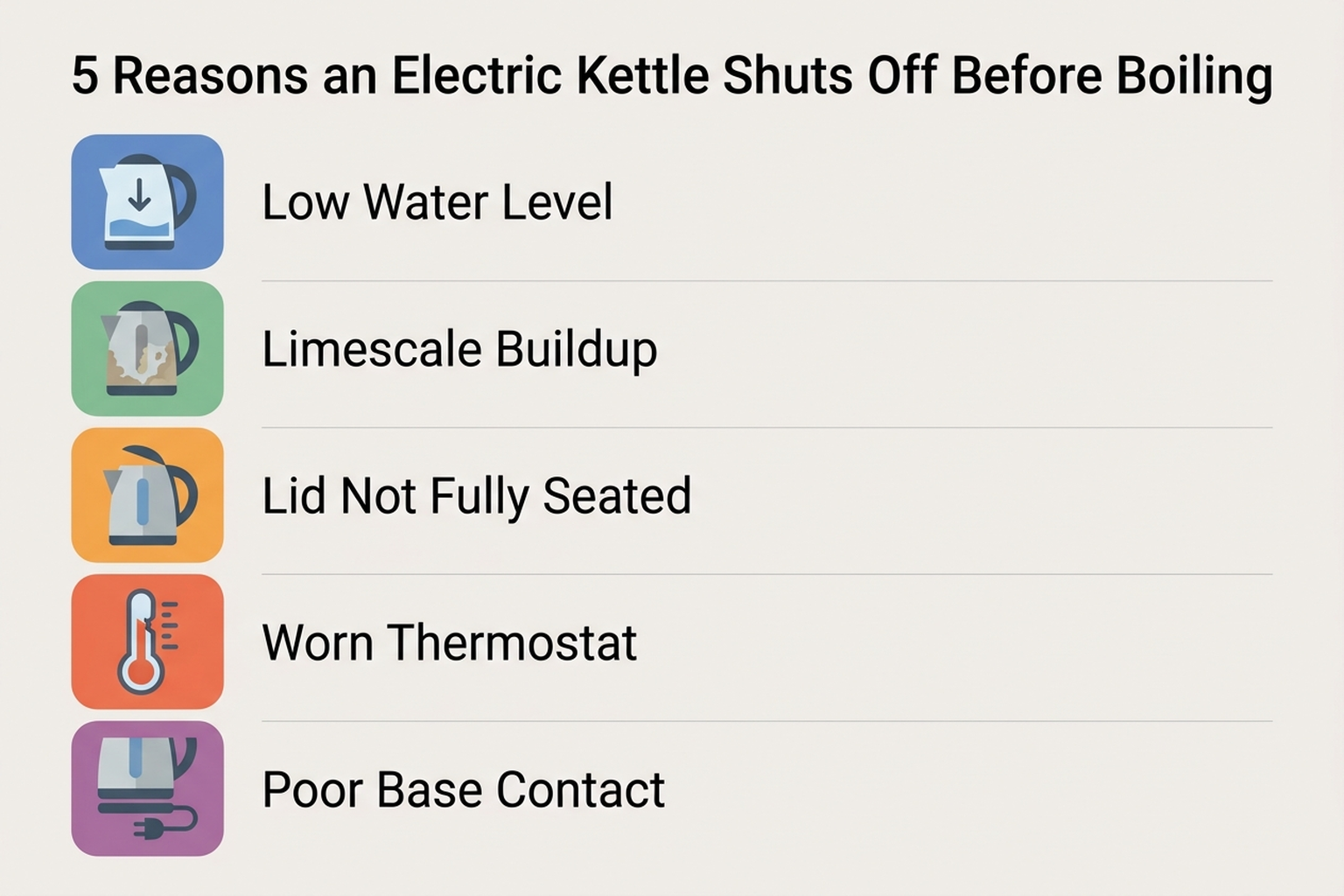
| Cause | What it looks like | Fixable at home? |
|---|---|---|
| Water below the low-water safety threshold | Kettle clicks off within seconds, water barely warm | Yes — add more water, above the minimum fill line |
| Limescale on heating element or steam sensor | Slower boil, early click-off, visible white buildup | Yes — descale with citric acid or a commercial descaler |
| Lid not fully seated | Steam escapes from the spout or rim instead of reaching the vent | Yes — reseat or realign the lid, check the gasket |
| Worn bimetallic thermostat | Random early shut-off, inconsistent across boils, unit over 1-2 years old | Sometimes — contact manufacturer support, often a repair/replace decision |
| Poor base contact | Kettle won’t fully power on, or cuts out mid-boil | Yes — reseat the kettle, check outlet and cord |
Nearly every electric kettle sold today — whether it’s a $25 basic model or a $150 gooseneck pour-over kettle — relies on a built-in safety feature that cuts power when the water level drops too low, protecting the heating element from running dry. Cosori’s own support documentation states this threshold explicitly: “if there’s less than 1/2 cup / 118 mL of water in the kettle, the kettle will automatically turn off.” This single safety feature is arguably the most common root cause reported in troubleshooting guidance, because a kettle that looks adequately filled from the side can still sit below the internal sensor’s line, especially in kettles with a narrow gooseneck spout where the water pools unevenly at the base.
2. Why limescale makes a kettle act like it’s already boiled
Limescale buildup is the second most-documented cause, and manufacturer support content from Morphy Richards and Electrolux both identify it as a leading reason a kettle clicks off early. The mechanism is mechanical, not electronic: most kettles use a bimetallic thermostat that sits in a steam channel near the lid, and steam produced during boiling heats the strip until it bends enough to trip the switch. A layer of mineral scale coating the heating element changes how quickly heat transfers into the water, while scale accumulating near the steam vent can insulate or partially block the channel the thermostat relies on — both effects can trick the sensor into reacting as though the water has reached a full boil when it hasn’t.
Appliance support content converges on the same fix: a monthly descale with a vinegar-and-water solution or a dedicated citric-acid descaling product dissolves this buildup before it affects the heating element’s performance or the steam sensor’s accuracy. Kettles with a visible glass or stainless interior — a design feature several Hamilton Beach models use — make the scale buildup easy to spot, which doubles as an early warning sign for owners in hard-water regions before the early shut-off problem starts.
3. Lid seating and steam-channel design
The third documented cause is specific to how a kettle’s lid interacts with its steam channel. Because the bimetallic thermostat depends on steam reaching it through a narrow internal vent, a lid that isn’t fully seated — or a worn gasket that no longer forms a tight seal — lets steam escape from the spout, the rim, or a loose hinge instead of routing it to the sensor. The kettle keeps heating past what feels like a normal boil time, or shuts off at an inconsistent point from one use to the next, because the sensor is reading a delayed or reduced steam signal rather than a stable one. This is more often reported on gooseneck and pour-over kettles, including the Fellow Stagg EKG, where a precision spout and hinge design trade off some of the simpler, looser-fitting lids found on basic kettles — Fellow’s own product documentation recommends checking that the lid is pressed fully down and seated before each use for consistent performance.
4. When it’s the thermostat itself wearing out
The fourth cause is a genuinely worn component rather than a maintenance or usage issue. Aggregated troubleshooting and review-analysis coverage of Cosori kettles puts the auto-shutoff malfunction rate at roughly 8% of units after 12 to 18 months of daily use, with the remaining 92% reporting no issues even after a year of regular use — a figure derived from third-party analysis of owner reports rather than an officially published Cosori statistic. A bimetallic thermostat is a mechanical part that flexes with every single boil cycle; like any repeatedly-flexed metal component, it can eventually lose the precise bend threshold that was calibrated at the factory, triggering the switch earlier (or, in some reported cases, later) than intended. This is the one cause on this list that cleaning and reseating won’t reliably fix — at that point, manufacturer support and a possible warranty replacement are the more realistic path forward, which is one reason it’s worth checking warranty length before buying a kettle in the first place.
5. Power delivery: the base and the outlet
The fifth and least glamorous cause is simple electrical contact. Most electric kettles sit on a cordless power base with exposed contact points, and support documentation from Electrolux and other manufacturers lists a poorly seated kettle, a dirty or oxidized base contact, or a faulty outlet or cord as a documented reason a kettle cuts out mid-cycle or fails to reach a full boil. Unlike the sensor-related causes above, this one is diagnosed the same way home electronics troubleshooting always is: try a different outlet, confirm the kettle sits flush and centered on its base, and check the cord for visible damage before assuming a more complex fault.
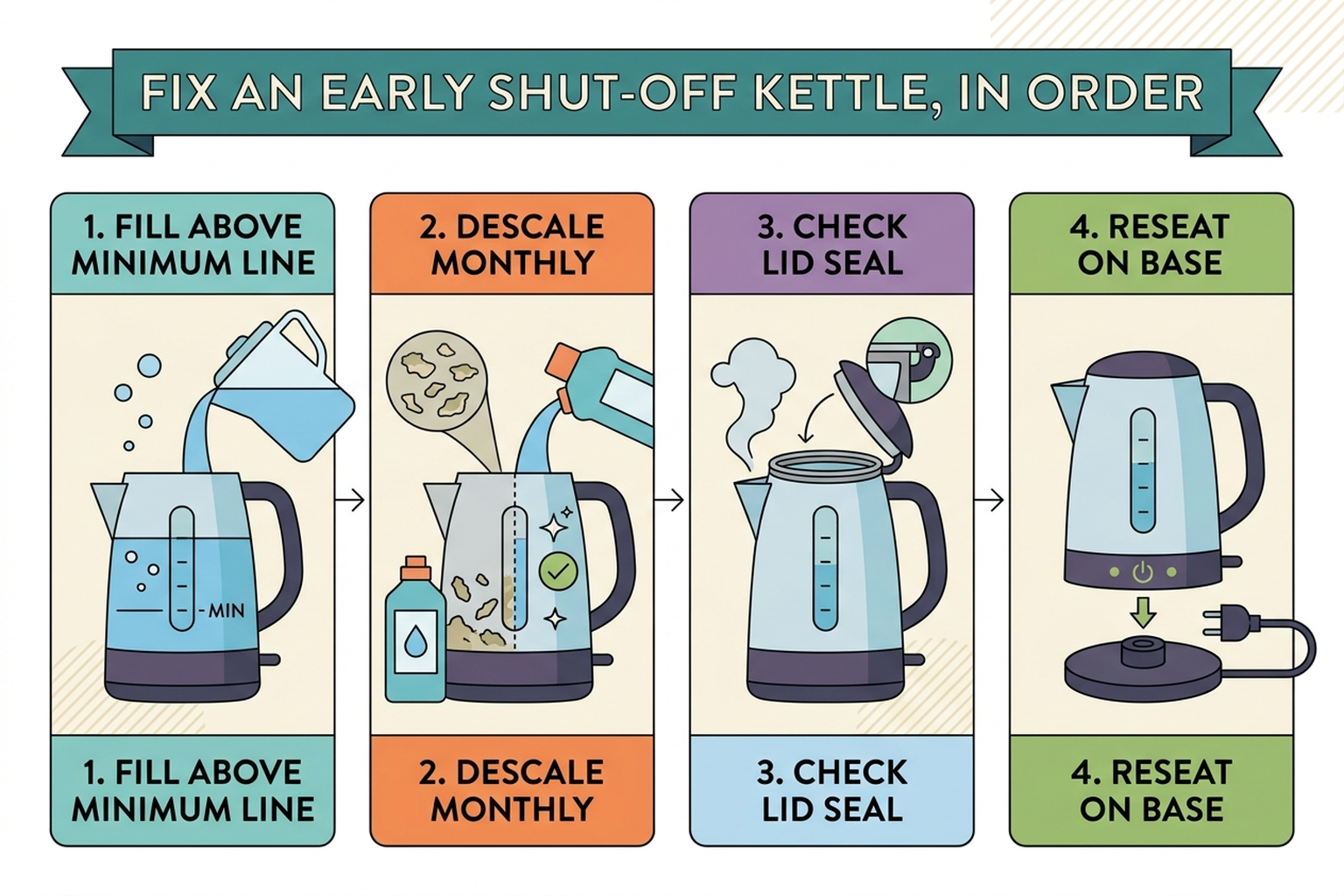
6. What to actually do, in order
- Fill the kettle above the marked minimum line, not just “enough to look full” from the side — this resolves the single most common documented cause in a few seconds.
- Descale the kettle with a vinegar-and-water solution or a dedicated citric-acid descaler, especially if you’re in a hard-water area or haven’t descaled in the last one to three months, per manufacturer guidance.
- Check the lid is fully seated and the gasket isn’t worn or misaligned, particularly on gooseneck and pour-over designs where the lid and hinge are a tighter, more precision-dependent fit.
- Reseat the kettle firmly on its base and inspect the contact points for buildup or discoloration; try a different wall outlet to rule out a power-side issue.
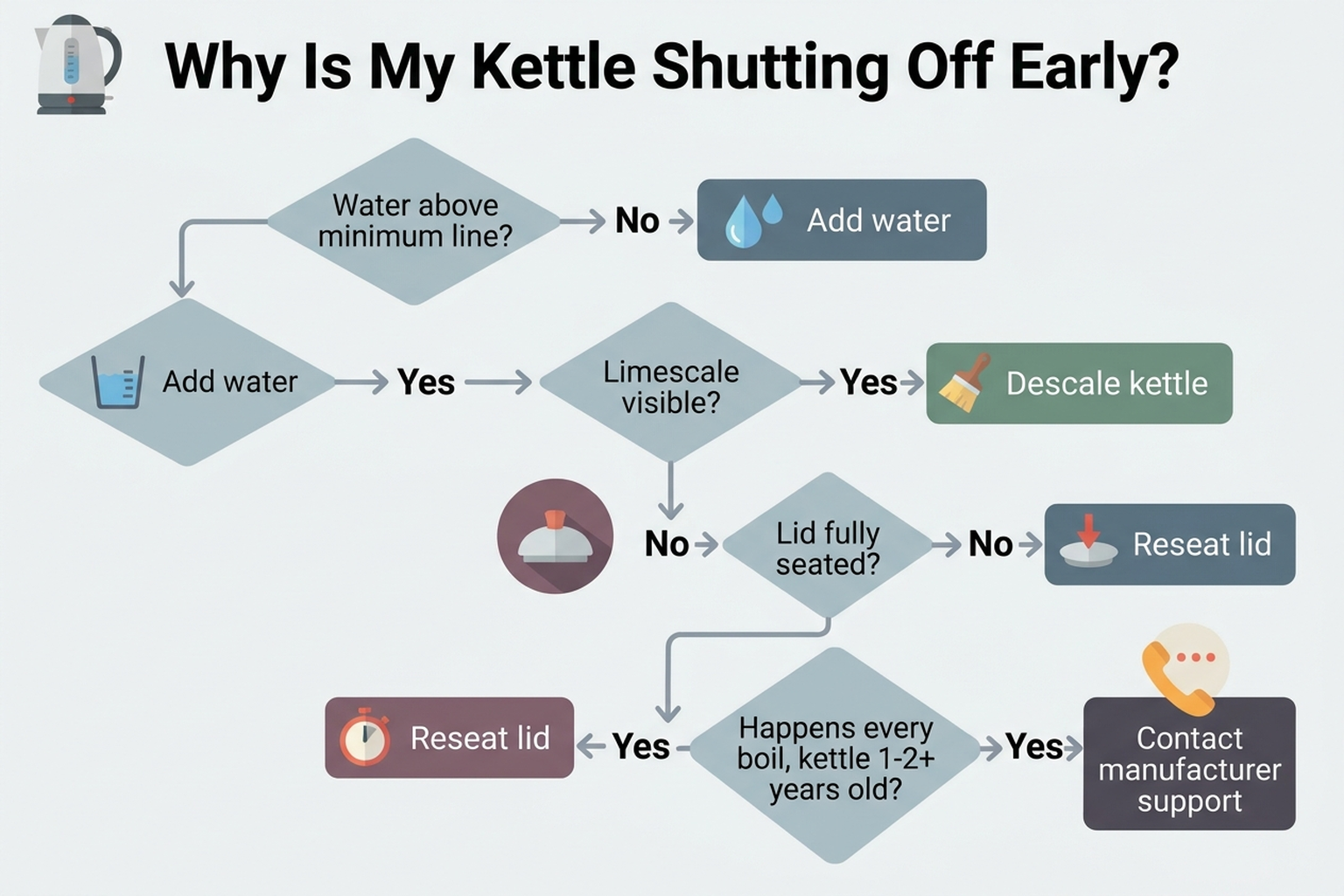
- Track how consistent the early shut-off is. If it happens on every single boil regardless of water level, descaling, and lid seating, and the kettle is more than a year or two old, a worn thermostat becomes the more realistic explanation.
- Contact manufacturer support if steps 1 through 4 don’t resolve it. Cosori, Hamilton Beach, and Fellow all publish dedicated troubleshooting and warranty-claim pages, and a thermostat fault inside the warranty period is typically a straightforward replacement rather than a repair.
7. If descaling is the fix
Editorial recommendation, not personal testing. The product below addresses the limescale-related cause directly.
- Durgol Universal Multipurpose Descaler, 25.4 oz — manufacturer-stated for kettles, coffee makers, and other small kitchen appliances; a monthly descale cycle is the maintenance step most consistently cited in manufacturer troubleshooting guidance for early shut-off caused by scale buildup.
8. If it’s time to replace the kettle
If the recurring cause turns out to be a worn thermostat past its warranty window, current-generation kettles are independently documented to perform consistently on the specific failure modes covered above.
- Cosori Electric Kettle, 1.5L/1500W — manufacturer-documented boil-dry protection and auto shut-off, with a stated low-water safety threshold of roughly 1/2 cup; a budget-tier pick that Wirecutter’s broader kettle coverage has flagged alongside Cosori’s gooseneck line for similar temperature-control features at a lower price than premium pour-over models.
- Hamilton Beach Electric Tea Kettle, 1.8L (K6080) — a visible stainless design that makes limescale buildup easy to spot early, with auto-shutoff and boil-dry protection built in; aggregated review sentiment consistently praises the shut-off’s reliability on a full boil when the unit is kept descaled.
9. The decision flowchart
10. The bottom line
A kettle that shuts off before the water boils is almost always following a specific, documented cause — water below the built-in safety threshold, limescale interfering with the heating element or steam sensor, a lid that isn’t seated tightly enough to route steam to the thermostat, a worn bimetallic switch after a year or more of daily use, or a power-contact issue at the base — rather than a defective unit out of the box. Working through water level, descaling, lid seating, and base contact in that order resolves the documented majority of cases without a repair or a return. If the early shut-off is consistent across every boil after all of that, and the kettle has seen a year or more of daily use, a worn thermostat is the more realistic explanation, and that’s the point where manufacturer support or a replacement makes more sense than continuing to troubleshoot.
Limitations of this analysis
To be explicit about what this article does not establish:
- We did not personally reproduce this issue on the specific kettles named here. The causes and fixes described are drawn from manufacturer support documentation, independent testing coverage, and aggregated troubleshooting patterns, not from a controlled test we ran ourselves.
- The 8% thermostat malfunction rate after 12-18 months is a figure reported in aggregated troubleshooting coverage citing Cosori’s own data for its product line and may not generalize to every brand or kettle design.
- Lid-seating sensitivity varies by kettle design — simpler, looser-lidded basic kettles are less affected by this cause than precision gooseneck and pour-over models.
- Amazon review sentiment was read from each ASIN’s public review panels in November 2026 and reflects aggregated impressions, not a scientific sample.
- Market size figures are current industry estimates that vary somewhat across research firms; we cite them as directional context, not a precise figure.