Eero vs Google Nest WiFi: Which Mesh Router Wins in 2026?

Eero and Google Nest WiFi are the two mesh systems US shoppers compare most often when a single router can’t cover the whole house, and the two brands are backed by the two ecosystems most homes are already locked into. Amazon-owned Eero leans on Alexa and a built-in Zigbee hub; Google’s Nest WiFi Pro leans on Google Home, Matter, and a Thread border router in every node. Consumer Reports’ lab testing as of February 2026 puts nearly every current Eero model ahead of the Google Nest WiFi Pro 6E on overall performance and reliability — but Google’s system is free of Eero’s subscription requirement for basic security features, and it’s the stronger pick for Matter-based smart-home builds. This guide compares the two brand-for-brand, tier-for-tier, using aggregated Amazon customer data, independent lab testing, and manufacturer specifications.
As an Amazon Associate, Arekore earns from qualifying purchases. The Amazon product links in this article may include our affiliate tracking ID and may earn us a commission if you buy through them, at no additional cost to you. See our Links Policy for details on how we select products and how commissions do not influence our recommendations.
TL;DR / Quick Verdict
- Best overall performance, per independent lab testing: Eero. Consumer Reports’ February 2026 router ranking places nearly every current Eero model ahead of the Google Nest WiFi Pro 6E on throughput and predicted reliability.
- Best for a Matter/Thread smart-home build and Google Home households: Google Nest WiFi Pro. Every node ships with a built-in Matter and Thread border router, plus real-time threat protection and parental controls included at no extra cost.
- Cheaper to use long-term if you want security features: Google. Eero gates ad blocking, advanced parental controls, and backup-internet failover behind the eero Plus subscription (roughly $10/month or $99.99–$149.99/year); Google includes comparable threat protection and parental controls free for as long as you own the router.
- RTINGS’ closest head-to-head goes to Eero at longer range: the eero Pro 6E and Google Nest WiFi Pro 6E “perform similarly,” per RTINGS’ own comparison tool, with Eero pulling ahead specifically at longer range and Google finishing narrowly ahead on RTINGS’ multi-level-home score for its Pro 6E vs. Eero’s older Pro 6 (not Pro 6E) unit.
- Ecosystem lock-in cuts both ways: if you already use Alexa, Zigbee, or Thread devices, Eero’s app and hub integration make more sense; if you’re deep in Google Home, Nest thermostats, or Nest doorbells, the Matter/Thread hub built into every Nest WiFi Pro node is the more useful pick.
How We Reached These Conclusions (Methodology)
This is an editorial analysis, not a hands-on review; we did not personally test the products covered here. This guide synthesizes three kinds of public information: (a) aggregated amazon.com customer reviews for current-generation Eero and Google Nest WiFi hardware, sampled in September 2026; (b) independent third-party lab testing and reporting from Consumer Reports and RTINGS; and (c) manufacturer-published specifications for throughput, coverage area, and subscription pricing. Where we cite a manufacturer figure — coverage square footage, device-connection limits, speed claims — we label it as a manufacturer claim rather than an independently verified result. Prices are amazon.com figures at the time of writing and change frequently, especially around sale events; treat every price below as approximate.
Technical Approach: Ecosystem Hub vs. Raw Lab Performance
The two brands are optimizing for different things: Eero for raw throughput and reliability scores, Google for a built-in smart-home hub that comes free with every node.
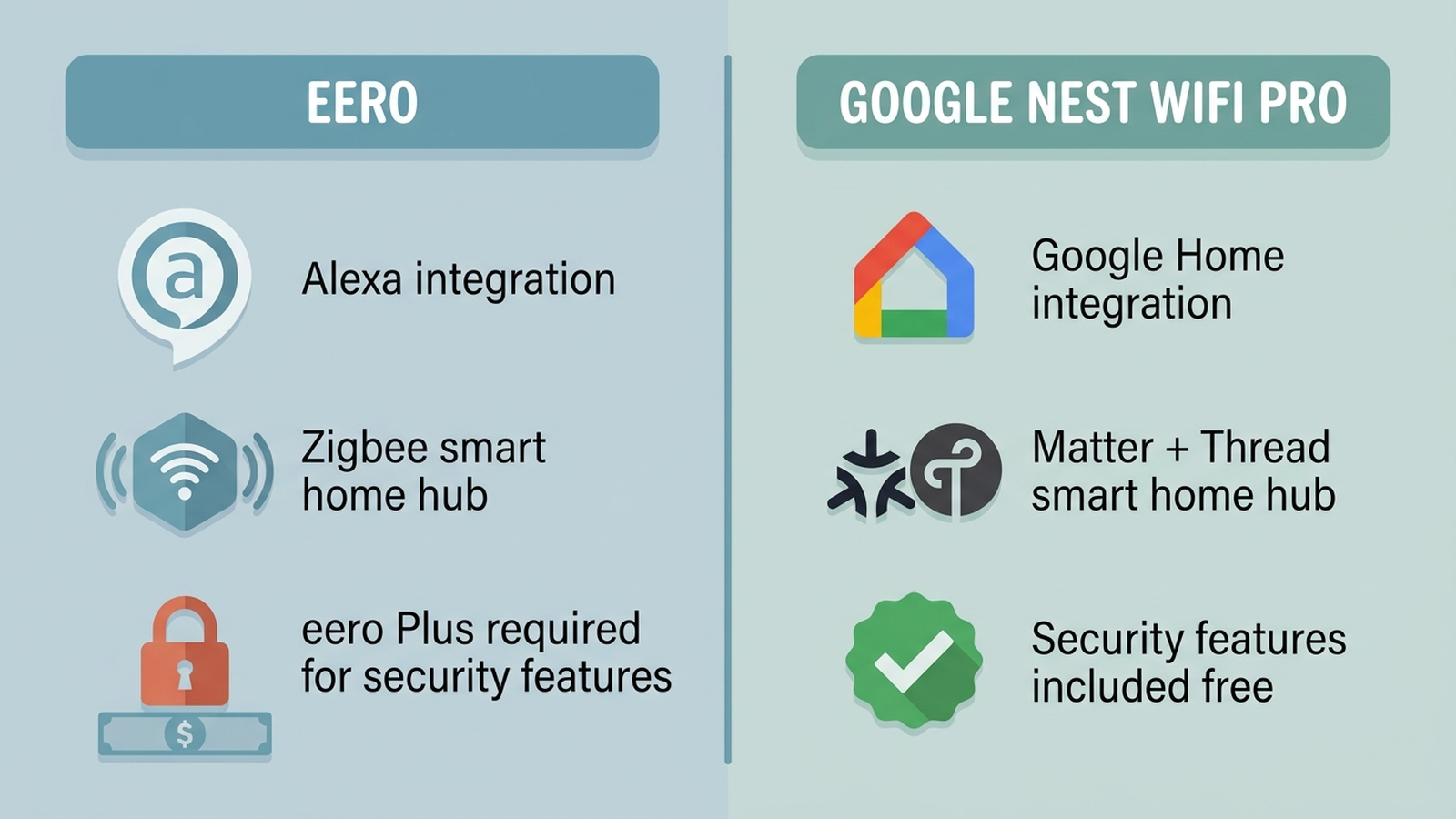
- Smart-home hub built in. Every Google Nest WiFi Pro node includes a Matter and Thread border router, so it doubles as a hub for Nest thermostats, Nest door locks, and any Matter-certified accessory without extra hardware. Eero’s Pro-series nodes include a built-in Zigbee smart-home hub, which covers a different (older but still widely used) class of devices than Nest WiFi Pro’s Matter/Thread focus.
- Subscription-gated features. Eero requires the eero Plus subscription (~$10/month, or $99.99–$149.99/year) to unlock ad blocking, advanced parental controls, and internet backup/failover. Google includes real-time threat protection and parental controls free for as long as you own the Nest WiFi Pro hardware — no subscription required for those specific features.
- Lab-tested performance. Consumer Reports’ February 2026 ranking, which scores routers on throughput, range, predicted reliability, and data security, places nearly every current Eero model ahead of the Google Nest WiFi Pro 6E; the one exception is the 3-pack eero 6+ AX3000, which Consumer Reports found lagging on throughput compared to its own 2-pack configuration.
- App and setup experience. Eero’s app has consistently drawn praise in aggregated reviews for its clear device list, per-profile controls, and built-in speed tests. Google’s setup is comparably simple through the Google Home app, and Consumer Reports specifically credits Nest WiFi Pro with beating Eero on ease of setup and data-privacy scoring, even where Eero wins on raw performance.
Manufacturer Deep Dive
Eero (Amazon)
Eero, owned by Amazon since 2019, positions its mesh systems around raw performance and tight Alexa integration. The current flagship, eero Pro 7, supports Wi-Fi 7, internet plans up to 5 Gbps, and a manufacturer-claimed coverage of up to 6,000 sq. ft. in a 3-pack — figures from Amazon’s own product listing, not independently verified. Consumer Reports’ lab testing, comparing the eero Pro 7 directly against the Google Nest WiFi Pro 6E, found the eero model ahead on data security and on throughput at every tested range, while Google’s unit came out ahead on data privacy and ease of setup specifically. On RTINGS’ comparison tool, the (older, Wi-Fi 6) eero Pro 6 scores lower in a multi-level-home test than the newer Google Nest WiFi Pro 6E (7.8), while RTINGS’ separate comparison of the same-generation eero Pro 6E against Nest WiFi Pro 6E found the two “perform similarly,” with Eero specifically pulling ahead at longer range. Reading across both RTINGS comparisons: generation-for-generation, Eero’s edge over Google narrows or disappears depending on which specific Eero model is being tested — buyers should check the exact model number, not just the “Eero” brand name, before assuming Eero wins outright. Eero’s subscription, eero Plus, costs roughly $10/month (or $99.99–$149.99/year) and is required to unlock ad blocking, advanced parental controls, and backup-internet failover — features that ship free on the competing Google hardware.
Google Nest WiFi Pro
Google’s current mesh flagship, Nest WiFi Pro, ships Wi-Fi 6E across every node and includes a built-in Matter and Thread border router in each unit — a meaningful advantage for households already invested in Nest thermostats, Nest door locks, or other Matter-certified smart-home accessories, since no additional hub hardware is needed. Unlike Eero, Google bundles real-time threat protection and parental controls into the base hardware price with no recurring subscription required for those features. Consumer Reports’ February 2026 ranking found the Nest WiFi Pro’s overall reliability score “more moderate” than the above-average reliability Consumer Reports measured across most current Eero models, even as Google edged ahead on ease of setup and data-privacy criteria specifically. Google continues to sell the original, older Nest Wifi (non-Pro, Wi-Fi 5/AC2200) alongside the newer Pro 6E line at a lower price point, which matters for shoppers comparing budget-tier options rather than flagship-to-flagship.
Head-to-Head: Flagship Tri-Band Systems
Eero Pro 7 (3-pack) is Eero’s current Wi-Fi 7 flagship, supporting internet plans up to 5 Gbps with a manufacturer-claimed coverage of up to 6,000 sq. ft. and 200+ connected devices. It typically lists around $399.99–$599.99 but has been discounted to roughly $235–$300 during recent sale events (as of 2026-09-18) — check the live listing, since Eero’s pricing swings widely around Prime Day and other promotions.
Check the Eero Pro 7 (3-pack) on Amazon
Google Nest WiFi Pro (3-pack, Wi-Fi 6E) covers a comparable whole-home footprint with a built-in Matter/Thread hub in every node. It typically lists around $399.99 and has been discounted to roughly $249.99–$270 in recent Amazon and Google Store pricing (as of 2026-09-18).
Check the Google Nest WiFi Pro (3-pack) on Amazon
Verdict at this tier: per Consumer Reports’ direct eero Pro 7 vs. Nest WiFi Pro 6E comparison, Eero wins on throughput at every tested range and on data security; Google wins on ease of setup and data-privacy scoring. Buyers deep in Matter/Thread smart-home devices still get more out-of-the-box value from Nest WiFi Pro’s built-in hub; buyers who prioritize raw speed and already use Alexa or Zigbee devices get more from Eero.
Head-to-Head: Budget/Entry Tier
Eero 6+ (3-pack) supports internet plans up to a gigabit with a manufacturer-claimed coverage up to 4,500 sq. ft. It typically lists around $299.99 but has hit lows near $195 during Prime Day-adjacent sales (as of 2026-09-18). Consumer Reports flagged the 3-pack configuration specifically as its weakest current Eero result, citing throughput well below the 2-pack’s score.
Check the Eero 6+ (3-pack) on Amazon
Google Nest Wifi (2-pack, original AC2200 generation) is Google’s older, non-Pro mesh line — Wi-Fi 5-class rather than 6E — with a manufacturer-claimed coverage around 2,200 sq. ft. per unit. It typically sells for well under $200 for the 2-pack (as of 2026-09-18), making it the cheaper entry point of the two brands, at the cost of older Wi-Fi standards and no Matter/Thread hub.
Check the Google Nest Wifi (2-pack) on Amazon
Verdict at this tier: neither budget option is each brand’s best lab performer. Consumer Reports specifically dinged the eero 6+ 3-pack’s throughput relative to its own 2-pack, so buyers considering that configuration should compare the eero 6+ 2-pack instead before assuming more nodes means better performance. Google’s original Nest Wifi is the cheaper of the two here but skips Wi-Fi 6E and the Matter/Thread hub found on the newer Pro line.
Customer Sentiment Synthesis
- App usability favors Eero. Aggregated owner feedback frequently praises Eero’s app for its clear device list, per-profile parental controls, and built-in speed-test tool, describing the setup flow as more polished than competing mesh apps.
- Subscription friction is Eero’s most common complaint. Reviewers repeatedly flag that ad blocking, advanced parental controls, and backup-internet failover require the paid eero Plus tier, while equivalent Google features ship free — a recurring point of frustration in owner feedback for buyers who expected those features included at the hardware price.
- Matter/Thread integration draws praise for Nest WiFi Pro among smart-home-heavy households. Owners with multiple Matter-certified devices report the built-in hub simplifying setup compared to needing separate hub hardware.
- Net read: aggregated sentiment favors Eero on app polish and raw performance, and favors Google on total cost of ownership and smart-home hub value — neither brand is complaint-free, and buyers already committed to Alexa or Google Home should weight ecosystem fit as heavily as the lab scores above.
Comparison Table
Prices as of 2026-09-18 — Amazon frequently runs short-term discounts on both brands, especially around Prime Day and Black Friday; check the live listing before buying.
| Product | Wi-Fi standard | Claimed coverage | Smart-home hub | Security features included free | Price |
|---|---|---|---|---|---|
| Eero Pro 7 (3-pack) | Wi-Fi 7 | ~6,000 sq. ft. | Zigbee | No (requires eero Plus) | ~$235–$599 |
| Google Nest WiFi Pro (3-pack) | Wi-Fi 6E | ~6,600 sq. ft. | Matter + Thread | Yes | ~$250–$400 |
| Eero 6+ (3-pack) | Wi-Fi 6 | ~4,500 sq. ft. | Zigbee | No (requires eero Plus) | ~$195–$300 |
| Google Nest Wifi (2-pack, original) | Wi-Fi 5 (AC2200) | ~2,200 sq. ft./unit | None | Limited | Under $200 |
How to Decide
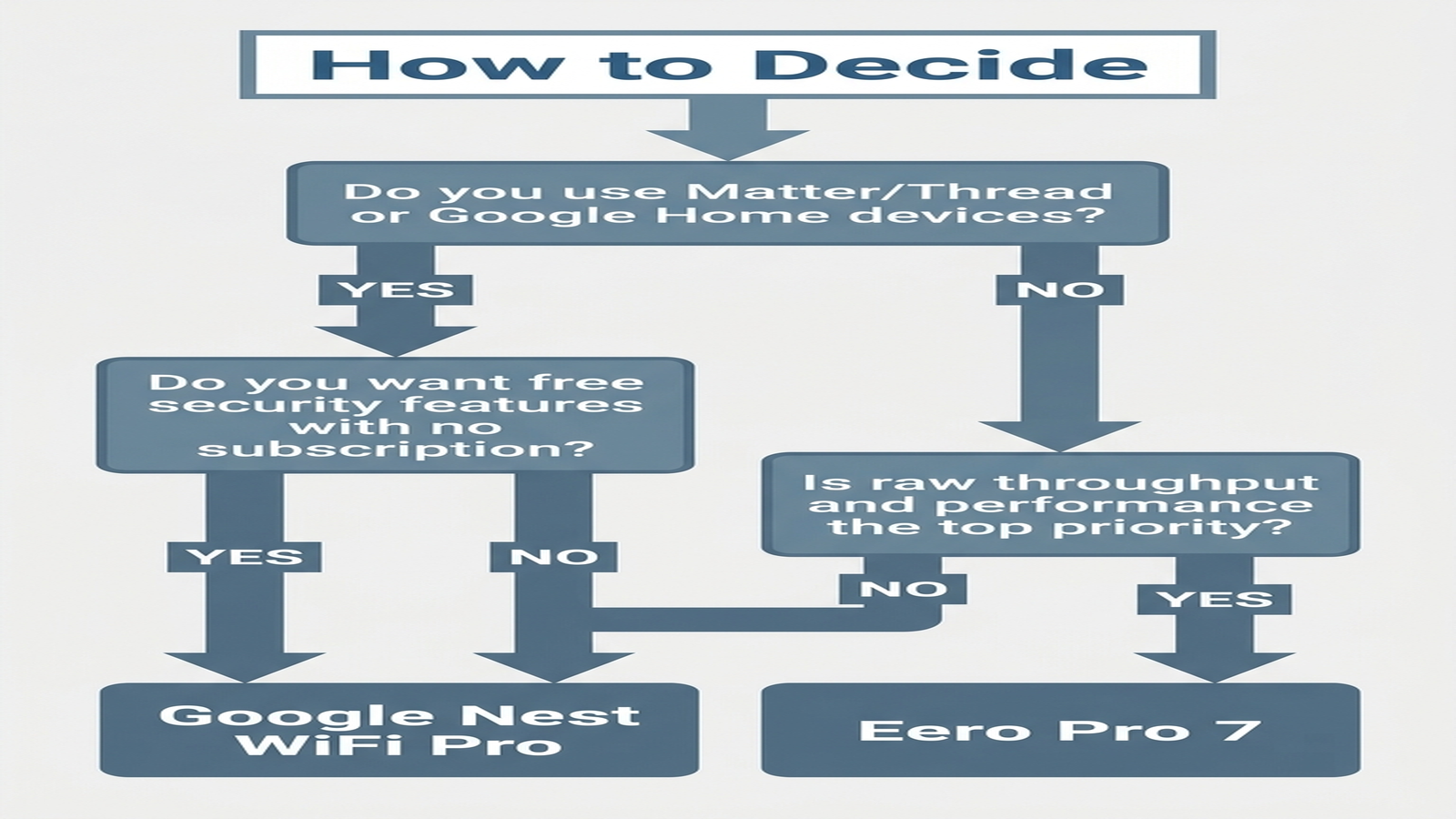
- You want the best independently tested raw performance and already use Alexa or Zigbee devices: Eero, per Consumer Reports’ February 2026 ranking — but check the specific model, since results vary by generation and pack size.
- You have Matter or Thread smart-home devices, or you’re deep in Google Home: Google Nest WiFi Pro’s built-in hub is the more useful pick out of the box.
- You don’t want to pay a subscription for basic security features: Google includes threat protection and parental controls free; Eero gates comparable features behind eero Plus (~$10/month).
- You’re buying the eero 6+ specifically: compare the 2-pack and 3-pack throughput scores before choosing the 3-pack for coverage alone — Consumer Reports found the 3-pack configuration’s throughput notably weaker.
- Budget is the top priority and you don’t need Wi-Fi 6E: the older Google Nest Wifi 2-pack is the cheapest option of the four covered here, at the cost of an older Wi-Fi standard and no Matter/Thread hub.
Decision Flowchart: Ecosystem, Budget, or Raw Performance
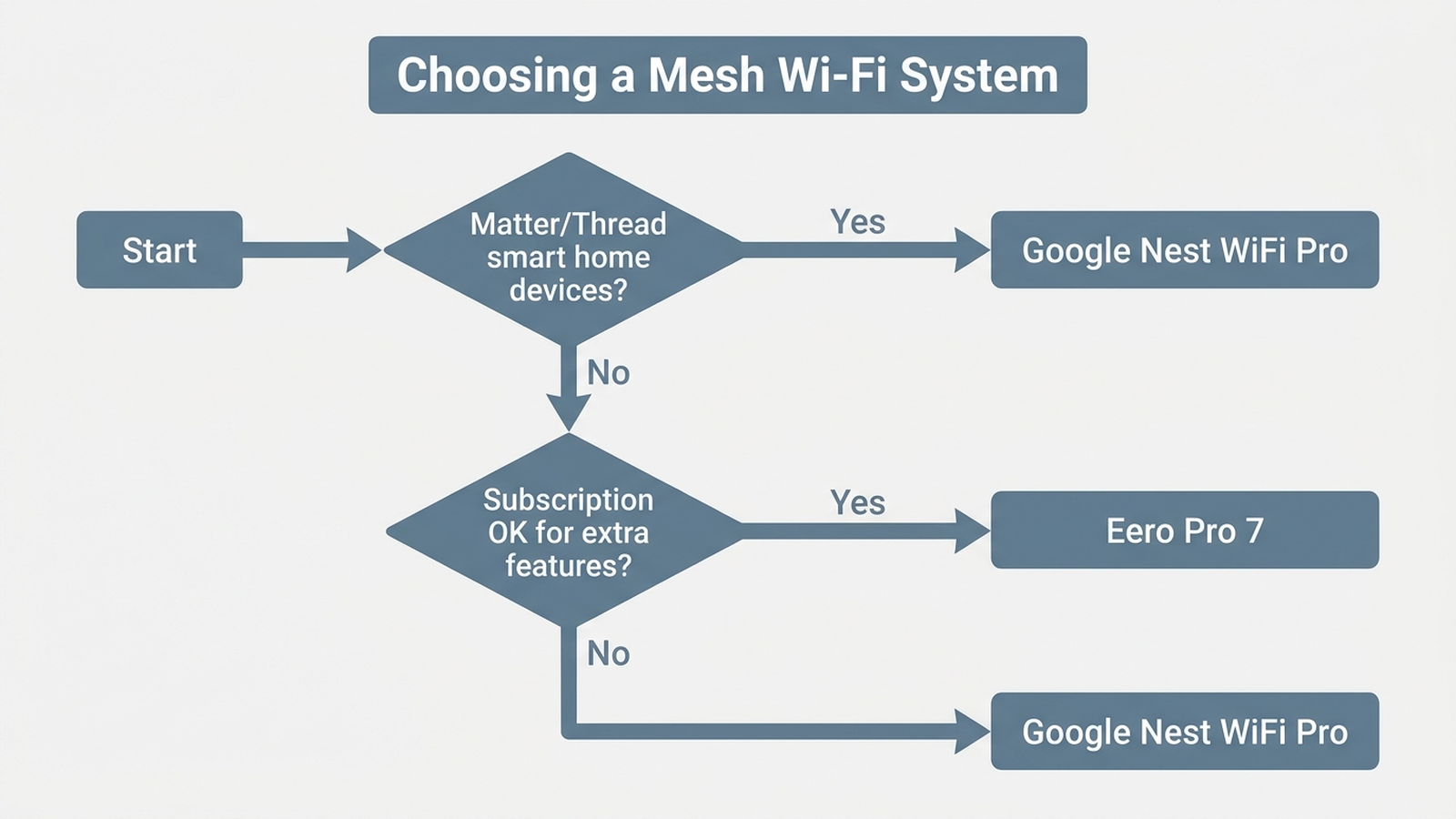
Start with the ecosystem question: if your smart home already runs on Matter or Thread devices, or you’re centered on Google Home, Nest WiFi Pro’s built-in hub makes it the more practical pick regardless of raw lab scores. If you’re Alexa-based or ecosystem-agnostic, move to the subscription question: do you want ad blocking, advanced parental controls, and backup-internet failover included free, or are you fine paying ~$10/month for them? Answering “included free” points to Google; “fine paying, and I want the best lab-tested throughput” points to Eero. If budget is the deciding factor above all else, compare the eero 6+ 2-pack (not 3-pack) against the original Google Nest Wifi 2-pack rather than either flagship.
Warranty and Support
Both brands offer a standard 1-year limited hardware warranty in the US on new units (manufacturer terms; confirm at purchase), covering manufacturing defects but not damage from misuse or third-party power surges. Neither brand bundles extended hardware coverage into its base subscription tier as of this writing. Coverage-area, device-connection-limit, and speed figures cited above are manufacturer specifications unless attributed to Consumer Reports or RTINGS by name; actual coverage and throughput vary with home layout, building materials, and the internet plan speed feeding the router.
Editorial Recommendation by Use Case
- You want the best independently tested performance and you’re comfortable with a subscription for extra features: the Eero Pro 7, per Consumer Reports’ February 2026 direct comparison against Google Nest WiFi Pro 6E.
- You have Matter-certified smart-home devices or Nest hardware already: the Google Nest WiFi Pro (3-pack) — its built-in Matter/Thread hub is a real convenience the Eero lineup doesn’t match feature-for-feature.
- You don’t want to pay monthly for parental controls or threat protection: Google Nest WiFi Pro ships those features free; budget for eero Plus (~$10/month) if you go with Eero.
- You’re buying on a tight budget and don’t need Wi-Fi 6E or 7: the older Google Nest Wifi (2-pack) is the cheapest of the four systems compared here.
- You’re considering the eero 6+ specifically: check the 2-pack before defaulting to the 3-pack — Consumer Reports found the 3-pack’s throughput a clear weak point relative to the 2-pack.
Limitations
This analysis relies on publicly available reviews, third-party lab testing from Consumer Reports and RTINGS, and manufacturer specifications; we did not independently lab-test these units. Coverage-area, device-connection-limit, and speed figures are manufacturer claims unless specifically attributed to a named third-party tester. Subscription pricing for eero Plus and hardware pricing for both brands have changed multiple times in the past year and may change again; confirm current pricing directly with each brand before buying. Prices and availability were accurate to our research at the time of writing and fluctuate frequently on Amazon, especially around sale events — verify the current listing price before buying. Individual experience with coverage, throughput, and reliability varies with home layout, building materials, node placement, and the internet plan feeding the router.
Before you buy either brand’s mesh system, it pays to check that a listing’s reviews are genuine and that a sale price is an actual discount rather than an inflated “was” price. That is exactly what Arekore does: paste the Amazon URL and our AI analyzes review authenticity, surfaces the most useful low-star feedback, and compares pricing in about five minutes — so you end up with the mesh router that actually fits your home and your smart-home ecosystem, not just the one with the biggest brand name on the box.