Dyson V15 Detect Review 2026: Worth the Price Jump?
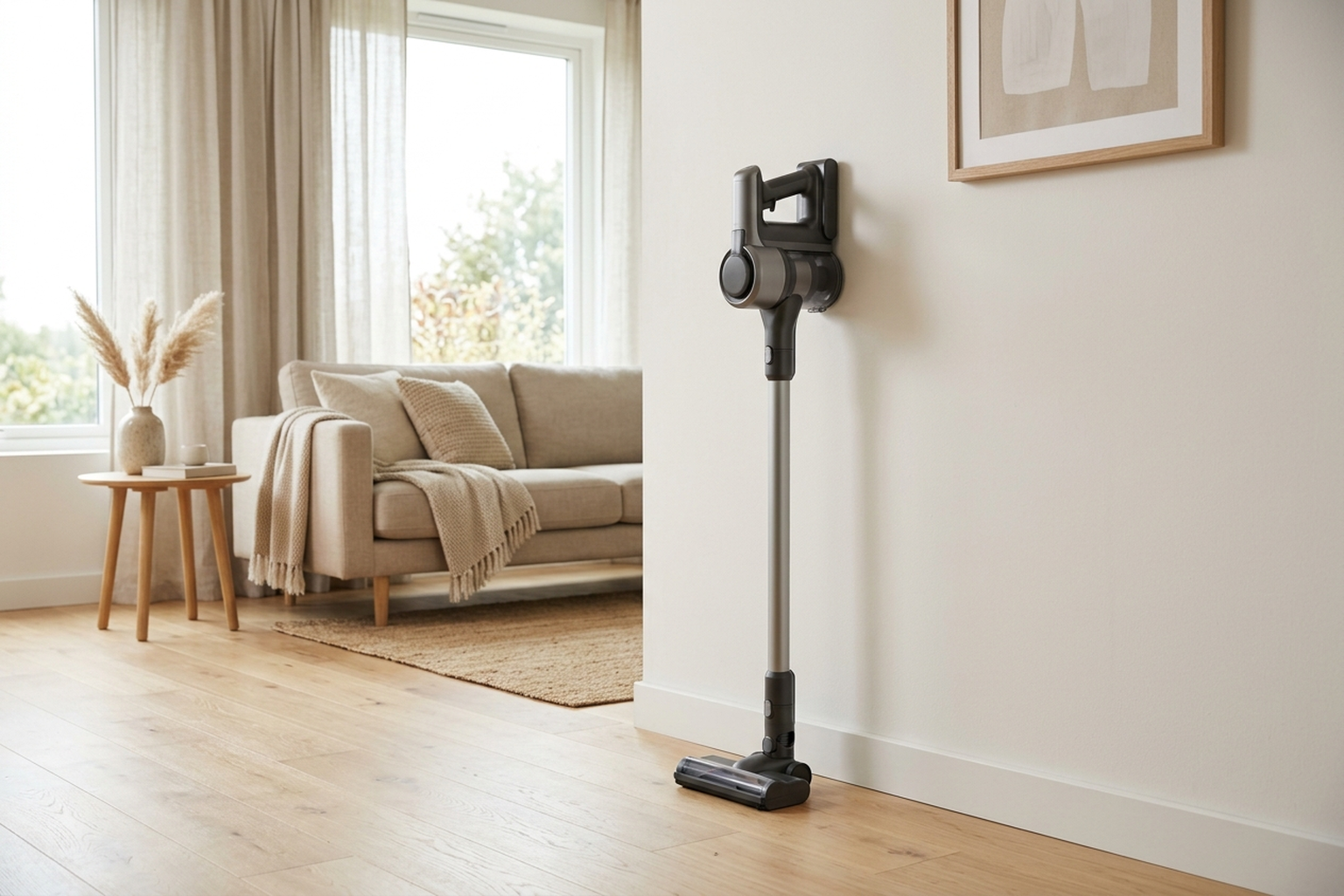
The Dyson V15 Detect launched in 2021 as Dyson’s first cordless vacuum with a laser dust detector built into the cleaner head, and it’s still selling at close to its original list price years later — at a time when Dyson’s own newer Gen5detect line costs even more. That combination of age and persistent high price raises an obvious question for anyone shopping in the $500–$1,000 cordless vacuum tier: does the V15 still hold up against both cheaper competitors and Dyson’s own newer models, or are you paying a legacy premium for a vacuum that’s been quietly surpassed? We pulled apart independent lab testing, manufacturer specifications, and aggregated owner feedback to find out.
As an Amazon Associate, Arekore earns from qualifying purchases. The Amazon product links in this article include our affiliate tracking ID and may earn us a commission if you buy through them, at no additional cost to you. See our Links Policy for details on how we select products and how commissions do not influence our recommendations.
TL;DR / Quick Verdict
- The V15 Detect remains among the best-tested cordless vacuums on the market, per RTINGS, which rates it the best Dyson and the best overall cordless vacuum it has evaluated, citing strong pickup across carpet and bare floors plus standout pet-hair performance.
- The price jump to the newer Gen5detect buys modest, not transformative, gains: roughly 9% more suction (262AW vs. 240AW), a finer HEPA filter rated to 0.1-micron particles instead of 0.3-micron, and about 10 extra minutes of runtime — for a list price several hundred dollars higher.
- Real-world battery life commonly falls short of the 60-minute manufacturer claim. Owner reports and independent reviewers note runtimes closer to 40–52 minutes on higher power settings, which matters more for larger homes than for quick daily touch-ups.
- The trigger-hold design, not the laser or sensor, is the most-cited everyday annoyance — you must keep the trigger depressed for continuous suction, which some owners find tiring during longer cleaning sessions.
- Best fit: buyers who want Dyson’s flagship-tier cleaning performance without paying for the Gen5detect’s incremental suction and filtration upgrades, especially if you can catch the V15 on sale below its ~$850 list price.
How We Reached These Conclusions (Methodology)
This is an editorial analysis, not a hands-on review; we did not personally test the products covered here. It synthesizes (a) independent lab and long-term testing from RTINGS, TechRadar, and Consumer Reports, (b) Dyson’s published manufacturer specifications for the V15 Detect and Gen5detect lines, and (c) aggregated owner sentiment drawn from Dyson’s own published customer ratings alongside a third-party review aggregator covering Reddit and retailer feedback. We did not independently verify a specific Amazon review count, since totals fluctuate and vary by product variant (standard, Plus, Pro, Origin). Manufacturer-claimed figures — suction in air watts (AW), runtime in minutes, filtration particle size — are labeled as such throughout. Prices are amazon.com figures at the time of writing (October 2026) and change frequently, especially around holiday sales events.
What $849.99 Actually Buys You
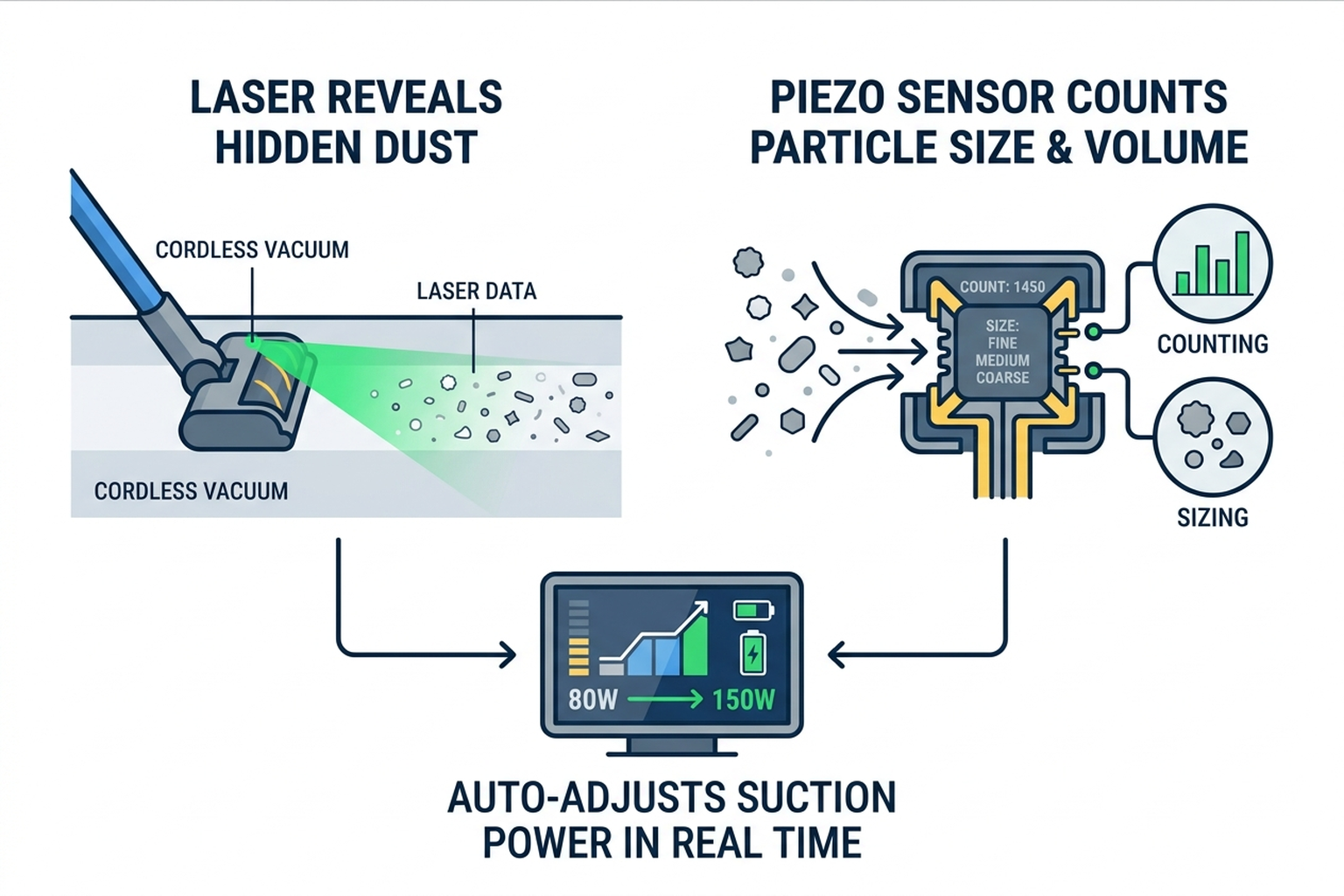
The V15 Detect’s headline feature is a precisely angled green laser built into the Fluffy Optic cleaner head, positioned to catch light at an angle that makes dust on hard floors visible to the eye even when it’s too fine to see under normal lighting. Paired with it is a piezoelectric sensor inside the machine that continuously counts and sizes dust particles as they’re pulled in, feeding an LCD screen on the handle that displays real-time particle counts, current power mode, and remaining runtime down to the second. In Auto mode, that sensor data drives the vacuum’s suction up or down depending on how much debris it’s detecting — the pitch being that you don’t have to manually guess which power setting a given room needs.
On measured performance, RTINGS’ review calls the V15 Detect the best Dyson vacuum and the best cordless vacuum it has tested overall, pointing to strong cleaning results across carpet and bare floors alike and especially strong pet-hair pickup — a category where cordless stick vacuums have historically struggled compared to upright or canister models. The V15 also improved on its V11 predecessor with a larger dustbin, longer rated battery life, and more included tools, while coming in lighter overall. Whole-machine filtration is rated to capture 99.99% of particles down to 0.3 microns, a manufacturer specification Dyson applies across the standard V15 Detect line (the newer Gen5detect improves this further, discussed below).
Consumer Reports’ own testing places the V15 Detect at the top of Dyson’s stick-vacuum lineup and ahead of roughly 50 other cordless vacuums the organization has rated, though its reviewers describe the result as a solid, not exceptional, performer rather than an outright standout — a useful counterweight to RTINGS’ more enthusiastic framing, and a reminder that “best in category” and “flawless” aren’t the same claim.
The Gen5detect Upgrade: What You’re Actually Paying More For
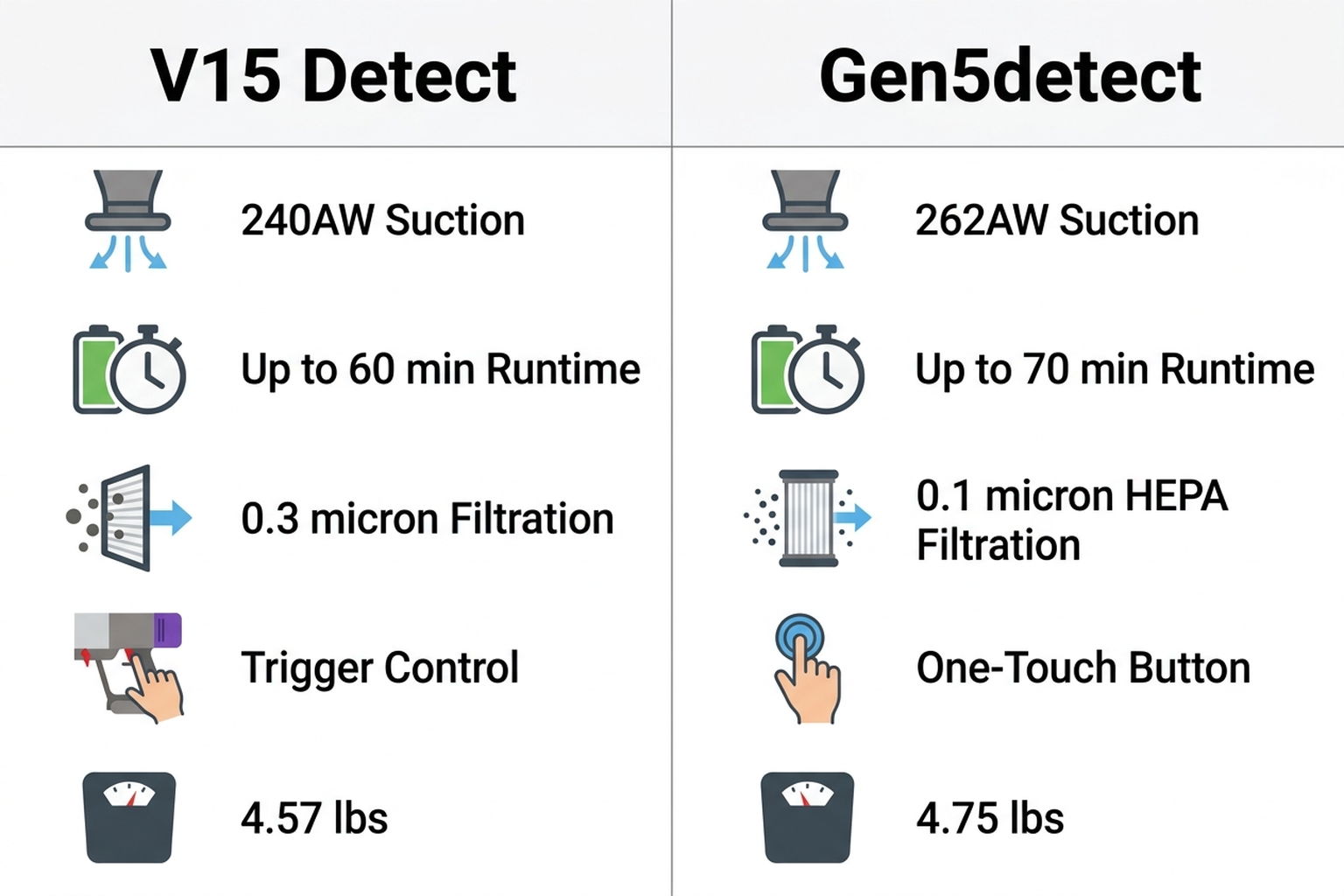
Dyson’s Gen5detect, released after the V15, is positioned as the direct successor, and the spec sheet gap between the two is smaller than the price gap suggests. The Gen5detect’s manufacturer-rated suction is 262AW versus the V15’s 240AW — roughly a 9% increase. Runtime climbs from a claimed 60 minutes on the V15 to 70 minutes on the Gen5detect, and both share the same 4.5-hour charging time. Filtration is where the Gen5detect makes its most meaningful jump: Dyson rates its HEPA filter to capture particles as small as 0.1 microns, compared to 0.3 microns on the V15 — relevant mainly for households managing allergies or asthma, where the finer particle threshold has a more direct practical case. The Gen5detect also swaps the V15’s trigger for a one-touch on/off button, which several reviewers single out as a quality-of-life improvement over having to hold a trigger depressed through an entire cleaning session, and its handheld unit weighs slightly more at 4.75 lbs versus the V15’s 4.57 lbs (total wanded weight is higher on both and varies by attachment configuration).
None of that is a small vacuum’s worth of difference, but it’s also not a generational leap — RTINGS’ own head-to-head testing frames the newer Gen5outsize (a related, larger-bin sibling) similarly: it offers real improvements like a proper on/off button and bigger dustbin, but “doesn’t offer enough to justify its significantly higher price” over the V15 for most buyers. The same logic broadly extends to the standard Gen5detect: buyers chasing marginal suction and filtration gains will notice them most if they have pets, allergies, or a larger home; everyone else is likely paying list-price premium for a 9% suction bump and a trigger-to-button swap.
What Owner Reviews Say the Spec Sheet Doesn’t
Dyson’s own published customer ratings for the V15 Detect sit at 4.5 out of 5 stars across more than 24,000 ratings on the company’s site — a large enough sample to be a reasonably reliable signal, even allowing that a brand’s own review page naturally skews toward satisfied buyers who register their purchase. Looking past that headline number, a third-party aggregator pulling together Reddit discussion and retailer review threads found a consistent pattern: battery life, charging reliability, trigger fatigue, and brush clogging are the most frequently cited frustrations, with durability complaints showing up disproportionately among owners who report running the vacuum on max suction for extended, whole-home sessions rather than quick spot cleaning.
The battery complaint lines up with independent test data: several outlets measured real-world Auto-mode runtime in the 48–52 minute range rather than the full 60 minutes Dyson claims, and some owner reports describe closer to 40 minutes under sustained max-power use — a gap that matters far more if you’re cleaning a three-bedroom house in one pass than if you’re doing a five-minute kitchen touch-up. On clogging, Dyson has already addressed part of this at the hardware level: the brush roll design was revised specifically to reduce hair wrap-around, a direct response to what had been one of the more persistent complaints on earlier Dyson cordless models. The trigger itself — holding it depressed for continuous suction rather than a toggle or button — remains unchanged on the V15 and is the single most commonly repeated ergonomic complaint, which is exactly the control scheme Dyson changed on the newer Gen5detect.
Comparison Table
Prices are amazon.com figures at the time of writing (October 2026) and fluctuate significantly around sales events; always check the current listing before buying.
| Model | ASIN | Suction (mfr. claim) | Runtime (mfr. claim) | Filtration | Control | Best for |
|---|---|---|---|---|---|---|
| Dyson V15 Detect Plus | B0CT97D9R2 | 240AW | Up to 60 min | 99.99% of particles ≥0.3 microns | Trigger | Buyers who want Dyson’s flagship-tier performance below Gen5detect pricing |
| Dyson V15 Detect (standard) | B0979R48CX | 240AW | Up to 60 min | 99.99% of particles ≥0.3 microns | Trigger | Budget-conscious V15 buyers who don’t need the Plus bundle’s extra tools |
| Dyson Gen5detect | B0C2JD5H7D | 262AW | Up to 70 min | HEPA, particles ≥0.1 microns | One-touch button | Allergy/asthma households and heavy pet-hair homes who value the finer filtration |
Check the Dyson V15 Detect Plus on Amazon · Check the Dyson V15 Detect (standard) on Amazon · Check the Dyson Gen5detect on Amazon
Editorial Recommendation: Is the V15 Still Worth Buying in 2026?
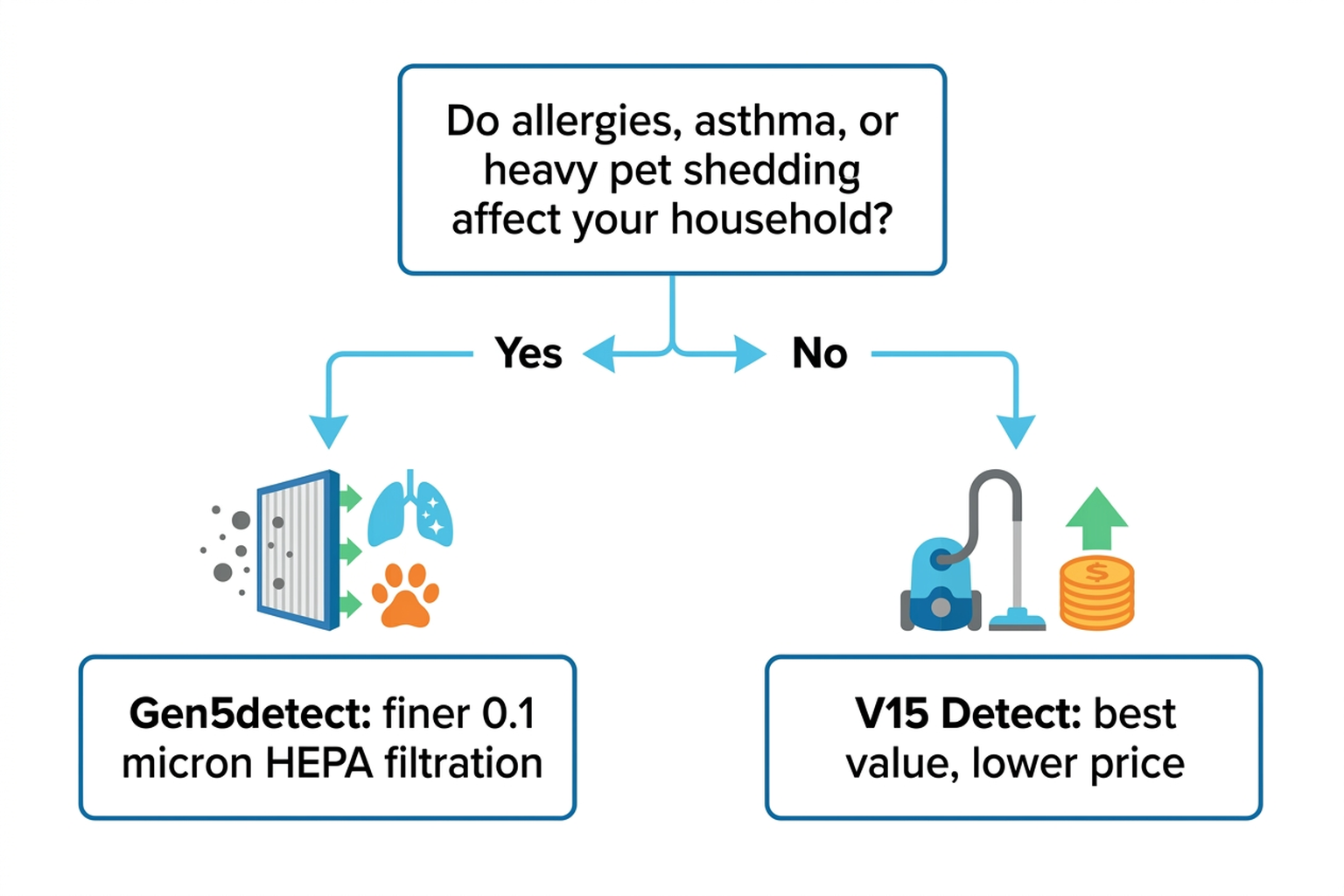
- If you want Dyson’s cleaning performance without paying Gen5detect pricing: the V15 Detect remains independently tested as a top-tier cordless vacuum, and the Gen5detect’s suction and runtime gains are real but incremental — the V15 is the stronger value case for most households.
- If allergies, asthma, or heavy pet shedding are a factor in your home: the Gen5detect’s finer 0.1-micron HEPA filtration is a more defensible reason to pay the premium than suction power alone.
- If trigger fatigue during longer cleaning sessions bothers you: that’s a V15-specific ergonomic complaint the Gen5detect’s one-touch button directly addresses, and it may be worth the switch on its own.
- If your home is larger than roughly 1,500–2,000 square feet: budget for closer to 45–50 minutes of real-world runtime on Auto mode rather than the full claimed 60 minutes, and plan a mid-clean recharge if needed.
Warranty
Dyson backs the V15 Detect with its standard manufacturer warranty on parts and labor; coverage terms, length, and any extended-protection options can vary by retailer and promotion, so confirm the current terms on the specific product listing before buying, especially for third-party-sold or renewed units.
Limitations of This Analysis
This analysis relies on third-party testing from RTINGS, TechRadar, and Consumer Reports, Dyson’s published manufacturer specifications, and a third-party aggregation of Reddit and retailer owner feedback; we did not personally test the V15 Detect, its Plus/Pro/Origin variants, or the Gen5detect. Individual results vary with home size, flooring type, and pet presence, and manufacturer-claimed figures — suction in air watts, runtime in minutes, and filtration particle size — are not independently re-verified in every test we cite. The U.S. cordless vacuum cleaner market was estimated at roughly $2.76 billion in 2025 by one market-research firm, projected to grow at a compound annual rate near 8.71% through 2032; separate industry reports place Dyson’s global cordless-vacuum share in the low double digits behind or alongside competitors like LG and Samsung depending on methodology, so we present these figures as directional market context rather than precise, universally agreed numbers. Prices, ASIN availability, and warranty terms change frequently — always confirm current details on the product page before buying.
The Bottom Line
Years after launch, the Dyson V15 Detect still tests as one of the strongest cordless vacuums on the market, and the newer Gen5detect’s real advantages — modestly higher suction, finer HEPA filtration, a longer claimed runtime, and a less fatiguing one-touch control — come at a price premium that’s larger than the performance gap for most households. The V15’s most persistent weaknesses are the trigger-hold design and real-world battery life that tends to fall short of the 60-minute claim, not the laser or sensor technology that made it famous. Whether that trade-off is worth it depends mostly on whether allergy-grade filtration or trigger fatigue actually affect your household — check the current price and recent reviews on the specific listing before buying, and if you want a second opinion, paste the URL into Arekore and let the AI scan the reviews and price history for you in about five minutes.