Dorm Mini-Fridge Buzzing 2026: Causes, Fixes, and Recalls

TL;DR. Most dorm mini-fridge buzzing comes down to one of four causes: a straining compressor start relay, dust-clogged condenser coils, an unlevel floor, or a loose electrical connection — and three of those are cheap, five-minute fixes. Before you troubleshoot anything, check your fridge’s model and serial number against the active CPSC recall for Frigidaire-brand minifridges, which as of early 2026 covers close to a million units sold at major retailers. If there’s no recall match and no burning smell, clean the coils, level the unit, and give it 24 hours before assuming the compressor itself is failing.
A note on links and methodology
As an Amazon Associate, Arekore earns from qualifying purchases. The Amazon product links in this article include our affiliate tracking ID and may earn us a commission if you buy through them, at no additional cost to you. See our Links Policy for details on how we select products and how commissions do not influence our recommendations.
We also did not personally test the replacement products recommended below. Every diagnostic and product claim in this article is an editorial synthesis of public data, cited inline.
Methodology
This is an editorial analysis based on publicly available data collected in July 2026. We did not run controlled failure tests on mini-fridge compressors ourselves; instead we synthesized:
- US federal safety records — the Consumer Product Safety Commission (CPSC) recall database, specifically the ongoing Curtis International/Frigidaire-brand minifridge recall for fire and burn hazards.
- Independent appliance-repair and troubleshooting documentation covering compressor start-relay behavior, condenser-coil maintenance, and the noise differences between compressor and thermoelectric cooling.
- Reviewed (USA Today)‘s mini-fridge testing coverage, including its comparison of compressor-based mini-fridges against thermoelectric coolers and its hands-on pick for dorm use.
- University housing policy pages (e.g., Georgia State University Housing) describing typical dorm appliance rules on cubic-foot limits and Energy Star certification requirements.
- Manufacturer specification sheets for Midea, Danby, and BLACK+DECKER compact refrigerators, cross-checked against their amazon.com listings.
- Aggregated Amazon customer review sentiment on amazon.com for the specific replacement products recommended in this article, read via each product’s “Top reviews” and “Customers say” panels in July 2026. We do not report a precise review-count N because Amazon’s review panels do not expose a stable, verifiable count; a fabricated number would be misleading.
We deliberately do not simulate a specific personal dorm-room experience, invent a fake reviewer persona, or claim we personally own the units discussed. The advice below is a synthesis of documented troubleshooting steps, federal safety records, and manufacturer specifications — treat it as a starting framework, not a substitute for checking your own unit’s recall status directly.
1. First: check whether your fridge is part of an active recall
Before diagnosing buzzing as routine wear, rule out the one cause that isn’t routine at all. The U.S. Consumer Product Safety Commission has been expanding a recall of Curtis International’s Frigidaire-brand minifridges since mid-2024: an initial recall of roughly 634,000 units (models EFMIS129, EFMIS137, EFMIS149, and EFMIS175) was followed by a January 2026 expansion adding 330,000 more units (model EFMIS121 and additional serial ranges), after reports that internal electrical components could short-circuit and ignite the plastic housing. Combined reporting puts the cumulative total at close to a million units across the recall’s history, with more than $700,000 in reported property damage and at least two smoke-inhalation injuries.
How to check your unit: the model and serial number are printed on a label on the back of the fridge. If your model matches EFMIS121, EFMIS129, EFMIS137, EFMIS149, or EFMIS175, do not rely on any serial-number range you see quoted secondhand — including in this article. Go directly to the CPSC recall page or the recall registration site, enter your exact serial number there, and follow the result rather than troubleshooting the noise yourself.
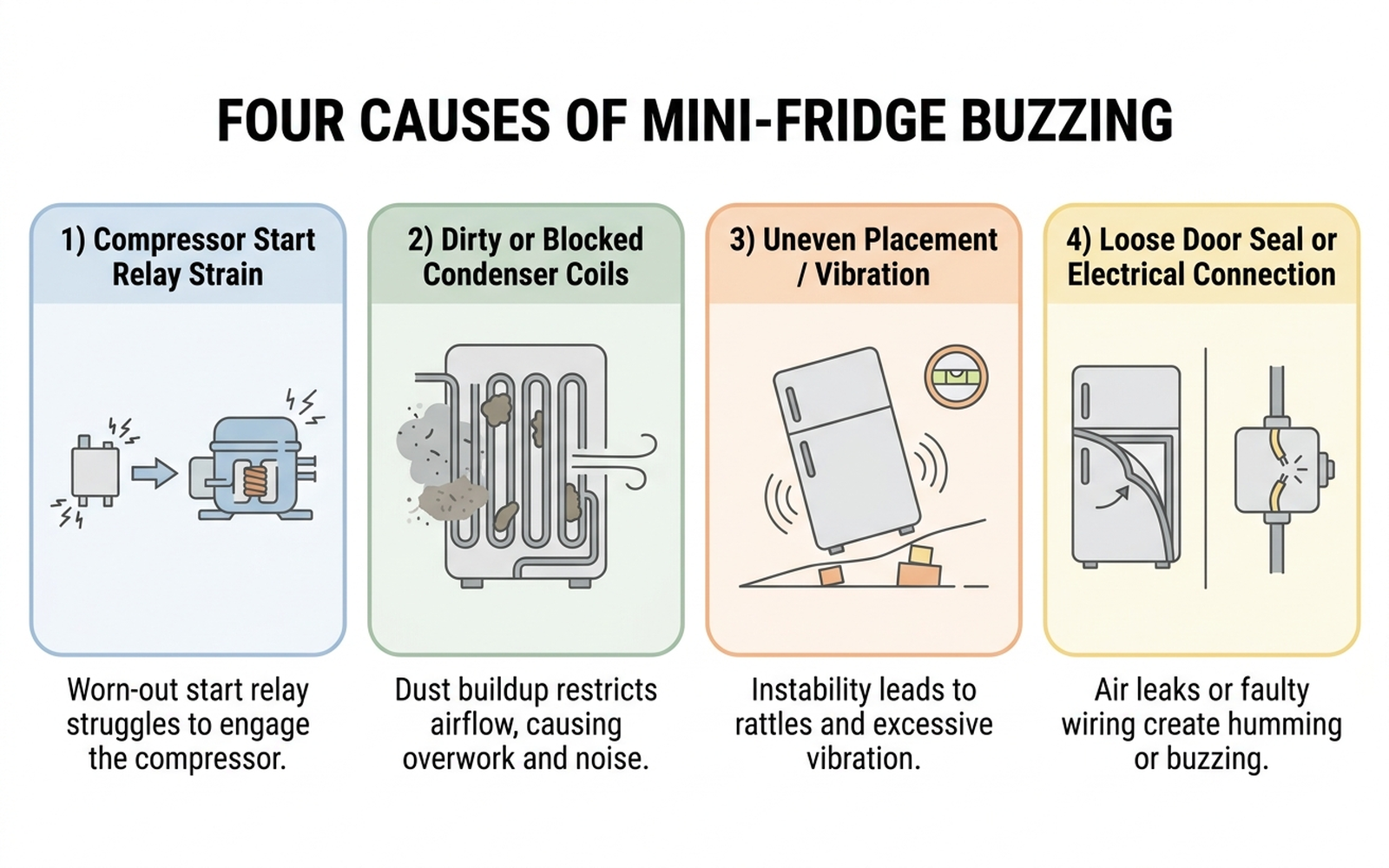
If your fridge isn’t a recalled Frigidaire-brand unit, a buzzing sound is very likely one of four more mundane causes, roughly in order of how often each shows up in appliance-troubleshooting documentation:
| Cause | What it sounds like | Fixable in a dorm room? | Urgency |
|---|---|---|---|
| Compressor start relay under strain | A buzzing burst lasting about 30 seconds, sometimes repeating every few minutes, especially right after the fridge cycles on | Rarely — this usually means the relay or compressor itself is wearing out | Medium: fridge may eventually fail to cool |
| Dirty or blocked condenser coils | A steady hum that gets louder over weeks, often paired with the fridge running longer than usual | Yes — cleaning the coils is the single most common fix | Low |
| Uneven placement / vibration against a wall or furniture | A rattling buzz that changes or stops when you nudge the fridge slightly | Yes — re-leveling takes under 5 minutes | Low |
| Loose door seal or electrical connection | An intermittent buzz, sometimes only when the door is slightly ajar or the outlet is a shared power strip | Yes — check the gasket and the outlet | Low-medium |
The distinction that matters most: the first cause (a straining start relay) is a genuine early-failure signal, while the other three are maintenance issues that don’t threaten the fridge’s lifespan. None of the four should come with a burning smell or a hot outer housing — if yours does, treat it the same way as a recall match: unplug it and stop using it.
2. Why dorm mini-fridges specifically buzz more than kitchen fridges
Dorm-size compact refrigerators (typically 1.7 to 4.5 cubic feet) are disproportionately compressor-based rather than thermoelectric, because most university housing policies require actual refrigerator-grade cooling, not the mild cooling a thermoelectric unit provides.
Independent testing from Reviewed (USA Today) found that thermoelectric coolers “cannot reliably maintain safe refrigeration temperatures”: across its test units, “none could keep their temperatures consistently below 40°F,” with most “wander[ing] all over the 50s” and swings of up to 10°F over a five-day test — because thermoelectric cooling only pulls the “cool side” a fixed amount below room temperature, so it degrades as the room warms up. Separately, in Reviewed’s mini-fridge testing roundup, its top dorm pick — a Magic Chef retro compressor fridge — “maintain[ed] fridge temperatures to within a degree or two of its target,” holding close to the standard 37-40°F food-safety range. Compressor units use the same refrigerant-cycle technology as a full-size kitchen fridge, which is why they hold a true, room-temperature-independent target rather than a fixed offset. That reliability gap is exactly why compressor units dominate the dorm category, and exactly why compressor-related buzzing — not thermoelectric fan noise — is the more common dorm complaint.
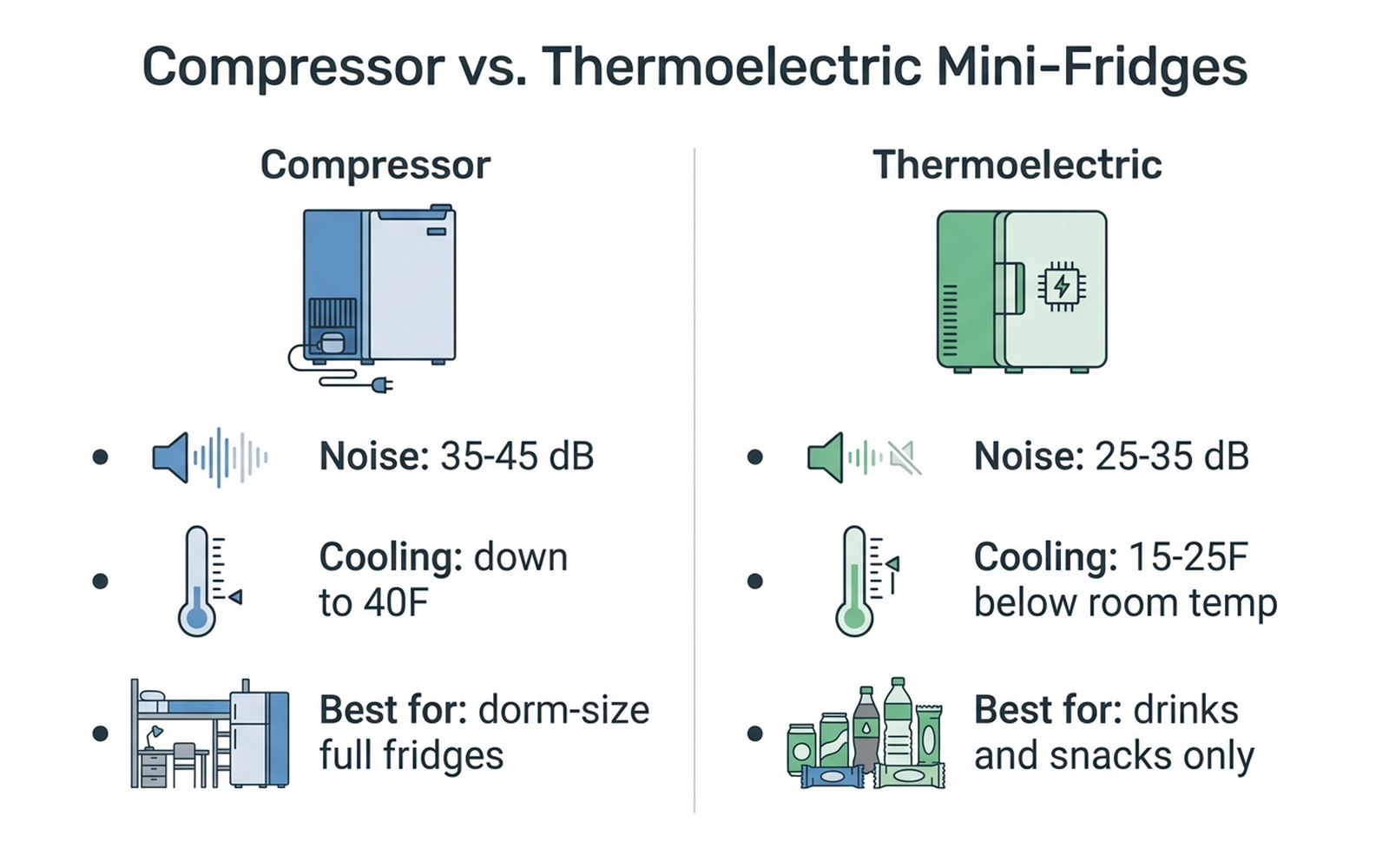
Noise is the tradeoff for that reliability. Manufacturer and retailer specification sheets for compressor-based compact refrigerators commonly list noise ratings in the mid-40-decibel range during an active cooling cycle (for example, the Midea 3.1 cu ft model discussed below lists a 45-decibel rating), while thermoelectric coolers — which use a fan rather than a compressor — typically run quieter. This is an editorial approximation based on published spec sheets rather than a controlled side-by-side sound test we ran ourselves. The gap is audible in a small dorm room, especially at night, which is also why “quiet for a compressor fridge” is one of the more common phrases in aggregated Amazon review sentiment for dorm-marketed compact refrigerators. A fridge that buzzes noticeably louder than that baseline, or whose cycle length is clearly getting longer, is worth the five-minute maintenance check in the next section before you assume it needs replacing.
3. What most university housing policies require (and why it affects fridge choice)
Most college housing offices cap compact refrigerators at roughly 3.1 to 4.5 cubic feet and a low wattage draw, and many explicitly require Energy Star certification — Georgia State University Housing, for example, sets a 4.4 cubic foot combined limit and requires Energy Star certification for any refrigerator-freezer unit. Some schools are more permissive (University of Michigan allows up to 5.5 cu ft), but checking your specific housing policy before buying — not after move-in — avoids a fridge getting flagged during a room inspection.
This matters for the buzzing question too: Energy Star-certified compressor units are designed to cycle on and off more efficiently than older or non-certified models, which in practice means shorter, less frequent compressor cycles — and less cumulative wear on the start relay that’s the leading cause of persistent buzzing.
4. What to actually do, step by step
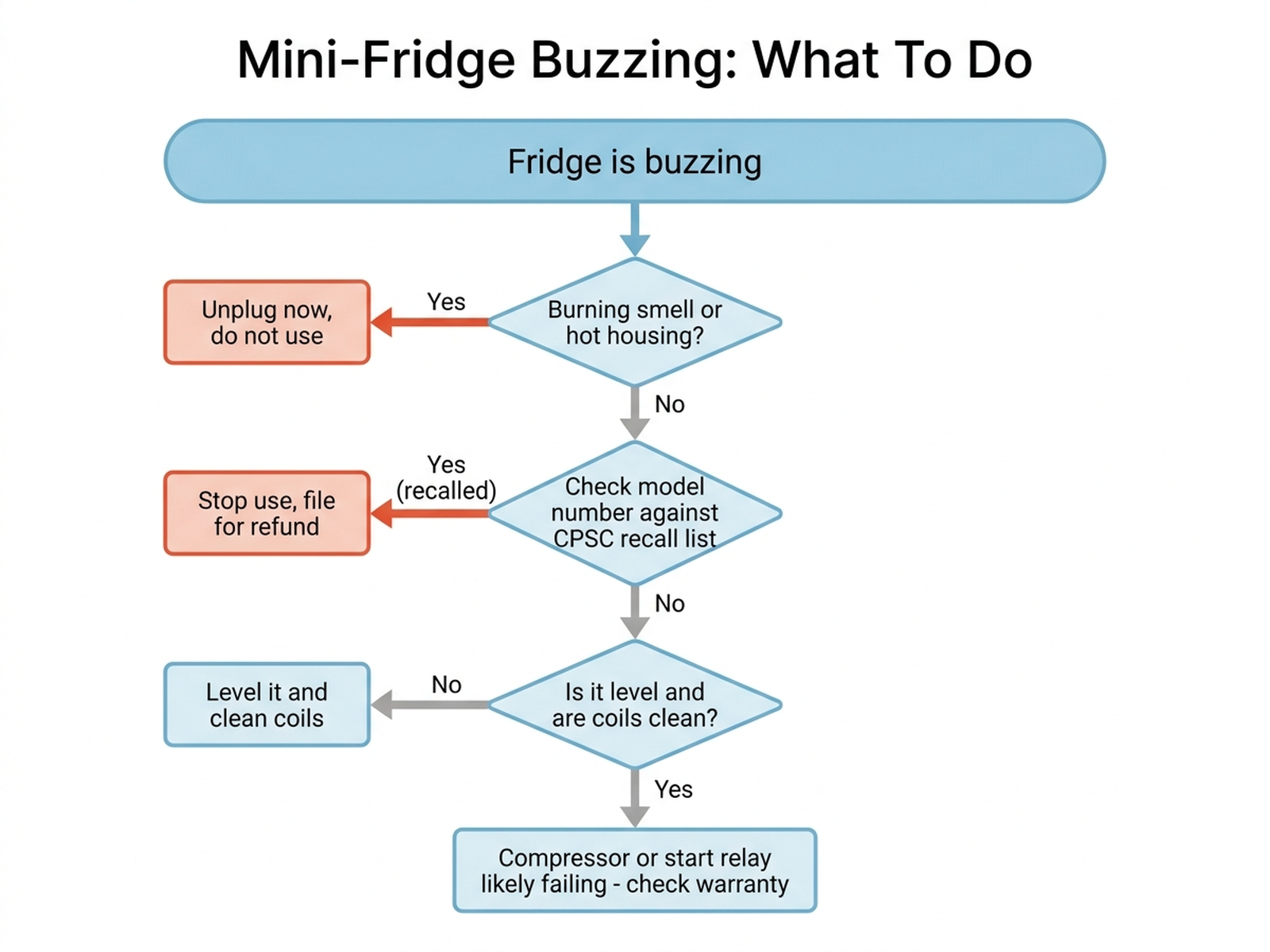
- Check the recall first. Look at the back label for the model number. If it matches the Frigidaire-brand EFMIS series described above, stop here — unplug it and register for a refund rather than troubleshooting.
- Unplug immediately if you smell burning, see smoke, or notice the outer housing getting hot. Do not continue troubleshooting a unit showing these signs.
- Pull the fridge out and check for level. Dorm rooms often have uneven flooring or carpet; a fridge tilted even slightly can rattle against a wall or an adjacent piece of furniture. Adjust the leveling feet (most compact fridges have them) or add a thin foam pad underneath.
- Clean the condenser coils and rear vent. Unplug the unit, then use a vacuum brush attachment or compressed air on the coils and vents on the back or bottom of the fridge. Dust buildup is one of the most commonly cited causes of both increased noise and reduced cooling efficiency in appliance-troubleshooting documentation.
- Check the outlet and door seal. Plug the fridge directly into a wall outlet rather than a shared power strip if possible, and make sure the door gasket is sealing fully (a dollar bill should grip slightly when closed in the door).
- If the buzzing persists after these steps, and the fridge is still within its warranty period, contact the manufacturer rather than assuming the compressor needs replacing — a failing start relay is often covered.
- If it’s out of warranty and the buzzing is a 30-second burst on every cycle, budget for replacement. A compressor start-relay failure on a sub-$250 dorm fridge is rarely worth an independent repair-shop visit; the labor cost alone typically exceeds the price of a comparable new unit.
5. If you’re replacing it: dorm-appropriate options by size
Editorial recommendation, not personal testing. These are current, Energy Star-certified, compressor-based compact refrigerators sized within the cubic-foot ranges most university housing policies allow.
| Product | Capacity | Price (USD, at time of writing) | Energy Star | Notes from aggregated review sentiment |
|---|---|---|---|---|
| BLACK+DECKER BCRK25B | 2.5 cu ft | ~$170-$180 | Yes | Reviewers frequently describe it as one of the quieter units at this size; smallest footprint of the three, best for strict housing size caps |
| Midea WHD-113FB1 | 3.1 cu ft | ~$200-$210 | Yes | Reviewers commonly note it runs quiet enough that they “have to listen closely” to tell it’s on; double-door layout with a separate small freezer |
| Danby DAR032B1BM | 3.2 cu ft | ~$190-$220 | Yes | Larger usable interior since it’s an all-refrigerator (no freezer compartment); some reviewers describe the compressor as louder than a full-size kitchen fridge, which matches the general compressor-noise pattern described above, not a defect specific to this unit |
All three fall within the 3.1-4.5 cubic foot range that most housing offices allow and are Energy Star certified, which — per the housing-policy pattern described above — is frequently a hard requirement, not a suggestion.
6. Warranty comparison
| Brand | Typical warranty | Covers compressor/electrical noise issues? | How to claim |
|---|---|---|---|
| Midea | 1 year parts and labor | Yes, manufacturing defects | Midea customer service |
| Danby | 1 year parts and labor (longer on sealed system in some lines) | Yes | Danby customer service; register product for full coverage |
| BLACK+DECKER (licensed compact refrigerators) | 1 year | Yes | Manufacturer/distributor customer service per product packaging |
If your current fridge is still within its first year, a persistent buzzing noise is worth a warranty call before you spend money on a repair or a replacement.
7. The decision flowchart
8. The bottom line
Check the recall first — it takes 60 seconds and it’s the one cause on this list that actually matters more than the noise itself. After that, a buzzing dorm mini-fridge is usually a cheap fix: level it, clean the coils, check the outlet. A 30-second buzz on every single cooling cycle, on a fridge outside its warranty, is the one pattern worth budgeting for replacement over — and at the sub-$250 price point most dorm fridges sit at, replacing almost always beats an independent repair quote on pure economics.
Limitations of this analysis
To be explicit about what this article does not establish:
- We did not personally test or disassemble any of the specific units named here. The causes described (start-relay strain, coil buildup, leveling, connections) are drawn from published appliance-troubleshooting documentation, not a controlled test we ran ourselves.
- The recall is still expanding. New models or serial ranges may be added after this article’s publication date; always check the current CPSC recall page directly rather than relying on a snapshot description.
- Prices cited are approximate ranges captured in July 2026 and fluctuate with promotions; confirm current pricing on the linked page before purchase.
- University housing policy details vary by school and the examples cited (Georgia State, University of Michigan) are illustrative, not universal — always confirm your own school’s specific appliance policy.
- Amazon review sentiment was read from each ASIN’s public review panels in July 2026 and reflects aggregated impressions, not a scientific sample.
- We found no active recall for the Midea, Danby, or BLACK+DECKER units recommended in this article at the time of writing.