Dorm Gear That Lasts 2026: A Buy-Once College Checklist
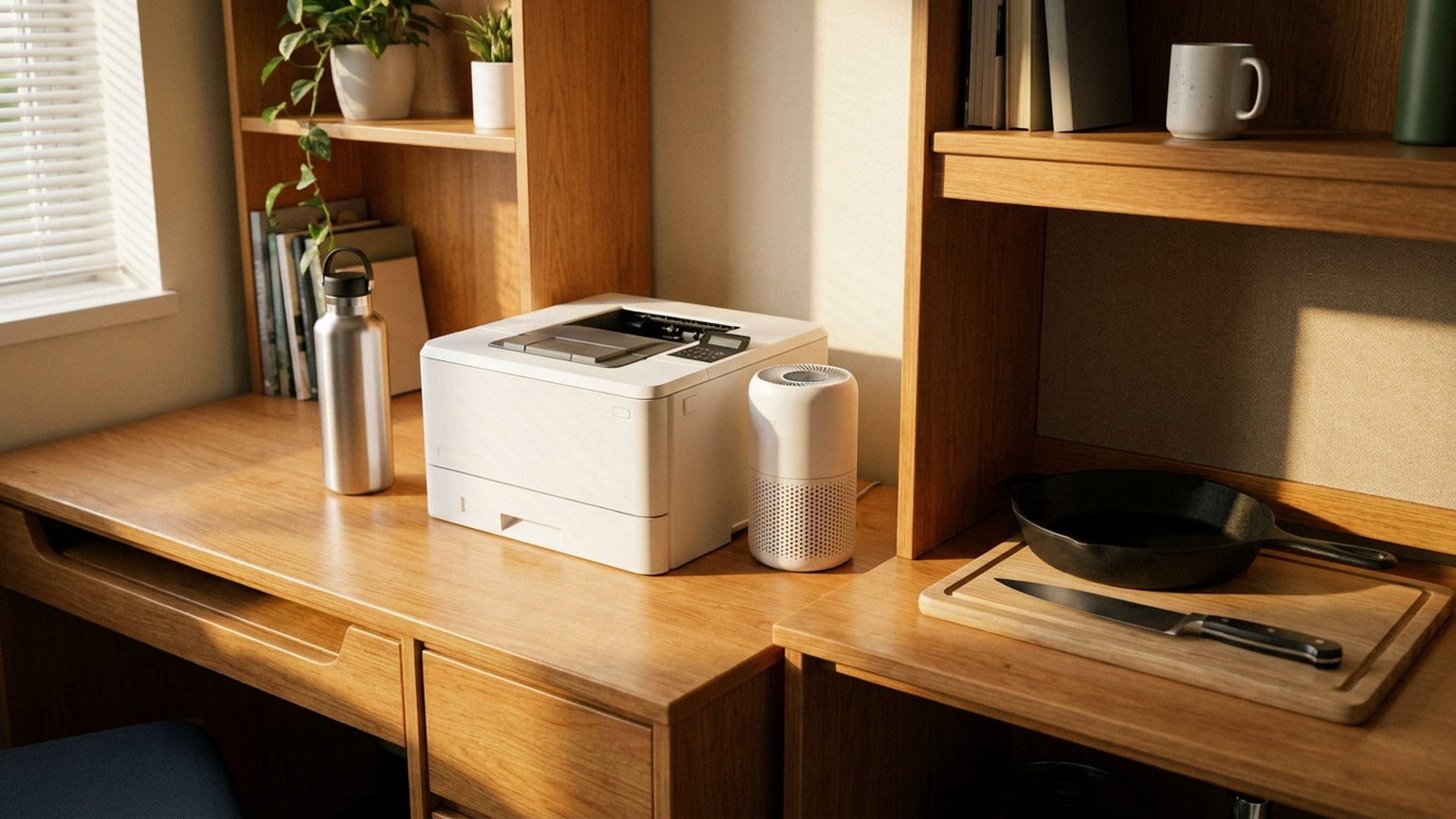
Every August, American families spend more than a thousand dollars outfitting a college student — and every May, a startling share of that gear ends up in a dumpster next to the residence hall. Cheap mini-appliances, flimsy plastic organizers, and $12 pans that lasted exactly two semesters are the default back-to-school purchase, and they are also the first things students abandon at move-out. This guide takes the opposite approach: a short list of six items worth buying once, at ordinary prices, that credibly survive four years of dorm life and move straight into a first apartment. Every pick is available on US Amazon, and every recommendation is grounded in aggregated review data, independent third-party testing, and manufacturer specifications.
This article is provided by Arekore, an AI shopping assistant. Paste a product URL and our AI checks review authenticity, digs into low-star feedback, and compares prices in about five minutes.
TL;DR / Quick Verdict
- The two kitchen pieces that outlive everything else: the Lodge 10.25-inch cast iron skillet (roughly $20–$30) and the Victorinox Fibrox Pro 8-inch chef’s knife (roughly $45–$60). Both are decades-long staples of independent test kitchens, and both routinely last longer than the person who bought them stays in one apartment.
- The desk pick that ends printer misery: a Brother monochrome laser printer (HL-L2405W). Toner does not dry out between assignments the way inkjet cartridges do, and a single cartridge typically covers a semester or more of coursework.
- The quiet workhorses: an Anker surge-protector power strip (dorm outlets are never where you need them), a Levoit Core 300-P air purifier (one of the most-reviewed purifiers on Amazon), and a Hydro Flask 32 oz Wide Mouth backed by a limited lifetime warranty.
- The principle: favor simple materials (cast iron, stainless steel, laser toner), long or lifetime warranties, and products with nothing to subscribe to — those are the traits that predict gear still working at graduation.
How We Reached These Conclusions (Methodology)
This is an editorial analysis, not a hands-on review. We did not personally test the products covered here. Instead, this guide synthesizes three kinds of public information: (a) aggregated amazon.com customer ratings and the substance of low-star reviews, sampled in July 2026; (b) independent third-party testing and reporting from America’s Test Kitchen, Consumer Reports, RTINGS, Wirecutter (NYT), Reviewed (USA Today), and Forbes; and (c) manufacturer specifications and published warranty terms. Where we cite a manufacturer figure — a print speed, a warranty length, a capacity — we label it as a manufacturer claim rather than an independently verified result. We deliberately avoid quoting review percentages we cannot verify; sentiment summaries below are directional. Prices are amazon.com figures at the time of writing and fluctuate, especially around back-to-school promotions.
The Back-to-College Market in 2026: Spend More, Keep Less
Back-to-college shopping is an enormous, and enormously wasteful, category. The National Retail Federation put total US back-to-college spending at $88.8 billion in 2025, up from $86.6 billion the year before, with families of college students planning to spend an average of $1,325.85 per household — even as more shoppers traded down to discounters and store brands to stretch budgets.
What happens to that gear is the other half of the story. Environmental reporting on campus move-outs estimates the average college student generates roughly 640 pounds of solid waste per year, with the largest spike at move-out (Planet Aid). The University of New Hampshire has reported producing about 25 tons of waste in a typical month — but 105 tons in May, the surplus consisting almost entirely of discarded furniture, mini-fridges, bedding, and small appliances. Boston University’s donation program alone diverted an estimated 113 tons from landfills during a single May move-out (2024).
The pattern behind those numbers is consistent: the things students throw away are overwhelmingly the cheap, semi-disposable versions of things they will immediately need again in a first apartment. Buying a smaller number of durable items is not just a sustainability argument — it is usually cheaper over a four-to-six-year window than replacing flimsy gear two or three times.
1. What “Buy Once” Actually Means
Not every expensive product is durable, and not every durable product is expensive — the Lodge skillet below costs about as much as two campus-area pizzas. Across aggregated long-term reviews and buy-it-for-life community discussions, four traits reliably predict whether dorm gear survives to graduation:
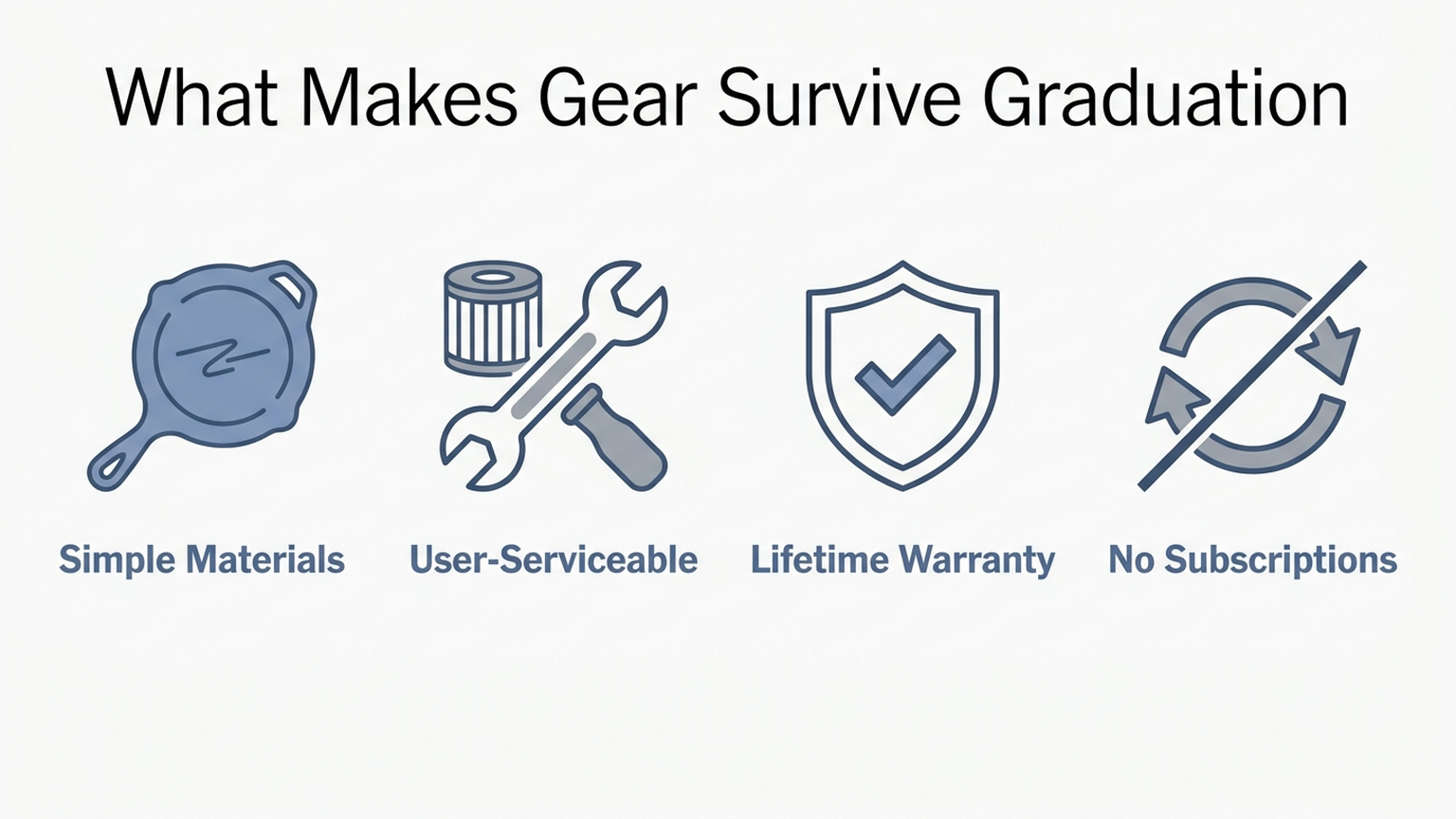
- Simple, proven materials. Cast iron, stainless steel, and high-carbon blade steel fail slowly and visibly. Nonstick coatings, cheap plastics, and glued seams fail quickly and all at once.
- User-serviceable design. A skillet can be re-seasoned; a knife can be sharpened; a purifier filter can be replaced. Gear that can be maintained gets maintained. Sealed, unrepairable gadgets get discarded.
- A warranty the maker expects you to use. Hydro Flask’s limited lifetime warranty or Victorinox’s lifetime guarantee against defects in material and workmanship (manufacturer terms) signal a company pricing in longevity.
- No subscriptions, no proprietary consumables at inflated prices. Inkjet printers are the canonical failure here: the hardware is cheap, but dried-out cartridges and ink subscriptions quietly make it the most expensive item on a dorm desk. Laser toner avoids the trap.
The six picks below apply those criteria to the categories nearly every student actually needs: cooking, printing, power, air, and hydration.
2. Comparison Table
Prices are approximate amazon.com figures at the time of writing (July 2026) and fluctuate. Specifications and warranty terms are manufacturer figures.
| Item | ASIN | Approx. price | Key spec | Warranty (manufacturer) | Survives graduation because |
|---|---|---|---|---|---|
| Lodge Cast Iron Skillet, 10.25” | B00006JSUA | ~$20–$30 | Pre-seasoned, made in USA, ~5 lbs | Limited lifetime | Solid iron; re-seasonable indefinitely |
| Victorinox Fibrox Pro Chef’s Knife, 8” | B0922MFRM7 | ~$45–$60 | High-carbon stainless, Swiss-made | Lifetime vs. defects | Sharpenable; no parts to break |
| Brother HL-L2405W Laser Printer | B0CPL7HRQN | ~$100–$130 | Mono laser, up to 30 ppm, Wi-Fi | 1 year | Toner never dries out; high page yield |
| Anker Power Strip, 2000J | B0CFV3ZTHT | ~$25–$35 | 8 AC + USB-C/USB-A, 5 ft cord | 18 months | Surge protection; dorm-rule friendly |
| Levoit Core 300-P Air Purifier | B07VVK39F7 | ~$80–$100 | HEPA-grade 3-in-1 filter, AHAM Verifide | 2 years | Only the filter is consumable |
| Hydro Flask Wide Mouth, 32 oz | B07MZBZ41X | ~$40–$50 | Vacuum-insulated stainless steel | Limited lifetime | Stainless body; replaceable caps |
3. Lodge 10.25” Cast Iron Skillet — The $25 Pan That Outlasts the Degree
If one item defines buy-once, it is a Lodge cast iron skillet. Lodge has been casting iron in Tennessee since 1896, and the 10.25-inch skillet arrives pre-seasoned with vegetable oil, works on dorm-apartment stoves, ovens, grills, and induction, and weighs about 5 pounds (manufacturer figures). There is no coating to scratch off and no handle to snap: when the cooking surface degrades, you re-season it and it is functionally new.
Independent testing consistently treats Lodge as the value benchmark of the category. Forbes named the Lodge 10.25-inch skillet its best-value pick after testing eight popular cast iron skillets, finding it fried eggs without sticking and seared steaks with a proper crust, and long-term reviewers commonly report the same pan still in regular service after many years of use. That is the relevant time horizon for a student: this is plausibly the only pan they will need to buy between freshman year and their thirties.
The trade-offs are the classic cast iron ones. It is heavy, the handle gets hot, and it asks for basic care — dry it after washing, avoid long soaks, add a thin coat of oil occasionally. Aggregated low-star reviews cluster on arrival condition (rough spots, seasoning blemishes) rather than on failure in use, which is consistent with a product that essentially cannot wear out.
Check the Lodge 10.25” Cast Iron Skillet on Amazon
4. Victorinox Fibrox Pro 8” Chef’s Knife — The Test-Kitchen Default
A single decent chef’s knife replaces the entire $20 knife-block set that rusts in a dorm sink by sophomore year. The Victorinox Fibrox Pro 8-inch is the most consistently recommended budget chef’s knife in American test media: America’s Test Kitchen has tested and recommended it for nearly three decades, with Cook’s Illustrated naming it the winner over nine competitors across tasks from breaking down a chicken to dicing onions. It is made in Ibach, Switzerland, with a high-carbon stainless blade and a non-slip Fibrox handle (manufacturer figures), and Victorinox backs it with a lifetime guarantee against defects in material and workmanship (manufacturer terms).
For a student, the practical case is simple: the knife has no mechanism, battery, or coating to fail. Kept minimally sharp — a $10 honing rod and an occasional proper sharpening — it will still be the primary kitchen knife in a first and second apartment. Long-term reviewers report the same knife in service after 20 years.
Trade-offs: it is a stamped (not forged) blade, so it is light rather than luxurious, and the utilitarian handle wins no style points. Aggregated review criticism focuses on exactly that — people expecting a premium-feeling object at a $50 price. As a tool, the sentiment is overwhelmingly positive.
Check the Victorinox Fibrox Pro 8” Chef’s Knife on Amazon
5. Brother HL-L2405W Laser Printer — Ending the Inkjet Cycle
The single most common printer mistake students make is buying a $60 inkjet, printing twice a month, and discovering each October that the cartridges have dried into $40 bricks. A monochrome laser printer breaks that cycle: toner is a dry powder and does not dry out, no matter how irregular the printing schedule — which is exactly a student’s printing schedule.
The Brother HL-L2405W prints up to 30 pages per minute, holds 250 sheets, and connects over dual-band Wi-Fi or USB (manufacturer figures). Its product family is well documented by independent labs: RTINGS reviews the HL-L2400D/HL-L2405W/HL-L2460DW family and highlights the low cost-per-print typical of Brother’s monochrome line, and Consumer Reports has tested the HL-L2405W itself — rare third-party lab coverage for a printer in this price class. Customer sentiment aggregated across retailers praises print quality, compact size, and easy setup; recurring complaints center on the bundled “starter” toner cartridge being smaller than a standard replacement, and on Brother’s optional toner-subscription upsell, which you can simply decline.
One honest limitation: it is monochrome and it only prints — no scanning, no color. For essays, problem sets, and readings, that is the right trade; for the occasional color page, campus print centers exist.
Check the Brother HL-L2405W Laser Printer on Amazon
6. Anker Surge-Protector Power Strip — The Dorm-Rules Workhorse
Dorm rooms chronically have two outlets, both behind furniture — and most university housing rules require power strips to be surge-protected and UL/TUV listed while banning daisy-chaining. A quality strip is therefore less an accessory than mandatory infrastructure, and it moves to every apartment afterward.
The Anker power strip (2000-joule surge rating) covers the whole desk: 8 AC outlets plus USB-A and 20W USB-C ports on a 5-foot flat-plug cord, TUV listed (manufacturer figures). The 2,000-joule rating matters for longevity: joule capacity is a budget that surge events spend down over years, so a higher rating is what makes a strip a multi-year purchase rather than a disposable one. Anker’s charging accessories are among the most positively reviewed electronics on Amazon, and aggregated sentiment on its dorm-oriented strips echoes that — praise for build quality and outlet spacing, with the main criticism being that flat plugs make it awkward to use behind some furniture orientations.
Practical note: check your specific housing handbook before move-in; a few campuses cap cord length or outlet count. Anker lists an 18-month warranty and a $20,000 connected-equipment guarantee for this model (manufacturer terms); confirm current terms on the product page.
Check the Anker 2000J Surge Protector Power Strip on Amazon
7. Levoit Core 300-P Air Purifier — Small-Room Air, One Consumable
Shared hallways, communal kitchens, seasonal allergies, and the occasional roommate cold make a small air purifier one of the most-praised dorm purchases in aggregated reviews. The Levoit Core 300-P is arguably the default choice in the category: Wirecutter names it its pick among small-space purifiers, Reviewed (USA Today) rates it highly for small rooms, and Gizmodo notes the model carries a 4.7-star average across more than 107,000 Amazon ratings — making it one of the most-reviewed purifiers on the platform. It is AHAM Verifide with a 3-in-1 filter including a HEPA-grade layer, covers small bedrooms comfortably, and runs a near-silent sleep mode (manufacturer and review-platform figures).
The buy-once logic: the machine itself is a simple fan-and-filter design with a 2-year manufacturer warranty; the only recurring cost is a replacement filter every 6–8 months of typical use (manufacturer guidance). It is small enough to move from dorm to apartment indefinitely, and the filter supply is standardized and widely available.
Trade-offs: it is sized for a bedroom, not an open-plan living room, and low-star reviews most often mention filter replacement cost and a faint plastic smell out of the box that dissipates. Neither affects longevity.
Check the Levoit Core 300-P Air Purifier on Amazon
8. Hydro Flask 32 oz Wide Mouth — The Bottle With a Lifetime Warranty
Disposable water bottles and $8 plastic tumblers are exactly the kind of gear that gets repurchased every semester. A vacuum-insulated stainless bottle is the buy-once alternative, and the Hydro Flask 32 oz Wide Mouth is one of the most credentialed: Wirecutter’s testing of the Hydro Flask Wide Mouth line — its pick is the 24 oz size — found it completely leakproof and pleasant to carry, and Hydro Flask backs its bottles with a limited lifetime warranty against manufacturer defects (manufacturer terms). The TempShield double-wall insulation keeps drinks cold for up to 24 hours and hot for up to 12 (manufacturer claims), and the wide mouth takes ice and survives dishwashers and drops.
Longevity here is structural: the body is a single stainless vessel with no seams to fail, and the parts that do wear — caps, gaskets, straws — are sold separately and are cross-compatible, so a chewed-up lid is a $10 fix rather than a new bottle. Aggregated sentiment is strongly positive on insulation and durability; the recurring criticisms are that painted finishes can chip if the bottle is dropped on concrete and that 32 ounces of water plus steel is genuinely heavy in a side pocket.
Check the Hydro Flask 32 oz Wide Mouth on Amazon
9. How to Make Buy-Once Gear Actually Last
Durable gear still needs five minutes of occasional care. The habits below are the difference between “buy once” and “buy twice.”
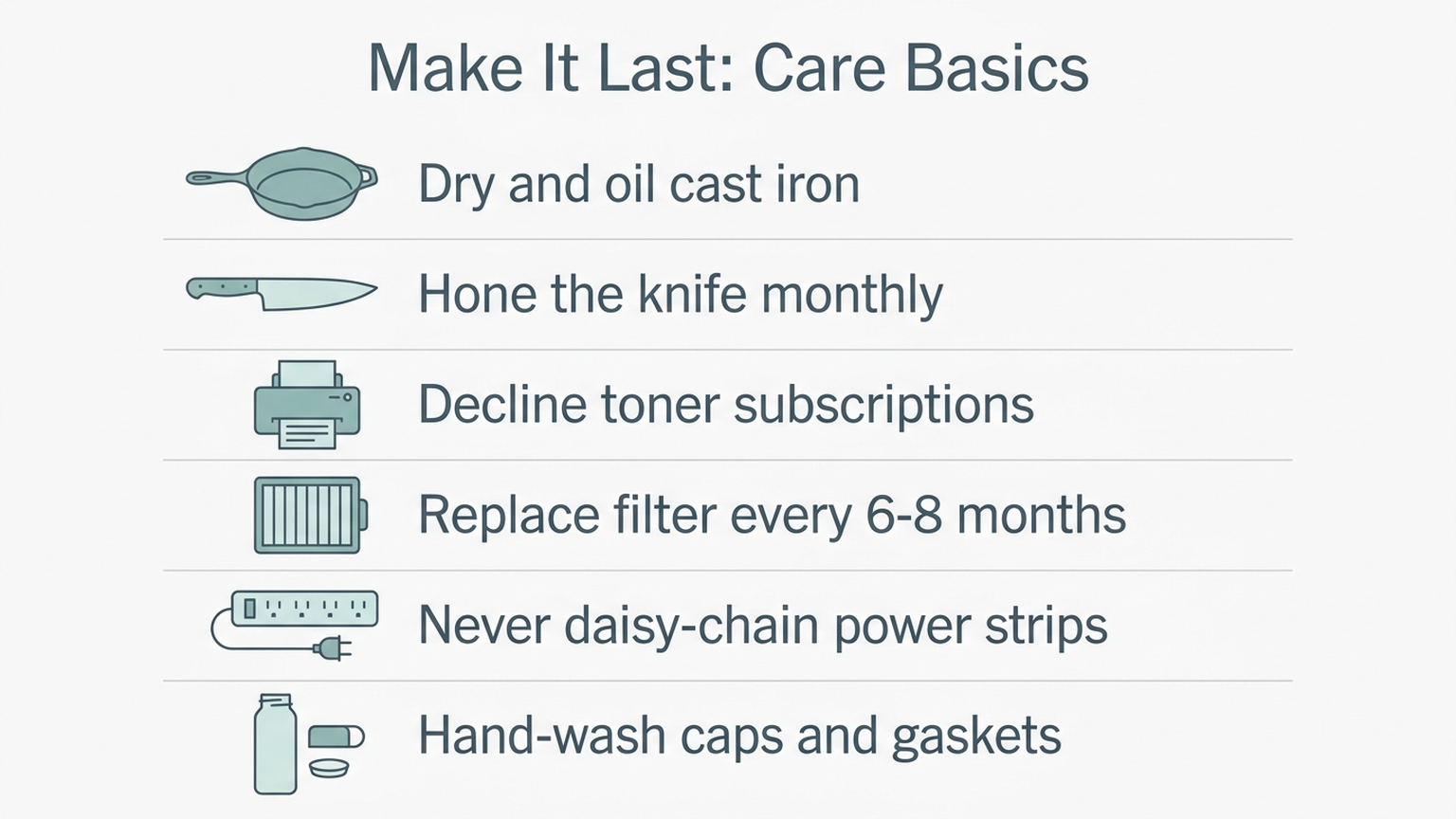
- Cast iron: wash with water and a brush (a drop of soap is fine), dry immediately on a warm burner, wipe with a thin film of neutral oil. Never leave it soaking. If it rusts, scrub and re-season — it is never ruined.
- Chef’s knife: hand-wash and dry (skip the dishwasher despite the rating — it dulls edges and it beats up the handle), hone monthly, get a real sharpening once a year. Cut on wood or plastic, never on plates or granite.
- Laser printer: decline the toner subscription, buy a standard high-yield cartridge when the starter runs out, and print a page or two if it has sat unused for a month to keep the rollers clean.
- Power strip: surge protection is a consumable — after a known major surge event or many years of service, replace the strip. Never daisy-chain it; that is both a fire risk and a housing violation.
- Air purifier: replace the filter on schedule (6–8 months typical) and vacuum the intake occasionally. A $25-a-cycle filter is what keeps a $90 machine alive for a decade.
- Insulated bottle: hand-wash the cap and gasket where grime hides, and buy a replacement cap instead of a replacement bottle when the lid wears out.
10. How to Choose: A Priority Flowchart
Few students buy all six at once. If the budget is staged, this is the order that maximizes value per dollar.
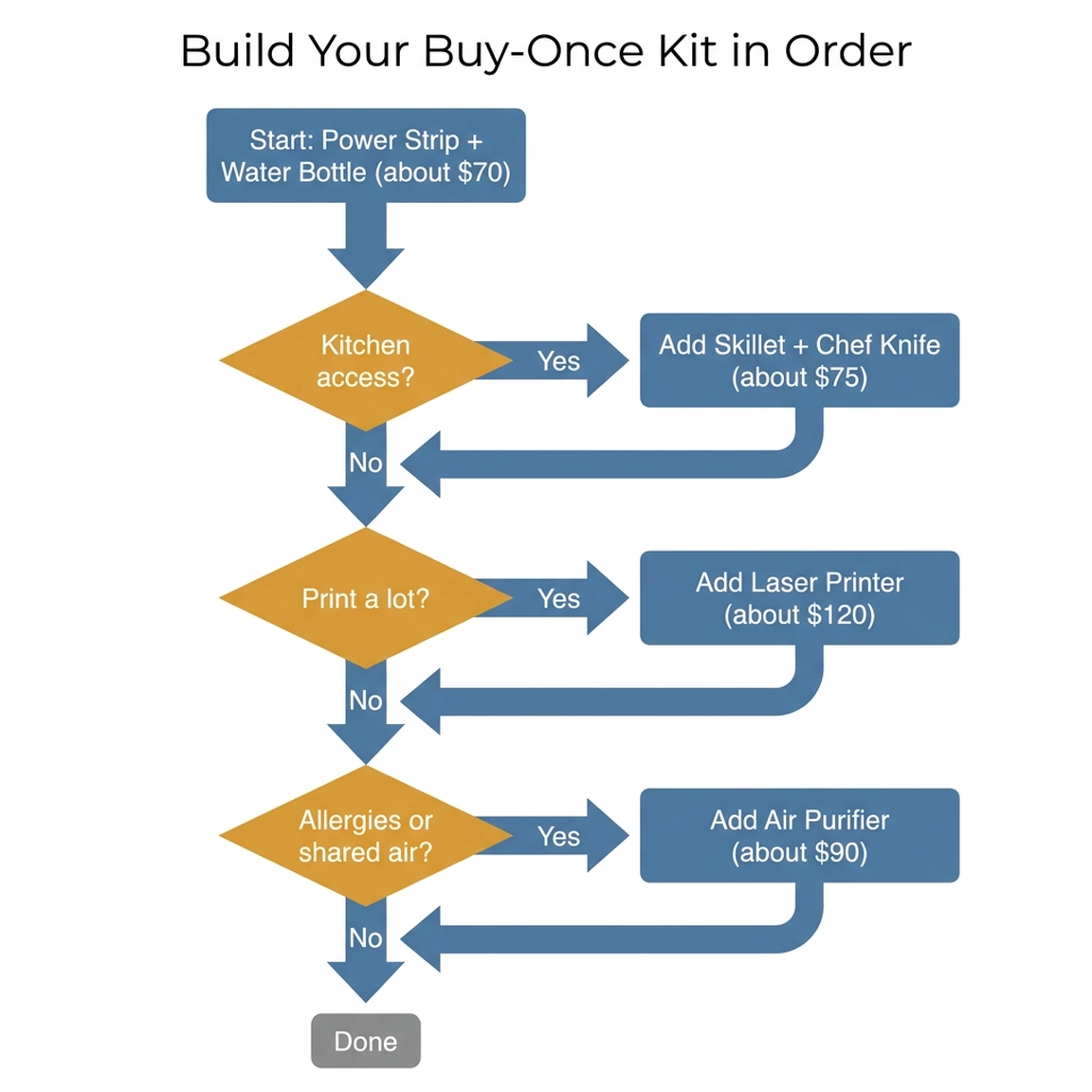
- Start with what every room needs (about $70): the Anker power strip and the Hydro Flask. Both are used daily from day one, dorm rules effectively require the first, and neither has a cheaper substitute that survives the year.
- Add the kitchen pair when you have kitchen access (about $75): the Lodge skillet and Victorinox knife. In a dorm with only a shared floor kitchen they can wait a semester; in an apartment-style dorm or off-campus housing they are immediate.
- Add the printer if you print more than occasionally (about $120): heavy readers, lab-report majors, and anyone whose campus print quota is stingy will hit break-even against inkjet ink within roughly a year.
- Add the purifier if the air is a problem (about $90): allergies, an older residence hall, wildfire-season campuses, or a roommate who is perpetually sick all justify it; otherwise it is the most optional item here.
Editorial Recommendations by Use Case
- Best single purchase if you buy only one thing: the Lodge 10.25” cast iron skillet. Lowest price on the list, longest plausible service life, and validated by independent testing for decades.
- Best for the chronic printer-sufferer: the Brother HL-L2405W. The economics of toner versus ink are decisive for irregular printers, which is what students are.
- Best for the sustainability-minded shopper: the Hydro Flask 32 oz plus the Victorinox knife — both are lifetime-warranty products that directly replace repeat purchases.
- Best for allergy-prone students in older dorms: the Levoit Core 300-P, the rare sub-$100 purifier with both AHAM verification and a top pick from a major independent test outlet.
- Best “boring but mandatory” pick: the Anker 2000J power strip — the item every housing handbook effectively requires and every first apartment reuses.
Warranty and Longevity, Compared
Warranty terms below are manufacturer figures at the time of writing; confirm current terms on each product page, as they change.
- Lifetime-class: Hydro Flask (limited lifetime against manufacturer defects), Victorinox (lifetime against defects in material and workmanship), and Lodge (limited lifetime; in practice, cast iron is restorable regardless of warranty).
- Multi-year: Levoit backs the Core 300-P with a 2-year warranty; the filter is a scheduled consumable rather than a failure point.
- Standard: Brother covers the HL-L2405W with a 1-year warranty, though laser printers’ aggregated longevity reputation — Brother monochrome lasers are a running “still works after a decade” joke in review threads — exceeds the paper coverage. Anker covers the power strip above for 18 months with a connected-equipment guarantee (manufacturer terms).
- Worth knowing about the category: some brands make lifetime warranties the entire product story — Darn Tough’s unconditionally guaranteed socks are the famous example — and while apparel is outside this guide’s scope, the same warranty-first logic is a useful filter for any future dorm purchase.
Limitations of This Analysis
This analysis relies on publicly available reviews, independent third-party tests, and manufacturer specifications; we did not personally test these products, and individual experience varies with use intensity, housing conditions, and unit-to-unit variance. Longevity claims are probabilistic: any individual unit can fail early, and “survives graduation” describes the category’s aggregated track record, not a guarantee for a specific purchase. Market and waste statistics come from the National Retail Federation, university sustainability offices, and environmental organizations whose methodologies differ, so treat them as directional. Warranty terms, prices, ASIN availability, and model revisions change frequently — Amazon listings in particular rotate color and bundle variants under different ASINs — so always confirm the current price, version, and warranty on the product page before buying. Dorm electrical and appliance policies vary by university; verify your housing handbook before purchasing power strips or appliances.
The Bottom Line
The cheapest way through college is not the cheapest cart at move-in. Six unglamorous items — a cast iron skillet, a real chef’s knife, a monochrome laser printer, a surge-protected power strip, a small air purifier, and a stainless bottle — cost around $350 total at typical prices, and each has the materials, serviceability, and warranty profile to still be working at graduation and beyond. That is money that stays out of the May dumpster. Whichever items you prioritize, verify the exact version and current price before checkout — and if you want a second opinion on a specific listing, paste the URL into Arekore and let the AI scan the reviews and price history for you in about five minutes.