Do Weighted Blankets Really Reduce Anxiety? The Data
Weighted blankets are now a roughly $1.1 billion product category growing at a 14.1% compound annual rate, according to market researcher Verified Market Reports, and “reduces anxiety” is the single most repeated marketing claim across nearly every brand selling one. That claim traces back to a real, if narrow, body of clinical research — but the research doesn’t say what the marketing implies. We read the actual trials, not just the press releases describing them, to find out what deep pressure stimulation does and doesn’t do for anxiety.
As an Amazon Associate, Arekore earns from qualifying purchases. The Amazon product links in this article include our affiliate tracking ID and may earn us a commission if you buy through them, at no additional cost to you. See our Links Policy for details on how we select products and how commissions do not influence our recommendations.
TL;DR / Quick Verdict
- The strongest evidence is for acute, situational anxiety — pre-surgery nerves, psychiatric inpatient settings, dental procedures — not for treating a diagnosed anxiety disorder long-term.
- The best-supported benefit is actually sleep, not anxiety directly. A 120-person randomized trial found roughly 4 in 10 adults with insomnia and a psychiatric diagnosis reached insomnia remission after four weeks under a weighted chain blanket, versus about 1 in 28 under a light control blanket.
- Direct anxiety-score trials are small and mixed. A randomized trial in just 23 patients with eating disorders found a roughly 1-point drop on a 21-point anxiety scale that did not reach statistical significance, though same-session distress scores did drop significantly.
- The proposed mechanism — deep pressure touch calming the nervous system — has real physiological backing, per a 2024 review in Frontiers in Psychiatry, but “a plausible mechanism exists” is a different claim than “this treats anxiety disorders.”
- Fair summary: real comfort effect for many people in high-stress moments and for sleep-related anxiety, not an established clinical treatment for generalized anxiety disorder.
How We Reached These Conclusions (Methodology)
This is an editorial analysis, not a hands-on test; we did not personally test the products covered here. This guide synthesizes: (a) the published randomized controlled trial by Ekholm, Spulber, and Adler (Journal of Clinical Sleep Medicine, 2020) on weighted chain blankets for insomnia in 120 adults with a co-occurring psychiatric diagnosis; (b) a 2022 randomized controlled trial on weighted blankets and anxiety in patients with anorexia nervosa and avoidant/restrictive food intake disorder (American Journal of Occupational Therapy); (c) a 2021 randomized controlled trial on weighted blankets and chronic pain with a trait-anxiety subgroup analysis (The Journal of Pain); (d) a 2024 mechanism review in Frontiers in Psychiatry on deep pressure touch and the parasympathetic nervous system; (e) third-party buying-guide testing from Sleep Foundation and Tom’s Guide; (f) aggregated amazon.com customer review sentiment for weighted blankets, sampled in October 2026; and (g) Verified Market Reports’ 2026 market-sizing data. We did not run our own clinical trial or controlled comparison — we are summarizing and citing existing published research. Where a figure comes from a single small trial rather than a meta-analysis, we say so. Prices are amazon.com figures at the time of writing and fluctuate.
What the Research Actually Tested
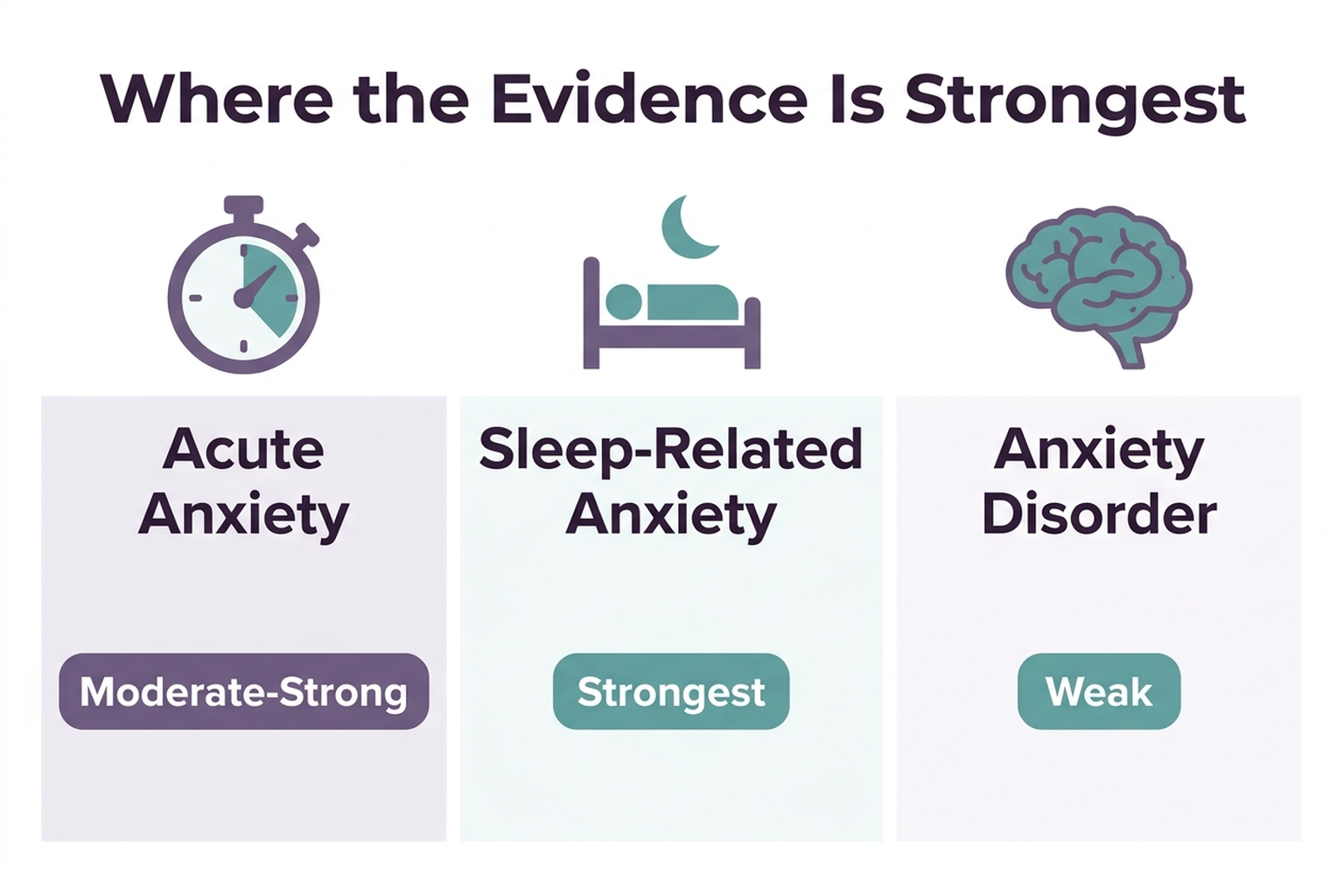
“Weighted blankets reduce anxiety” is really three different, loosely related claims, and the trials behind them don’t all point the same direction:
- Acute, situational anxiety — the moments before surgery, a dental procedure, or during a psychiatric inpatient stay. This is where the evidence is most consistent: a multicenter randomized controlled trial published in AORN Journal (2024) tested a warm weighted blanket against standard pre-surgical practice and found measurable reductions in presurgical anxiety and pain. Reviews of the broader literature describe this acute-setting benefit as the single most consistent finding across weighted-blanket studies.
- Sleep-related anxiety and insomnia. This is the best-powered trial in the category: Ekholm et al. randomized 120 adults with insomnia and a co-occurring diagnosis (major depressive disorder, bipolar disorder, generalized anxiety disorder, or ADHD) to a weighted metal chain blanket or a light control blanket for four weeks. Of the 102 participants who completed the trial, roughly 4 in 10 in the weighted-blanket group reached insomnia remission (an Insomnia Severity Index score of 7 or below), compared with roughly 1 in 28 in the control group — a finding the American Academy of Sleep Medicine highlighted on publication, with benefits reportedly holding at 12-month follow-up. (A separate, larger-effect outcome in the same trial — a 50%-or-greater reduction in insomnia severity score — was reached by close to 6 in 10 in the weighted-blanket group versus about 1 in 20 in the control group; the remission figures above are the stricter of the two outcomes.)
- Diagnosed anxiety disorders, measured directly. This is the weakest link in the chain. The 2022 AJOT randomized trial, which included just 23 participants, measured anxiety directly (Beck Anxiety Inventory) in patients with anorexia nervosa and ARFID and found only a 1.16-point reduction versus control — not statistically significant on that scale, though patients did report a statistically significant drop in subjective distress during the session itself. A 2024 mini-review in PBSIJ covering multiple adult anxiety studies describes the pattern similarly: real short-term comfort, not a demonstrated treatment effect on a validated anxiety disorder.
The common thread: deep, even pressure across the body is the proposed mechanism in every study, and a 2024 Frontiers in Psychiatry review lays out the physiological case — deep pressure touch is theorized to shift the autonomic nervous system toward parasympathetic (rest-and-digest) activity, which would plausibly explain both the sleep and acute-stress findings. A plausible, biologically reasonable mechanism is not the same as a proven treatment for a clinical anxiety disorder, which is why none of these trials claim the latter.
What the Chronic Pain Trial Adds
A separate 2021 randomized controlled trial in The Journal of Pain wasn’t designed to study anxiety directly — it tested whether a heavier (15 lb) weighted blanket reduced chronic pain better than a lighter (5 lb) one. It did. But the trial’s subgroup analysis found something relevant here: the pain-reduction effect was significantly stronger in participants with high trait anxiety than in those with low trait anxiety. That’s a secondary finding from a pain trial, not a direct anxiety-outcome study, so it belongs in the “suggestive, not conclusive” bucket — but it’s consistent with the deep-pressure-touch mechanism showing up across multiple unrelated outcome measures.
How to Evaluate Whether It’s Working for You
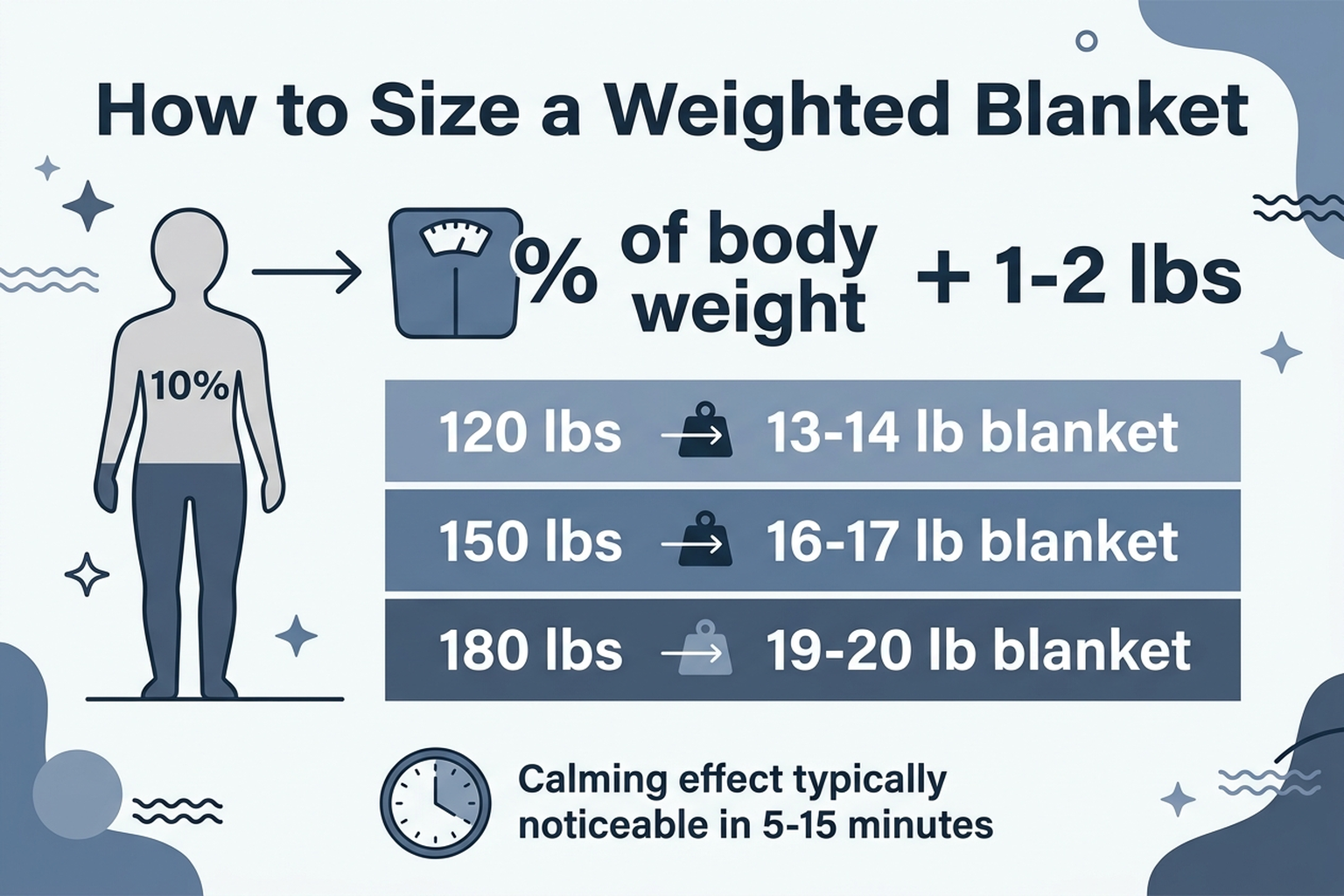
The sizing guideline nearly every manufacturer and occupational-therapy source agrees on is roughly 10% of your body weight, plus 1–2 lbs — a 150 lb adult lands around a 15–17 lb blanket. Buying heavier than that doesn’t produce a stronger calming effect in the research; it mainly adds difficulty repositioning the blanket at night.
Sleep Foundation’s published testing and buying guidance, along with Tom’s Guide’s weighted-blanket coverage, both describe the calming effect as typically noticeable within 5 to 15 minutes of use, consistent with the acute-stress trial timelines above. If you don’t notice any difference after several nights of consistent use at the correct weight, that’s meaningful information — the research suggests a real subset of people get no effect, and a heavier blanket isn’t the fix for that.
One safety note that applies regardless of the anxiety question: occupational-therapy contraindication guidance advises checking with a doctor first if you have a respiratory condition (asthma, COPD, sleep apnea), a cardiac or circulatory condition, or are pregnant, since the added chest and torso pressure is the same mechanism in every scenario — calming for most people, a plausible concern for these groups. Weighted blankets and weighted sleep products are also not appropriate for infants or toddlers under 3; the Consumer Product Safety Commission has confirmed multiple infant deaths linked to weighted infant sleep products.
Two Products, Two Use Cases
Neither of the trials above tested a specific retail brand — clinical trials use research-grade chain or bead blankets, not necessarily what’s sold on Amazon. But the sizing and construction principles from the research (correct weight, even pressure distribution) do carry over to retail products.
YnM’s 15 lb option (ASIN B073429DV2) is the lowest-weight version of Amazon’s top-selling weighted blanket line, built with seven-layer construction and small glass-bead pockets designed to keep weight evenly distributed — the even-distribution detail matters because the trials above used blankets designed specifically to avoid pressure “hot spots.” At roughly $35–$60, it’s a low-cost way to test whether the deep-pressure effect works for you before buying a premium option.
Check the YnM 15 lb weighted blanket on Amazon
Gravity’s 15 lb cotton blanket (ASIN B0BBJFG796) is a heavier-duty construction with a removable, washable microfiber duvet cover, priced around $175. Gravity blankets were among the first mass-market weighted blankets and are frequently cited in buying-guide testing (including Tom’s Guide) for consistent, even pressure distribution — the same property the acute-stress and chronic-pain trials link to the calming effect.
Check the Gravity 15 lb weighted blanket on Amazon
Comparison Table
Prices are approximate amazon.com figures at the time of writing (October 2026) and fluctuate.
| Evidence category | Strength of evidence | Key trial | Typical effect size |
|---|---|---|---|
| Acute/situational anxiety (surgery, dental, inpatient) | Moderate — most consistent finding | AORN Journal 2024 RCT | Measurable reduction in presurgical anxiety and pain |
| Sleep-related anxiety / insomnia | Strongest — largest, best-controlled trial | Ekholm et al., JCSM 2020 (n=102) | ~40% reached remission vs. ~3.6% control at 4 weeks |
| Diagnosed anxiety disorder, measured directly | Weak — small trial, non-significant on primary scale | AJOT 2022 RCT (eating disorders, N=23) | 1.16-point drop, not statistically significant |
| Chronic pain with high trait anxiety | Suggestive — secondary subgroup finding | J Pain 2021 RCT | Stronger pain reduction in high-anxiety subgroup |
| Product | Weight tested | Construction | Approx. price |
|---|---|---|---|
| YnM 15 lb | 15 lbs | 7-layer, glass-bead cotton | $35–$60 |
| Gravity 15 lb | 15 lbs | Cotton with removable microfiber cover | $150–$180 |
Decision Flowchart
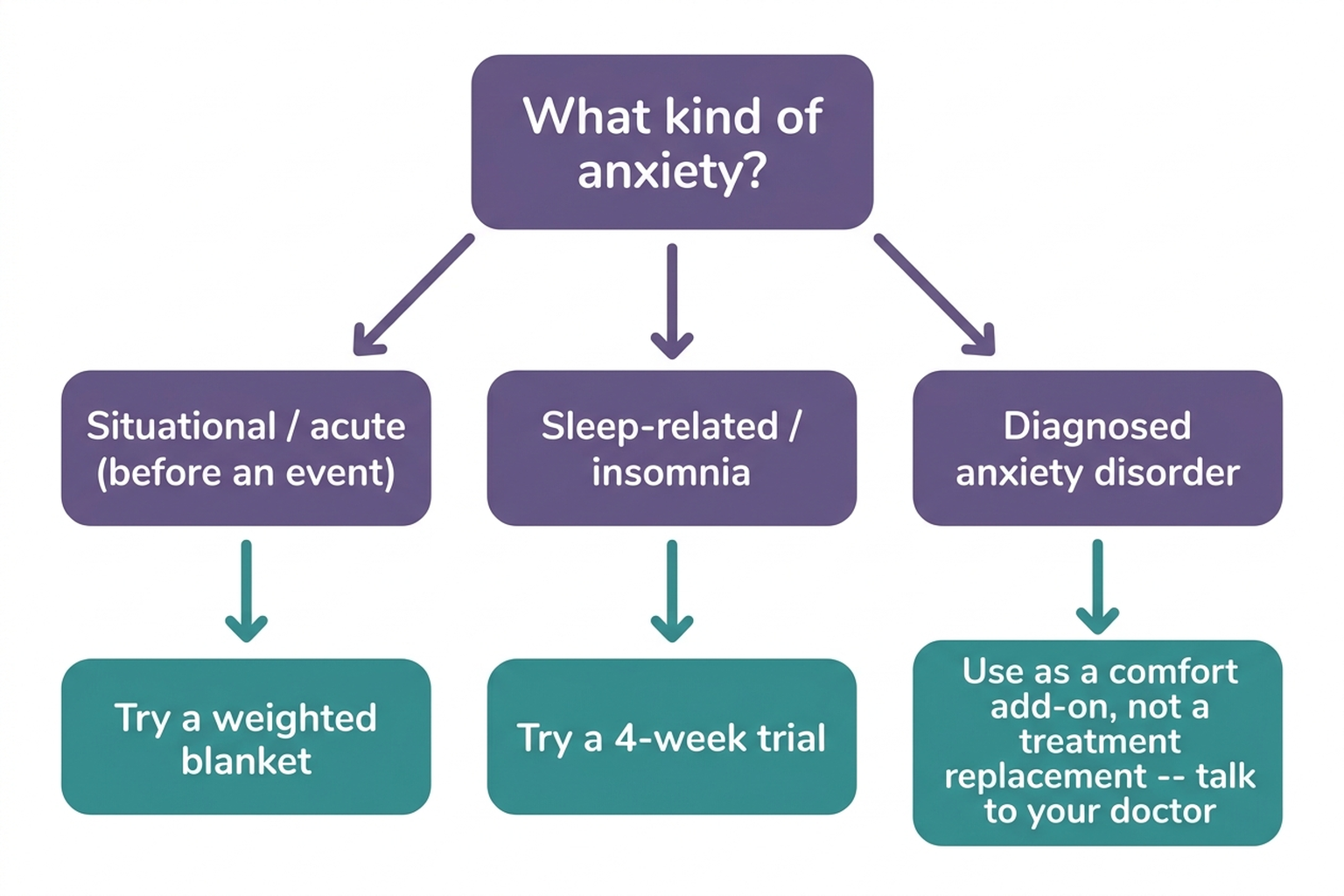
Start with what kind of anxiety you’re trying to address. If it’s situational — before a procedure, a flight, a stressful week — the acute-stress trial evidence is the most directly applicable, and a weighted blanket is a low-risk thing to try. If the issue is trouble falling or staying asleep alongside anxious thoughts, the insomnia trial is the best-matched evidence, and a 4-week trial period mirrors how the research was actually structured. If you have a diagnosed anxiety disorder you’re managing with therapy or medication, the direct-anxiety-outcome evidence is thin — a weighted blanket is reasonable as a comfort add-on, not as a replacement for treatment, and the research doesn’t support treating it as one. In every case, check the respiratory/cardiac/pregnancy caution above before buying.
Limitations
This analysis relies on published randomized controlled trials, a mechanism review, and third-party buying-guide testing rather than our own clinical study or product test. Several of the key trials are small (the AJOT trial, for instance, involved patients with eating disorders specifically, which may not generalize to the general population) and short in duration (most ran four weeks or less), so long-term effects and effects in a general, non-clinical population are less established than the short-term findings suggest. The Ekholm et al. insomnia trial is the largest and most rigorous study cited here, but it studied insomnia severity as the primary outcome, with anxiety as one of several comorbid diagnoses among participants — it is strong sleep evidence, not a dedicated anxiety-disorder trial. No cited trial tested the specific retail products linked in this article; research-grade trial blankets and consumer products share a mechanism but were not directly compared. Individual response to deep pressure stimulation varies, and this article is not a substitute for medical advice for a diagnosed anxiety disorder. Prices fluctuate on amazon.com and should be verified on the current product page before buying.
Bottom Line
Weighted blankets have real clinical research behind the anxiety claim — it’s just narrower than the marketing suggests. The strongest evidence supports situational, acute stress and sleep-related anxiety, backed by a well-controlled 102-person trial showing meaningfully better insomnia outcomes. The evidence for treating a diagnosed anxiety disorder directly is thin: small trials, mixed results, and no large-scale confirmation. If you’re dealing with pre-event nerves or anxious sleeplessness, the data says it’s worth a reasonably priced try. If you’re managing a diagnosed anxiety disorder, treat a weighted blanket as a comfort add-on alongside your actual treatment, not a replacement for it.
Before you buy, paste the product link into Arekore — our AI assistant checks review authenticity, surfaces what the one-star reviews actually complain about, and compares prices, free, in about five minutes.