Do Tower Fans Cool a Room? What DOE and CDC Data Say

TL;DR
No — a tower fan does not lower the air temperature in a room. The U.S. Department of Energy is explicit on this point: fans “cool people, not rooms,” by creating a wind-chill effect that speeds up sweat evaporation from skin. The air itself stays exactly as hot as it was before you turned the fan on. That distinction matters more than marketing copy suggests, because the CDC has found that fans stop helping — and can even raise heat-illness risk — once the heat index climbs above roughly 90°F with humidity above 35%, since blowing air that’s hotter than your skin just adds convective heat instead of removing it. Below that threshold, a well-placed tower fan is still one of the cheapest ways to feel several degrees cooler, and pairing one with an AC unit lets most households raise the thermostat about 4°F without losing comfort, per DOE guidance.
Methodology
This analysis synthesizes (a) published physiological and energy-efficiency guidance from the U.S. Department of Energy, the CDC’s Morbidity and Mortality Weekly Report, and peer-reviewed heat-wave research summarized by Scientific American and Science.org, (b) manufacturer specification sheets for three current Amazon US tower fans (Dreo, Lasko, Vornado), and (c) aggregated Amazon US customer reviews for those models, sampled in October 2026. We did not personally test the products covered here.
Technical Approach: Four Ways Manufacturers Market “Cooling”
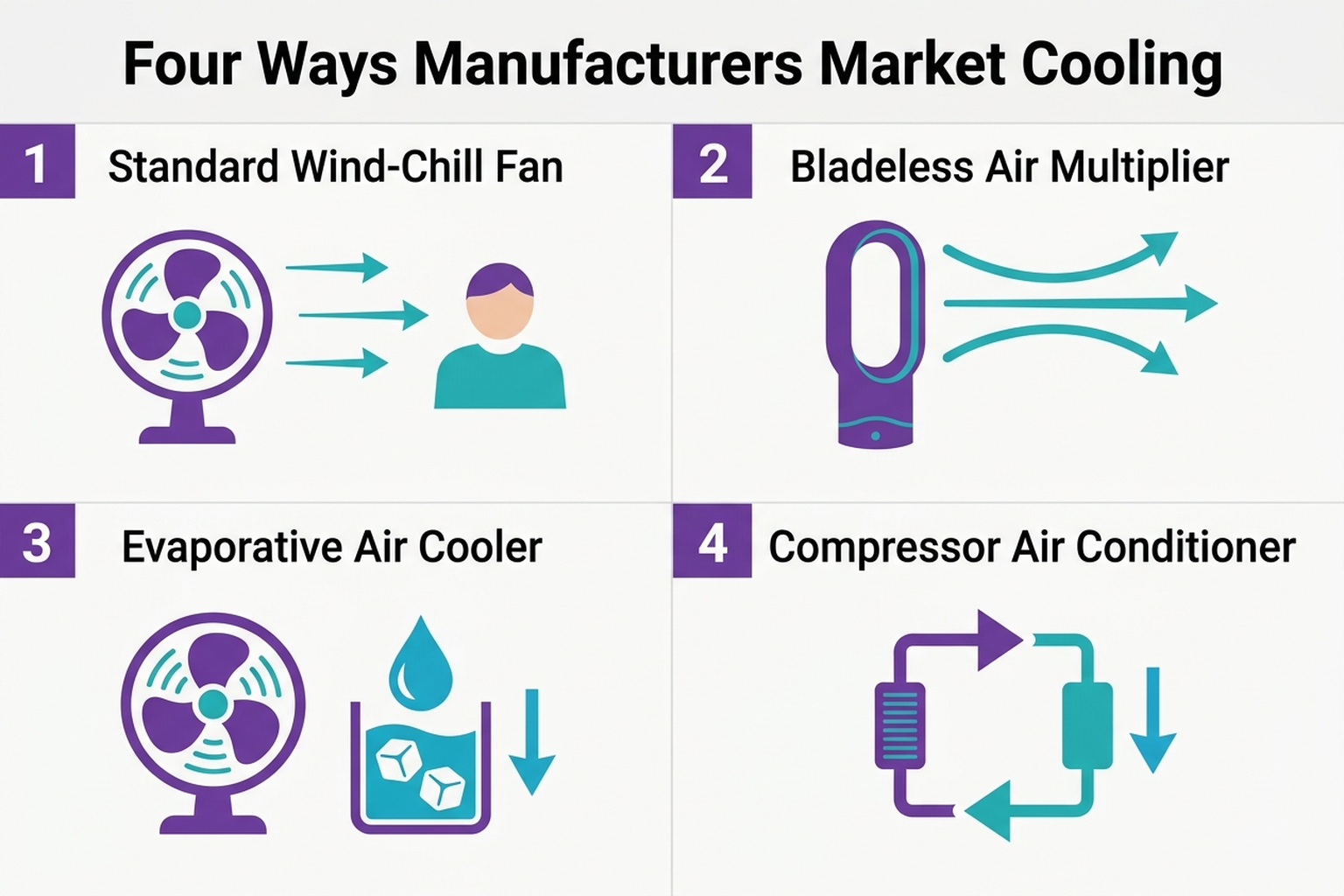
Part of the confusion behind this question is that Amazon’s “tower fan” category actually contains two physically different product types, sold with overlapping marketing language.
- Standard wind-chill tower fans (most Lasko and Vornado models): A motor spins blades or an impeller to move existing room air past your body. This increases evaporative cooling of sweat on skin — the wind-chill effect — without changing the air’s actual temperature. The DOE’s energy-saving guidance confirms this is the entire mechanism.
- Bladeless “Air Multiplier” fans (Dyson-style designs): Pull air through the base and accelerate it through a narrow annular slot, amplifying the same wind-chill effect through a smoother, quieter airstream. Physically, this is still air movement, not refrigeration — no manufacturer in this category claims to lower air temperature.
- Evaporative air coolers marketed as “tower fans that blow cold air” (some Dreo models): Pull air through a water-soaked pad or ice-pack reservoir, which does measurably drop the output air temperature a few degrees via evaporative cooling — but only in low-humidity climates, since evaporation slows as ambient humidity rises. These are a genuinely different appliance from a standard fan, even though they’re sold in the same “tower fan” search category.
- Compressor-based air conditioners (portable or window units, not covered in this article’s product picks): The only category that actually removes heat from a room via a refrigerant cycle, lowering air temperature regardless of humidity.
Manufacturer Details
Dreo sells both standard wind-chill tower fans and evaporative “blow cold air” models side by side, which is the direct source of the “do tower fans actually cool a room” confusion — the two look similar in product photos but work on different physical principles. The standard Dreo Smart Tower Fan (DR-HTF007S) is built around a DC motor Dreo rates at 28 ft/s airflow velocity and 20 dB on the lowest of 8 speeds — a manufacturer noise claim, not an independently lab-verified figure, though it’s broadly consistent with the “quietest fan I own” theme in Amazon reviews.
Lasko positions its Apex RST200 around AirSense Technology, which the company says automatically adjusts fan speed to maintain a set airflow level, plus a washable Carbon X filter Lasko markets for dust and hair. Lasko publishes a 29 ft/s airflow and 28 dB low-speed noise rating for this model — both manufacturer figures. Lasko’s standard warranty language covers defects in workmanship and materials for one year from purchase, with some models extended to two years; buyers should check the specific instruction manual rather than assuming a universal term across the Lasko lineup.
Vornado builds the OSCR37 AE around its signature deep-pitch V-Flow blade, which the company says can project air up to 75 feet to circulate an entire room rather than cool one spot. This is a circulator-first design, and Vornado backs it with a 5-year warranty — the longest of the three brands here by a wide margin, and a detail worth weighing against its higher price versus Lasko.
How to Use: Getting Real Cooling Benefit From a Fan
- Check the heat index before relying on a fan alone. CDC guidance (MMWR) found fans stop being protective once heat index exceeds roughly 90°F with humidity above 35% — above that point, a fan can accelerate heat gain instead of cooling, because the moving air is already hotter than your skin.
- Combine with AC rather than replacing it in extreme heat. DOE guidance says a fan lets most households raise the thermostat about 4°F without losing comfort, which cuts AC energy use — but only works because the AC is still removing heat; the fan alone cannot do that job once it gets hot enough.
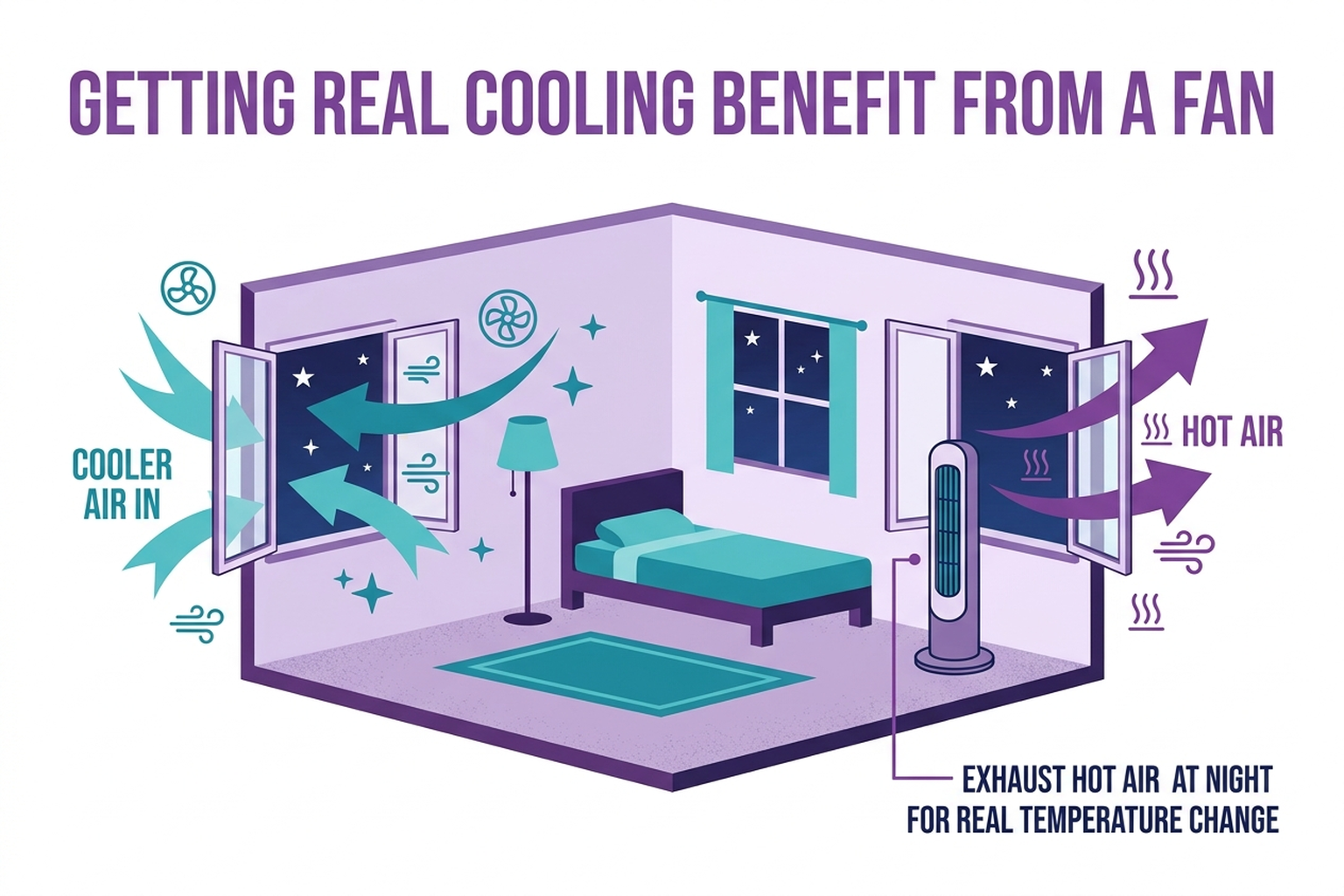
- Exhaust hot air at night instead of just oscillating. Pointing a tower fan out an open window after sunset pulls cooler outside air in through other openings, which does change room air temperature — unlike daytime oscillation, which only redistributes air that’s already there.
- Turn it off when the room is empty. Since a fan cools people, not air, DOE guidance notes there’s no efficiency benefit to running one in an unoccupied room.
- If you’re shopping by name alone, read the spec sheet. A listing that says “blows cold air” is very likely an evaporative cooler with a water tank or ice-pack slot, not a standard circulator — check for a water reservoir in the product photos before assuming it behaves like a typical tower fan.
Comparison Table
| Model | Price (as of 2026-10-28) | Rated Airflow | Noise (Low) | Speeds | Warranty | Amazon Rating |
|---|---|---|---|---|---|---|
| Dreo Smart Tower Fan (DR-HTF007S) | $79.98 | 28 ft/s (claimed) | 20 dB (claimed) | 8 | 1 year | 4.5★ (sampled listings) |
| Lasko Apex RST200 | $100.66 | 29 ft/s (claimed) | 28 dB (claimed) | 6 | 1–2 years (model-dependent) | 4.5★ (sampled listings) |
| Vornado OSCR37 AE | $119.99 | Up to 75 ft projection (claimed) | Not independently disclosed | 4 | 5 years | 4.4★ (sampled listings) |
Prices are retailer list prices sampled as of the stated date and change frequently with promotions; check the current listing before buying. None of these three models is an evaporative cooler — all work on the wind-chill principle described above.
Decision Flowchart: Fan, Evaporative Cooler, or AC?
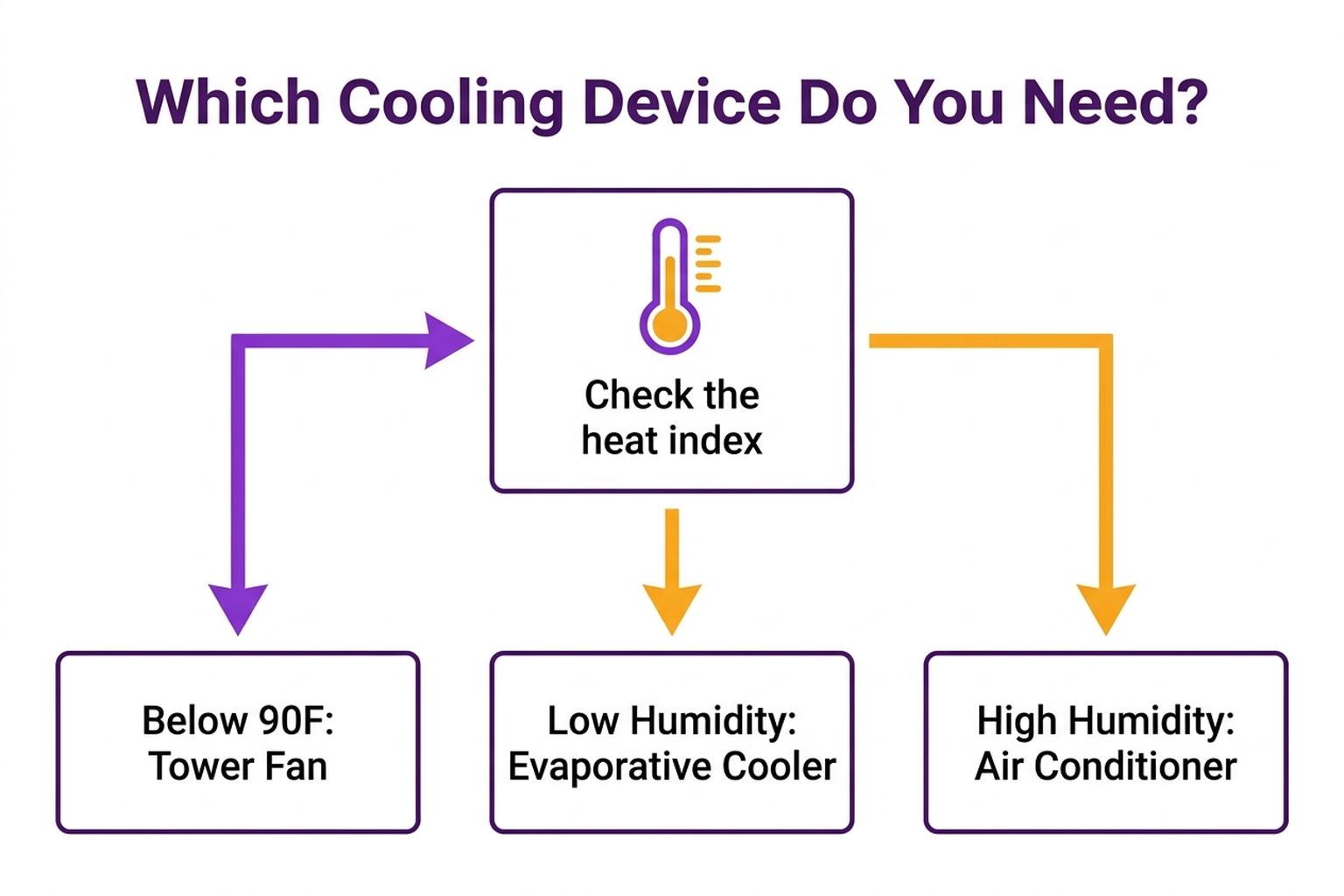
Use current local heat index and humidity, not just the thermometer reading, since the CDC’s 90°F/35% humidity threshold is a heat-index figure, not a plain air-temperature one.
Warranty Considerations
Warranty length tracks price and build philosophy more than it predicts reliability on its own. Vornado’s 5-year coverage reflects the brand’s circulator-first, built-to-last positioning and its higher price point. Dreo and Lasko both cluster around 1-year coverage (Lasko extends select models to 2 years), consistent with their lower price tiers and higher unit-replacement rate in the budget fan category generally. None of the three manufacturers publish failure-rate data, so warranty length here is a proxy for manufacturer confidence rather than an independently measured reliability figure.
Editorial Recommendation
- Best for a quiet bedroom: The Dreo Smart Tower Fan’s 20 dB low-speed claim and consistent “I can sleep with it on” review theme make it the strongest pick for overnight use, at the lowest price of the three.
- Best for whole-room circulation: The Vornado OSCR37 AE’s V-Flow design and 5-year warranty suit buyers trying to even out temperature across a larger room or push air from a window AC unit deeper into a space, rather than cool one person sitting nearby.
- Best for filtered airflow on a mid-range budget: The Lasko Apex RST200’s washable Carbon X filter and AirSense auto-adjustment add a feature set closer to the pricier bladeless category, without the premium price tag.
- When none of these are the right purchase: If your climate regularly pushes the heat index above 90°F with high humidity, the data above says a standard tower fan — any of the three — will not meaningfully help and may add risk. An evaporative cooler (effective only in dry heat) or a compressor-based AC unit (effective in any humidity) is the appropriate purchase instead.
Limitations
This analysis relies on publicly available DOE, CDC, and manufacturer-published specifications, plus aggregated Amazon customer reviews rather than our own lab testing. Manufacturer airflow and noise figures (ft/s, dB) are self-reported and tested under conditions each company does not fully disclose, so they should be read as directional rather than independently verified. Individual experience with heat tolerance, room layout, and humidity varies, and the CDC’s 90°F/35%-humidity threshold is a population-level finding, not a guarantee for any specific person’s comfort or safety.
As an Amazon Associate, Arekore earns from qualifying purchases. The Amazon product links in this article include our affiliate tracking ID and may earn us a commission if you buy through them, at no additional cost to you. See our Links Policy for details on how we select products and how commissions do not influence our recommendations.
- Dreo Smart Tower Fan (DR-HTF007S)
- Lasko Apex Oscillating Tower Fan (RST200)
- Vornado OSCR37 AE Oscillating Tower Fan
Visit Arekore to compare current prices and verify any product yourself before buying.