Do Robot Vacuums Spread Germs Between Rooms? We Checked
TL;DR
The peer-reviewed data says the fear is overstated for ordinary household dust and bacteria, but not zero. A 2018 Journal of Applied Microbiology study found that commercial robotic vacuums spread less than 0.6% of a concentrated contamination “hotspot” to other parts of a room during a single pass — a small number, but not nothing, and the study did not test spread between separate rooms. The real cross-contamination risk in everyday use comes from a different source entirely: running a robot over fresh pet waste, which can smear fecal bacteria like E. coli across multiple rooms in one cleaning cycle. Mop models with hot-water self-cleaning docks (158–185°F in the models compared here) measurably reduce bacterial buildup on the pad itself between runs.
Methodology
This analysis synthesizes (a) the peer-reviewed microbiology literature on robotic vacuum contamination transfer, including the 2018 Thompson et al. study in the Journal of Applied Microbiology and the related 2013 Environmental Science & Technology study on Bacillus spore sampling, (b) manufacturer-published specifications for self-cleaning dock temperatures and filtration across four current Amazon US robot vacuum-mop models, (c) veterinary and consumer-safety guidance on pet-waste handling, and (d) aggregated Amazon customer review sentiment on odor and maintenance complaints, sampled in October 2026. We did not personally test the products covered here, and we did not run our own microbiology sampling.
What the Research Actually Found
The most directly relevant study is Thompson, Paton, Pottage, and Bennett (published in the Journal of Applied Microbiology, 2018), which seeded a “hotspot” of Bacillus atrophaeus spores — a standard, harmless surrogate bacteria used in biodefense and cleaning research — onto laminate, PVC, and carpet flooring, then ran four commercially available robotic vacuums over it. The results were more encouraging than the average “robot vacuums spread germs” headline implies:
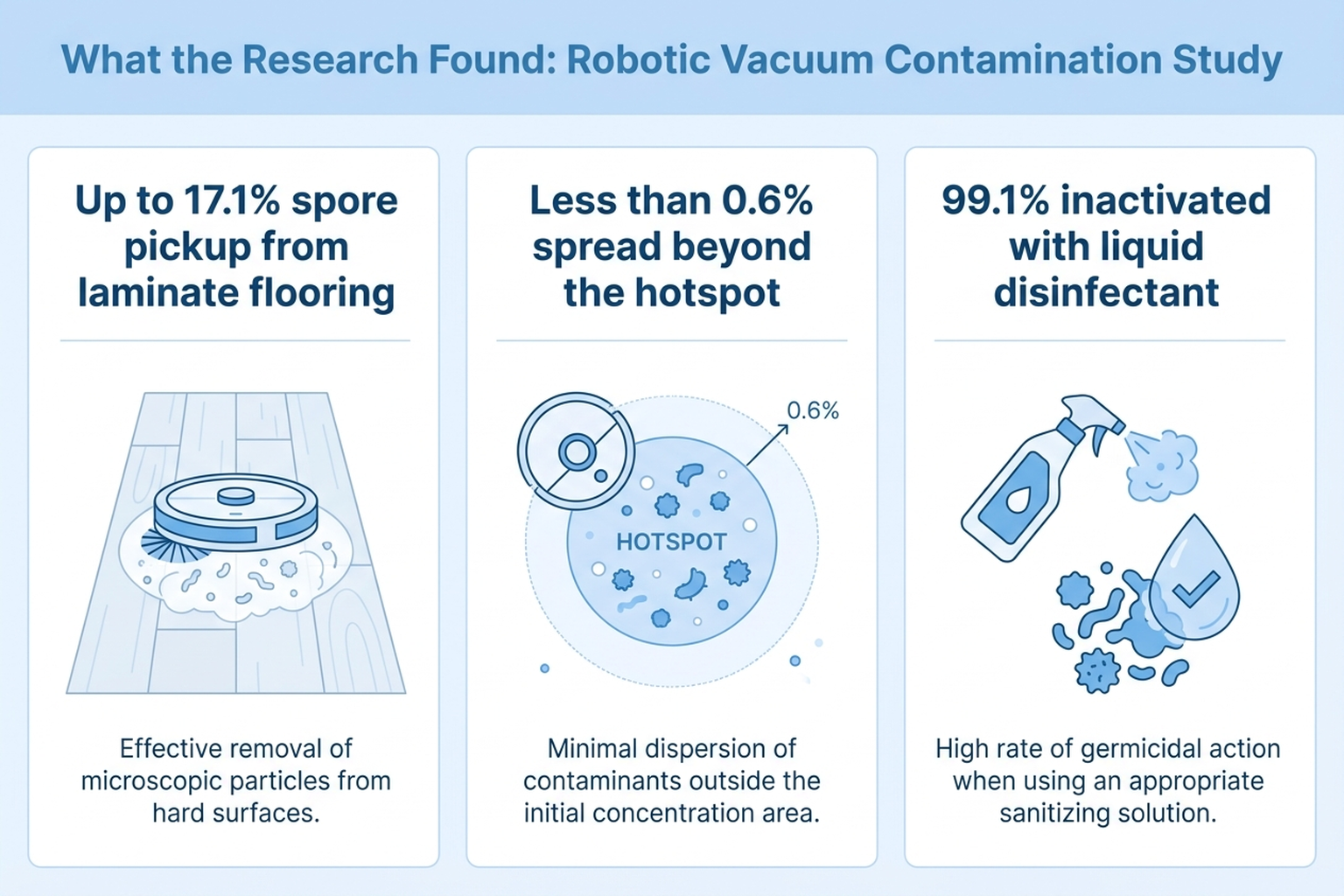
- Pickup, not just spread, was the dominant effect. Robots recovered up to 17.1% of spores from laminate flooring (less on PVC, least on carpet), meaning most of the contamination that didn’t stay put was captured in the robot’s bin rather than redistributed.
- Spread beyond the hotspot was small. All four robots tracked less than 0.6% of the total contamination outside the original hotspot area during a single cleaning pass.
- The study tested a single room, not a house. This is an important limitation: the robots were evaluated on spread within the flooring sample they were tested on, not on whether a robot would carry spores from a contaminated kitchen into a bedroom down the hall. No peer-reviewed study we located directly measured inter-room carryover for a full multi-room cleaning cycle.
- Decontamination worked well. When researchers added a liquid disinfectant step, the robots inactivated 99.1% of recovered spores from PVC flooring — relevant to mop-equipped robots that apply cleaning solution as they go.
In short: for the kind of dry, low-concentration household dust and bacteria these robots encounter on a normal day, the peer-reviewed evidence doesn’t support a meaningful room-to-room contamination risk. The caveat is that the study used a controlled surrogate bacteria at a known concentration — not the messier, higher-concentration biological material a robot actually meets in a home with pets or small children.
The Real Risk: Pet Waste, Not Household Dust
Veterinary and pest-control guidance converges on a different scenario as the actual source of cross-contamination complaints: a robot vacuum encountering fresh pet waste mid-cycle. Dog and cat feces can carry E. coli, Giardia, and roundworm eggs. A robot’s rotating brush and suction mechanism can smear solid or semi-solid waste across a brush and casters, then redistribute it as the robot continues its route into other rooms — the mechanism aggregated owner reports describe as the robot “doing more harm than good” in that specific failure case.
Object-recognition features marketed as “pet waste avoidance” (branded AIVI, ObstacleSense, or similar across manufacturers) are explicitly built to address this, but none of the manufacturers claim 100% detection, and independent coverage notes that smeared or partially liquid waste is harder for computer-vision obstacle detection to flag than a solid, well-formed pile.
Comparison Table: Hygiene-Relevant Specs
| Model | Self-Clean Dock Temp | Mop Pad Drying | Dustbin Filtration | Pet-Waste Detection | Price (as of 2026-10-04) |
|---|---|---|---|---|---|
| iRobot Roomba Combo 10 Max | Hot water wash (temp not published) | Hot-air dry | Allergen-lock bag | PrecisionVision AI obstacle avoidance | ~$999–$1,399 |
| Roborock Saros 10R | Up to 185°F (85°C) | Hot-air dry | Washable + HEPA-grade filter | StarSight Autonomous System 2.0 (3D obstacle/pet-waste detection) | ~$999 |
| Ecovacs Deebot X8 Pro Omni | 167°F (75°C) | Hot-air dry | HEPA filtration | AIVI 3D obstacle avoidance | ~$800–$900 |
| Dreame X50 Ultra | Up to 158°F (70°C) | Hot-air dry | HEPA filtration | AI-vision obstacle/pet-waste recognition (separate from the ProLeap™ step-climbing system) | ~$900–$1,360 |
Prices fluctuate on Amazon; treat this table as a snapshot rather than a live price feed.
Brand-by-Brand Notes
iRobot’s AutoWash dock washes and dries the mop pad after every run rather than letting it sit damp between cycles, which independent coverage flags as the main lever against bacterial growth on the pad itself; iRobot does not publish an exact wash-water temperature the way some competitors do.
Roborock’s Saros line washes mop pads at up to 185°F, among the higher published temperatures in this comparison, and pairs it with a washable pre-filter plus a HEPA-grade final filter, which reduces what gets re-aerosolized from the dustbin during self-emptying.
Ecovacs’s OZMO system on the Deebot X8 Pro Omni runs a 167°F hot-water wash cycle specifically marketed around pet-owning households, reflecting the brand’s positioning toward the pet-waste cross-contamination concern rather than general household dust.
Dreame’s X50 Ultra runs a comparatively cooler 158°F wash cycle; third-party comparisons note this is still well above the temperature needed to kill most common household bacteria, but it is the lowest of the four compared here.
How to Minimize Real Cross-Contamination Risk
The research and manufacturer guidance point to the same handful of practical habits, which matter far more than which model you buy:
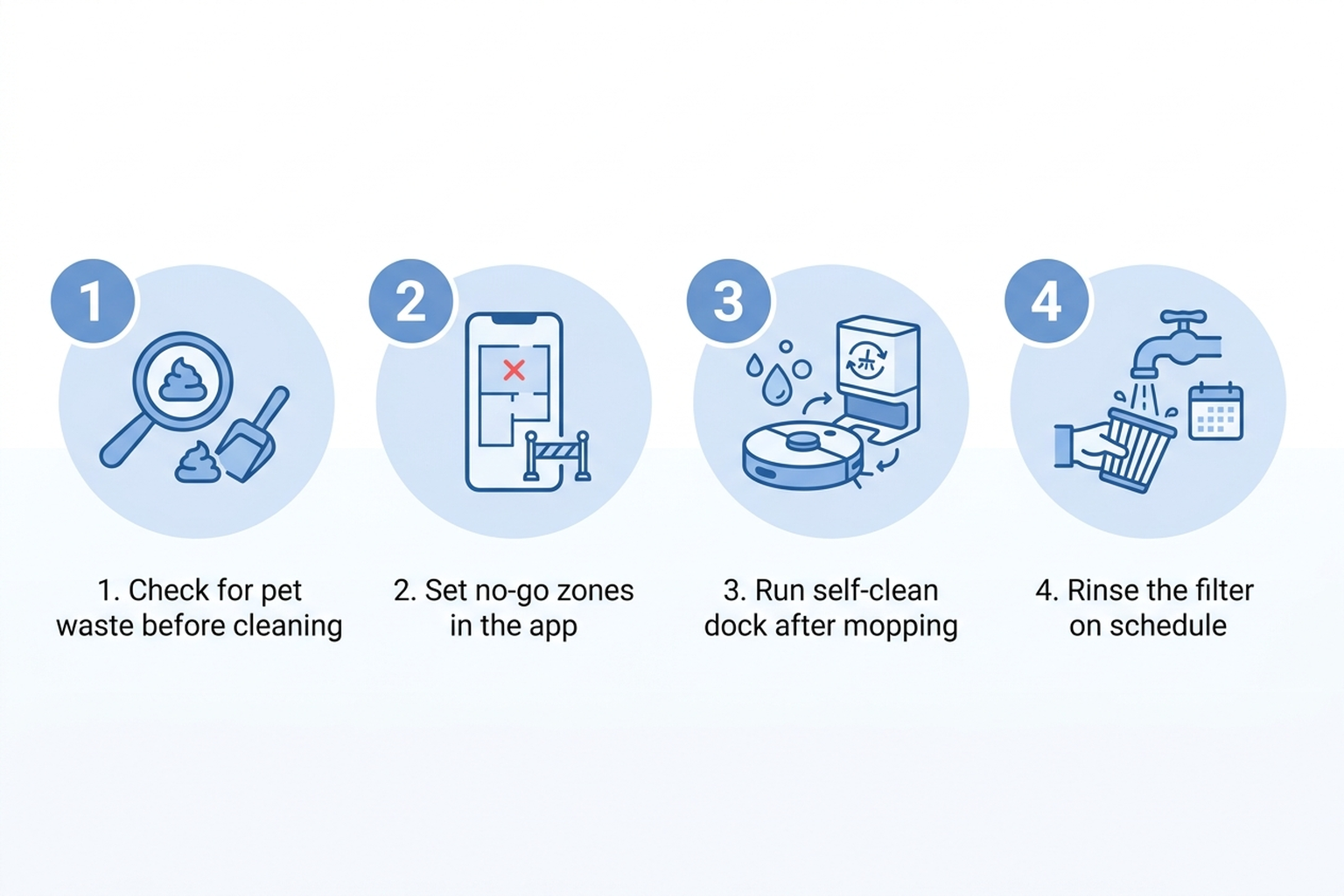
- Do a visual sweep for pet waste before every cleaning cycle, especially with puppies, senior dogs, or any pet with a known stomach issue. This single step addresses the scenario every source agrees is the actual risk driver.
- Set no-go zones in the companion app around litter boxes and any area where accidents are more likely, rather than relying solely on obstacle detection.
- Run the self-cleaning dock cycle after every mopping run, not just when the app reminds you — letting a damp pad sit between cycles is the condition under which bacteria actually multiply, according to self-cleaning-dock engineering explainers.
- Empty and rinse the dustbin’s washable filter on the manufacturer’s recommended schedule; a HEPA-grade filter only performs as rated if it isn’t clogged with the sampled dust and pet dander from a month of runs.
Decision Guide: How Much Should Hygiene Features Weigh in Your Choice?
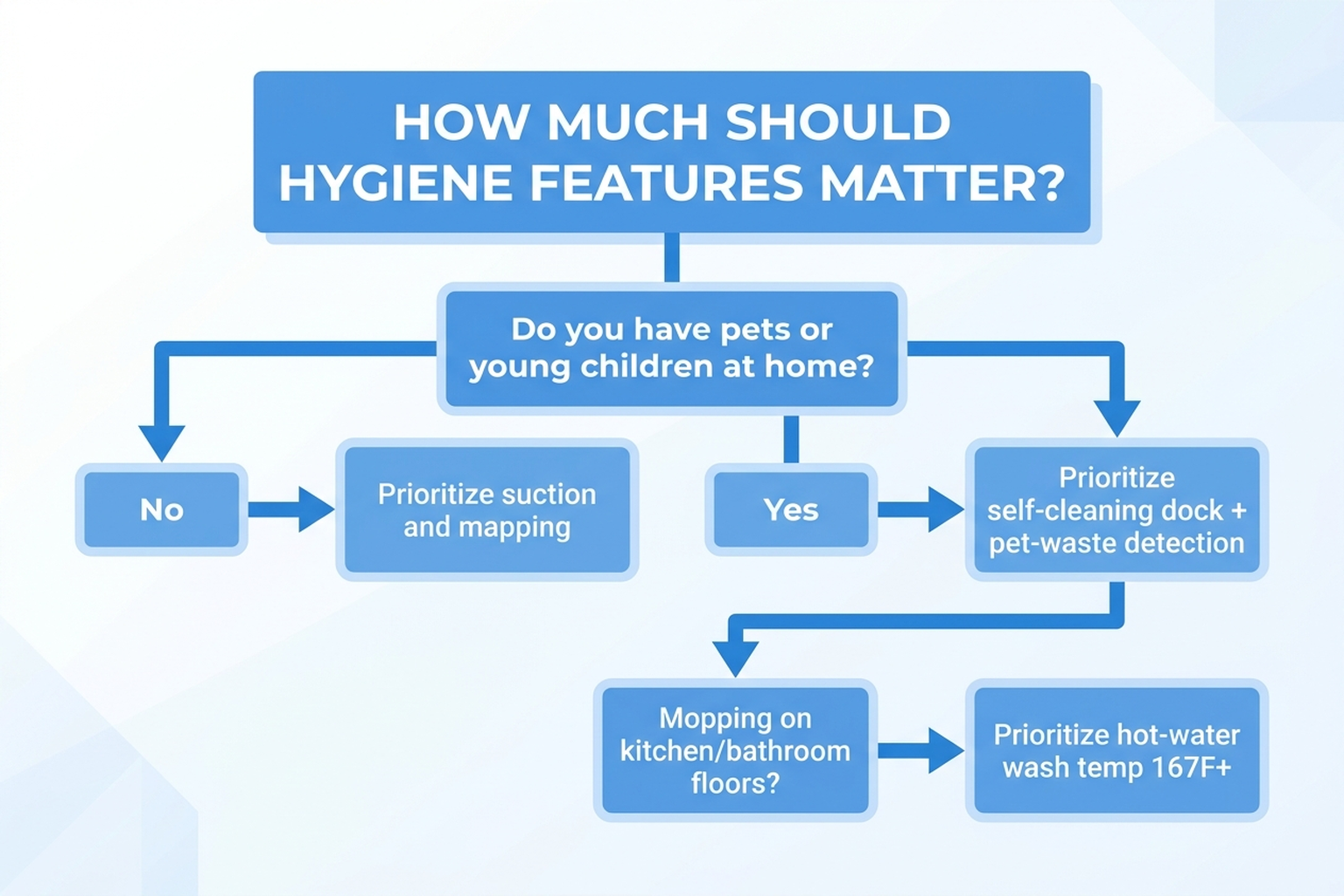
- No pets, no young children, mostly hard flooring: The peer-reviewed spread risk (under 0.6% per the 2018 study) is low enough that hygiene features are a nice-to-have, not a deciding factor — prioritize suction and mapping instead.
- Dogs or cats in the home, especially puppies or seniors: Prioritize strong pet-waste obstacle detection and a self-cleaning dock with hot-water pad washing; this is the scenario the research and owner reports both flag as the real risk.
- Mop function used on kitchen or bathroom floors: A higher wash-dock temperature (167°F+) and daily self-clean habit matter more here than on bedroom carpet, since those rooms see more spills and higher-bacteria messes.
- Household with an immunocompromised member or infant crawling on floors: Treat robot vacuum hygiene as one layer, not a substitute for manual spot-cleaning of any visible mess — none of the manufacturers claim their detection is foolproof.
Warranty Coverage
Warranty length offers an indirect signal of how much a manufacturer stands behind its self-cleaning hardware specifically, since dock pumps and heating elements are common failure points: according to each brand’s published support pages, iRobot, Ecovacs, and Dreame standardize on a 1-year limited warranty, while Roborock’s standard coverage is also 1 year from the manufacturer, though some retailers list 2-year coverage on the Saros 10R specifically. All four brands offer paid extended-warranty plans beyond the standard term.
Editorial Recommendation
For pet-owning households where the real cross-contamination risk actually lives, the Ecovacs Deebot X8 Pro Omni’s pet-focused OZMO hot-water wash cycle and AIVI obstacle detection make it the most purpose-built option among the models compared here. Households without pets, where the peer-reviewed spread risk is already under 0.6% per cleaning pass, can prioritize the Roborock Saros 10R’s higher 185°F wash temperature and HEPA-grade filtration for general dust hygiene without needing pet-specific detection. Buyers already inside the iRobot ecosystem should weigh the Roomba Combo 10 Max’s AutoWash dock — with the caveat that iRobot filed for Chapter 11 bankruptcy in December 2025 and is being acquired by contract manufacturer Shenzhen Picea Robotics, a transition the company says will not disrupt near-term product support, but is worth factoring into a purchase focused on long-term hygiene-feature reliability.
As an Amazon Associate, Arekore earns from qualifying purchases. The Amazon product links in this article include our affiliate tracking ID and may earn us a commission if you buy through them, at no additional cost to you. See our Links Policy for details on how we select products and how commissions do not influence our recommendations.
- iRobot Roomba Combo 10 Max Robot Vacuum and Mop + AutoWash Dock
- Roborock Saros 10R Robot Vacuum and Mop
- ECOVACS DEEBOT X8 PRO OMNI Robot Vacuum and Mop
- DREAME X50 Ultra Robot Vacuum and Mop
Limitations
The core peer-reviewed study we cite (Thompson et al., 2018) used a harmless surrogate bacteria (Bacillus atrophaeus spores) at a controlled concentration on a single flooring sample, not real-world pet waste, vomit, or other biological material at variable concentrations, and it measured spread within one test area rather than carryover between separate rooms in a full-house cleaning cycle. We were unable to locate a peer-reviewed study that directly measured room-to-room bacterial carryover during a full multi-room robot vacuum cycle. Manufacturer-published dock temperatures and filtration specs are self-reported and have not been independently verified by a third-party lab for this article. Individual results depend heavily on how quickly a household notices and removes pet waste before a cleaning cycle starts.
Visit Arekore to verify current pricing, ASINs, and availability before buying any product mentioned here.