Do Robot Mops Use More Water Than Hand Mopping? We Checked

TL;DR
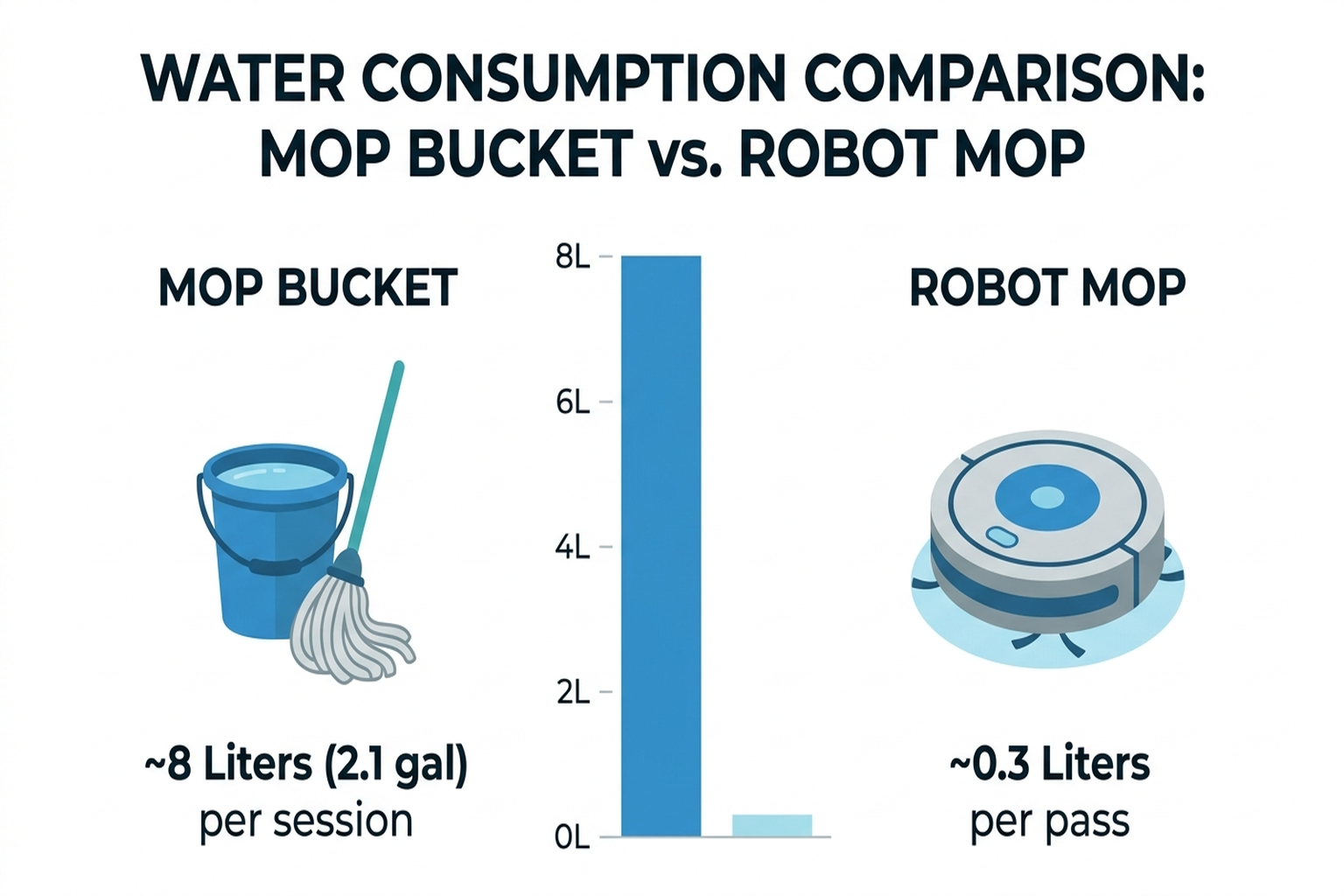
Per cleaning session, a robot mop uses dramatically less water than a bucket and mop — brand-reported figures put a single robot mopping pass at roughly 0.3 liters against roughly 8 liters (2.1 gallons) for a filled mop bucket. The gap narrows once you count the hidden second water use: self-emptying docks that wash the mop pad with hot water between passes, which adds consumption the per-pass marketing number does not include. The bigger issue independent reviewers and owners actually raise is not total volume, it’s hygiene — both methods recirculate dirty water unless you drain and refill often, and a neglected robot-mop dock tank grows the same bacteria a neglected mop bucket does.
Methodology
This analysis synthesizes (a) manufacturer-published water-tank capacities and per-session water-use figures for four current robot vacuum-mop combinations sold on Amazon US, (b) a brand-sponsored water-audit comparison between robot and manual mopping, read with appropriate skepticism given the source, (c) Wirecutter’s and Consumer Reports’ independent lab testing notes on robotic mop cleaning performance, and (d) published discussions of mop-dock hygiene and greywater handling from cleaning-industry and consumer sources, sampled in November 2026. We did not personally test the products covered here, and we did not independently measure water volume per cleaning cycle.
The Water-Use Numbers
A standard mop-and-bucket session fills a bucket with roughly 8 liters (2.1 gallons) of water, most of which gets dumped, visibly dirty, down a drain at the end. A robot mop with a clean-water tank in the 4–4.6 liter (1.1–1.2 gallon) range and flow-controlled dispensing — the design most current mid-to-premium models use — puts down roughly 0.3 liters of water per mopping pass over a typical home, according to a water-and-energy audit published by Dreame, the maker of one of the robots being compared. That is a large stated gap, and it lines up directionally with how these systems are designed: a bucket mop soaks the floor and the mop head continuously, while a robot sprays or releases a controlled, metered amount just ahead of the cleaning pad.
The catch is that “per pass” is not “per month.” Testing round-ups note that Dreame, Roborock, and Ecovacs models can complete roughly three mopping runs on a 1,000-square-foot space at maximum water flow before the tank needs a refill — useful for estimating weekly water use, but it is a number from flow-rate testing, not an independently audited utility-bill comparison against manual mopping.
The Water Use the Marketing Number Skips
Flow-controlled water dispensing only covers the mopping pass itself. Most current self-emptying docks also run a separate wash-and-dry cycle on the mop pad or roller between runs, and several premium models use hot water for that step — Ecovacs states its OZMO ROLLER system washes its roller at 167°F inside the dock, for example, a figure from the manufacturer’s own spec sheet rather than an independently measured value. That wash cycle draws from the same clean-water tank (or a second tank, depending on the model) and is not counted in a “0.3 liters per pass” figure, because that figure describes water applied to the floor, not water used by the whole cleaning system. A robot that self-washes its pad after every run is using meaningfully more total water than one that is emptied and refilled by hand only occasionally — the tradeoff is convenience, not a pure water-savings story in every configuration.
Customer Sentiment Synthesis
Reviewers of self-emptying mop docks do not commonly frame complaints in terms of water volume — nobody appears to be tracking gallons used month over month. What does come up repeatedly, across cleaning-industry sources and device reviews, is water quality and hygiene: owners and cleaning professionals both flag that closed dirty-water tanks with poor airflow can develop mold or a sour odor if left unemptied for more than a day or two, and that a wet mop pad left attached to the robot stays damp long enough to grow bacteria in the meantime. This is functionally the same complaint directed at a neglected mop bucket left to sit overnight — the hygiene risk tracks how often either system’s water is changed, not which system uses more water in total.
Comparison Table: Water-Related Specs
| Model | Clean-Water Tank | Hot-Water Pad Wash | Runs per Fill (1,000 sq ft, max flow) | Price (as of 2026-11-04) |
|---|---|---|---|---|
| iRobot Roomba Combo 10 Max | AutoWash dock reservoir (capacity not published) | Yes (AutoWash dock) | Not independently tested | ~$999–$1,399 |
| Roborock Saros 10R | 5L / ~1.3 gal (dock) | Yes, hot-water self-clean | ~3 runs reported in testing round-ups | ~$999 |
| Ecovacs Deebot X8 Pro Omni | ~4–4.6L / ~1.1–1.2 gal (dock) | Yes, 167°F OZMO ROLLER wash (per manufacturer spec) | ~3 runs reported in testing round-ups | ~$800–$900 |
| Dreame X50 Ultra | ~4.5L / ~1.2 gal (dock) | Yes, hot-water DuoScrub wash | ~3 runs reported in testing round-ups | ~$900–$1,360 |
Prices fluctuate on Amazon; treat this table as a snapshot rather than a live price feed. The “runs per fill” figures come from third-party testing round-ups describing flow-rate behavior at maximum settings, not a controlled side-by-side utility audit.
Brand-by-Brand Notes
iRobot’s AutoWash dock washes the mop pad between runs and refills from a reservoir in the dock base, but the company does not publish an exact per-session water figure the way some competitors do, making a direct volume comparison against the other three models here difficult.
Roborock’s Saros 10R uses a 5-liter (~1.3-gallon) dock reservoir, among the larger clean-water tanks in this comparison, which independent testing round-ups note supports roughly three mopping runs on a 1,000-square-foot home before a refill is needed at maximum flow.
Ecovacs’s OZMO ROLLER design on the Deebot X8 Pro Omni self-washes its roller mop with water the manufacturer specs at 167°F inside the dock after each pass, trading a lower per-pass floor-application volume for a hot-water wash step that adds to total system water use.
Dreame’s X50 Ultra, built around a roughly 4.5-liter (~1.2-gallon) dock tank, is also the source of the brand’s own water-audit comparison claiming its robot uses over 96% less water than a traditional mop bucket per session — a figure worth reading as a manufacturer claim about its own product’s floor-application rate, not an independently verified whole-system number.
How to Minimize Water Waste and Hygiene Risk With Either Method
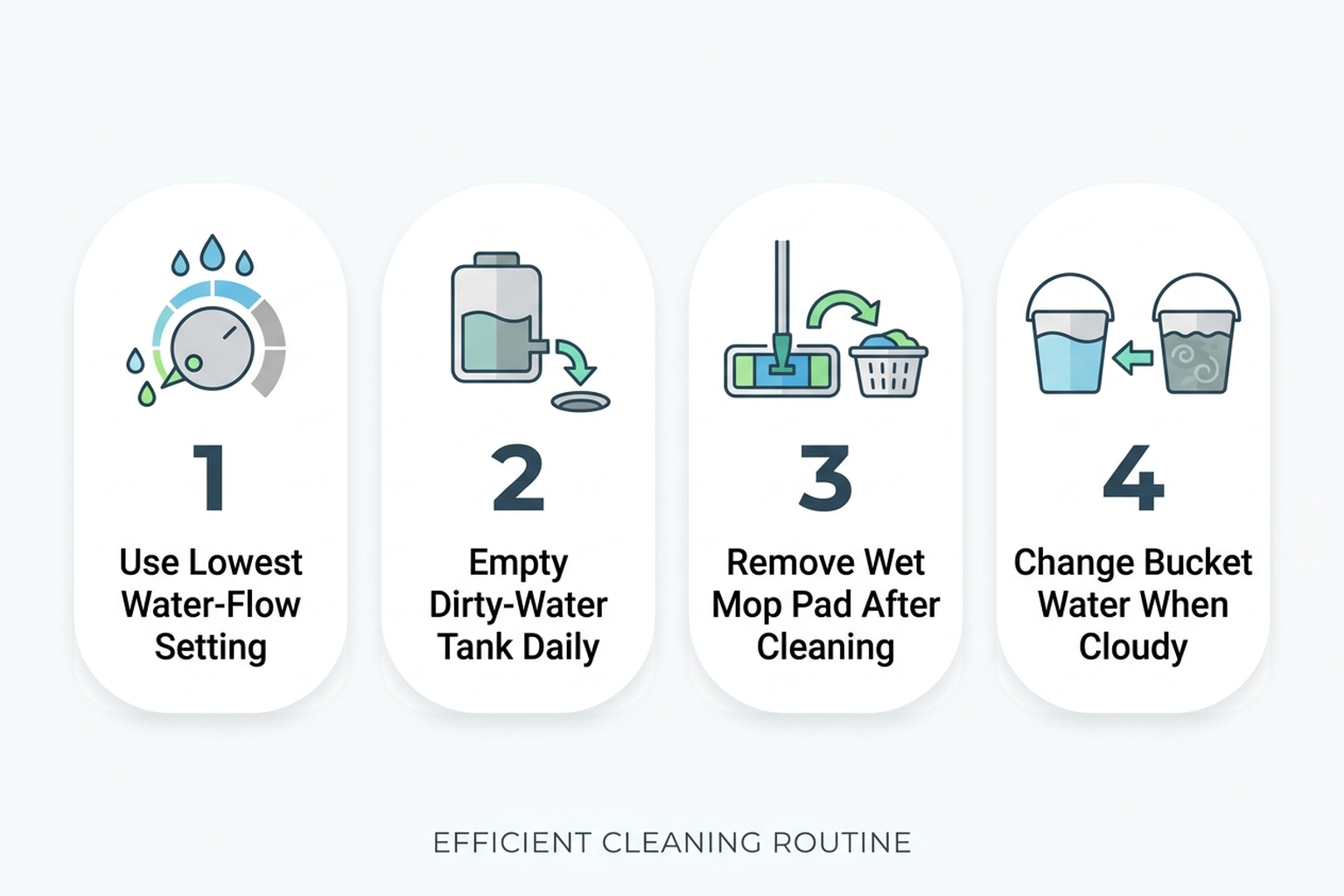
For a robot mop, set the lowest water-flow level that still leaves floors visibly clean for routine maintenance mopping, and empty the dock’s dirty-water tank daily rather than letting it sit — this single habit addresses most of the mold and odor complaints found in owner reports. For manual mopping, change the bucket water once it turns visibly cloudy rather than finishing an entire home on one fill, since continuing to mop with heavily soiled water mostly redistributes dirt rather than removing it — a criticism echoed in Wirecutter’s and Consumer Reports’ testing notes on mopping effectiveness more broadly.
Decision Guide: Does Water Use Matter for Your Choice?
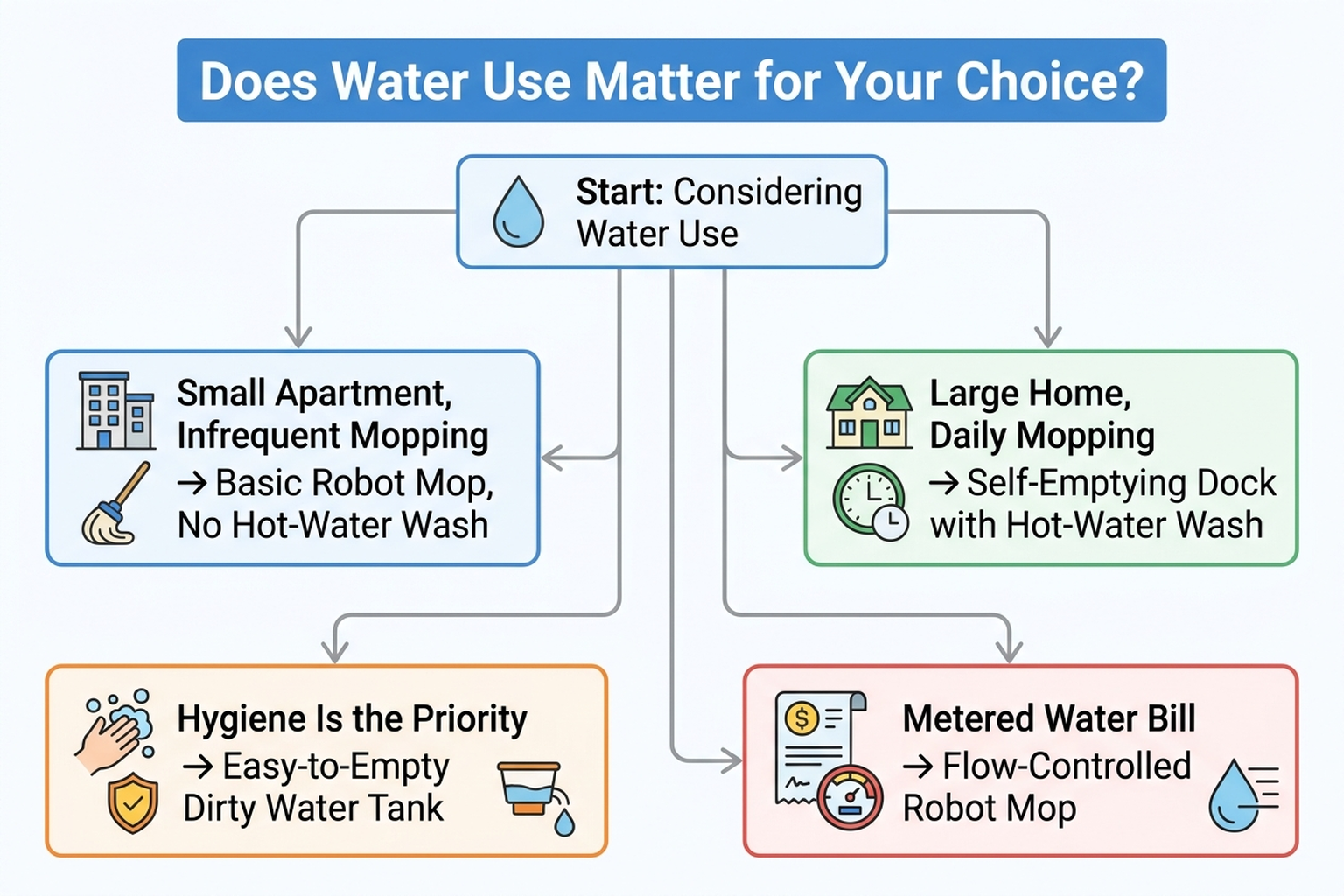
- Small apartment, infrequent mopping, no interest in a self-emptying dock: A basic robot mop with a smaller tank and no hot-water wash cycle uses the least total water of any option here.
- Large home, daily maintenance mopping: A self-emptying dock with hot-water pad washing uses more total water than a no-frills robot, but still substantially less than refilling and dumping a full mop bucket on every room.
- Concerned primarily about hygiene, not volume: Prioritize how easy a model’s dirty-water tank is to remove and empty daily, not the clean-tank capacity — the hygiene risk comes from stagnant water, not water quantity.
- On a metered or expensive water bill and mopping multiple times a week: A flow-controlled robot mop is very likely a net water reduction versus a full bucket fill every time, even accounting for a hot-water wash cycle, though we could not verify an independently audited utility-bill comparison to confirm the exact savings.
Warranty Coverage
Warranty length doesn’t track water efficiency directly, but it reflects how much confidence each manufacturer places in a water-handling mechanism that lives inside the robot and dock long-term: iRobot and Roborock both offer 2-year standard warranties on current models, while Ecovacs standardizes on 1 year and Dreame offers 1 year extendable to 2 years through app registration within 30 days of purchase.
Editorial Recommendation
For households mainly weighing water efficiency, the Roborock Saros 10R’s 5-liter (~1.3-gallon) dock reservoir gives the largest buffer between refills among the models compared here, reducing how often the dirty-water tank needs manual attention. Buyers who want the lowest total water footprint and are comfortable managing a dock tank themselves should look closely at models without a hot-water self-wash step, since that feature is the biggest driver of total water use beyond the floor-application amount. Anyone specifically chasing the Dreame-published “96% less water” figure should treat it as a manufacturer claim about floor-application volume on Dreame’s own hardware, not a verified comparison across brands or a complete accounting of dock-side water use.
As an Amazon Associate, Arekore earns from qualifying purchases. The Amazon product links in this article include our affiliate tracking ID and may earn us a commission if you buy through them, at no additional cost to you. See our Links Policy for details on how we select products and how commissions do not influence our recommendations.
- iRobot Roomba Combo 10 Max Robot Vacuum and Mop + AutoWash Dock
- Roborock Saros 10R Robot Vacuum and Mop
- ECOVACS DEEBOT X8 PRO OMNI Robot Vacuum and Mop
- DREAME X50 Ultra Complete Robot Vacuum with Self-Cleaning & Emptying
- O-Cedar EasyWring Microfiber Spin Mop and Bucket Cleaning System
Limitations
The core “0.3 liters vs. 8 liters” comparison in this article traces back to a water-and-energy audit published by a robot vacuum manufacturer (Dreame) about its own product line, not an independent lab measurement; we are presenting it as the manufacturer’s claim rather than a verified fact, and readers should weigh it accordingly. We were also unable to locate an independently audited, apples-to-apples utility-bill comparison between robot-mop and manual-mop water consumption over a full month of typical use, so the “runs per fill” and total-system water estimates in this article are directional rather than precise. Actual water use for any household depends heavily on floor area, mopping frequency, water-flow setting chosen, and whether a self-washing dock is used after every cycle or only occasionally.
Visit Arekore to verify current pricing, ASINs, and availability before buying any product mentioned here.