Do Robot Lawn Mowers Damage Your Lawn? We Checked the Data
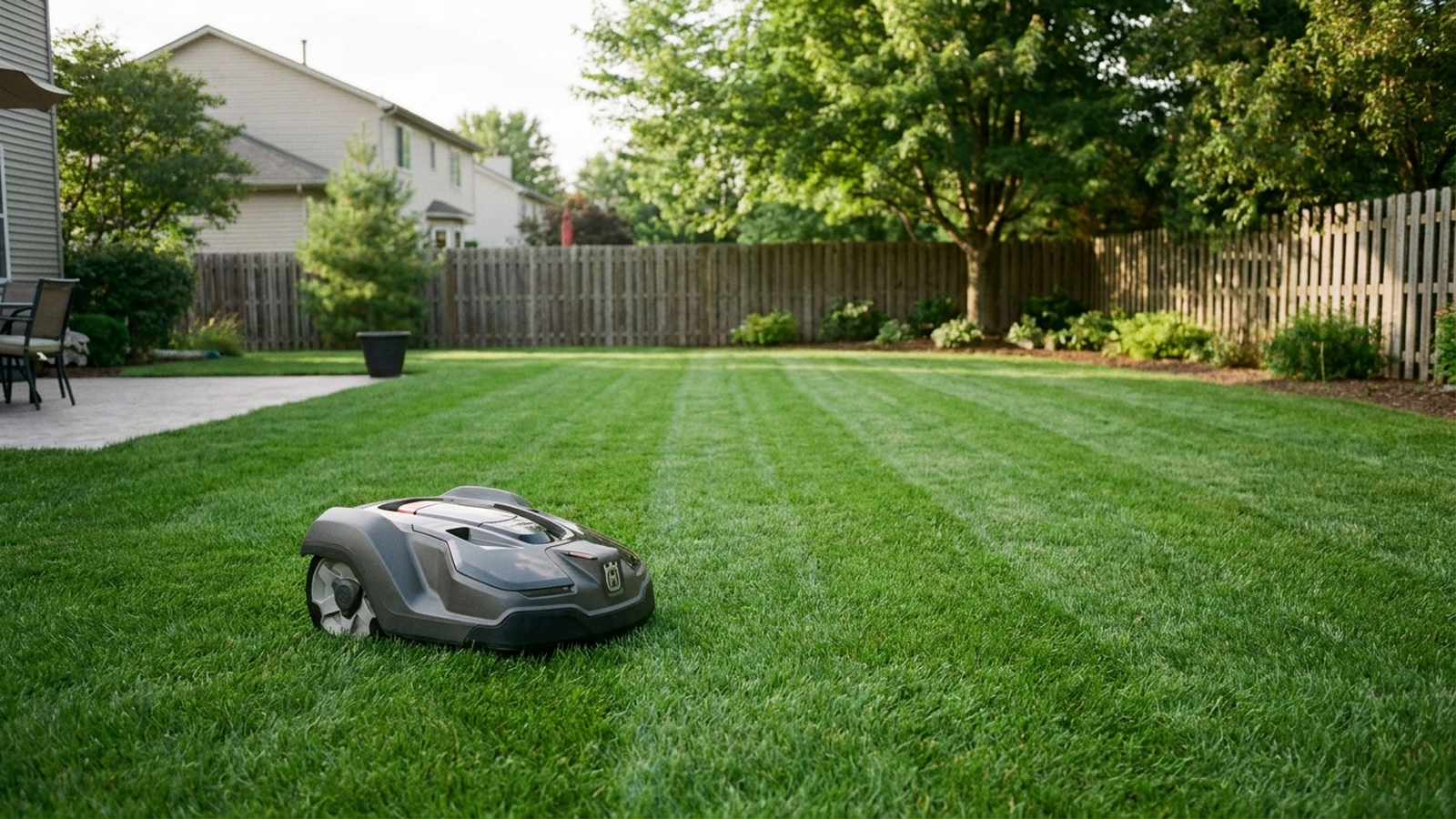
Robot lawn mowers are sold on a simple promise: set it, forget it, and never push a mower again. But a scroll through owner forums and Amazon reviews turns up a recurring complaint — ruts along the lawn’s edge, bald wheel tracks on a hill, or a scalped patch where the mower cut too low. So do robot mowers actually damage grass more than a walk-behind mower does, or is that a handful of loud complaints from unusual yards? We checked manufacturer specifications, independent test data, and aggregated owner reviews to find out what actually causes the damage — and whether it’s the robot or the yard.
As an Amazon Associate, Arekore earns from qualifying purchases. The Amazon product links in this article include our affiliate tracking ID and may earn us a commission if you buy through them, at no additional cost to you. See our Links Policy for details on how we select products and how commissions do not influence our recommendations.
TL;DR / Quick Verdict
- Robot mowers generally reduce scalping risk, not increase it — because they mow every day or two instead of once a week, they cut a smaller amount of grass each time, which is the opposite of the “cut too much at once” mechanism behind most scalping.
- The real damage driver is wheel slip, not the blade. Traction on wet or damp grass drops sharply — lawn-care industry estimates commonly cite a 40–60% reduction — and a slipping wheel tears roots and leaves a bare track. This is reported far more often than blade-related scalping in owner reviews.
- Rear-wheel-drive (RWD) mowers are more exposed on slopes than all-wheel-drive (AWD/4WD) models. 4WD mowers with traction control, like the Segway Navimow X3 series, are built specifically to cut wheel-slip damage on inclines.
- Uneven ground — not the mower itself — causes most scalping complaints. Dips, exposed roots, and rigid (non-floating) cutting decks are the most commonly cited causes of a lawn “cut too short in one spot” among tested models.
- The brand matters less than matching the mower’s slope rating to your yard. Buying a mower rated 5–10° higher than your steepest section is the single most-repeated piece of guidance across manufacturer documentation and independent test coverage.
Methodology
This is an editorial analysis, not a hands-on lawn test — we did not personally run these mowers on a test lawn over a full season. This article synthesizes (a) manufacturer specification sheets and support documentation for Husqvarna, Worx, and Eufy robot mower lines, (b) independent test coverage and owner-experience reporting from Reviewed (USA Today), Wirecutter (NYT), and Toptenreviews, (c) aggregated sentiment from Amazon customer reviews and owner forums describing wheel-track and scalping complaints, and (d) 2026 robotic-lawn-mower market data from Global Market Insights and Mordor Intelligence. We did not personally measure wheel traction, cutting height, or slope performance under controlled conditions.
The Technical Approach: Where Grass Damage Actually Comes From
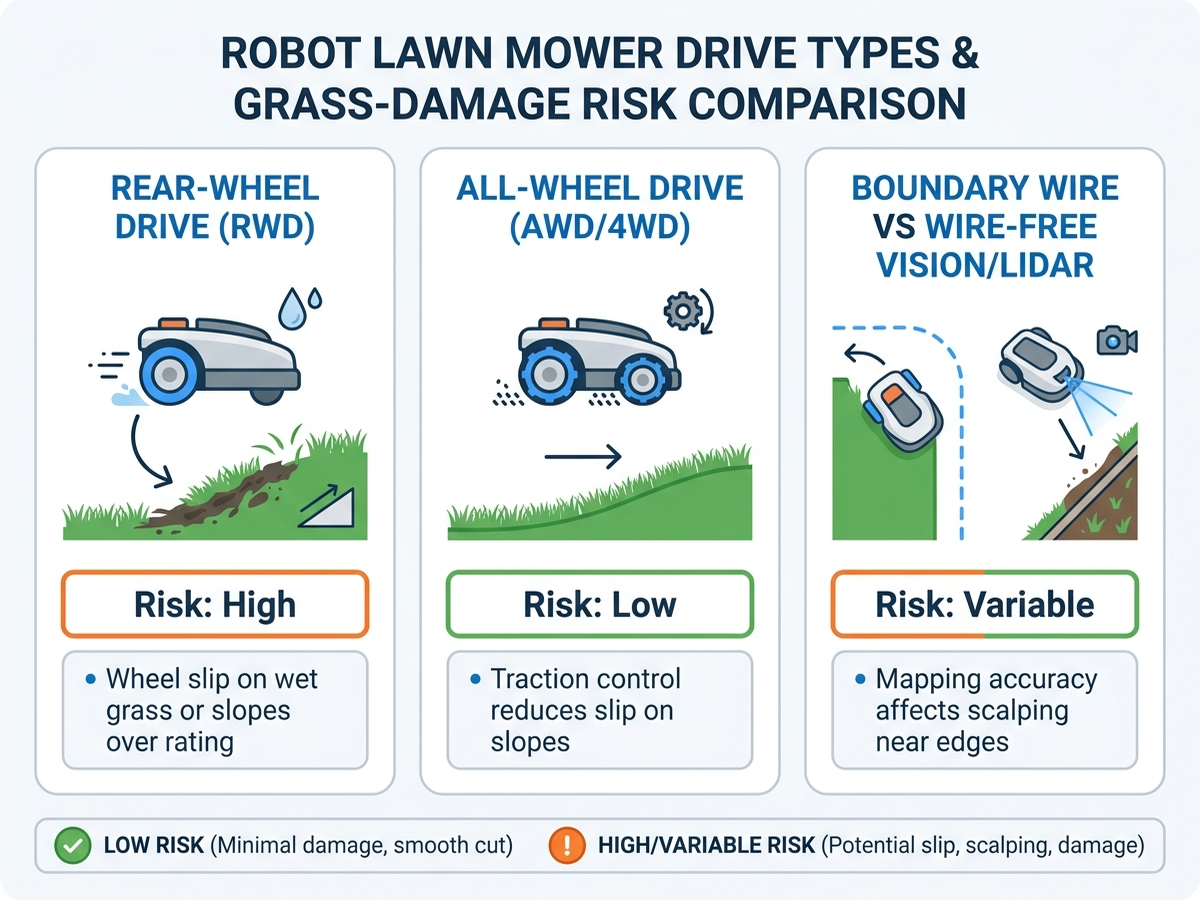
Reporting and manufacturer documentation point to two distinct damage mechanisms, and they get conflated in casual reviews:
- Wheel slip (the dominant cause). When a mower’s drive wheels lose grip — on wet grass, damp shade, or a slope beyond its rated capacity — the spinning wheel tears grass roots rather than rolling over them, leaving a rut or bald track. Lawn-care industry sources commonly estimate that traction on wet grass falls by 40–60% compared to dry conditions, which is why even a slightly damp lawn on a hill is the single most-cited condition behind wheel-track damage.
- Scalping from deck design and terrain (the secondary cause). A rigid, non-floating cutting deck holds a fixed angle between the mower body and the blade. On a lawn with dips, exposed roots, or an uneven edge near a retaining wall, that fixed angle can suddenly cut lower than intended, exposing soil. Floating-deck designs, which let the deck pivot independently of the chassis, are built specifically to hold a consistent cutting height over uneven ground.
Drive-system architecture is the biggest single variable between brands. Husqvarna’s Automower line and Worx’s Landroid line are predominantly rear-wheel-drive (RWD) on their consumer models, while newer all-wheel-drive (AWD) models — including Segway’s Navimow X3 series with its stated Traction Control System — are built to specifically address wheel-slip damage on inclines up to a 50% grade. Eufy’s E-series mowers use camera-based vision navigation rather than a buried boundary wire, which changes how precisely the mower tracks the lawn’s actual edge rather than a fixed wire loop.
Manufacturer Specs: What Husqvarna, Worx, and Eufy Actually Publish
Husqvarna Automower
Husqvarna’s Automower line, led by the 430X, uses three small pivoting razor blades mounted on a rotating disc rather than one large blade. Independent test coverage describes this system as producing a notably clean, even cut at lower heights with minimal visible clippings. Several Automower models, including the 430X, include a gradual height-adjustment feature that lowers the cutting height from maximum down to the target setting over roughly 10 days rather than immediately — Husqvarna’s own documentation frames this as reducing shock to the lawn compared with an abrupt height drop. Husqvarna’s mid-tier and premium Automower models are GPS-assisted for tracking mowed areas, though independent testers have reported the 415X struggling with traction on hills and in rutted terrain, consistent with the RWD wheel-slip pattern described above.
Worx Landroid
Worx’s Landroid line uses a single 7-inch blade spinning at high RPM rather than Husqvarna’s multi-blade disc. Independent side-by-side comparisons describe the Landroid’s cut as slightly less clean at the lawn’s edges than the Automower’s, but note it mulches leaves and debris more effectively due to the larger blade and higher RPM. The Landroid line offers a wider adjustable cutting-height range than some Automower tiers, which Worx markets as flexibility for owners who prefer to keep grass longer — a relevant factor since mowing turf shorter than its ideal range is one of the underlying causes of scalping-prone, thin turf in the first place.
Eufy E-Series (E15 / E18)
Eufy’s E18 forgoes both a buried boundary wire and GPS in favor of camera-based vision navigation (“RTK-free,” per Eufy’s own marketing) paired with AI obstacle avoidance, mapping the lawn from onboard cameras rather than a fixed perimeter. Independent testing describes the E18 as capable but occasionally getting stuck in ruts at the boundary between lawn and adjacent terrain, such as where a lawn meets a wooded area or retaining wall — a pattern the same test attributed more to terrain transitions than to the mower’s cutting system. Eufy’s published specs list an 18° maximum slope rating and a cutting height range of 1–3 inches, both of which are meaningfully lower than the specs Husqvarna and Segway publish for their higher-tier, slope-oriented models.
How to Minimize Grass Damage With a Robot Mower
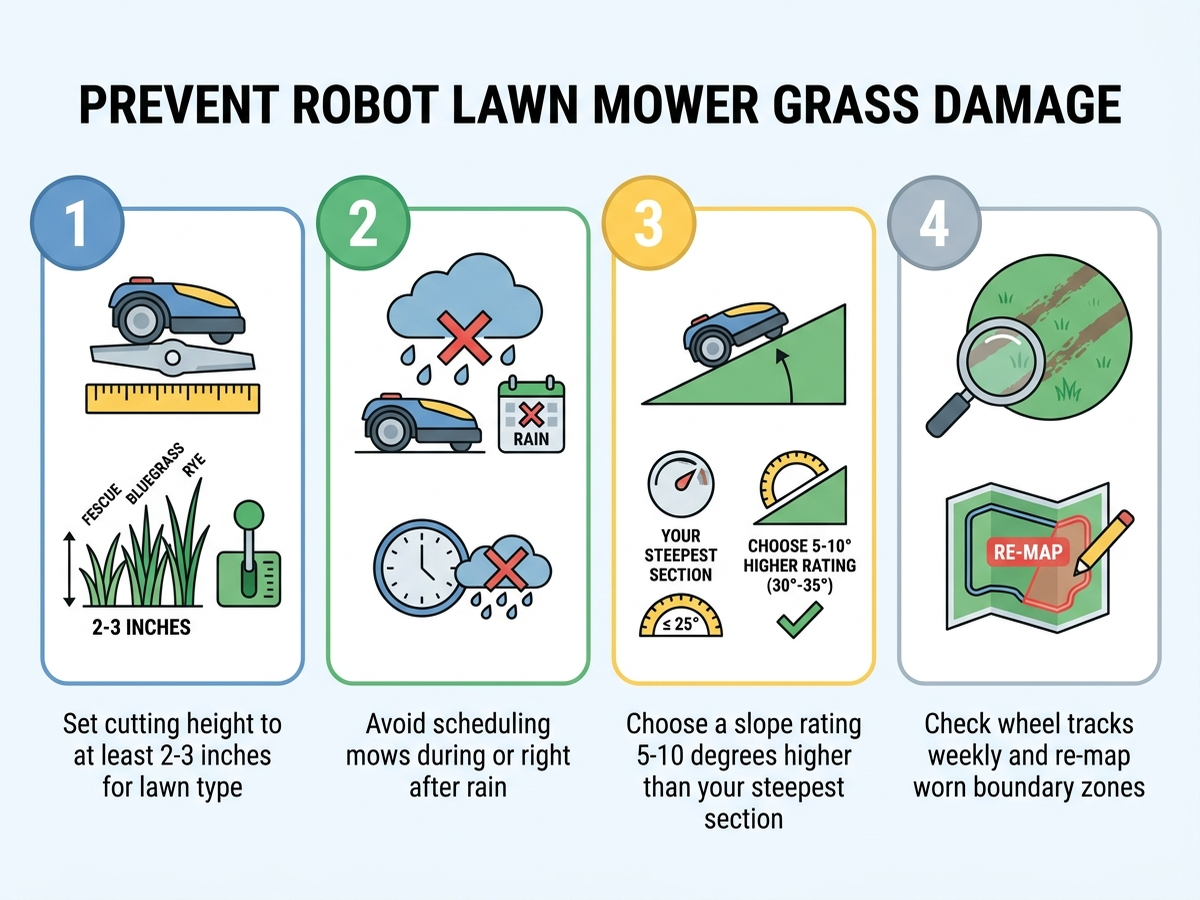
- Set the cutting height to at least 2–3 inches for common US lawn types; coarser, wider-bladed grasses like tall fescue need a mower capable of at least a 2–4 inch cutting height to avoid scalping.
- Avoid scheduling mows during or immediately after rain. Since wet-grass traction loss is the single biggest driver of wheel-slip damage, most app-based scheduling tools let you set a dry-weather-only mowing window.
- Buy a slope rating with headroom. Choosing a mower rated 5–10° higher than your yard’s steepest measured section is the most consistently repeated piece of guidance across manufacturer specs and test coverage, and it’s the step most owners skip.
- Check wheel tracks weekly, especially near edges. Boundary zones near retaining walls, garden beds, or wooded transitions are where both wire-guided and vision-guided mowers most often get stuck or re-cut the same strip, per aggregated owner reports.
Is Your Yard a Risk? A Simple Way to Decide
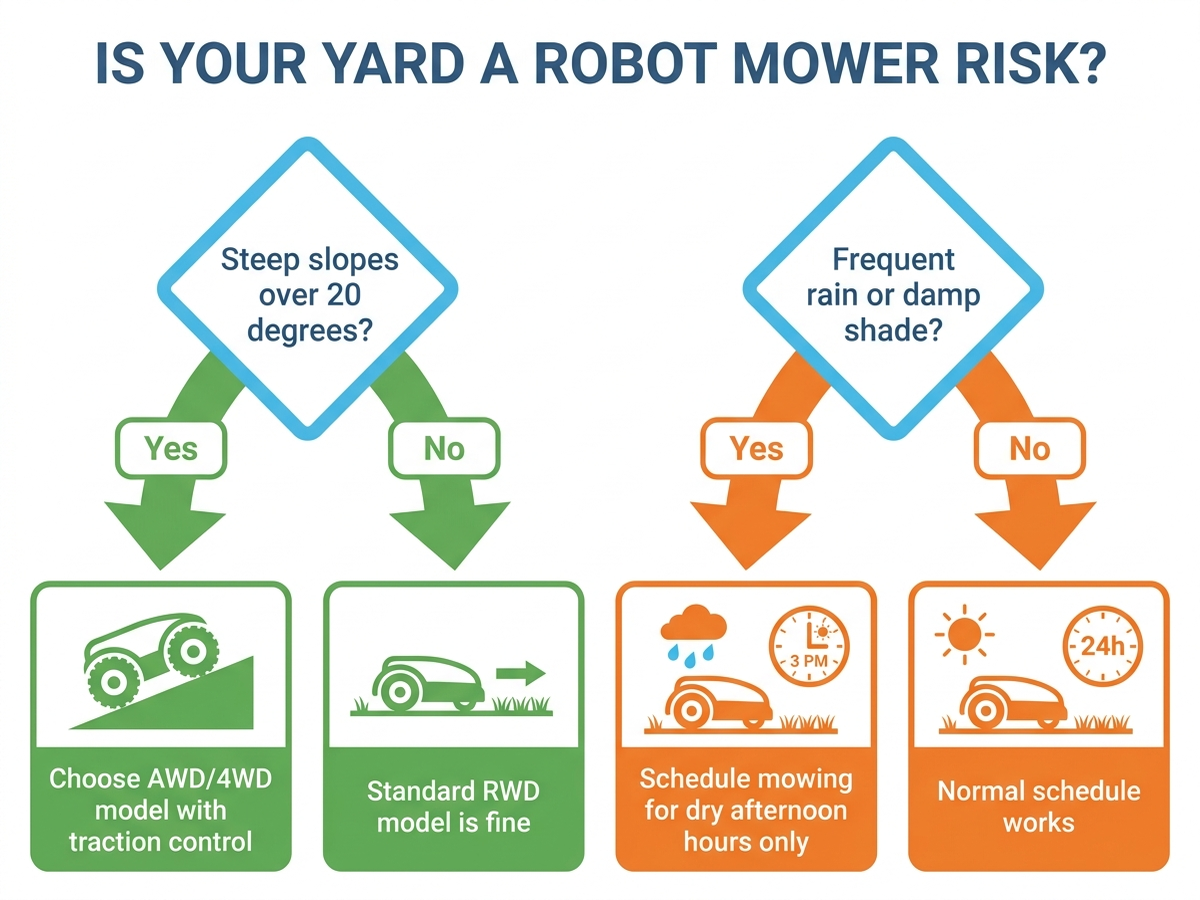
- If your yard has slopes over roughly 20°, an RWD model — including entry-tier Automower and Landroid units — is more exposed to wheel-slip damage than an AWD/4WD model with dedicated traction control, such as Segway’s Navimow X3 series.
- If your yard gets frequent rain or has damp, shaded sections, scheduling mowing for dry afternoon hours materially reduces the traction-loss window regardless of which drive system you choose.
- If your lawn has dips, exposed roots, or an uneven edge along a wall or bed, prioritize a mower with a floating deck or a gradual height-adjustment feature over one with the highest-rated slope tolerance, since deck design — not slope handling — is what’s driving the scalping risk in that scenario.
Comparison: Drive System, Slope Rating, and Cutting Height by Model
Prices as of 2026-09-27 — check the live Amazon listing before buying, since robot mower pricing shifts frequently with seasonal promotions.
| Model | Drive System | Max Slope Rating | Cutting Height Range | Coverage |
|---|---|---|---|---|
| Husqvarna Automower 430X | RWD, GPS-assisted | Not spec’d for extreme slopes; suited to moderate terrain | Gradual auto-adjust to target height | Up to 0.8 acre |
| Worx Landroid (WR147, 20V) | RWD | Moderate slope tolerance (model-dependent) | Wider adjustable range than entry Automower tiers | Up to 1/4 acre |
| Eufy E18 | RWD, vision navigation (no boundary wire) | 18° max | 1”–3” | Up to 0.3 acre |
Editorial Recommendation
- Best for hilly or slope-heavy yards: prioritize an AWD/4WD model with a stated traction-control system over a flat slope-rating number alone — wheel slip, not blade height, is the leading cause of grass damage on inclines per aggregated reporting.
- Best for a clean, low-maintenance cut on mostly flat lawns: Husqvarna Automower 430X (amazon.com) — the multi-blade disc and gradual height-adjustment feature are specifically designed to avoid the abrupt-height-change mechanism behind scalping.
- Best for owners who don’t want to bury a boundary wire: Eufy E18 (amazon.com) — vision-based mapping skips the wire-install step, though its lower 18° slope rating and smaller coverage area mean it’s a better match for flatter, smaller yards than steep or large ones.
- Best value for a small, mostly flat lawn: Worx Landroid WR147 (amazon.com) — a wider adjustable cutting-height range helps avoid scalping thin or drought-stressed turf that needs to be kept longer.
- Regardless of model, match the slope rating to your yard with headroom. This single step shows up more consistently across manufacturer guidance and test coverage than any brand-versus-brand difference in cutting system.
Limitations
This analysis synthesizes manufacturer specifications, independent test coverage, and aggregated owner-review sentiment; it is not a controlled side-by-side test of wheel traction or cutting quality on a shared test lawn. Slope ratings, cutting-height ranges, and traction performance are self-reported by manufacturers or observed by third-party reviewers under their own test conditions, which may not match your yard’s soil type, grass species, or drainage. Wheel-slip and scalping complaints referenced here come from aggregated review and forum sentiment rather than a controlled failure-rate study, so the frequency of these issues relative to total units sold is not independently verifiable. Individual experience will vary based on lawn slope, soil moisture, grass type, and how closely the mower’s rated slope tolerance is respected during setup.
Verify Before You Buy
Slope ratings and cutting-height ranges vary by specific model and firmware version, so confirm the exact spec sheet for the SKU you’re considering rather than assuming a shared brand name means shared capability. Visit Arekore to compare current listings and pricing before you buy.