Do Portable Power Stations Work in Cold Weather? We Checked
TL;DR
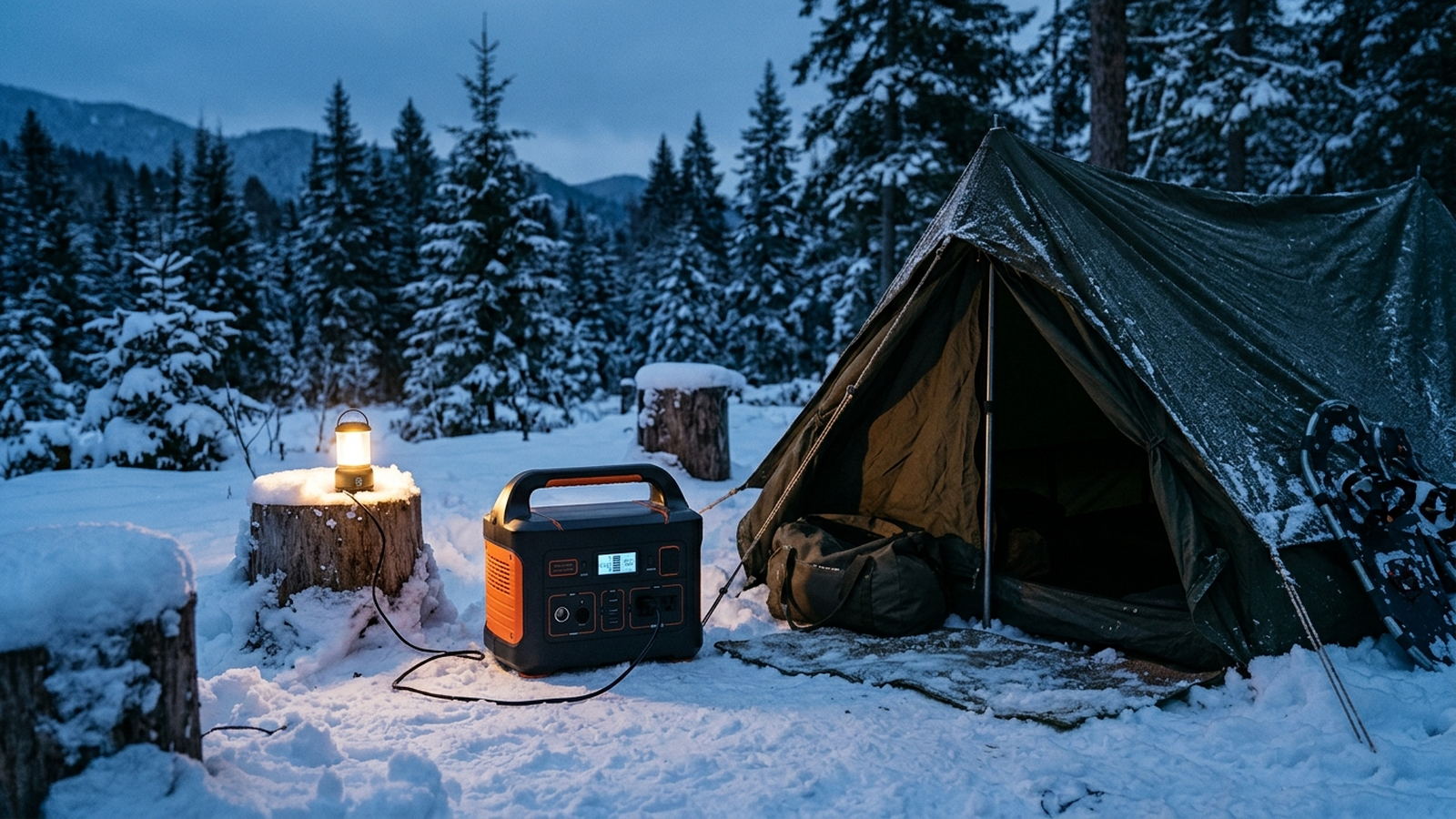
Yes, a portable power station will generally still turn on and run a load in freezing temperatures — but it will not charge below freezing, and it will deliver less runtime than its rated capacity promises. Every major brand’s battery management system (BMS) blocks charging once the cell temperature drops below roughly 32°F (0°C), a hard safety cutoff, not a bug. Discharging (running a lamp, phone charger, or heater off the battery) works colder than that, but how much colder varies by brand: Jackery and EcoFlow rate their current LiFePO4 units down to 14°F (-10°C), while Anker SOLIX and Bluetti rate theirs down to -4°F (-20°C). Owner reports and field tests consistently describe meaningfully reduced capacity in the cold, not a hard failure — the device that “died” in a reviewer’s cold-weather test had usually been left to freeze solid, then plugged in to charge before it warmed back up.
Methodology
This analysis synthesizes (a) manufacturer-published operating-temperature specifications for four current LiFePO4 portable power stations sold on Amazon US, (b) Consumer Reports’ lab-based generator and portable-power-station testing program, which evaluates these devices independently of manufacturer marketing claims, (c) aggregated Amazon customer reviews and independent field-test write-ups describing cold-weather charging failures and capacity loss, and (d) current US portable-power-station market-size data, sampled in November 2026. We did not personally run a controlled cold-chamber test of these units; capacity-loss figures cited from field tests and owner reports should be read as directional, not as standardized lab measurements, and we did not calculate a precise review sample size for the cold-weather-complaint pattern described below — Amazon does not expose a count broken out by complaint type.
The Real Question Isn’t “Does It Work” — It’s “Charging or Discharging?”
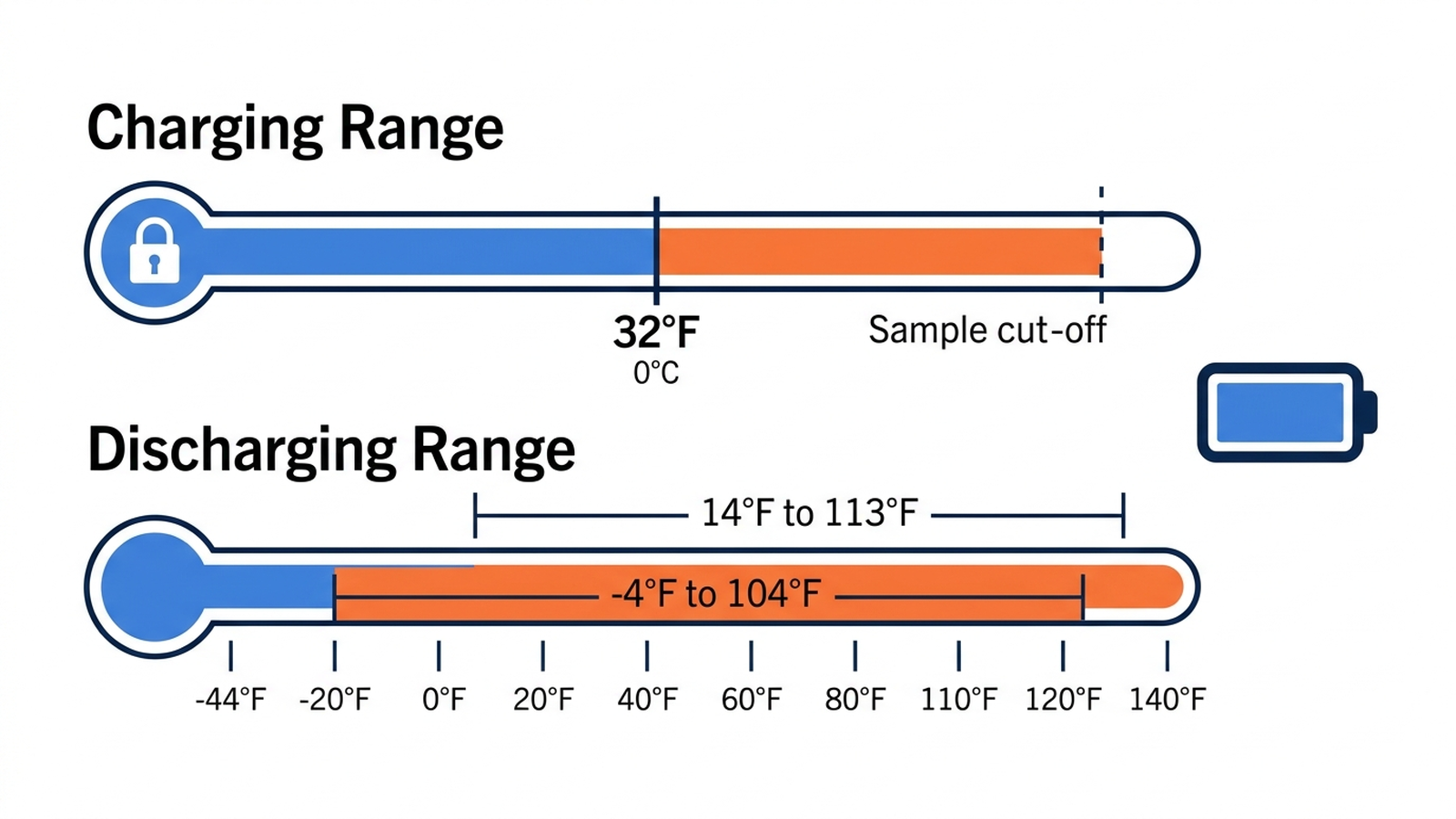
Most of the confusion around portable power stations and cold weather comes from treating “operating temperature” as a single number, when every manufacturer actually publishes two: a charging range and a discharging range, and the discharging range is always wider.
Charging is the fragile side. Lithium iron phosphate (LiFePO4) cells — the chemistry used in nearly every current mid-to-large power station — can be permanently damaged by charging below freezing. Pushing current into a cold cell can deposit metallic lithium on the anode instead of absorbing it normally, a process called lithium plating that is not reversible: it reduces usable capacity and raises internal resistance for the life of the battery. Because of that risk, every major brand’s BMS simply refuses to accept a charge once internal cell temperature reads below about 32°F (0°C), and resumes automatically once the cells warm.
Discharging — drawing power out to run something — tolerates more cold because it does not carry that plating risk. This is the specification that actually answers “will it work outside in winter,” and it is where brands diverge.
What the Manufacturers Actually Specify
| Model | Charging Range | Discharging Range | Chemistry | Capacity | Price (as of 2026-11-04) |
|---|---|---|---|---|---|
| Jackery Explorer 1000 v2 | 32°F–113°F (0°C–45°C) | 14°F–113°F (-10°C–45°C) | LiFePO4 | 1,070Wh | ~$500–$800 |
| EcoFlow DELTA 3 Plus | 32°F–113°F (0°C–45°C) | 14°F–113°F (-10°C–45°C) | LiFePO4 | 1,024Wh | ~$500–$700 |
| Anker SOLIX C1000 Gen 2 | 32°F–104°F (0°C–40°C) | -4°F–104°F (-20°C–40°C) | LiFePO4 | 1,024Wh | ~$500–$700 |
| Bluetti Elite 200 V2 | 32°F–104°F (0°C–40°C) | -4°F–104°F (-20°C–40°C) | LiFePO4 | 2,073.6Wh | ~$900–$1,400 |
Prices fluctuate on Amazon; treat this table as a snapshot rather than a live price feed. All four manufacturers agree on the charging cutoff: 32°F. None of them will accept a charge below freezing regardless of brand. The split shows up on discharge — Anker and Bluetti’s current flagship units are rated 18 degrees Fahrenheit colder on the low end than Jackery and EcoFlow’s. For most US winters outside the coldest parts of the upper Midwest and mountain West, the 14°F floor covers overnight lows in a typical cold snap; the -4°F floor adds margin for genuinely harsh conditions like an unheated garage during an arctic outbreak or a pre-dawn ice-fishing trip.
Worth noting as a side case, not a buying recommendation tied to an Amazon listing here: Bluetti’s newer Pioneer Na line uses sodium-ion rather than LiFePO4 chemistry specifically to push cold-weather performance further, with a discharge rating down to roughly -13°F — a reminder that chemistry, not just BMS tuning, sets the real floor, though it is not currently sold through Amazon US.
What Happens to Capacity in the Cold
None of the four manufacturers above publish an exact capacity-loss percentage at a given cold temperature — that figure comes from field testing and owner reports rather than a spec sheet. Independent and owner-reported cold-weather tests describe a consistent pattern rather than a precise number: expect noticeably reduced usable capacity as temperatures drop toward and below freezing, with the loss becoming more pronounced the colder it gets, and the battery’s rated capacity recovering once it warms back up. This matches how lithium chemistries generally behave — reduced capacity in the cold is temporary and tied to internal resistance at low temperature, not permanent degradation, as long as the unit was never charged while frozen.
Treat any specific cold-weather capacity-loss percentage you see online — including figures from field tests referenced in this article — as a result from one reviewer’s equipment and conditions, not a standardized, cross-brand lab measurement; no major test house has published a controlled, apples-to-apples cold-chamber comparison across all four brands above using the same protocol.
Customer Sentiment Synthesis
Amazon reviews rarely use the words “capacity loss” — what shows up instead is confusion framed as a malfunction. Owners describe bringing a power station in from a cold garage or vehicle and getting an “overload” or charging-error message on the display, or finding the unit simply won’t take a charge at all until it’s been inside for a while. Read against the manufacturer specs above, this is expected behavior, not a defect: it is the BMS enforcing the 32°F charging cutoff exactly as designed. The complaint that does represent a real functional gap, raised across both reviews and independent field write-ups, is that a unit running a space heater or similar high-draw device outdoors in deep cold depletes noticeably faster than the same load would at room temperature — consistent with reduced cold-temperature capacity rather than a fault.
Brand-by-Brand Notes
Jackery’s Explorer 1000 v2 shares the 14°F discharge floor with EcoFlow and is the most widely reviewed unit in this comparison; aggregated owner feedback is strongest on ease of use and Jackery’s companion app, with cold-weather complaints concentrated on the expected charging cutoff rather than discharge failures.
EcoFlow’s DELTA 3 Plus matches Jackery’s discharge range but adds a narrower “optimal operating” window (68°F–86°F) in its own documentation — a reminder that the published min/max discharge range is a safe-operation limit, not the range in which the unit performs at its rated output.
Anker SOLIX’s C1000 Gen 2 extends 18°F colder on discharge than the Jackery/EcoFlow pair, which independent field tests and owner reports tie to relatively strong cold-weather capacity retention in this comparison, alongside a fast claimed wall-charge time once brought back above freezing.
Bluetti’s Elite 200 V2 matches Anker’s -4°F discharge floor at roughly double the capacity, making it the pick in this set for buyers who want both cold-weather headroom and enough capacity to run more than lights and phones through a winter outage.
How to Use a Power Station Safely in the Cold
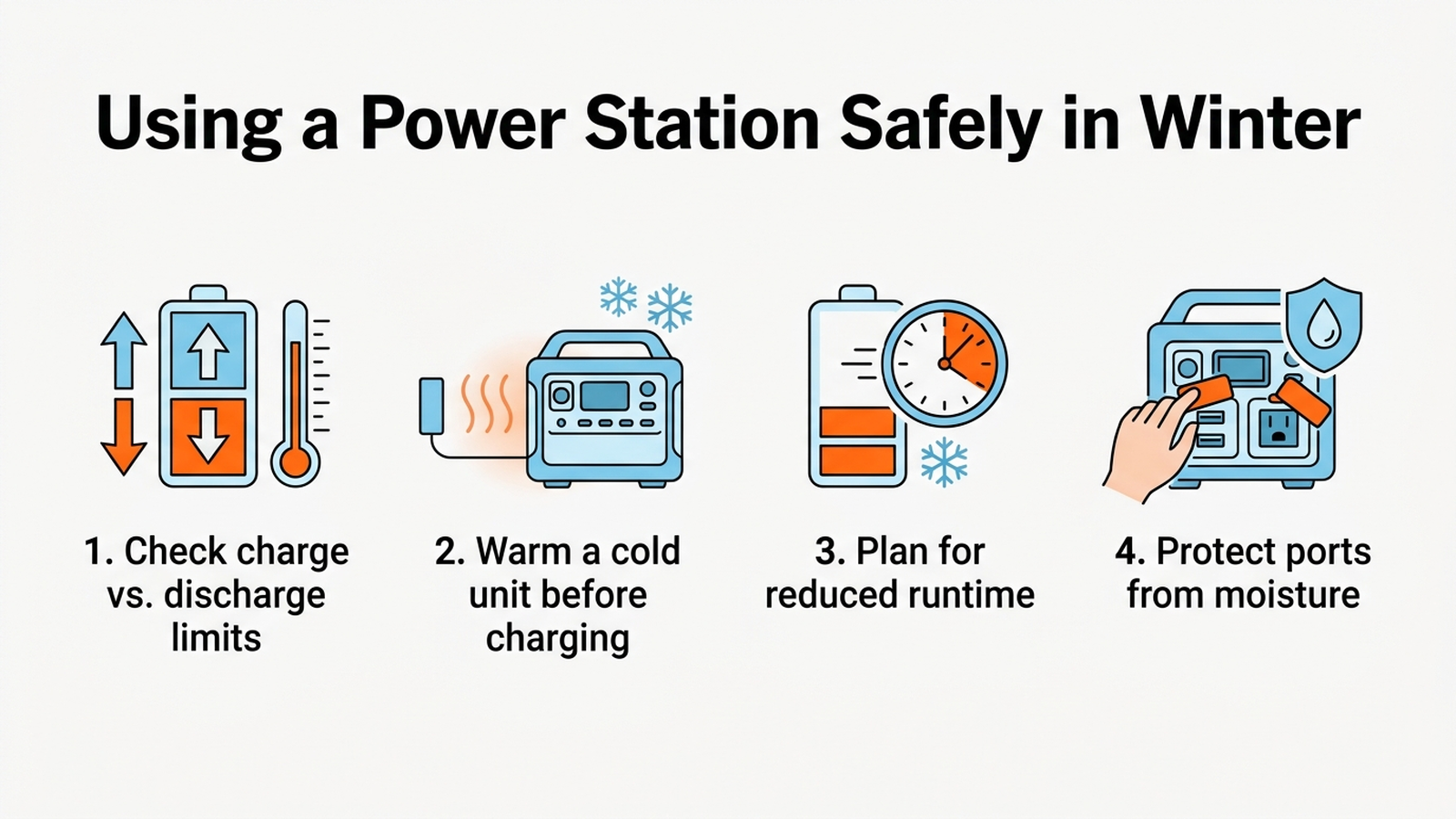
- Know the difference between the two numbers. Check whether you’re near the charging cutoff (32°F for all four brands here) or the discharging floor (14°F or -4°F depending on brand) before assuming a problem.
- Never plug in a unit that’s been sitting in the cold. Bring it inside and let it return to room temperature first — most BMS units will simply refuse the charge below freezing, but a unit just above that threshold can still be colder internally than the display suggests.
- Expect reduced runtime outdoors, and plan for it. Size your load with margin if you’re relying on the unit below freezing — a device rated for 8 hours at room temperature may run meaningfully shorter in a cold tent or unheated garage.
- Keep it off direct contact with snow or ice where practical. This is about moisture and condensation at the ports, not the battery chemistry itself.
- If you must charge in the field, warm the unit first. A sleeping bag, an insulated case, or simply bringing it inside a heated vehicle cabin for 20–30 minutes is enough to clear most BMS low-temperature charge locks.
Decision Guide: How Much Cold-Weather Headroom Do You Need?
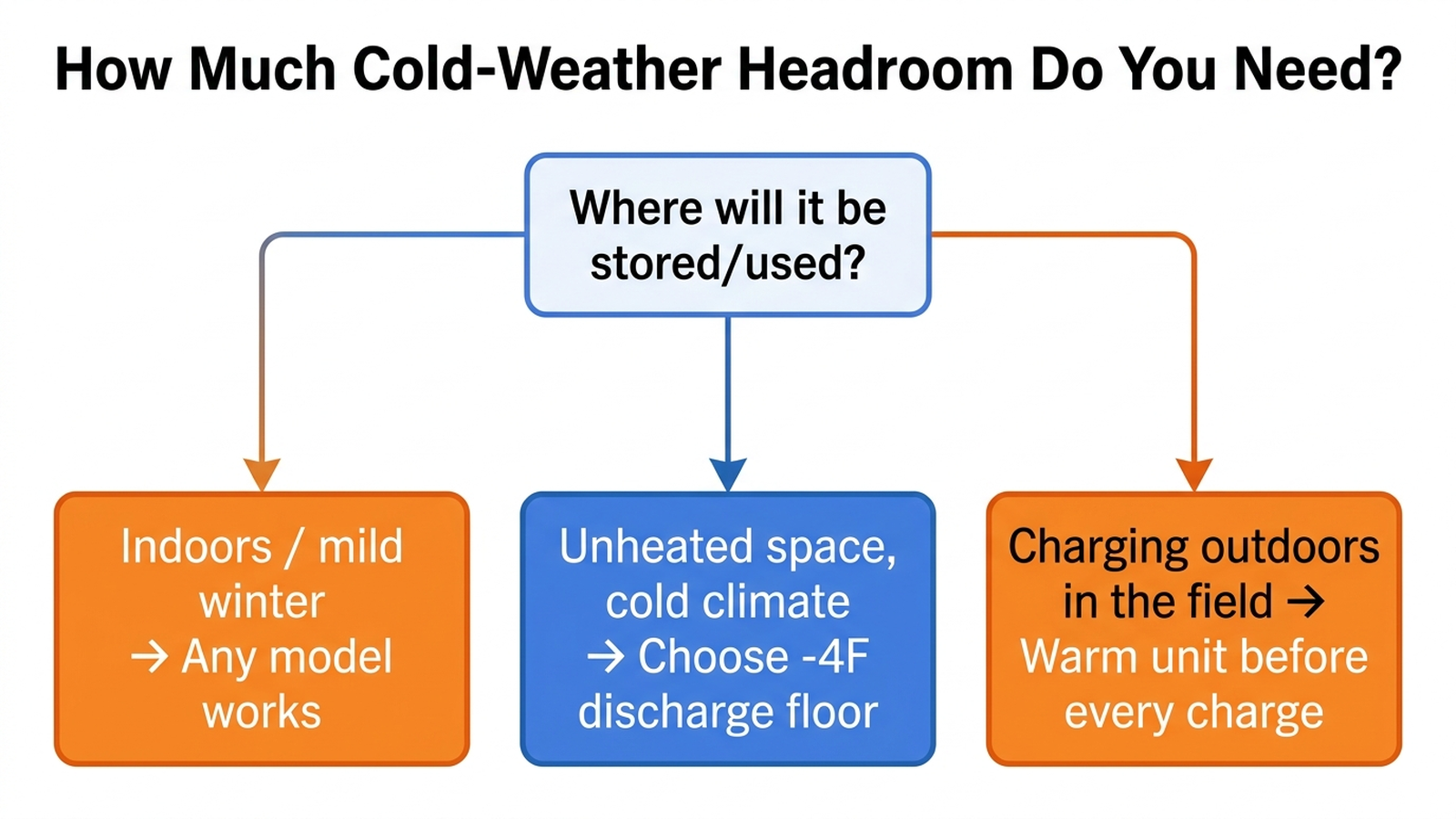
- Mild-winter climate, occasional power outage backup stored indoors: Any of the four units here will work fine — you’re unlikely to approach either temperature limit if the station lives in a closet or garage attached to a heated house.
- Cold-climate power outages where the unit may sit in an unheated space: Prioritize the -4°F discharge floor (Anker SOLIX C1000 Gen 2 or Bluetti Elite 200 V2) for extra margin during an extended cold-weather outage.
- Winter camping, ice fishing, or tailgating where you’ll charge in the field: The charging limit matters more than the discharge limit here, since you may need to recharge from a vehicle or solar panel outdoors. Plan to warm the unit in a vehicle cabin before every charge attempt, regardless of brand.
- You mainly need cold-weather performance for a once-a-winter cold snap: The 14°F floor on Jackery or EcoFlow covers the overwhelming majority of US winter lows outside the coldest regions; the extra -4°F headroom on Anker or Bluetti is most valuable in genuinely harsh climates.
Warranty Coverage
None of the four manufacturers extend warranty coverage to damage caused by charging outside the stated temperature range — all four void coverage for that specific failure mode, since it’s a user-controllable risk rather than a manufacturing defect. Beyond that shared exclusion, Jackery, EcoFlow, and Anker SOLIX commonly offer 5-year warranties on their current LFP units (confirm current terms at purchase), while Bluetti’s Elite 200 V2 pairs a standard warranty with a separately marketed cycle-life projection — a lifespan estimate, not an extended warranty term, and the two should not be confused.
Editorial Recommendation
For most US buyers whose power station will live indoors or in an attached garage, the charging-temperature limit — identical across all four brands at 32°F — matters more than the discharge floor, and any of these four units is a reasonable pick on cold-weather grounds alone. Buyers in colder climates, or anyone who expects to run a unit in an unheated space through a multi-day winter outage, get the most headroom from the Anker SOLIX C1000 Gen 2 or the Bluetti Elite 200 V2, both rated to -4°F on discharge — 18 degrees colder than the Jackery Explorer 1000 v2 or EcoFlow DELTA 3 Plus. Winter campers and anyone charging outdoors in the field should treat the 32°F charging cutoff as the real constraint regardless of brand, and build a warm-up step into their routine rather than choosing a model to work around it.
As an Amazon Associate, Arekore earns from qualifying purchases. The Amazon product links in this article include our affiliate tracking ID and may earn us a commission if you buy through them, at no additional cost to you. See our Links Policy for details on how we select products and how commissions do not influence our recommendations.
- Jackery Explorer 1000 v2 Portable Power Station
- EcoFlow DELTA 3 Plus Portable Power Station
- Anker SOLIX C1000 Gen 2 Portable Power Station
- Bluetti Elite 200 V2 Portable Power Station
Limitations
The capacity-loss figures referenced in this article come from independent field tests and aggregated owner reports rather than a single standardized cold-chamber protocol applied consistently across all four brands — no major test house has published that exact comparison, so treat specific percentages as directional, not as verified lab data. Manufacturer-published temperature ranges describe safe operating limits the BMS enforces, not the temperature at which a unit performs at its full rated output; actual cold-weather runtime depends on the specific load, how long the unit has been exposed to cold, wind chill versus still-air conditions, and unit-to-unit variance. We did not personally test any of the products covered here in cold-chamber or field conditions.
Visit Arekore to verify current pricing, ASINs, and availability before buying any product mentioned here.