Do Noise-Cancelling Headphones Protect Hearing? We Checked
“Noise cancelling protects your hearing” is a claim that shows up constantly in headphone marketing and in casual conversation, usually alongside a flagship model like the Sony WH-1000XM6 or Bose QuietComfort Ultra. About 40 million U.S. adults aged 20-69 already have measurable noise-induced hearing loss, according to CDC data, so it’s a reasonable thing to want a $300+ purchase to help with. The research says the claim is real, but only under one specific condition — and the same technology can do nothing for your hearing, or arguably encourage worse habits, outside that condition.
We checked the marketing claim against WHO and NIOSH exposure guidelines, peer-reviewed research on ANC and listening volume, and manufacturer specifications for best-selling models on amazon.com. The short version: active noise cancellation (ANC) protects hearing only by letting you lower your volume in a noisy environment — it does nothing on its own, and in a quiet room there’s no noise for it to cancel in the first place.
As an Amazon Associate, Arekore earns from qualifying purchases. The Amazon product links in this article may include our affiliate tracking ID and may earn us a commission if you buy through them, at no additional cost to you. See our Links Policy for details on how we select products and how commissions do not influence our recommendations.
TL;DR / Quick Verdict
- ANC’s hearing benefit is indirect, not direct. It doesn’t lower the volume hitting your eardrum by itself — it removes background noise, which removes your reason to turn the volume up. A 2024-2025 personal-listening-device preprint study found all four tested earbud models reduced their volume output when ANC was switched on versus off, in both quiet and noisy listening tests (P<.001).
- The benefit only exists where there’s noise to cancel. WHO guidance puts safe daily exposure at 85 dB for up to 8 hours, dropping to just 15 minutes at 100 dB. ANC’s whole mechanism is generating an inverse waveform against a sustained ambient noise floor — a quiet home office or bedroom doesn’t have one, so there’s nothing for the feature to remove.
- Passive isolation alone gets you roughly 5-10 dB of reduction; hybrid ANC roughly 15-20 dB; full active ANC in flagship models roughly 20-30 dB, per aggregated manufacturer and independent lab test data — meaningful in a loud cabin, meaningless in a quiet room.
- The 60/60 rule is the actual safety guardrail, with or without ANC: no more than 60% of max volume for 60 minutes at a stretch, per Mayo Clinic and American Osteopathic Association guidance. ANC changes how loud you need to go in a noisy place; it doesn’t change what’s safe once you get there.
How We Reached These Conclusions (Methodology)
This is an editorial analysis, not a hands-on test or a medical recommendation. We did not personally test the products covered here, and nothing in this article should replace guidance from an audiologist or physician. This guide synthesizes: (a) World Health Organization safe-listening guidance and NIOSH/CDC/NIDCD occupational and recreational noise-exposure standards; (b) a 2024-2025 personal-listening-device (PLD) preprint study (JMIR Preprints, not yet peer-reviewed) testing four earbud models with ANC on versus off, alongside a separate peer-reviewed functional-network / listening-effort study on ANC published via PMC; (c) RTINGS.com’s 2026 lab test rankings for ANC performance; (d) manufacturer-published noise-reduction specifications for best-selling models on amazon.com; and (e) aggregated audiologist commentary on safe-listening rules such as the 60/60 rule. Prices are approximate amazon.com figures as of 2026-09-14 and fluctuate.
The Three Isolation Approaches, and What They Actually Cancel
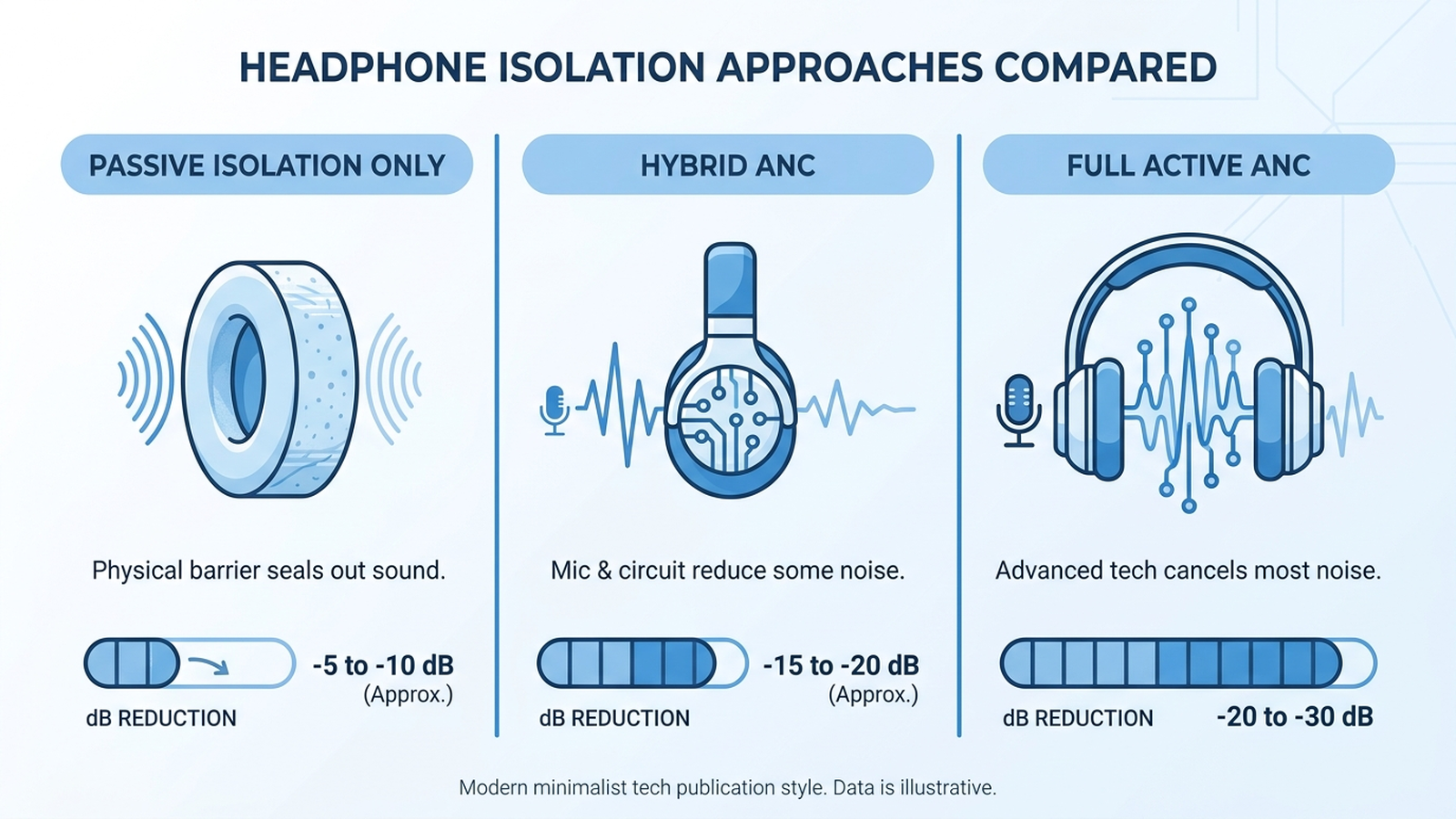
Not all “noise cancelling” claims describe the same mechanism, and the difference matters for what each one can and can’t do for your hearing:
- Passive isolation only. Foam or memory-foam ear cushions physically block sound the way earplugs do, with no electronics involved. Aggregated manufacturer and independent test data put this at roughly 5-10 dB of reduction — useful against high-frequency noise like keyboard clatter, weak against low-frequency rumble like an engine or HVAC system.
- Hybrid ANC. A microphone and a processing chip generate an inverse waveform against ambient noise, layered on top of passive isolation. Mid-range models in this category, including several budget over-ear headphones on amazon.com, land around 15-20 dB of additional reduction, concentrated in low-frequency, steady-state noise (engine drone, cabin hum).
- Full active ANC. Flagship models — Sony’s WH-1000-series, Bose’s QuietComfort Ultra, Apple’s AirPods Max — add more microphones and faster processing, reaching roughly 20-30 dB of reduction in RTINGS.com’s 2026 lab measurements. The newer Sony WH-1000XM6 currently tops RTINGS.com’s noise-cancelling category page; the prior-generation WH-1000XM5 covered below measures in the same 20-30 dB band and remains widely sold on amazon.com.
All three approaches share one limitation relevant to hearing: they cancel ambient noise arriving from outside the headphone. None of them changes the sound pressure level of the music or call audio you’ve dialed in — that part is entirely up to your volume setting.
What the Research Actually Shows About ANC and Volume
The mechanism connecting ANC to hearing health runs through volume, not through direct noise-cancellation of the audio signal itself. A personal-listening-device (PLD) preprint study testing four popular earbud models found that with ANC active, all four models produced lower output volume than with ANC switched off, across both quiet-room and simulated-noise test conditions (P<.001) — evidence that ANC measurably reduces the volume people land on, not just the ambient noise around them. Separate peer-reviewed research on ANC and listening effort, published via PMC, measured both subjective effort ratings and prefrontal-cortex activity (via near-infrared spectroscopy) during listening tasks in noise. Participants reported lower perceived listening effort with ANC engaged — the subjective finding relevant here — even though the brain-activity measurement itself showed increased, not decreased, prefrontal activation, a counterintuitive result the study’s authors flag directly. That distinction matters for what the study does and doesn’t support: it’s evidence for reduced perceived effort, not evidence that ANC quiets neural workload, and it’s a cognitive-load finding rather than a hearing-damage finding either way. It’s still consistent with the same underlying story on the volume side: ANC removes the reason to compensate for noise by turning the volume up.
That’s the entire causal chain: noisy environment → without ANC, you raise volume to hear over it → with ANC, the ambient noise is suppressed → you don’t need to raise volume as much → less sound energy reaches your eardrum over the same listening session. Remove the first link — no noisy environment — and there’s nothing left for the chain to act on.
The Volume Math: WHO and NIOSH Numbers
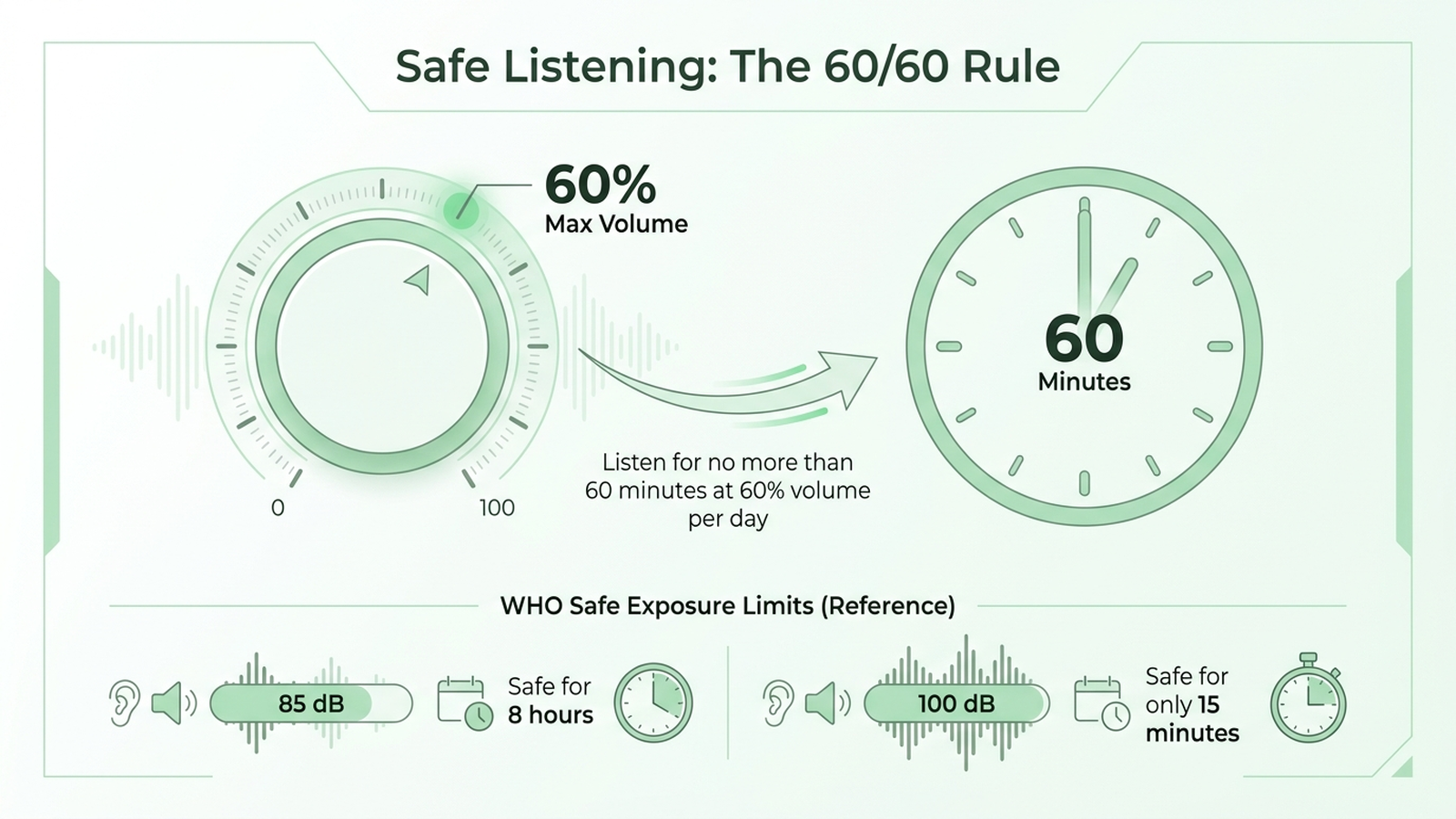
The exposure limits that make “lower volume” matter come from two aligned sources. The World Health Organization’s safe-listening guidance sets 85 dB as safe for up to 8 hours, with that safe duration cut roughly in half for every 3 dB increase — dropping to just 15 minutes at 100 dB, a level many smartphones and headphones can reach at or near max volume. NIOSH’s occupational recommended exposure limit independently lands at the same 85 dBA averaged over an 8-hour day, while NIDCD notes that sound at or below roughly 70 dBA is unlikely to cause hearing loss even with long-term exposure.
Audiologists translate that into a practical rule for personal listening devices: the 60/60 rule — no more than 60% of maximum volume for 60 minutes at a stretch — popularized in guidance from a Mayo Clinic audiologist and cited by the American Osteopathic Association. That rule doesn’t reference ANC at all. It’s a volume-and-duration ceiling that applies whether or not the headphones have any noise cancellation, which is the clearest evidence that ANC is a tool for reaching that ceiling more easily in a loud environment, not a replacement for respecting it.
Where ANC Helps, and Where It Does Nothing
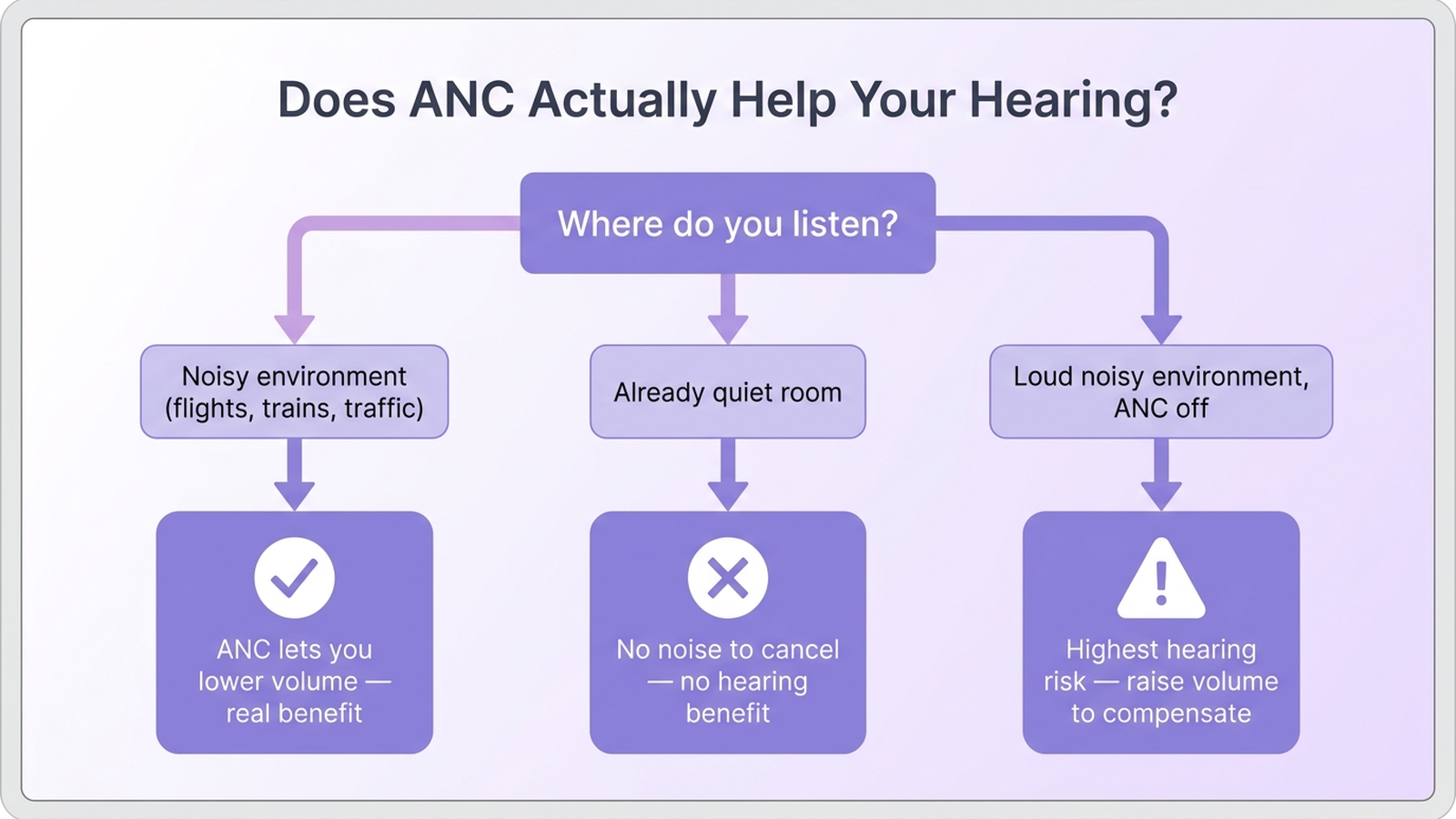
- Noisy environment, ANC on: the scenario the research actually measured a benefit in. Flights, trains, subways, and busy streets generate the sustained low-frequency noise floor ANC is built to suppress, which is where the PLD study’s lower-volume-with-ANC-on finding applies directly.
- Quiet room, ANC on or off: no measurable hearing benefit either way, because there’s no ambient noise floor for ANC to act on. Paying a flagship-tier premium for ANC used mainly in a quiet home office buys a feature that has nothing to do in that setting.
- Noisy environment, ANC off (or no ANC headphones): the highest-risk scenario in this comparison. Without noise cancellation, the natural response to ambient noise is to raise volume until the audio is audible over it — precisely the behavior that pushes a listening session past the WHO and NIOSH thresholds above.
Comparison Table
Prices are approximate amazon.com figures as of 2026-09-14 and fluctuate. Noise-reduction figures are manufacturer-published or RTINGS.com lab-measured claims, not independently verified by this publication for every model.
| Product | ASIN | Approx. price | Isolation type | Approx. dB reduction |
|---|---|---|---|---|
| Sony WH-1000XM5 | B09XS7JWHH | ~$280-$349 | Full active ANC | ~20-30 dB |
| Bose QuietComfort Ultra | B0CCZ1L489 | ~$349-$399 | Full active ANC | ~20-30 dB |
| Anker Soundcore Space Q45 | B0B5VHRX7F | ~$130-$150 | Hybrid ANC (adaptive) | ~15-20 dB |
| REED Instruments R8050 sound level meter | B00WR4AWUK | ~$60-$90 | N/A (measures your own environment) | N/A |
Customer Sentiment Synthesis
Aggregated amazon.com customer review sentiment for flagship ANC models consistently credits noise cancellation for making loud environments — flights and open offices, most often — noticeably easier to listen in at a comfortable volume, matching the mechanism the PLD research describes. Reviewers of budget hybrid-ANC models like the Space Q45 frequently note the noise reduction is smaller than flagship models but “good enough” for commuting and travel, consistent with the roughly 15-20 dB hybrid range versus 20-30 dB for flagship full ANC. We did not identify a pattern of reviews describing ANC as directly protecting hearing in quiet settings — the reviews that mention hearing or ear comfort are concentrated in noisy-environment use cases, which lines up with the research.
If You Want to Verify Your Own Listening Habits
Every figure above is a published guideline or an aggregated research finding, not a measurement of your specific headphones at your specific volume setting. A plug-in or handheld sound level meter is the only way to check what’s actually reaching your ears rather than relying on a volume-bar percentage that varies by device and headphone model.
REED Instruments R8050 Sound Level Meter
A dual-range, ANSI/IEC Type 2-rated handheld sound level meter that reads actual dB output — useful for checking whether a “quiet” room is genuinely below the 70 dBA NIDCD threshold, or for calibrating how loud your headphones actually get at a given volume percentage. About $60-$90 at the time of writing.
Check the REED Instruments R8050 Sound Level Meter on Amazon
Sony WH-1000XM5
The prior-generation Sony flagship — RTINGS.com’s current top-rated model is the newer WH-1000XM6 — still widely sold and reviewed on amazon.com, with full active ANC in the same 20-30 dB range per aggregated lab and manufacturer data. That’s the tier where the hearing-protection mechanism actually applies, in genuinely noisy environments.
Check the Sony WH-1000XM5 on Amazon
Bose QuietComfort Ultra
Bose’s current flagship, competitive with Sony’s top tier on lab-measured noise reduction, with a comfort-focused fit that reviewers frequently cite for longer flights and commutes.
Check the Bose QuietComfort Ultra on Amazon
Anker Soundcore Space Q45
A hybrid-ANC model at roughly a third of the flagship price, delivering a smaller but real noise-reduction benefit for the same noisy-environment use case, per manufacturer specifications and aggregated review sentiment.
Check the Anker Soundcore Space Q45 on Amazon
Limitations
This analysis relies on published WHO, NIOSH, NIDCD, and CDC guidance, one 2024-2025 personal-listening-device study, published listening-effort research, RTINGS.com lab test rankings, and manufacturer-published noise-reduction specifications, rather than our own instrumented measurement of any specific headphone model. Noise-reduction figures vary by fit, ear shape, glasses, and firmware version, and manufacturer-claimed dB figures are not independently verified for every model in this article. The 60/60 rule and WHO exposure limits are general population guidance, not a substitute for individualized advice from an audiologist, and this article makes no claim about hearing outcomes for any specific individual or medical condition. Prices are approximate amazon.com figures as of 2026-09-14 and change frequently.
Bottom Line
Do noise-cancelling headphones protect your hearing? Indirectly, and only in the environment they were built for. ANC’s real, research-supported effect is letting you use a lower volume in a genuinely noisy setting — a flight, a train, a loud street — which is a real hearing-health benefit in that specific context. It does nothing for hearing in a quiet room, because there’s no ambient noise floor to cancel, and it’s not a substitute for basic volume discipline like the 60/60 rule anywhere. If your listening happens mostly in loud, sustained-noise environments, that’s where the flagship-tier noise reduction earns its price; if it doesn’t, the safety habit that actually matters is the same one with or without ANC — keep the volume down and take listening breaks.
Before you buy, paste the product link into Arekore — our AI assistant checks review authenticity, surfaces what the one-star reviews actually complain about, and compares prices, free, in about five minutes.