Wi-Fi Routers and Your Health: What the Data Actually Shows

“Does my Wi-Fi router cause cancer?” is a question search interest keeps returning to, and Amazon’s own marketplace reflects it: hundreds of listings for radiation-blocking stickers, “EMF-shielding” phone cases, and “low-EMF” router alternatives show up when you search for router accessories. The underlying fear isn’t irrational on its face — a router sits a few feet from where people sleep, work, and put their kids to bed, running 24 hours a day. The question is whether the radiofrequency (RF) energy it emits is anything like the exposure regulators and researchers have actually studied.
We checked FCC exposure regulations, the WHO/IARC cancer classification that gets cited most often in this debate, the National Toxicology Program’s rat study, and the physics of how RF power drops off with distance, against what a mesh router actually emits. The short version: the studies people cite when they worry about Wi-Fi were almost all conducted on cell phones held against the head at far higher power than a router ever reaches at any distance a person actually stands from one — and the products marketed to “protect” against router radiation have already drawn a U.S. government fraud enforcement action for it.
As an Amazon Associate, Arekore earns from qualifying purchases. The Amazon product links in this article may include our affiliate tracking ID and may earn us a commission if you buy through them, at no additional cost to you. See our Links Policy for details on how we select products and how commissions do not influence our recommendations.
TL;DR / Quick Verdict
- No major health authority classifies Wi-Fi router exposure as a cancer risk. The American Cancer Society, FDA, and FCC all state that current evidence does not show RF exposure from routers or wireless devices causes cancer, and Wi-Fi routers emit RF continuously at levels the FCC requires to stay well under its Specific Absorption Rate (SAR) limit of 1.6 W/kg.
- The one relevant cancer classification is about phones, not routers, and it’s the weakest tier that exists. The WHO’s International Agency for Research on Cancer (IARC) put radiofrequency fields in Group 2B, “possibly carcinogenic” in 2011 — the same category as aloe vera extract and pickled vegetables — based on limited evidence from cell phone use held against the head, not ambient Wi-Fi exposure.
- Power output and distance are the two variables that matter, and a router loses on both compared to a phone. A typical home router transmits at roughly 100-200 milliwatts per band, versus up to 3 watts for a cell phone’s peak output, and RF intensity falls off by the inverse square law — doubling your distance from a router cuts your exposure to roughly a quarter.
- The National Toxicology Program’s 2018 rat study, the most-cited piece of evidence for RF cancer risk, exposed rodents to 900-1900 MHz radiation for 9 hours a day at power levels designed to be comparable to a cell phone held against the body — not to ambient Wi-Fi levels at typical household distances.
- “EMF protection” stickers and shields have no measurable effect on RF exposure, according to the FTC, which has brought fraud enforcement actions against sellers of these products going back to 2002, and independent physics testing continues to find no shielding effect from current listings.
How We Reached These Conclusions (Methodology)
This is an editorial analysis, not a hands-on test or a medical recommendation. We did not personally test the products covered here, and nothing in this article should replace guidance from a physician or a licensed health professional. This guide synthesizes: (a) FCC RF exposure regulations (47 CFR Part 1.1307/1.1310) and consumer guidance on wireless device safety; (b) the WHO International Agency for Research on Cancer’s 2011 Group 2B classification and the underlying epidemiological basis for it; (c) the National Toxicology Program’s 2018 rat and mouse carcinogenicity study on cell-phone-frequency RF radiation; (d) American Cancer Society and FDA public guidance on RF radiation and cancer risk; (e) published double-blind provocation studies on self-reported electromagnetic hypersensitivity; (f) manufacturer-published transmit power specifications for consumer Wi-Fi routers; and (g) FTC enforcement records on EMF-shielding consumer products. Prices are approximate amazon.com figures as of 2026-10-01 and fluctuate.
The Three Data Points People Actually Cite, and What Each One Covers
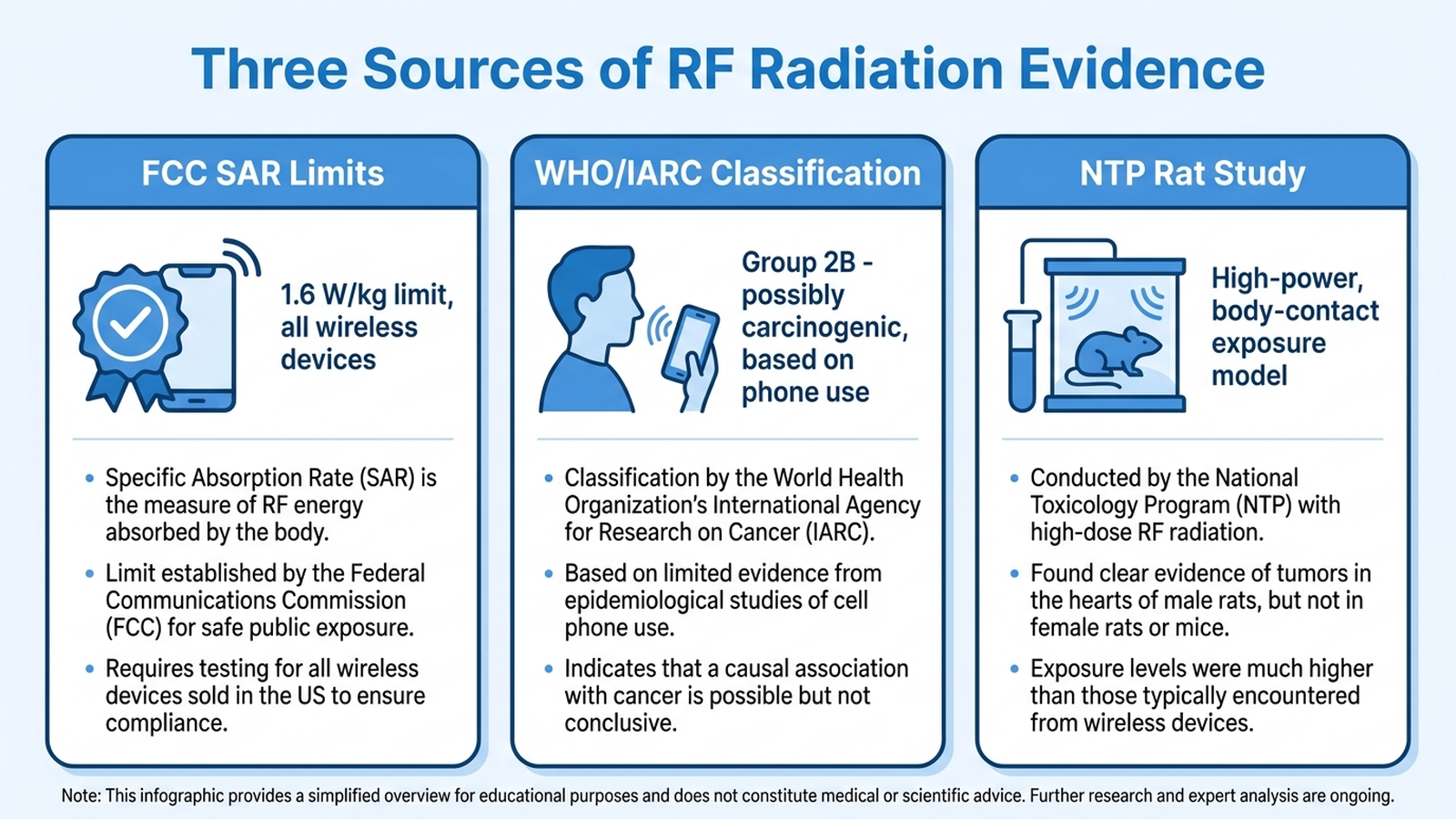
Almost every version of the “is Wi-Fi safe” debate traces back to one of three sources, and conflating them is where most of the confusion starts:
- FCC SAR limits (the regulatory floor). Since 1996, every wireless device sold in the U.S. — phones, tablets, routers — must be tested and certified to stay under an SAR exposure limit of 1.6 W/kg averaged over one gram of tissue. Routers are tested and certified before they can be sold, the same as phones, and a router’s continuous, lower-power transmission profile makes this an easier limit to stay under than a phone held against the head.
- The WHO/IARC Group 2B classification (about phones, not routers). In 2011, IARC classified radiofrequency fields as “possibly carcinogenic to humans” based on epidemiological studies of heavy cell phone users showing an association with glioma, a type of brain tumor. Group 2B is IARC’s lower-confidence tier — it means “limited evidence,” not “established risk,” and it covers phone use against the head, not passive exposure to a router across a room.
- The NTP rat study (about high-power, body-contact exposure). The National Toxicology Program’s 10-year, $30 million study found “clear evidence” of heart tumors in male rats exposed to 900 MHz and 1900 MHz RF radiation for 9 hours a day, at power levels designed to model a phone’s exposure profile at the body. It’s the most substantive animal evidence in this debate, and it is specifically a cell-phone-exposure model — the study was not designed to test ambient router-level exposure at typical household distances.
None of these three sources is a study of household Wi-Fi router exposure at the distances people actually live at. That gap is exactly where “Wi-Fi is basically a cell phone held to your head all day” claims go wrong.
The Power and Distance Math
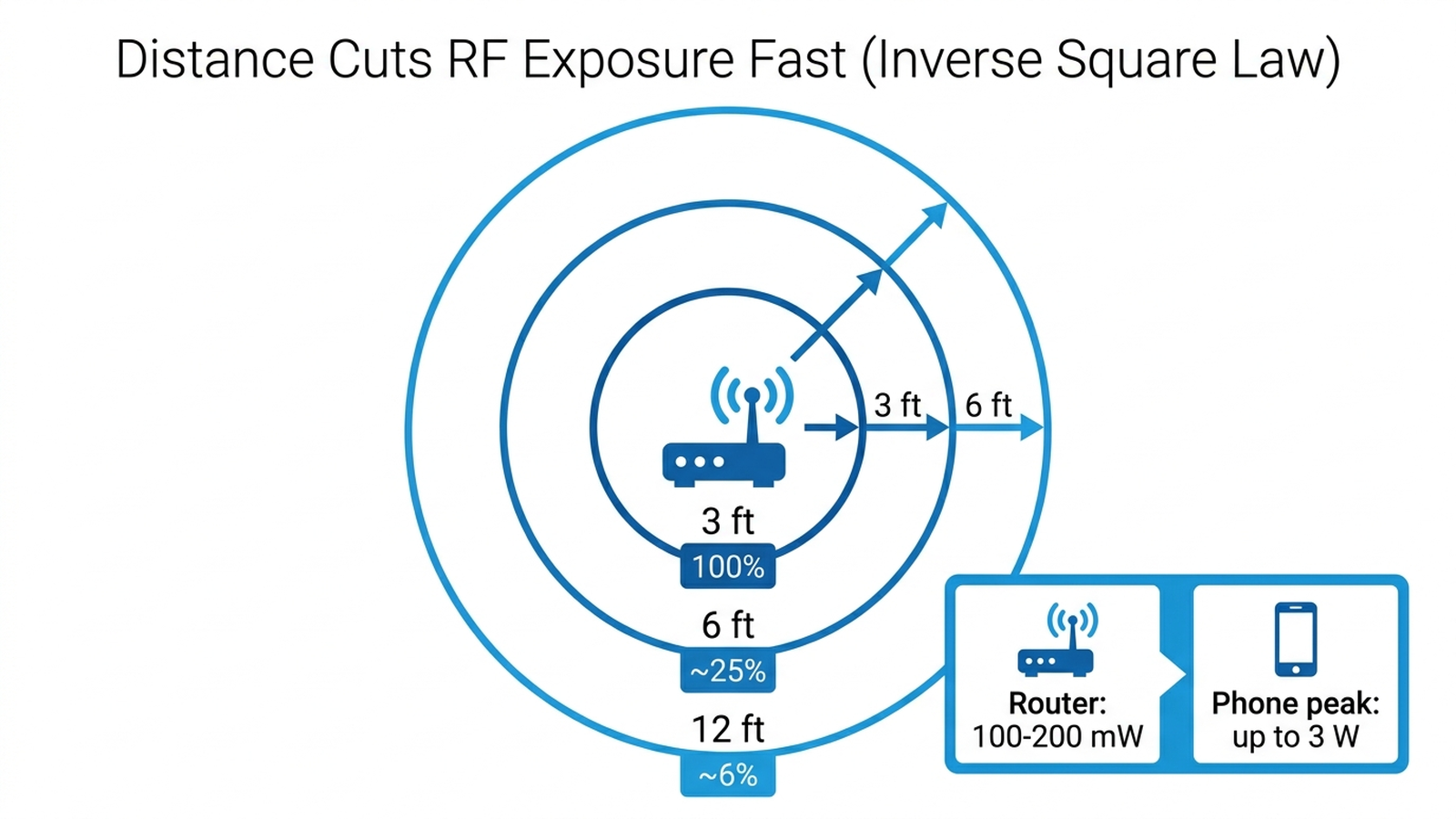
Two variables determine RF exposure: how much power the device transmits, and how far away you are from it. Routers lose on both counts compared to the device most of the cited cancer research actually studied.
Transmit power. Most consumer Wi-Fi access points transmit at roughly 100 milliwatts on the 2.4 GHz band and up to 200 milliwatts on 5 GHz, per FCC-regulated maximums and manufacturer specifications, with the U.S. ceiling for Wi-Fi equipment capped at 1 watt. A cell phone’s peak output can reach up to 3 watts of effective radiated power, though networks continuously throttle that down — often to as little as 1 milliwatt — when signal quality is good. The meaningful difference isn’t just peak power; it’s that a phone is designed to be held directly against the body, while a router is designed to sit on a shelf.
Distance. RF intensity follows the inverse square law: double your distance from the source and exposure drops to roughly a quarter, not half. A phone held against the ear is effectively at zero distance from the body. A router on a shelf across a room is typically 6-15 feet from the nearest person — moving from 3 feet to 6 feet away cuts exposure to about a quarter again. Distance does more work to reduce real-world exposure than almost any product marketed as “protection” ever will.
What Happens When Researchers Test the “I Can Feel It” Claim
A recurring argument in this debate is that some people report headaches, fatigue, or other symptoms specifically near Wi-Fi equipment — a condition researchers call self-reported electromagnetic hypersensitivity (EHS). The WHO acknowledges EHS as a real, sometimes debilitating set of symptoms for the people experiencing them, while noting current evidence does not support EMF exposure as the cause. The relevant test design is the double-blind provocation study, where participants who identify as EHS are exposed to real EMF and to sham (fake) exposure, without knowing which is which. A systematic review of these provocation studies by Rubin, Nieto-Hernandez, and Wessely, published in Bioelectromagnetics, found EHS participants were unable to detect genuine EMF exposure better than chance, and were just as likely to report symptoms during sham exposure as during real exposure — a pattern consistent with a nocebo effect (symptoms triggered by the expectation of harm) rather than with a direct physiological response to RF fields.
The EMF Protection Product Trap
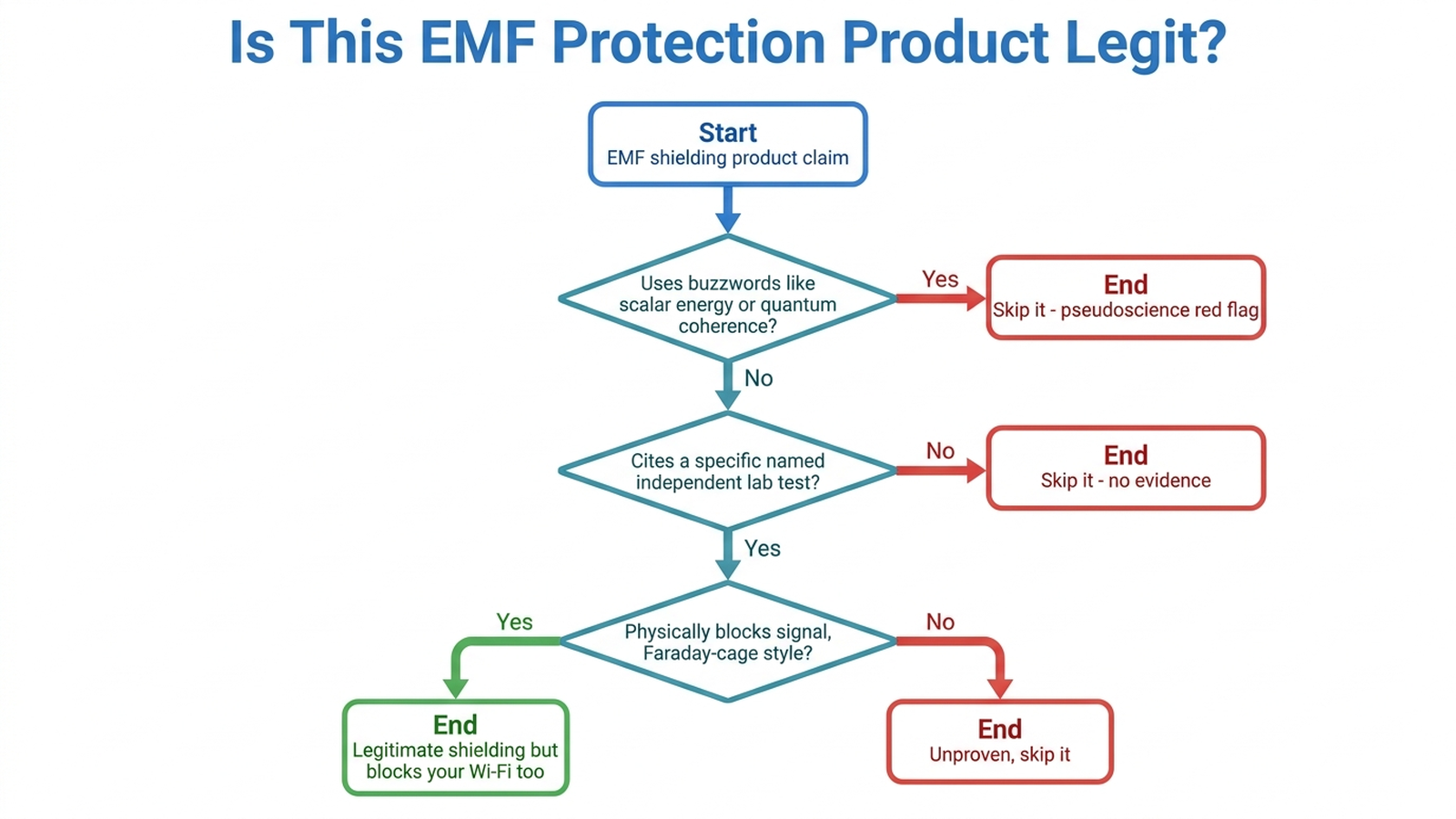
The gap between “no regulator considers router-level exposure dangerous” and “but I’d still feel better with less exposure” is exactly the gap a specific category of Amazon and third-party listings is built to exploit. In 2002, the FTC brought fraud charges against sellers of metallic-fiber cell phone earpiece patches, for falsely claiming to block 97-99% of RF radiation with no evidence to support it. That action targeted phone accessories specifically, not router products, but the same physics applies to anything marketed today as a Wi-Fi or router “radiation shield” — and two decades later, independent physics testing and regulatory guidance continue to find no measurable shielding effect from current-generation stickers, patches, and “harmonizing” devices sold under similar claims, whether aimed at phones or routers. A practical filter before buying any product marketed this way:
- Does it use terms like “scalar energy,” “resonant frequency harmonizing,” or “quantum coherence”? These are not recognized physics terms for RF shielding, and their presence on a listing is a stronger signal than any star rating.
- Does it cite a specific, checkable, independent lab test result (a named lab, a specific dB or percentage reduction, a methodology) rather than only customer testimonials?
- Does the product physically block or absorb RF energy (a Faraday-cage-style enclosure, which does work but also blocks your Wi-Fi signal) or does it claim to work while sitting next to the device with no physical barrier? The latter has no plausible mechanism.
If a listing fails the first check, no amount of review volume should change the verdict.
If You’re Choosing a Router Anyway, Choose on Real Criteria
None of this means router placement is pointless — it just means the reason to care about distance is basic RF-exposure minimization for the cautious, not a documented health risk to avoid. If you’re replacing a router, the criteria that actually matter are coverage, band, and mesh performance, not marketed “low-EMF” claims, which is not a standardized or independently verified spec on any router sold on amazon.com today.
Comparison Table
Prices are approximate amazon.com figures as of 2026-10-01 and fluctuate. Coverage figures are manufacturer-published for a 3-pack mesh configuration unless noted.
| Product | ASIN | Approx. price (3-pack) | Wi-Fi standard | Manufacturer coverage claim |
|---|---|---|---|---|
| Amazon eero Pro 6E | B091G64GVK | ~$400-$500 | Wi-Fi 6E, tri-band | Up to 6,000 sq. ft. |
| Google Nest Wifi Pro 6E | B0BCQSYPZB | ~$270-$300 | Wi-Fi 6E, tri-band | Up to 6,600 sq. ft. |
| TP-Link Deco XE75 Pro | B0BBV18ZD4 | ~$350-$400 | Wi-Fi 6E, tri-band | Up to 7,200 sq. ft. |
Amazon eero Pro 6E (3-pack)
Built-in Zigbee smart-home hub and tight integration with Alexa, which matters if the rest of your smart-home gear is Amazon-centric. Transmit power is FCC-certified the same as any other Wi-Fi 6E router in this comparison — there is no meaningfully lower-emission option among current mesh systems.
Check the Amazon eero Pro 6E on Amazon
Google Nest Wifi Pro 6E (3-pack)
The largest per-dollar manufacturer coverage claim of the three, with straightforward setup through the Google Home app and native Thread support for smart-home devices.
Check the Google Nest Wifi Pro 6E on Amazon
TP-Link Deco XE75 Pro (3-pack)
The highest manufacturer coverage claim in this set and a 2.5G WAN/LAN port for faster wired backhaul, at a similar price point to the other two options.
Check the TP-Link Deco XE75 Pro on Amazon
Customer Sentiment Synthesis
Aggregated amazon.com customer review sentiment for all three mesh systems above centers on coverage consistency and app setup ease, not health concerns — reviews specifically citing “EMF” or “radiation” worries are a small minority and appear concentrated on unrelated “shielding” accessory listings rather than on the routers themselves. Where reviewers do raise placement, it is almost always framed as a coverage question (dead zones, wall interference) rather than an exposure question, which matches the pattern the underlying science points to: distance and placement affect signal strength far more reliably than they affect any documented health outcome.
Limitations
This analysis relies on FCC regulatory documentation, the WHO/IARC 2011 classification, the NTP’s 2018 published study summary, American Cancer Society and FDA public guidance, a systematic review of EHS provocation studies, and manufacturer-published transmit power and coverage specifications, rather than our own RF measurement of any specific router model in a real home. Actual exposure varies by router model, wall material, number of connected devices, and distance, and this article makes no claim about health outcomes for any specific individual. The NTP rat study and the IARC classification remain actively debated within the scientific and regulatory community, and future research could shift current guidance. Prices are approximate amazon.com figures as of 2026-10-01 and change frequently.
Bottom Line
Do Wi-Fi routers cause cancer or other health problems? No major health authority — not the FCC, the FDA, the American Cancer Society, or the WHO’s own broader risk assessment beyond the narrow 2011 phone-specific classification — currently finds evidence for that. The research people cite most often in this debate was built around cell phones held against the head at several times a router’s transmit power, at effectively zero distance, not a router sitting on a shelf across the room. The products marketed to protect against router radiation are the part of this story regulators have actually taken enforcement action against, not the routers themselves. If router placement still matters to you for peace of mind, distance is the one variable with real physics behind it — a shelf a few extra feet from where you sleep or work does more than any sticker ever will.
Before you buy, paste the product link into Arekore — our AI assistant checks review authenticity, surfaces what the one-star reviews actually complain about, and compares prices, free, in about five minutes.