Do Massage Guns Reduce Soreness? What the Research Shows
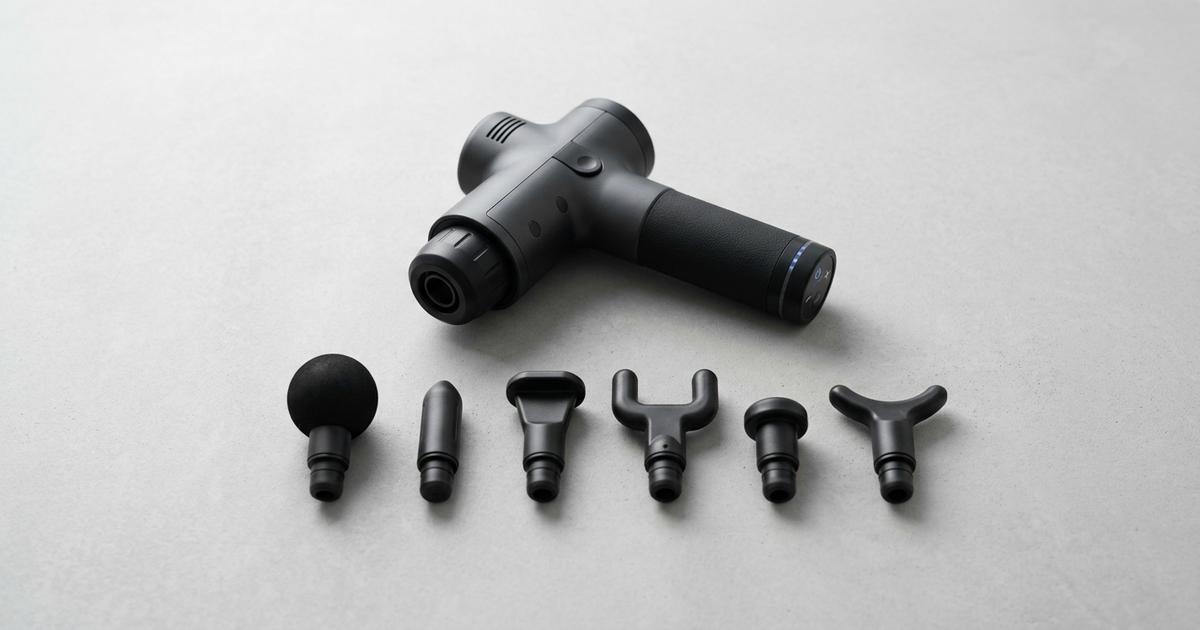
Percussion massage guns are now a roughly $793 million global market in 2026, projected to grow at a 7.25% compound annual rate to $1.21 billion by 2032, according to market researcher 360iResearch, with the U.S. accounting for close to a third of global unit sales. The pitch on nearly every product page is the same: hammer a sore muscle with rapid percussive strikes and recovery speeds up. That’s a specific, testable claim — not a vague wellness promise — so it’s one we can actually check against the published research rather than against marketing copy.
As an Amazon Associate, Arekore earns from qualifying purchases. The Amazon product links in this article include our affiliate tracking ID and may earn us a commission if you buy through them, at no additional cost to you. See our Links Policy for details on how we select products and how commissions do not influence our recommendations.
TL;DR / Quick Verdict
- The DOMS claim holds up in multiple 2025-2026 randomized controlled trials, with a real caveat: duration matters. A 2025 study in Frontiers in Public Health found 40 minutes of percussion massage produced significantly lower pain and better jump-recovery scores at 48 hours than 25 minutes of percussion or static stretching alone.
- One 2026 trial measured a 53% reduction in reported pain at 48 hours in a percussion-treated group, versus pain levels that stayed roughly flat in the control group over the same window — a large effect size for a non-drug intervention.
- The evidence for strength, power, and explosive-performance gains is weak to contradictory. A widely cited systematic review of 39 studies found percussion massage effectively reduces DOMS and improves flexibility, but does not meaningfully improve muscle activation or force production — and at least one newer systematic review found no clear improvement in maximum voluntary contraction recovery.
- Not every trial agrees even on soreness. Evidence is consistent enough to call DOMS reduction “research-supported,” not “settled science” — a minority of reviews report no clear soreness benefit, which is why we treat this as a real but modest effect rather than a guarantee.
- The device itself (which brand, how much it costs) is a secondary question to how it’s used. None of the trials behind the positive results tested a $600 flagship against a $90 budget model — they tested percussion therapy versus stretching or no treatment, using session length and technique as the controlled variables.
How We Reached These Conclusions (Methodology)
This is an editorial analysis, not a hands-on test. We did not personally test the products covered here. This guide synthesizes: (a) a 2026 randomized clinical trial in Physiotherapy Research International examining percussive massage’s acute effect on quadriceps cross-sectional area, strength, and late muscle pain after a fatigue protocol in physically active men; (b) a 2025 randomized controlled trial in Frontiers in Public Health comparing static stretching, 25 minutes of percussion, and 40 minutes of percussion after squat-induced DOMS in 30 physically active men; (c) a separate 2026 randomized controlled trial on percussion massage therapy and DOMS recovery, published via PubMed/PMC; (d) a 2025-2026 randomized controlled trial on fascia-gun percussive massage and exercise-induced fatigue recovery; (e) a widely cited systematic review of 39 studies on massage gun effects on performance and recovery; (f) Wirecutter’s and Consumer Reports’ current massage gun buying guides and test methodology; and (g) market-size data from 360iResearch and Persistence Market Research. Where a finding comes from a single trial rather than a replicated body of evidence, we say so explicitly. We did not find a sourced, independently verified figure for what percentage of massage gun owners use their device for the research-backed DOMS use case versus other purposes, so no such proportion is claimed. Prices are amazon.com figures at the time of writing (October 2026) and fluctuate.
What the Studies Actually Tested
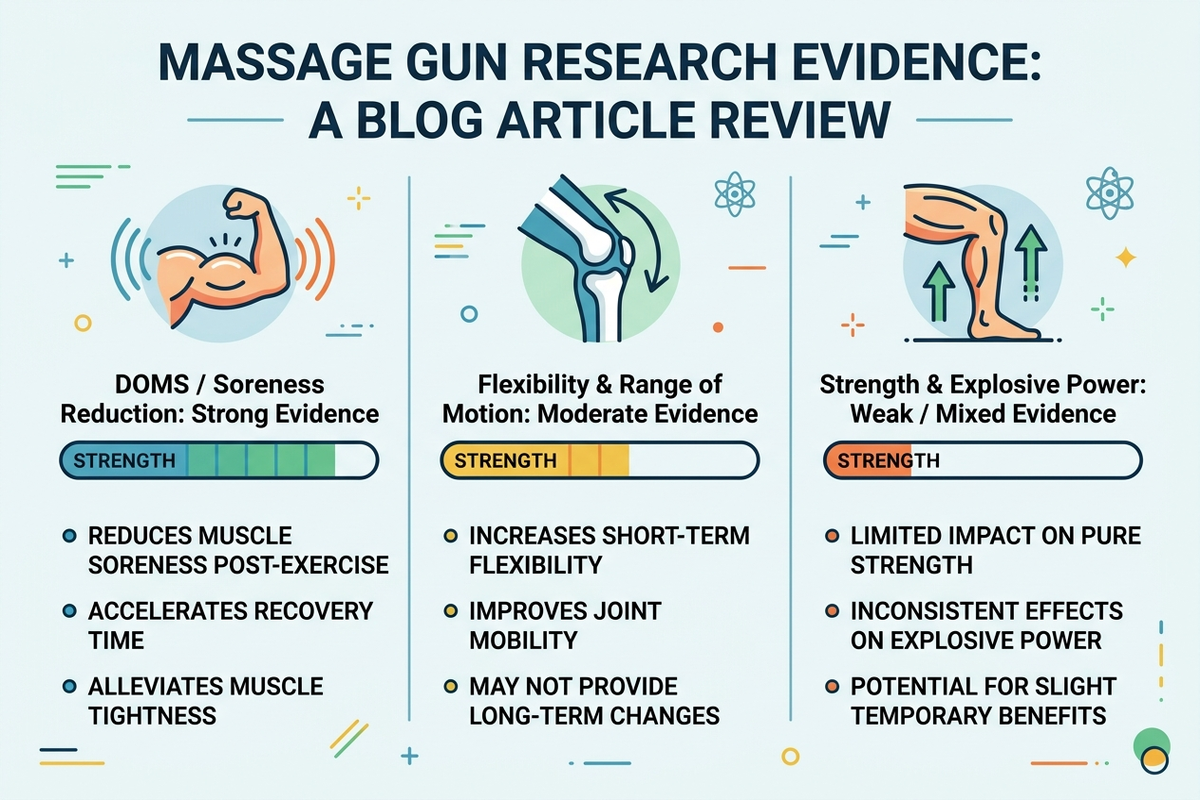
The research on percussion massage guns clusters around three separate questions, and they don’t all get the same answer:
- Does it reduce soreness (DOMS)? This is where the evidence is strongest. Delayed-onset muscle soreness — the stiffness and tenderness that peaks 24 to 72 hours after unfamiliar or intense exercise — is caused by microscopic muscle fiber damage and the inflammatory response that follows it. Multiple 2025-2026 randomized controlled trials found percussion massage meaningfully reduced reported pain scores and sped up functional recovery markers (range of motion, jump performance) compared with stretching alone or no treatment.
- Does it improve flexibility and range of motion? Evidence here is also reasonably consistent. The 39-study systematic review found percussion massage effectively increases flexibility, and several of the newer RCTs report improved joint range of motion alongside pain reduction.
- Does it improve strength, power, or explosive performance? This is where the marketing claims outrun the data. The same 39-study review found no significant impact on muscle activation or force production, and a separate systematic review specifically reported no clear improvement in maximum voluntary contraction (a standard strength-recovery measure). A smaller crossover study on percussion versus foam rolling found mixed results across flexibility, reactive strength, and muscular endurance measures depending on which specific outcome was tested.
The practical read: if the reason you’re considering a massage gun is “my legs are wrecked after leg day and I want to feel less sore tomorrow,” the research is on your side. If the reason is “I want to recover faster so I can lift heavier or jump higher sooner,” the evidence doesn’t support that specific expectation yet.
The Dosage Finding: Duration Changes the Result
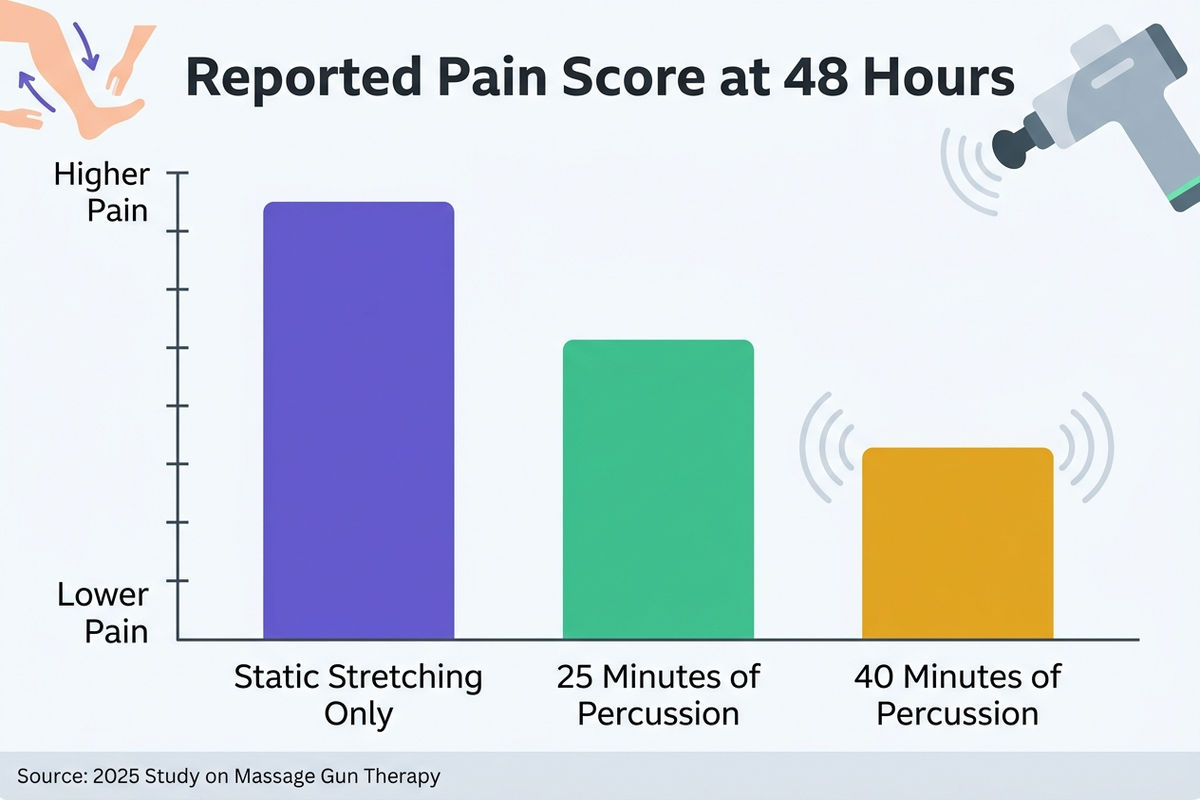
One of the more useful findings buried in this research doesn’t involve a specific product at all — it involves how long you use any massage gun per session. The 2025 Frontiers in Public Health trial randomized 30 physically active men into three groups after squat-induced DOMS: static stretching only, 25 minutes of percussion massage, or 40 minutes of percussion massage. At the 48-hour mark, the 40-minute group reported significantly lower pain, better knee range of motion, and better countermovement jump recovery than both the 25-minute group and the stretching-only group.
That’s a meaningfully longer session than how most people actually use a massage gun — product marketing and user habits both tend toward 2-5 minutes per muscle group, not 40 minutes in a single sitting. None of the available trials directly compared a realistic 5-10 minute consumer-style session against the 25- and 40-minute protocols used in the lab, so we can’t say a typical quick home session produces the same effect size as the 40-minute lab protocol. What the dosage finding does support is a directional conclusion: more consistent, longer application appears to outperform a token 60-second pass over a sore muscle, and the common practice of a few minutes per area likely captures only part of the benefit measured in these trials.
Does the Brand or Price Matter?
None of the positive RCTs behind the DOMS-reduction finding tested one consumer brand against another — they tested percussion therapy as a technique against stretching or no treatment, standardizing the device and protocol within each study. That means the clinical evidence supports percussion massage as a category of intervention, not any specific $600 flagship over a $90 budget model. Independent buying guides fill that gap differently: Wirecutter’s current pick is the Theragun Prime (ASIN B0BSMQGRF9, roughly $299), selected for its 16mm amplitude — matching Therabody’s own pricier Pro Plus — and a 10-foot-drop-tested build, after testing against rival models including Hyperice’s lineup. The Hyperice Hypervolt 2 Pro (ASIN B0CHCMQT4K, roughly $349) is the most direct competitor, with Quiet Glide motor technology and five speed settings. On the budget end, the RENPHO Active Thermacool (ASIN B0DXFGR2YM, roughly $85) adds heat and cold attachment options at under a third of the flagship price.
Check the Theragun Prime on Amazon
Check the Hyperice Hypervolt 2 Pro on Amazon
Check the RENPHO Active Thermacool on Amazon
The honest answer to “which one should I buy for the research-backed benefit” is that amplitude (how far the head travels, typically 10-16mm across the market) and stall force (how much pressure the motor can take before slowing down) matter more for comfort and perceived intensity than for whether the DOMS-reduction effect shows up at all — the trials behind that effect didn’t isolate amplitude or stall force as variables. A $85 device used for a consistent, longer session is plausibly closer to the tested protocol than a $600 device used for 45 seconds.
Comparison Table
Prices are approximate amazon.com figures at the time of writing (October 2026) and fluctuate.
| Model | Amplitude (mfr. claim) | Stall force (mfr. claim) | Price | Best for |
|---|---|---|---|---|
| Theragun Prime (B0BSMQGRF9) | 16mm | 30 lbs | ~$299 | Wirecutter’s top pick; balance of depth and quiet motor |
| Hyperice Hypervolt 2 Pro (B0CHCMQT4K) | 14mm | 30 lbs | ~$349 | Quiet Glide motor, 5 speeds, heated head option |
| RENPHO Active Thermacool (B0DXFGR2YM) | 12mm | 30 lbs | ~$85 | Budget option with heat/cold, adequate for the DOMS use case |
Decision Flowchart
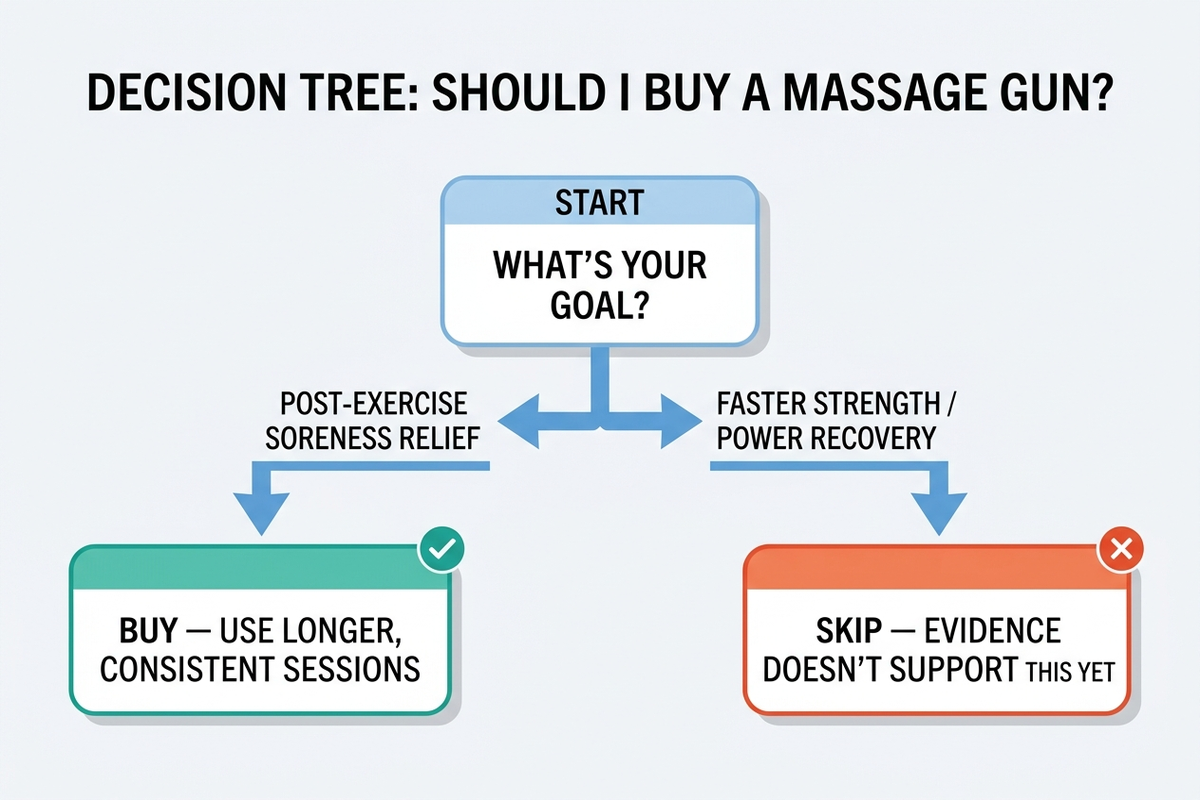
Start with what you’re actually trying to solve. If the goal is soreness after exercise, the research supports buying and using one — aim for longer, more consistent sessions per muscle group than the quick 60-second pass most people default to, since the trials showing the largest effect used 25-40 minute protocols. If the goal is faster strength or power recovery so you can perform better sooner, the current evidence doesn’t support that specific claim, and a massage gun purchase for that reason alone is based on an expectation the research doesn’t back. If you already have access to one at a gym or through a training partner, there’s limited reason to also buy a premium model at home — the clinical benefit comes from the technique and duration, not from a specific brand’s hardware. If you train regularly, get sore often, and don’t have gym access to a shared unit, a mid-range or budget model used consistently is a reasonable purchase.
Limitations
This analysis relies on a small number of recent randomized controlled trials (2025-2026) and systematic reviews rather than a large, settled body of replicated research — percussion massage gun science is still an active and relatively young area of study, and sample sizes in the individual RCTs cited here are modest (30 participants in the stretching/percussion comparison, for example). Findings on strength and power are more mixed across reviews than the DOMS findings, and we have flagged that explicitly rather than presenting percussion therapy as uniformly effective across every outcome studied. The 40-minute dosage finding comes from a single trial and has not yet been replicated at that specific duration; we have not found a study directly testing realistic 5-10 minute consumer sessions against it. Manufacturer specifications for amplitude and stall force are self-reported by Therabody, Hyperice, and RENPHO and have not been independently lab-verified by us. This article does not address the safety considerations relevant to anyone on blood thinners, with a clotting disorder, recent injury, or similar conditions — consult a doctor before use if any of those apply to you. Prices fluctuate on amazon.com and should be verified on the current product page before buying.