Do Electric Blankets Raise Your Power Bill? We Checked
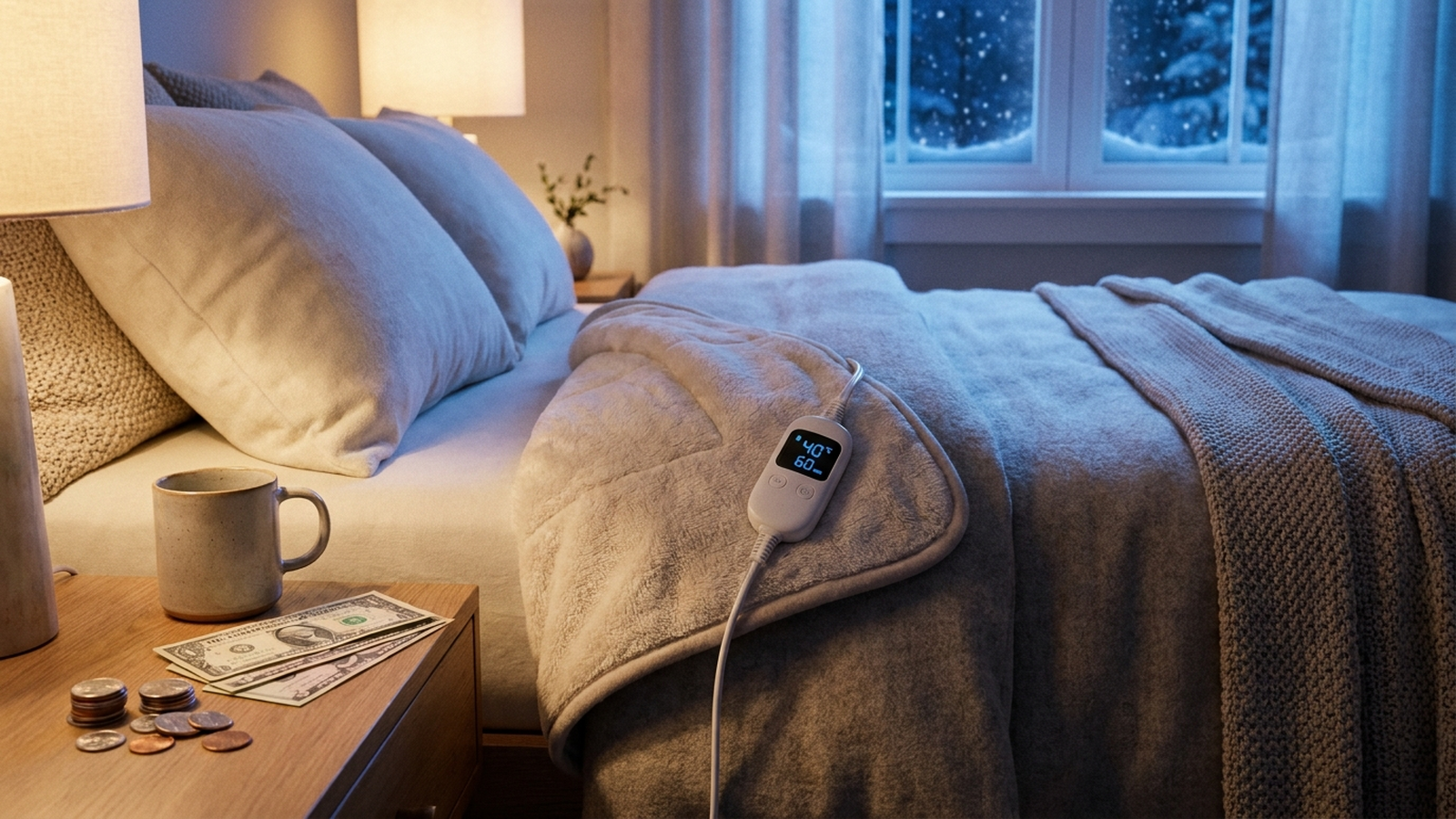
Every electric blanket sold in the US draws real, measurable wattage, and every watt shows up on a power bill somewhere. So does plugging one in every night this winter actually raise your electricity bill in a way you’d notice — or is “it costs pennies” just marketing shorthand? We ran the numbers against current U.S. Energy Information Administration (EIA) electricity rates and Department of Energy thermostat-setback data to see what an electric blanket actually costs to run, and whether it can offset the price of turning the furnace down at night.
As an Amazon Associate, Arekore earns from qualifying purchases. The Amazon product links in this article include our affiliate tracking ID and may earn us a commission if you buy through them, at no additional cost to you. See our Links Policy for details on how we select products and how commissions do not influence our recommendations.
TL;DR / Quick Verdict
- Yes, it raises your bill — but by cents, not dollars. At the EIA’s September 2026 average U.S. residential rate of 18.34¢/kWh, a typical queen-size electric blanket run 8 hours a night costs roughly 15–17 cents per night, or about $4.50–$5.10 a month of nightly use.
- A portable space heater costs about 13–15x more per night for comparable personal warmth, because it heats a whole room (750–1,500 watts) instead of a body (60–250 watts).
- The bill only goes down if you actually lower the thermostat. DOE guidance says a 7–10°F thermostat setback for 8 hours saves roughly 10% on a heating bill — using an electric blanket without changing the thermostat setting simply adds its small cost on top, it does not subtract anything.
- King and dual-zone blankets cost roughly double a queen run at the same setting, since they carry more heating wire and typically run near 200–250 watts split across two zones.
- The math depends on your local rate. Nevada’s 13.11¢/kWh and Hawaii’s 52.72¢/kWh (EIA, 2026) mean the same blanket costs nearly 4x more to run overnight in Hawaii than in Nevada.
Methodology
This is an editorial analysis, not a hands-on wattmeter test — we did not personally measure amperage draw on the specific blankets linked below. This article calculates estimated running costs using (a) manufacturer-published wattage specifications and user manuals for Sunbeam and Degrees of Comfort electric blanket lines, (b) the EIA’s September 2026 average U.S. residential electricity rate of 18.34¢/kWh and its state-level rate range, (c) Department of Energy Energy Saver guidance on thermostat setback savings, (d) UL’s published safety standard (UL 964) for electric blankets, and (e) aggregated wattage ranges reported across multiple electric-blanket manufacturer spec sheets and retailer product pages. We did not personally test heat output, energy draw, or thermostat behavior under controlled conditions.
The Technical Approach: Why Wattage Varies So Much by Size and Design
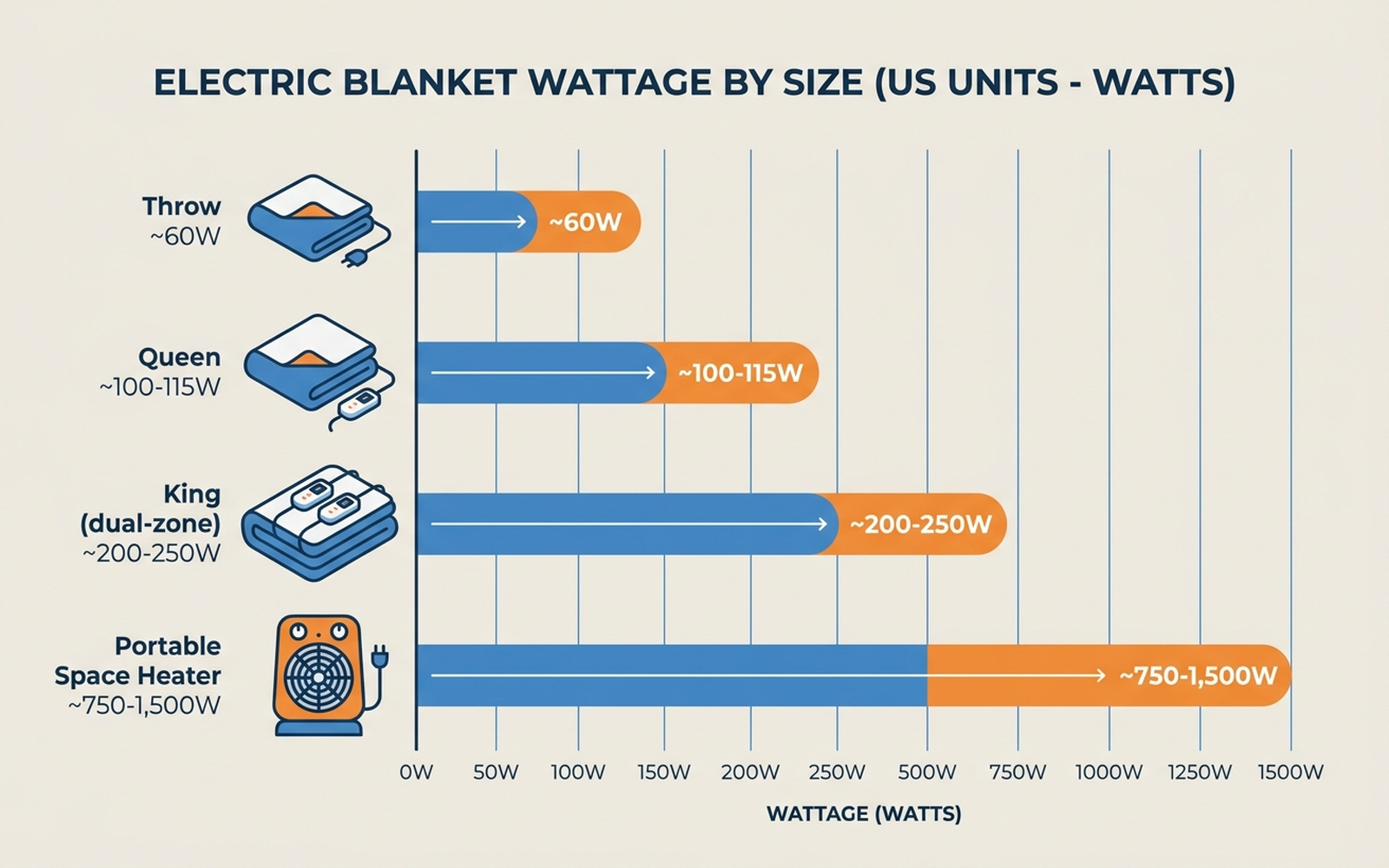
An electric blanket’s wattage scales with two things: surface area (bigger blanket, more heating wire) and zone count (a dual-control king runs two independent heating circuits, not one at double the size). Reported wattage across manufacturer spec sheets clusters into three tiers:
- Throws and twin-size blankets (~40–80 watts): the smallest heating-wire footprint, drawing well under 1 amp on a standard 120V US circuit.
- Full/queen single- or dual-zone blankets (~100–115 watts per side): the most common US bedroom size. Sunbeam’s Queen Microplush line, for example, uses an “exclusive wiring system” (the company’s ThermoFine sensing wire) that adjusts heat section by section rather than running at a flat wattage the whole night.
- King and dual-zone blankets (~180–250 watts total, split across two controllers): because king- and California king-size dual-control blankets run two independent heating zones side by side, the published wattage is often listed per full blanket rather than per side — check the specific listing rather than assuming a simple size-based multiple.
For comparison, a typical US portable space heater draws 750–1,500 watts to heat an entire room — 6 to 25 times the wattage of even the largest electric blanket, because it’s warming cubic feet of air rather than the surface of one body.
Manufacturer Specs: What Sunbeam and Degrees of Comfort Actually Draw
Sunbeam
Sunbeam’s current electric blanket lineup is built around its ThermoFine sensing wire, which the company markets as adjusting wattage by section rather than running the whole blanket at a single fixed heat level. Published wattage for Sunbeam’s queen-size Microplush and Luxurious Velvet lines falls in the roughly 100–115 watt range per the company’s own specification sheets and third-party retailer listings, with king-size versions running higher. All current Sunbeam electric blankets carry third-party UL or Intertek (ETL) safety certification per UL 964, the safety standard covering electric blankets, and ship with an automatic shut-off after up to 10–12 hours, depending on model.
Degrees of Comfort
Degrees of Comfort’s Advanced MicroPlush line uses conventional resistive heating wire rather than a sensor-adjusted system, with published specs showing 20 discrete heat levels per side on its queen-size dual-control SKU. The brand’s own product documentation states its blankets are “EMF radiation safe” and UL certified, and ships with a roughly 12.5-foot power cord plus a 6-foot controller cord. As with Sunbeam, exact wattage is listed per size rather than as one line-wide figure — the queen SKU and the king SKU are not simply the same wattage scaled up, since the king runs two zones rather than one.
How to Calculate Your Own Nightly Cost
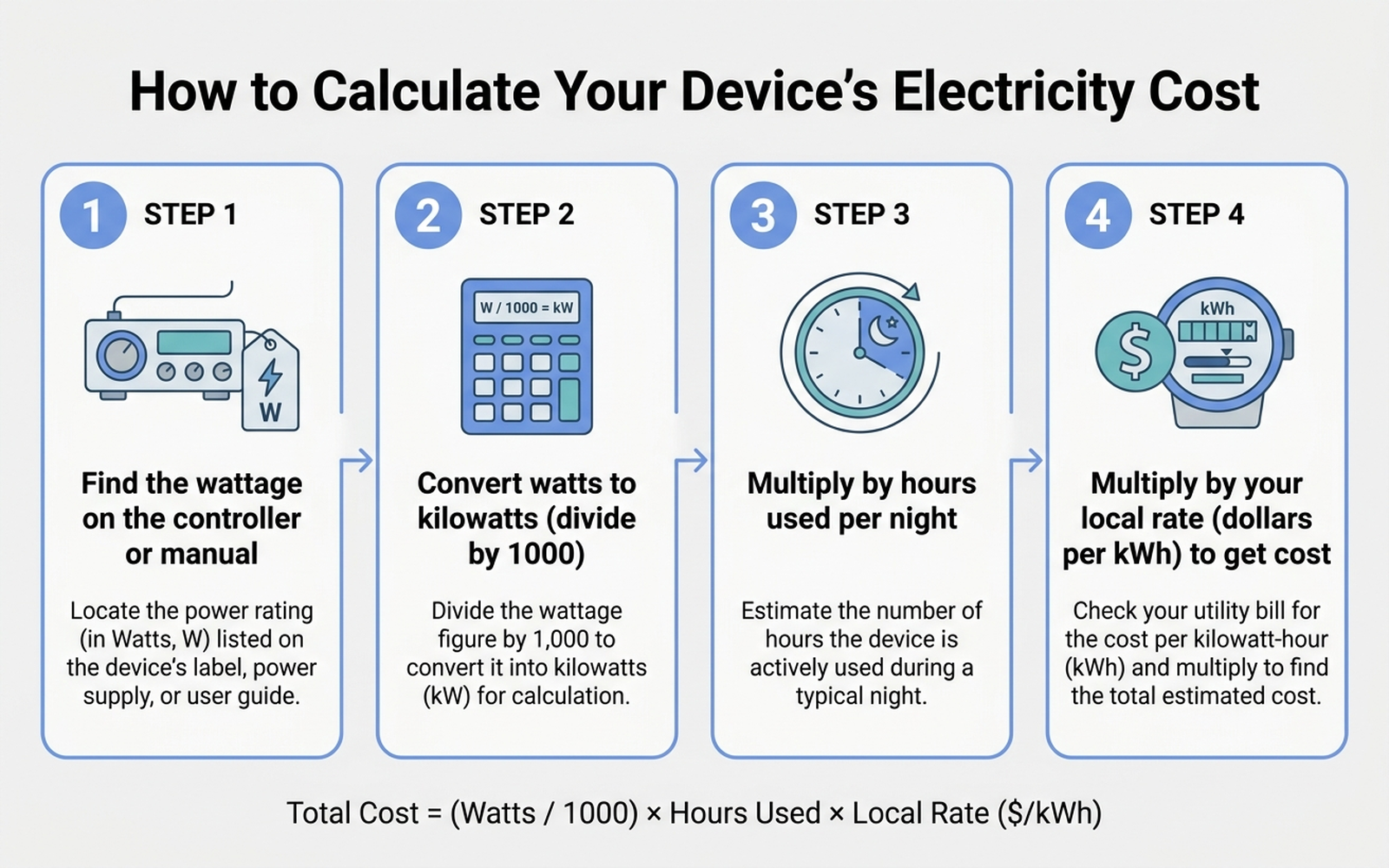
- Find the wattage. It’s printed on the controller, the fabric care tag, or the product manual — not always on the outer packaging.
- Convert watts to kilowatts. Divide by 1,000 (a 115-watt blanket is 0.115 kW).
- Multiply by hours used. 8 hours of overnight use × 0.115 kW = 0.92 kWh.
- Multiply by your electricity rate. At the EIA’s September 2026 national average of 18.34¢/kWh, 0.92 kWh × $0.1834 ≈ 17 cents. Check your own utility bill for your actual per-kWh rate — rates ranged from 13.11¢/kWh in Nevada to 52.72¢/kWh in Hawaii as of 2026, a roughly 4x spread nationally.
- Multiply by nights per month to get a monthly figure: 17 cents × 30 nights ≈ $5.10 a month for nightly use of a queen blanket at a mid-to-high heat setting; a lower setting or a smaller throw costs meaningfully less.
Does It Actually Offset a Lower Thermostat? A Simple Way to Decide
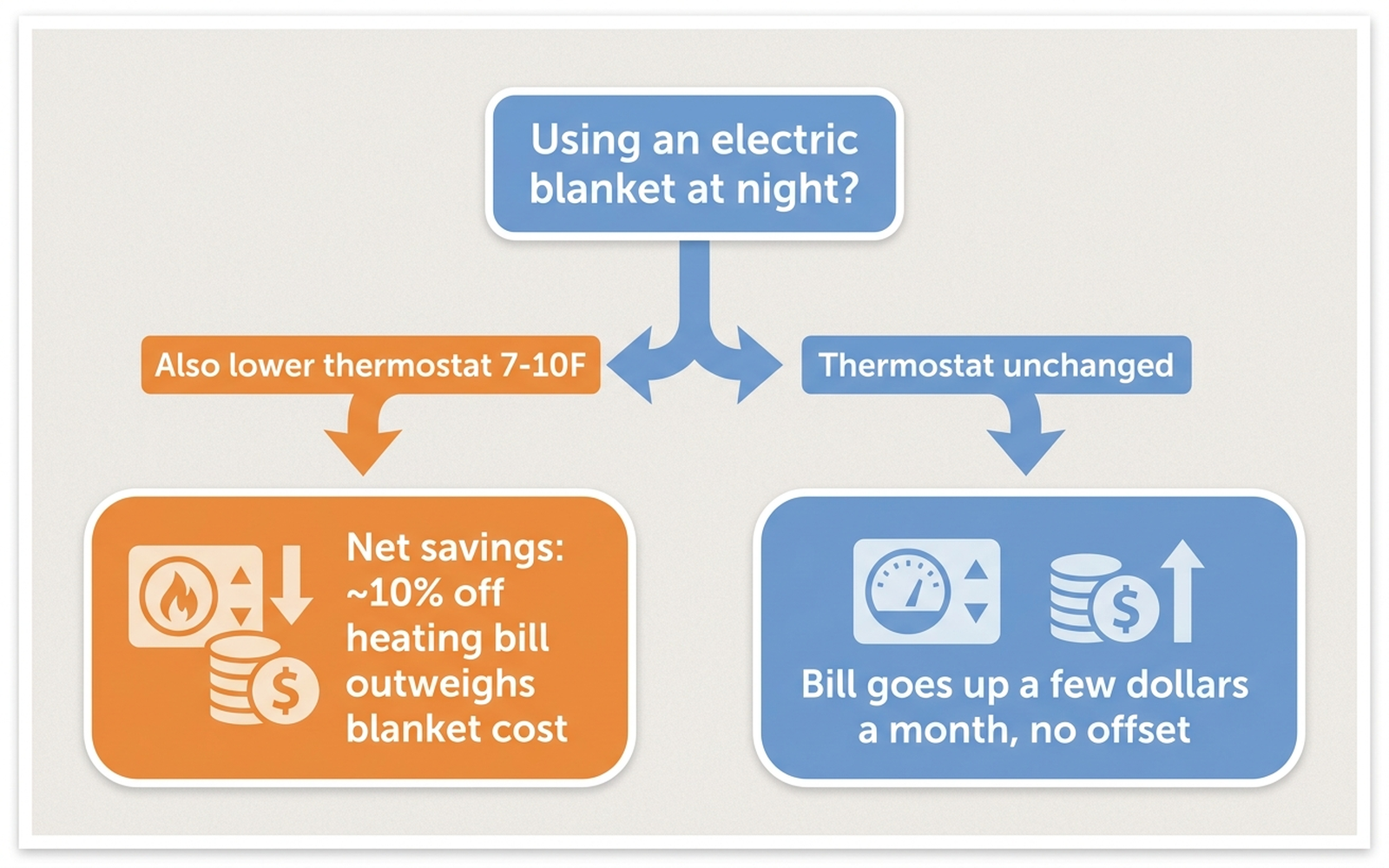
The Department of Energy’s Energy Saver program states that a 7–10°F thermostat setback for 8 hours can save roughly 10% a year on heating and cooling costs. On a $150 monthly winter heating bill, a 10% reduction is about $15 — which is more than enough to cover a queen electric blanket’s roughly $5-a-month running cost, if the thermostat setback is the thing that actually happens.
The catch, and the actual answer to “does it raise my bill,” is conditional:
- If you add the blanket and also turn the thermostat down while sleeping, the math above suggests you come out ahead overall, since the blanket’s cost is small relative to the whole-house heating savings from the setback.
- If you add the blanket but leave the thermostat exactly where it was, you have simply added a new load to your bill — a few dollars a month, not dramatic, but a real increase with no offsetting reduction.
Either way, the electric blanket itself does not “raise” or “lower” your bill in isolation — it raises it by its own wattage cost, and whether your total bill goes up or down depends entirely on what you do with the thermostat once it’s on.
Comparison: Estimated Nightly and Monthly Cost by Blanket Size
Costs calculated at the EIA’s September 2026 U.S. average residential rate of 18.34¢/kWh, 8 hours of nightly use. Prices as of 2026-09-27 — check the live Amazon listing before buying, since both categories run frequent seasonal discounts.
| Product Type | Typical Wattage | Cost per Night | Cost per Month (30 nights) |
|---|---|---|---|
| Heated throw (~60W) | 60W | ~$0.09 | ~$2.65 |
| Queen single/dual-zone blanket (~100–115W) | 100–115W | ~$0.15–$0.17 | ~$4.50–$5.10 |
| King dual-zone blanket (~200–250W) | 200–250W | ~$0.29–$0.37 | ~$8.80–$11.00 |
| Portable space heater (for reference) | 750–1,500W | ~$1.10–$2.20 | ~$33–$66 |
Editorial Recommendation
- Best for most bedrooms: Sunbeam Queen Microplush Electric Heated Blanket — ThermoFine sensor-adjusted wattage means the blanket isn’t running at a flat, wasteful wattage all night the way a fixed-wire model can.
- Best for maximizing manual control per dollar of running cost: Degrees of Comfort Advanced MicroPlush (Queen) — 20 heat levels per side let you dial in the lowest setting that still keeps you warm, which is the single biggest lever for cutting the cost estimates above.
- Skip a whole-room space heater if personal warmth is the actual goal — the wattage gap alone (6–25x) means an electric blanket almost always wins on running cost for the same subjective warmth, per hour, for one person in bed.
- The real lever isn’t brand, it’s the thermostat. Buying either blanket without changing your thermostat setting still adds a small but real cost; pairing it with a 7–10°F nighttime setback is what turns the purchase into a net saving, per DOE guidance.
Limitations
This analysis calculates estimated costs from published manufacturer wattage specifications and the EIA’s national average electricity rate; it is not a laboratory wattmeter measurement of the specific units linked below, and actual draw can vary by heat setting, ambient room temperature, and unit-to-unit variance. The DOE’s 10% thermostat-setback savings figure is a general heating-and-cooling guideline, not a number calculated for electric-blanket users specifically, and actual whole-house heating savings depend on furnace type, insulation, and how many hours per day the setback is maintained. Electricity rates vary substantially by state and utility (roughly 13 to 53 cents per kWh nationally as of 2026), so the dollar figures above will be higher or lower depending on where you live — recalculate using your own utility’s rate for an accurate figure. Individual experience may vary based on how many nights per month a blanket is actually used and at what heat setting.
Verify Before You Buy
Wattage varies by size and model even within the same brand, so check the specific listing’s manual or controller label rather than assuming the figures in this article apply to every SKU. Visit Arekore to compare current listings and pricing before you buy.