Do Dash Cams Lower Your Car Insurance? We Checked
TL;DR
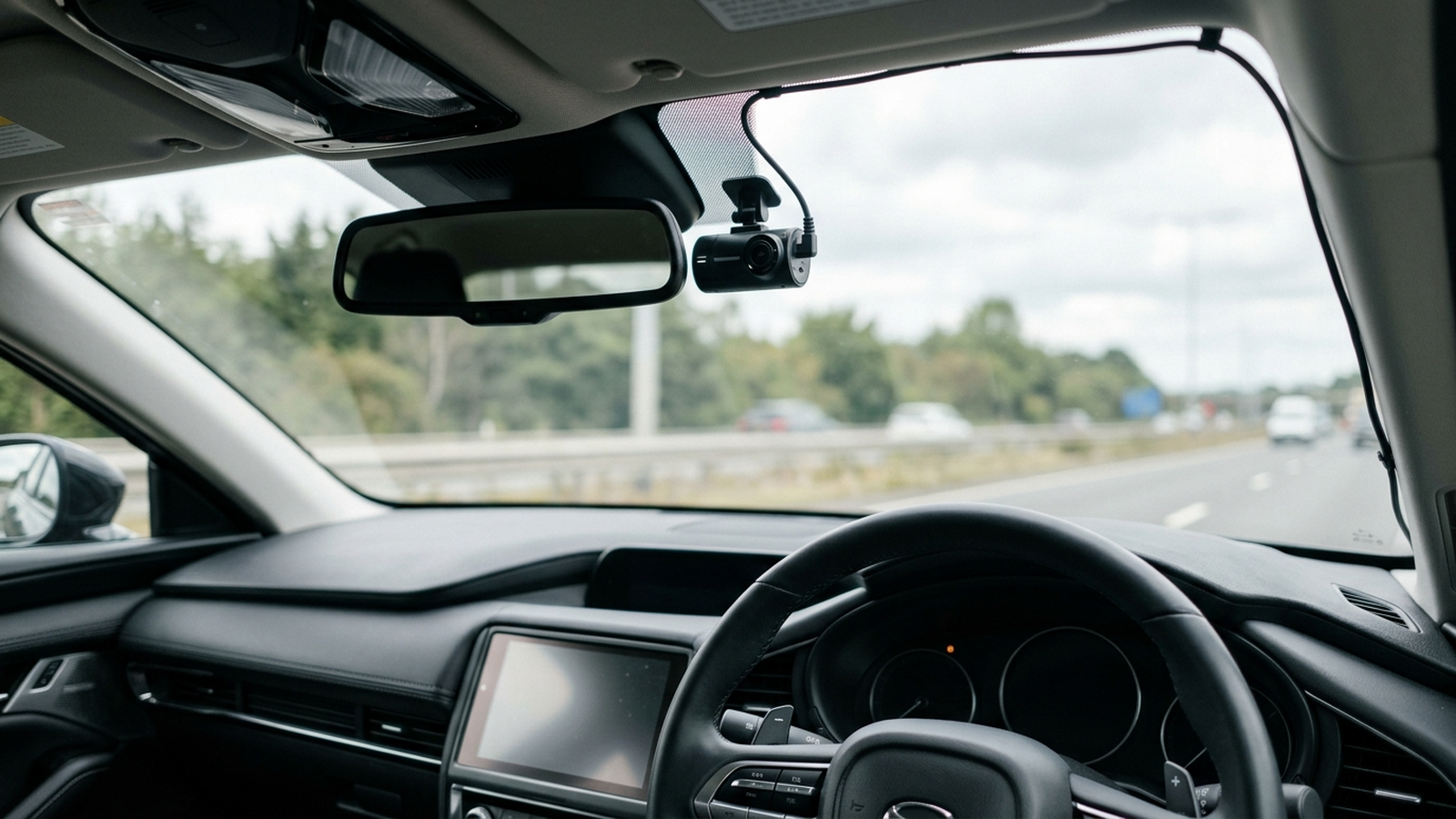
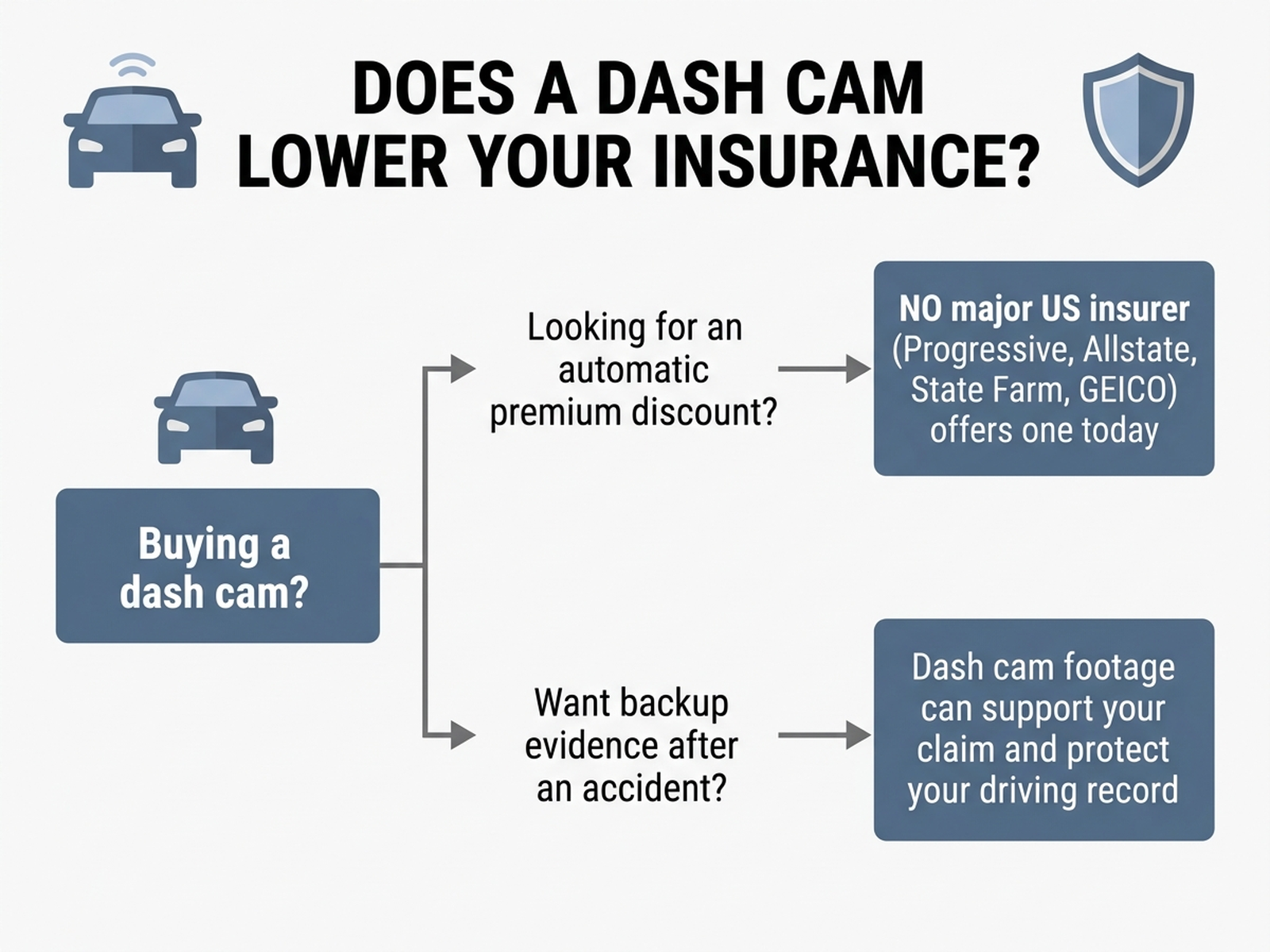
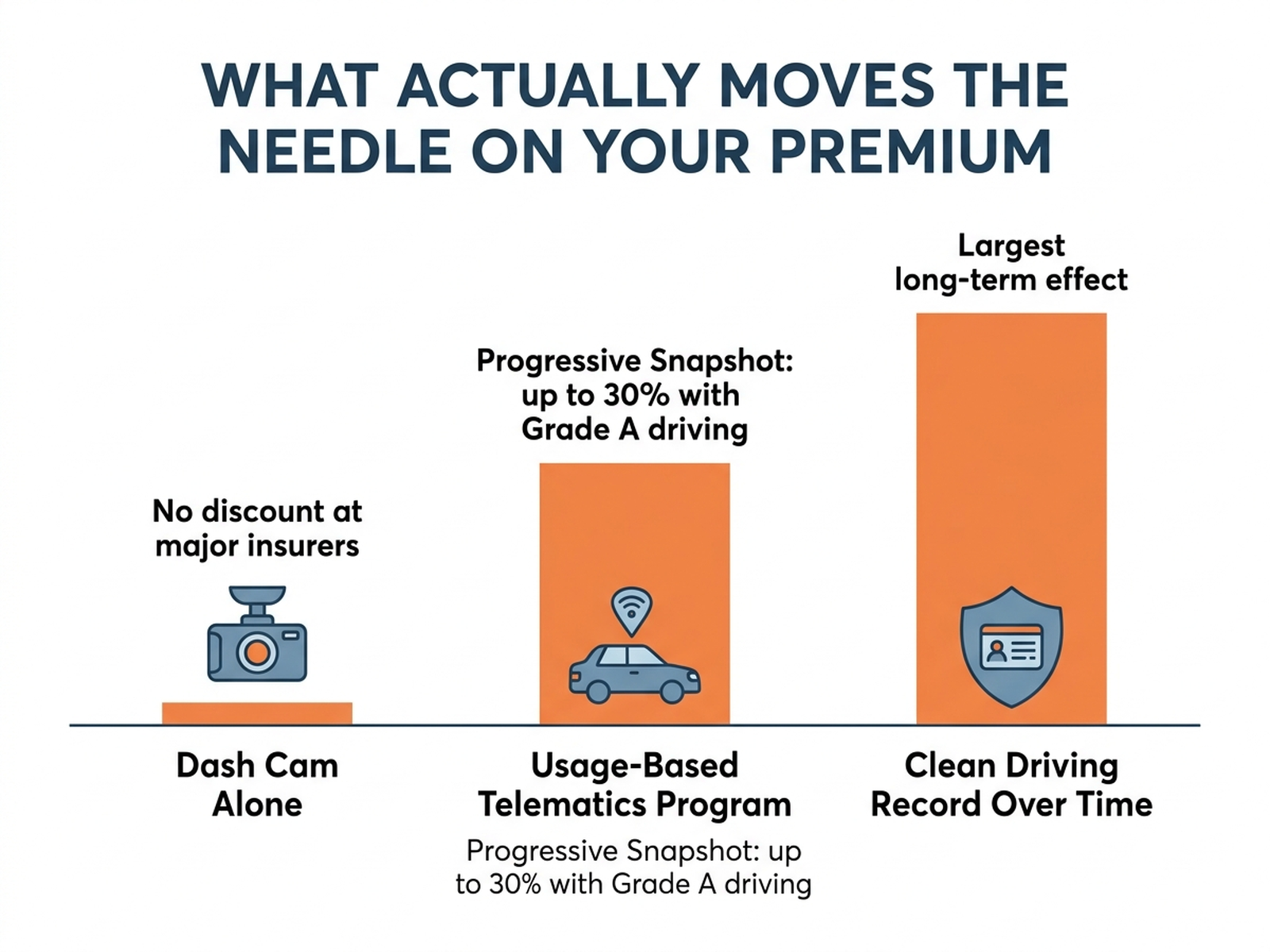
No major US insurer — not Progressive, Allstate, State Farm, or GEICO — currently offers an automatic premium discount just for owning a dash cam. What actually moves your rate is a usage-based telematics program (like Progressive Snapshot), which can cut premiums by up to 30% based on driving behavior, dash cam or not. A dash cam’s real financial value shows up after a crash, by giving you evidence to contest a disputed fault determination — though the specific “35% faster” and “40% more likely to win” statistics that circulate online trace back to marketing blogs, not to the primary sources they cite.
As an Amazon Associate, Arekore earns from qualifying purchases. The Amazon product links in this article include our affiliate tracking ID and may earn us a commission if you buy through them, at no additional cost to you. See our Links Policy for details on how we select products and how commissions do not influence our recommendations.
Methodology
This analysis synthesizes (a) a direct review of discount and policy pages published by four major US auto insurers (Progressive, Allstate, State Farm, GEICO), (b) the text of New York State Senate Bill S4397 and its predecessor bills on nysenate.gov, (c) third-party dash cam test data from Consumer Reports and Wirecutter, (d) Amazon US customer review patterns for four widely sold dash cam models, and (e) a trace-back of the “35% faster claims” and “40% more likely to win” statistics that recur across dash cam retailer blogs, to determine whether those figures point to a verifiable primary source. We did not personally test the dash cams covered here.
Claim #1: “Dash cams get you an insurance discount” — Mostly False
This is the claim worth checking first, because it’s the one that shows up in nearly every dash cam retailer’s marketing copy. We reviewed the discount pages and consumer FAQ pages for the four largest US auto insurers by market share:
- Progressive: has never listed a dash cam discount as a line item on its discounts page.
- Allstate: does not list a dash cam discount among its standard discount categories.
- State Farm: does not offer a dash cam discount.
- GEICO: does not currently offer a dash cam discount.
What these insurers do offer are usage-based telematics programs — Progressive Snapshot, State Farm Drive Safe & Save, Allstate Drivewise — that track driving behavior (braking, speed, time of day, phone use) through a plug-in device or smartphone app, independent of whether you own a dash cam. Progressive’s own public materials describe an average enrollment discount, plus a renewal discount for drivers who maintain a good driving record; data aggregated by third-party insurance comparison sites puts typical Snapshot outcomes around 10-20%, with up to 30% available for drivers who earn the program’s top behavior grade. Roughly 1 in 5 participants see no discount or a rate increase at renewal, driven by hard braking, speeding, late-night driving, or phone use flagged by the telematics data.
The two are easy to conflate because the same driver often has both a dash cam and a telematics app running — but the discount comes from the telematics behavior score, not from the camera footage sitting on an SD card.
An exception in progress, not yet law
New York has repeatedly introduced legislation that would require this to change. Senate Bill S4397, introduced in the 2025-2026 session (following near-identical bills in 2023, 2021, 2017, and 2015), would mandate a 5% auto insurance premium reduction for non-commercial vehicles with a certified, operating dashboard camera, verified at annual vehicle inspection. As of this writing, it remains in committee — it has not passed in any of its prior introductions over the past decade. If you see a claim that “New York drivers get 5% off for a dash cam,” it’s describing a bill, not current law.
Claim #2: “Dash cam footage settles claims 35% faster” — Unverified
This is where the research got more interesting than the headline discount question. Searching for the source of two specific statistics that appear across dozens of dash cam retailer and affiliate blogs — that dash cam-backed claims settle “35% faster” or resolve “50% faster,” and that drivers with dash cam footage are “40% more likely” to have claims resolved in their favor, attributed variously to the National Association of Insurance Commissioners (NAIC) or to an unnamed “AAA study” — turned up no primary publication from either organization. The figures appear consistently, often word-for-word, across sites that sell or are affiliated with dash cam brands, each citing the others rather than linking to an NAIC report, an AAA press release, or a dataset. We were not able to independently verify these numbers and are not repeating them here as fact.
What we can verify, from insurance industry trade coverage and attorneys who handle auto claims, is a more modest and defensible version of the same idea: fault in US auto accidents is frequently disputed because it comes down to one driver’s account against another’s, and dash cam footage is accepted as evidence by insurers, courts, and arbitration proceedings in all 50 states. Time-stamped video that clearly shows who had the right of way removes the “he said, she said” element that otherwise turns into a drawn-out claims investigation. That is a real, logical mechanism for a faster or more favorable outcome — we just can’t attach a specific percentage to it without a source we can stand behind.
Where the Real Savings Come From
Putting the two claims together, a dash cam’s financial case looks like this:
- No direct discount, full stop, in 2026. Budgeting for one on the assumption it will shave dollars off your renewal bill is planning around a program that doesn’t exist at any of the four largest US insurers.
- Telematics programs are the actual rate lever, and they work independently of a dash cam. If lowering your premium is the primary goal, enrolling in your insurer’s usage-based program will do more than any camera purchase.
- The dash cam’s payoff is defensive, not additive. It doesn’t lower your base rate; it protects you from a rate increase by helping you avoid being found at fault in a disputed accident, or supporting a hit-and-run or vandalism claim with footage of a license plate.
- 30% of US drivers already carry one for this reason. Industry tracking puts dash cam ownership at roughly 30% of US drivers, with adoption highest among urban drivers and gig-economy drivers who have more at stake in a contested accident.
What to Buy If You Decide to Get One
Since the discount argument doesn’t hold up, the purchase decision comes down to picture quality and reliability when it matters — which is exactly what Consumer Reports and Wirecutter test for.
Comparison Table
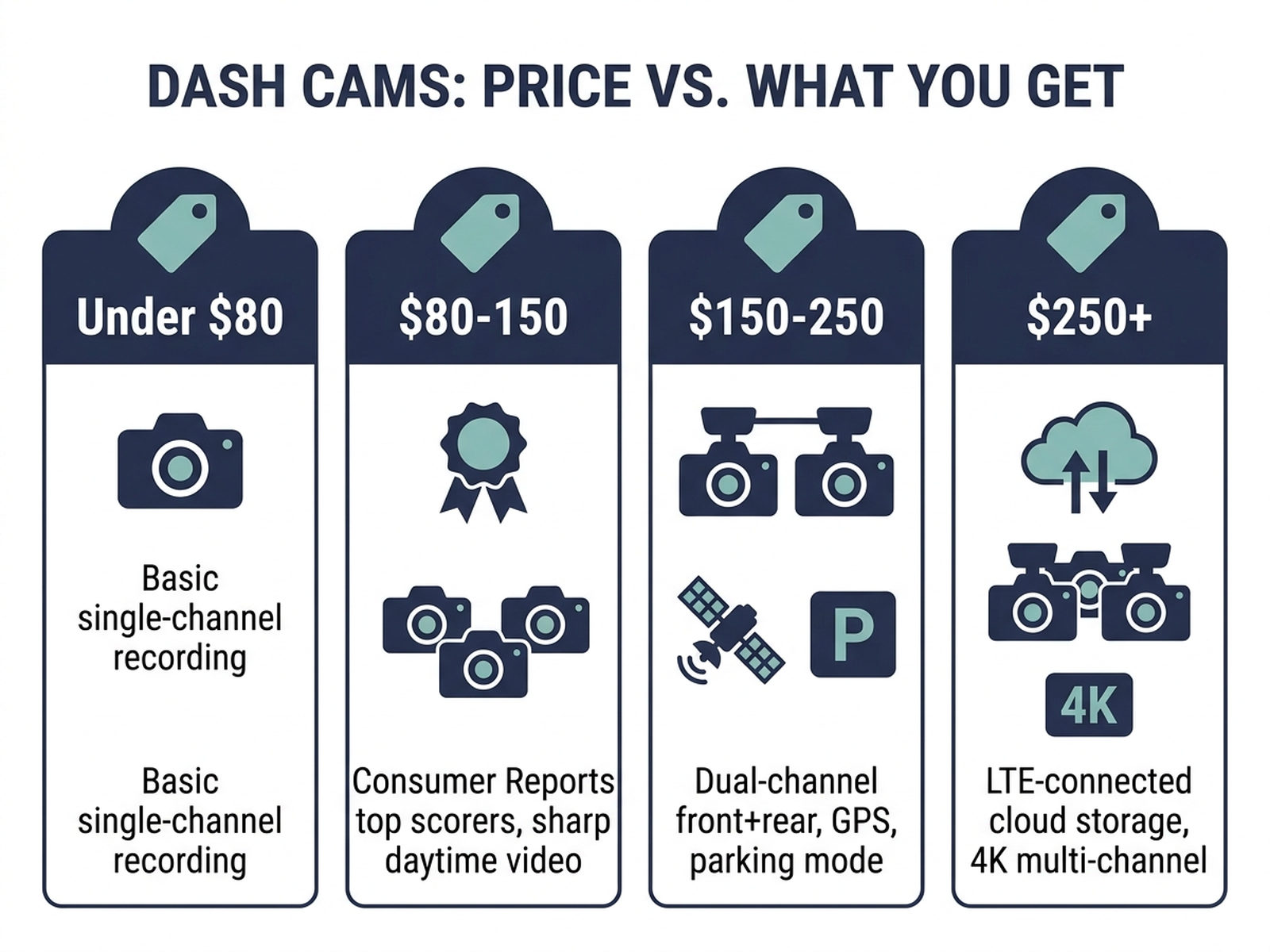
| Model | Resolution | Channels | Price (as of 2026-10-11) | Independent test result |
|---|---|---|---|---|
| VIOFO A229 Pro (2-channel) | 4K front + 2K rear | Dual | ~$280 | Wirecutter’s top overall pick after testing 61 models, citing best license-plate legibility across conditions |
| REDTIGER F7NP | 4K front | Single/dual kits | ~$150 | Consumer Reports’ top-scoring model tested (score: 72/100), excellent daytime video and audio |
| Garmin Dash Cam X210 | 1440p | Single | ~$250 | Not independently lab-tested by CR/Wirecutter in this cycle; included for Garmin’s connected-app ecosystem and compact form factor (current Garmin lineup; the older Dash Cam 57 has been discontinued) |
| Nexar Beam2 Mini | 1080p Full HD | Front (rear optional add-on) | ~$200 (+ optional $9.99/mo cloud plan) | Not independently lab-tested by CR/Wirecutter in this cycle; distinguishing feature is LTE-connected live/remote parking mode |
Prices as of 2026-10-11 and will fluctuate; check the live Amazon listing before buying.
Customer Sentiment Synthesis
Across the Amazon US review sections for these four models, a consistent pattern emerges: reviewers who specifically mention an insurance claim or accident dispute report using the footage as evidence submitted directly to their insurer or the other driver’s insurer, rather than citing any discount received for owning the camera. Complaints cluster around two issues regardless of brand: SD card reliability (cards failing or corrupting after repeated overwrite cycles in hot cars) and parking-mode battery drain when hardwired without a low-voltage cutoff. Both are maintenance issues, not product defects per se, and are addressed in each manufacturer’s installation guide.
Editorial Recommendation by Use Case
- Best for most drivers who want this as “crash insurance,” not discount insurance: REDTIGER F7NP. Consumer Reports’ top overall score at the lowest price in this comparison makes it the rational pick when the goal is clear footage for a claim, not fleet-grade features.
- Best if video quality is the top priority (e.g., you drive for rideshare and want the sharpest possible evidence): VIOFO A229 Pro. Wirecutter’s testing specifically calls out license-plate readability, which is the detail that actually matters in a fault dispute.
- Best for drivers who already use a connected-car ecosystem: Garmin Dash Cam X210, for its integration with Garmin’s vehicle-monitoring app.
- Best for drivers who want remote live-view and theft alerts over LTE, and are willing to pay a subscription for it: Nexar Beam2 Mini.
Limitations
This analysis relies on publicly available insurer discount pages, legislative text, third-party lab test data, and aggregated Amazon customer reviews; we did not personally test the camera models covered here. Insurer discount programs and legislative status can change — verify directly with your insurer and check the current status of NY S4397 before assuming either has changed since this was written. The “35% faster” and “40% more likely” statistics discussed above could not be traced to a publicly available primary source as of this writing; if NAIC or AAA publish a dataset supporting these figures in the future, this section should be revisited.
Visit Arekore
Before you buy any dash cam, confirm current pricing and check your own insurer’s discount list directly — policies and telematics programs are updated more often than retail product listings.