Do Cooling Mattress Pads Actually Work? We Checked the Data
“Cooling gel” has become one of the most common phrases on a mattress-pad product page, and it shows up on everything from a $30 foam topper to a $1,500 water-circulating bed system. The cool-gel mattress category alone is on track to grow from roughly $1.64 billion in 2025 to $2.62 billion by 2031 — an 8.1% annual growth rate — and gel-infused foam has become the default “cooling” material across a meaningful share of the mattress-topper market. That is a lot of money riding on the word “cooling,” and the products behind it range from a thin layer of gel beads to an actively refrigerated water pump.
So we compared what independent testing organizations have actually measured — not marketing copy — across the two broad categories: passive pads (gel-infused foam, phase-change fabric) and active systems (water-circulating and air-blowing pads with a bedside control unit). The short answer: they are not the same product wearing different price tags. One category reliably works as advertised; the other mostly buys you a temporary, modest effect.
As an Amazon Associate, Arekore earns from qualifying purchases. The Amazon product links in this article may include our affiliate tracking ID and may earn us a commission if you buy through them, at no additional cost to you. See our Links Policy for details on how we select products and how commissions do not influence our recommendations.
TL;DR / Quick Verdict
- Active, water-based systems genuinely work — and independent testing backs that up. Consumer Reports rated the Sleepme Ooler and ChiliPad “Excellent” for active cooling, with some tested units able to bring bed-surface temperature down toward the mid-40s°F, well below typical bedroom air temperature.
- Passive gel and phase-change pads produce a real but small, temporary effect. The gel or PCM layer absorbs body heat only until it saturates — typically within the first stretch of the night — after which it behaves like ordinary foam. Aggregated Amazon customer sentiment repeatedly describes this same pattern: cool at first, warm again within 15–30 minutes.
- Price roughly tracks the physics. Passive gel toppers run $30–$270; active water or air systems run $500–$1,800. Consumer Reports specifically notes the cheapest passive options in its tests “aren’t worth the frustration,” while its two most effective (active) systems started around $500.
- Reliability is the trade-off for active systems. Pump-based water systems have a documented minority failure mode — leaks at the pad, hose connections, or control unit — that a foam topper simply cannot have, because it has no moving parts.
How We Reached These Conclusions (Methodology)
This is an editorial analysis, not a hands-on test. We did not personally test the products covered here. This guide synthesizes (a) Consumer Reports’ published testing program for cooling mattress pads, which rates water-based and fan-based systems on cooling performance, heating performance, and precooling/preheating time; (b) Sleep Foundation’s documented temperature-control test protocol, which uses a heated water bottle, thermal camera, and laser thermometer to measure surface-temperature change under controlled conditions; (c) manufacturer specifications for best-selling models on amazon.com; and (d) aggregated Amazon customer review sentiment for gel-foam toppers and water-cooled systems, sampled in September 2026. We did not run our own thermal tests; where a specific degree figure is Consumer Reports’ or a manufacturer’s, it is labeled as such.
Two Technologies, Not One Category
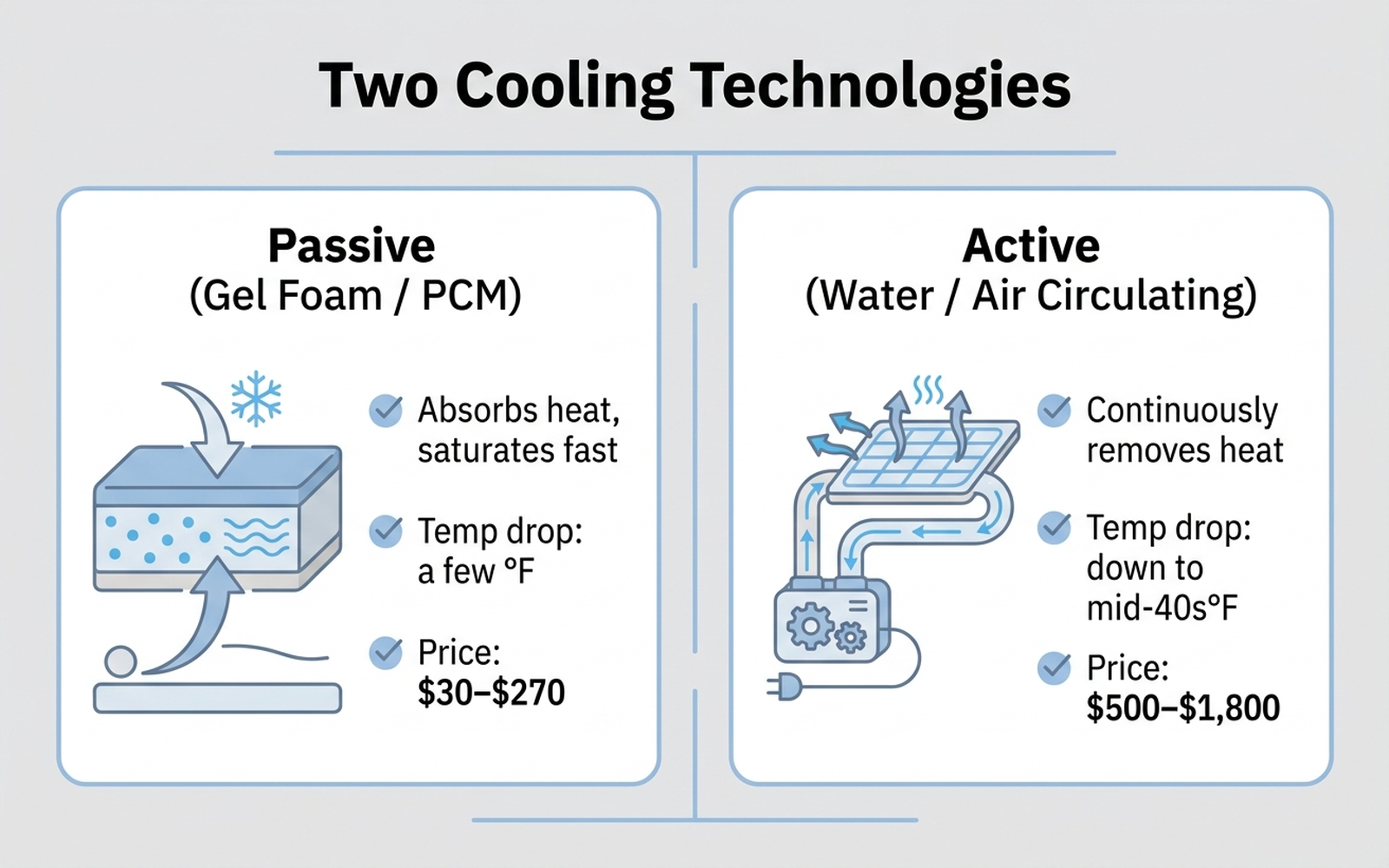
“Cooling mattress pad” covers two fundamentally different mechanisms, and confusing them is where most of the marketing overpromise happens:
- Passive materials (gel-infused foam, phase-change material/PCM fabric). These work by absorbing heat rather than removing it. A gel bead or PCM layer that melts or warms below body temperature will feel cool as it draws heat away from skin contact — but it has a fixed heat-absorbing capacity. Once that layer reaches body temperature, it stops absorbing and simply insulates like any other foam, per multiple manufacturer and mattress-industry technical explanations of PCM behavior. Some industry testing has found the best passive pads can lower surface temperature by only a few degrees Fahrenheit, and only for a limited window.
- Active systems (water-circulating pads, air-blowing units). These use a bedside control unit — a small refrigeration compressor and water reservoir, or a fan — to continuously pull heat away from the sleep surface and hold it at a set, programmable temperature all night, the same principle behind a car radiator. Because they are actively removing heat rather than storing it, they do not saturate the way a passive layer does.
That structural difference is why the same word — “cooling” — on the packaging can mean either “will feel cool to the touch for a few minutes” or “will hold my side of the bed at 65°F until sunrise.”
What Consumer Reports Actually Measured
Manufacturer claims about degrees of cooling are self-reported; Consumer Reports is one of the few outlets that has run a standardized, repeatable cooling test across multiple mattress-pad brands. Its published testing covers water-based systems (Sleepme’s Ooler and ChiliPad lines) and fan-based systems (BedJet), rating each on active cooling performance, active heating performance, and precooling/preheating speed. The Ooler earned an “Excellent” rating for cooling and “Very Good” for heating in Consumer Reports’ tests; the ChiliPad line scored similarly — “Excellent” for cooling, “Very Good” for heating, and “Good” for precooling and preheating. Consumer Reports also reports that in its testing, the coldest system was able to bring the sleep surface down to roughly 46°F, well below the 60–68°F range Sleep Foundation recommends for sleep — meaning the ceiling on active cooling is well past what most sleepers would ever need, not a limiting factor.
Consumer Reports’ broader conclusion across its testing program is a useful shortcut for anyone comparing categories: water-based, actively controlled systems consistently outperformed passive gel or fan-only alternatives in its cooling measurements, and its two most effective tested systems both started around $500 — while it specifically warned that the cheapest passive option it tried “isn’t worth the frustration.”
What Aggregated Customer Reviews Say
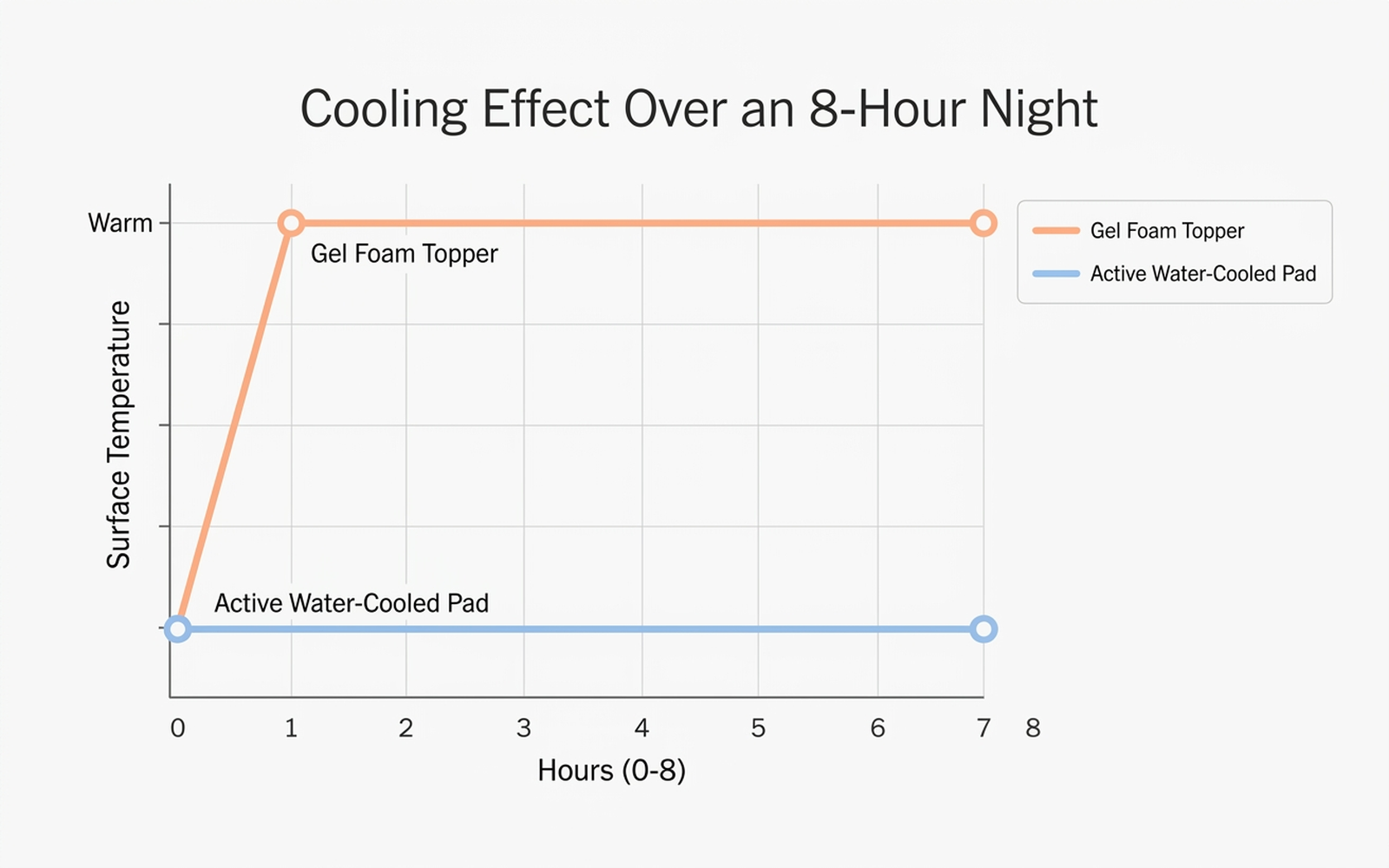
Customer sentiment on amazon.com for gel-infused foam toppers is consistent with the physics above: reviewers frequently describe an initial cool feeling at lights-out that fades within roughly 15 to 30 minutes, after which the topper behaves like standard memory foam. This is not a defect specific to one brand — it shows up across gel-topper listings broadly and matches the fixed-capacity limitation manufacturers themselves describe for phase-change and gel materials. It is also the most common one-star complaint pattern on gel toppers: “cool to the touch in the store, warm within the hour at home.”
Reviews of water-based active systems (Ooler, ChiliPad, and their successor, the Dock Pro) describe the opposite pattern for effectiveness — most reviewers who kept the system report it reliably holds a set temperature through the night — but surface a different concern: a minority of units develop leaks at the pad, hose fittings, or control-unit reservoir, typically reported within the first few months of use, and the pump/fan on the highest setting is audible enough that light sleepers sometimes switch it to a lower speed. That is the trade a moving-parts system makes for the temperature control a static foam layer cannot offer.
Editorial Recommendation by Use Case
- Best for a hot sleeper who wants the most reliable fix and can spend $500+: an active water-based system like the Sleepme Dock Pro. It is the technology category Consumer Reports’ testing consistently rates highest for actual measured cooling, with a programmable temperature range roughly 55–115°F.
- Best for a budget-conscious hot sleeper, or someone who runs warm only occasionally: a gel-infused foam topper in the $100–$270 range, like the Sleep Innovations Cooling Comfort or a Lucid gel topper. Expect a real but modest, front-loaded cooling effect rather than all-night temperature control.
- Best for couples who disagree on temperature: a dual-zone active system (Dock Pro dual-zone, or BedJet’s dual-zone configuration) that lets each side of the bed run independently — a problem no passive pad can solve, since foam has no way to be “colder” on one half.
- Best for anyone who wants air movement without water lines: BedJet 3, an air-based active system with no water reservoir or hose to leak, at a lower price point (roughly $500–$700) than the water-based systems, though its cooling ceiling is generally reported as less aggressive than a chilled-water pad.
- Skip a cooling pad entirely if your actual problem is a hot bedroom, not a hot mattress — a fan, lower thermostat setting, or breathable cotton sheets solves that more cheaply than any pad, and none of the technologies above overcome a bedroom that’s genuinely too warm.
Comparison Table
Prices are approximate figures gathered from manufacturer and retail listings as of 2026-09-21 and fluctuate.
| Product | Type | ASIN | Approx. price | Consumer Reports rating |
|---|---|---|---|---|
| Sleepme Dock Pro | Active, water-circulating | B0B3QQ7NDX | ~$1,199–$1,799 | Predecessor (Ooler/ChiliPad) rated “Excellent” cooling |
| BedJet 3 Climate Comfort | Active, air-blowing | B0FLNJP2G9 | ~$500–$700 | Tested category; fan-based systems rated below water-based in CR’s program |
| Sleep Innovations Cooling Comfort (4”, Queen) | Passive, gel-infused foam | B0B3PGLK4F | ~$120–$270 | Not individually CR-tested; category described as limited/temporary effect |
| Lucid 3” Gel Memory Foam Topper (Queen) | Passive, gel-infused foam | B08BNC8V2Q | ~$60–$150 | Not individually CR-tested; category described as limited/temporary effect |
Check the Sleepme Dock Pro on Amazon Check the BedJet 3 Climate Comfort System on Amazon Check the Sleep Innovations Cooling Comfort Topper on Amazon Check the Lucid Gel Memory Foam Topper on Amazon
Which One Is Right for You
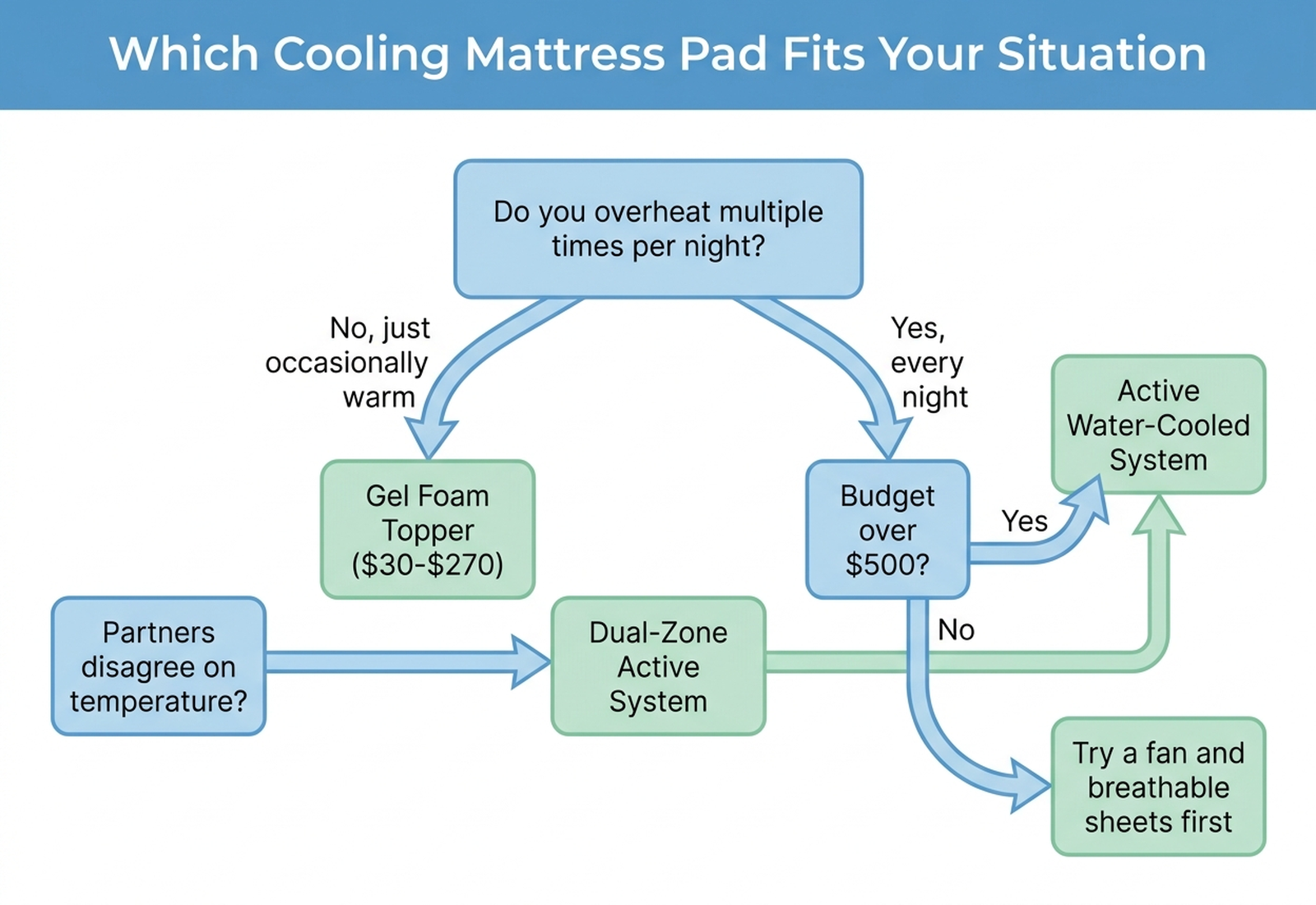
The decision mostly comes down to two questions: how much of the night do you need active cooling, and what is your budget. Occasional warmth for the first hour of sleep is squarely in gel-topper territory. Waking up sweating multiple times a night, every night, is the scenario the independent test data says a passive pad is not built to solve — that calls for an active system, budget allowing.
Warranty and Practical Notes
Gel-foam toppers typically carry a 3-year limited warranty against manufacturing defects (common across Lucid and Sleep Innovations listings), which is standard for foam bedding at this price point. Active water-based systems generally carry a shorter 1-year limited warranty on the control unit and pump, reflecting the added mechanical failure risk described above; if you buy one, registering the product and keeping the packaging for the warranty window is worth doing given the documented (if minority) leak reports. For either category, checking a specific listing’s current warranty terms before buying is worthwhile, since coverage details can change between product revisions.
Limitations
This analysis relies on Consumer Reports’ published testing summaries, Sleep Foundation’s documented test methodology, manufacturer specifications, and aggregated Amazon customer review sentiment, rather than our own instrumented thermal testing. Consumer Reports’ full numeric ratings and expanded test data are behind its subscriber paywall; we cite only the ratings and findings publicly summarized in its published articles. The Ooler and original ChiliPad have been succeeded by the Dock Pro as Sleepme’s current product line, so cooling performance for the exact current model may differ from the ratings recorded for its predecessor, though the underlying water-circulation technology is the same. Individual results depend on bedroom temperature, mattress thickness, body heat, and unit-to-unit variance; a pad rated highly in aggregate can still underperform for a specific sleeper or bed setup.
Bottom Line
Do cooling mattress pads actually work? It depends entirely on which technology is inside them. Active, water-based systems have real independent test data behind them — Consumer Reports rates the category “Excellent” for measured cooling performance — but cost $500 and up and carry a documented, if minority, leak risk. Passive gel-foam toppers cost a fraction of that and do produce a real cooling sensation, but the aggregated evidence, from both technical explanations of how phase-change materials work and thousands of customer reviews, points to the same conclusion: that effect fades within the first half hour, after which the topper is functionally just foam. Match the technology to how much of the night you actually need help, not to which one has the word “cooling” printed larger on the box.
Before you buy, paste the product link into Arekore — our AI assistant checks review authenticity, surfaces what the one-star reviews actually complain about, and compares prices, free, in about five minutes.