Do Bidets Cut Toilet Paper Costs? We Checked the Data

TL;DR
Yes, but the math only works out for one of the two bidet categories on Amazon. Non-electric bidet attachments ($40–$90) cut toilet paper use by roughly 75–80%, saving a typical household about $25–$30 a year at current toilet paper prices — enough to pay for the attachment itself within one to three years. Electric, heated bidet seats ($480–$650+) deliver the same paper savings, but their own electricity draw — anywhere from about $17 a year for an efficient tankless heater to $300+ a year for an older tank-style heater — can erase most or all of what you save on paper. If cost is the reason you’re buying, the data points toward a simple attachment, not a heated seat.
Methodology
This analysis synthesizes (a) current U.S. toilet paper pricing data and the 2021–2026 price trend reported by retail and consumer-cost trackers, (b) a peer-reviewed life-cycle comparison of toilet paper versus bidet use, (c) manufacturer-published water and electricity specifications for four current Amazon US bidet products, (d) aggregated Amazon and Walmart customer review ratings sampled in October 2026, and (e) North America bidet market sizing from industry research firms. We did not personally test the products covered here, and we did not measure water or electricity use in a real household.
The Toilet Paper Math, Checked
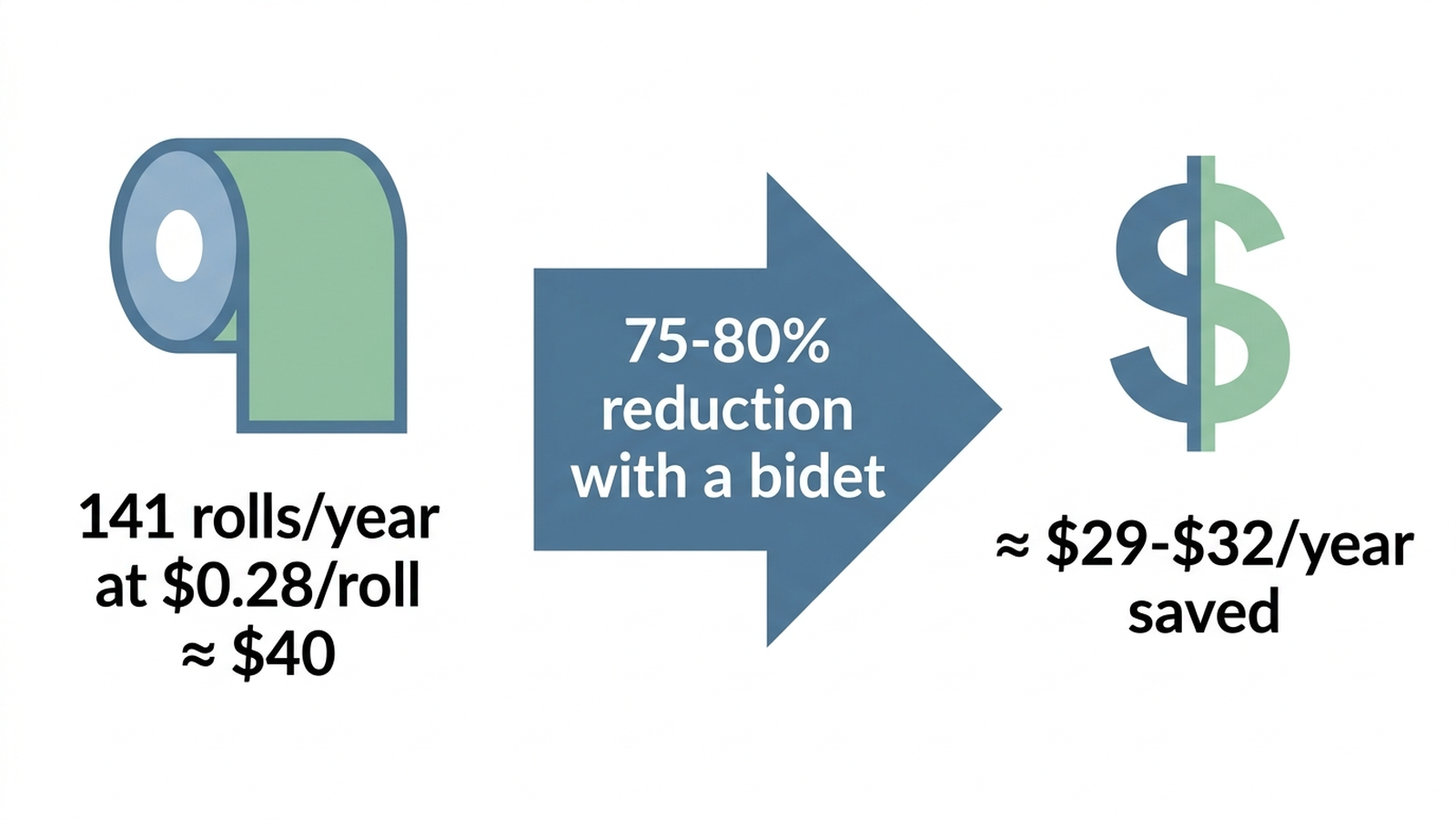
The starting assumption behind every “bidets save money” claim is how much toilet paper an average household actually uses. The commonly cited baseline is 141 rolls per person per year, and standard 2-ply toilet paper currently averages about $0.28 per roll in the U.S. (a range of $0.15–$0.50 depending on brand), putting typical annual per-person spending at roughly $40. That spending has climbed sharply in the last five years — Costco’s own Kirkland Signature bath tissue rose from $16.49 to $24.99 for the same 30-pack between 2021 and 2026, a roughly 51% increase, driven in part by tariffs on imported wood pulp.
Industry and manufacturer sources estimate that installing a bidet cuts toilet paper consumption by 75% to 80% or more, since most users still use a small amount of paper to pat dry rather than wipe. Applying that reduction to the 141-roll baseline:
- Before a bidet: ~141 rolls/year, ~$39–$40 in paper spending.
- After a bidet (75–80% reduction): ~28–36 rolls/year, ~$8–$10 in paper spending.
- Net paper savings: roughly $29–$32 per person per year at current prices.
That’s a real number, but it’s modest — not the dramatic “bidets pay for themselves in a month” claim sometimes made in marketing copy. Whether it actually pays off the hardware depends entirely on what kind of bidet you buy.
The Part Marketing Copy Leaves Out: Electricity
Non-electric bidet attachments run on cold or sink-sourced warm water and draw no power, so the water-side cost is close to negligible: at an estimated 1/8 gallon per use and typical U.S. municipal water rates, the added water cost works out to roughly $1–$3 per person per year — small enough to ignore next to the paper savings.
Electric, heated bidet seats are a different story. Cost-of-ownership research on electric bidet seats puts average annual electricity use around 211.7 kWh, or about $17 a year, for efficient tankless-heater models. But that figure varies enormously by heater design: older or budget tank-style heaters that keep a reservoir of water hot continuously can use up to roughly 2,100 kWh a year — in the $300+ range at typical U.S. electricity rates. Most mid-range and premium electric seats fall somewhere in a $17–$30 a year band, but the tank-style outliers are common enough in the budget segment that they’re worth checking before buying.
Put the two together, and the electric-seat version of the savings math looks very different:
- Efficient tankless electric seat: ~$30/year paper savings − ~$17–$20/year electricity ≈ $10–$13/year net savings.
- Tank-style electric seat: ~$30/year paper savings − up to ~$300+/year electricity ≈ net cost, not net savings.
Comparison Table
| Product | Type | Price (as of 2026-10-22) | Water/Power Source | Est. Added Annual Operating Cost | Amazon Rating |
|---|---|---|---|---|---|
| LUXE Bidet NEO 320 Plus | Non-electric attachment | ~$66 | Dual-temp, sink hot-water line | ~$1–$3 (water only) | 4.5★ (24,000+ reviews) |
| Brondell SimpleSpa Thinline SS-250 | Non-electric attachment | ~$40–$50 | Dual-temp, sink hot-water line | ~$1–$3 (water only) | 4.3★ (4,873 reviews) |
| TUSHY Classic 3.0 | Non-electric attachment | ~$90 | Cold water (tank line) | ~$1–$2 (water only) | ~4.5★ (29,900+ ratings, cross-retailer) |
| Brondell Swash 1400 | Electric heated seat | ~$480–$610 | 120V outlet + internal water heater | ~$17–$30 (tankless-class) | N/A (model-specific data limited) |
Prices and electricity-cost estimates fluctuate; treat this table as a snapshot rather than a live feed.
Customer Sentiment Synthesis
Aggregated ratings for the non-electric attachments are consistently strong: the LUXE Bidet NEO 320 Plus holds a 4.5-star average across more than 24,000 Amazon reviews, and reviewers across retailers for the TUSHY Classic line cluster in the same 4.5-star range across tens of thousands of combined ratings. Brondell’s SimpleSpa Thinline SS-250 sits slightly lower at 4.3 stars across 4,873 Amazon reviews, with review titles and comments frequently referencing reduced toilet paper use as a side benefit rather than the primary purchase driver — comfort, hygiene, and installation ease show up more often as the stated reason for buying than cost savings. That pattern matters for this article’s question: most buyers aren’t choosing a bidet to save money, which may be why the electricity trade-off on heated seats gets so little attention in marketing material and casual reviews.
Brand-by-Brand Notes
TUSHY’s Classic 3.0 is a cold-water-only attachment (no sink hookup required for warmth), which keeps installation simpler but means no warm-water option — a factor separate from the cost question but relevant to comfort in colder climates.
LUXE Bidet’s NEO 320 Plus draws warm water from the bathroom sink’s hot line via a T-valve, avoiding any electrical draw while still offering temperature control, which is the core reason its operating-cost profile matches the Brondell attachment rather than the electric Swash.
Brondell’s SimpleSpa Thinline line is built around an ultra-slim, 0.2-inch profile designed to sit beneath the existing toilet seat; the company also sells the electric Swash series, so a buyer researching “Brondell bidet” needs to check carefully which product line — attachment or seat — they’re looking at, since the cost math is completely different between the two.
Electric seats in general (not just the Swash 1400) add features non-electric attachments can’t match — heated seats, warm-air drying, night-lights, remote controls — but every one of those features either draws power directly or depends on the same internal water heater driving the operating-cost range described above.
How to Estimate Your Own Payback Period
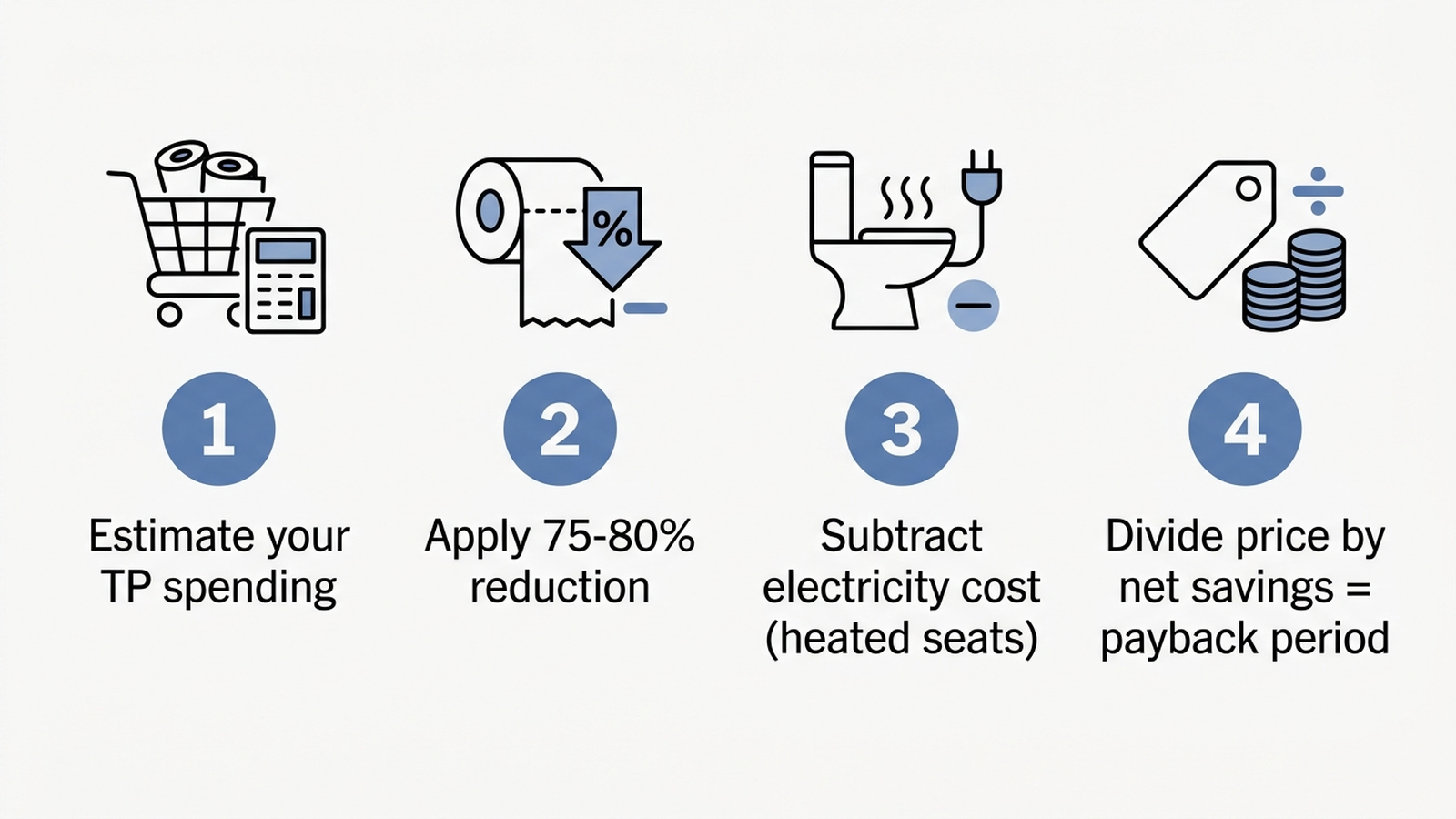
- Estimate your current toilet paper spending. Check a receipt or your Amazon order history for your actual roll count and price per roll rather than relying on the national 141-roll average, which can be well off for a single-person household or a family of five.
- Apply a 75–80% reduction to estimate your post-bidet toilet paper spending, and subtract that from your current spending to get gross annual savings.
- Subtract any added operating cost. For a non-electric attachment, subtract $1–$3 for water. For an electric seat, check the manufacturer’s published wattage and heater type (tankless vs. tank) and subtract the higher end of the range if the spec sheet doesn’t say.
- Divide the device price by your net annual savings to get a payback period in years. If the number comes back negative or the device costs more per year to run than it saves, you’re buying it for comfort and hygiene, not cost — which is a legitimate reason, just a different one than “it pays for itself.”
Decision Guide: Which Bidet Type Fits Your Goal?
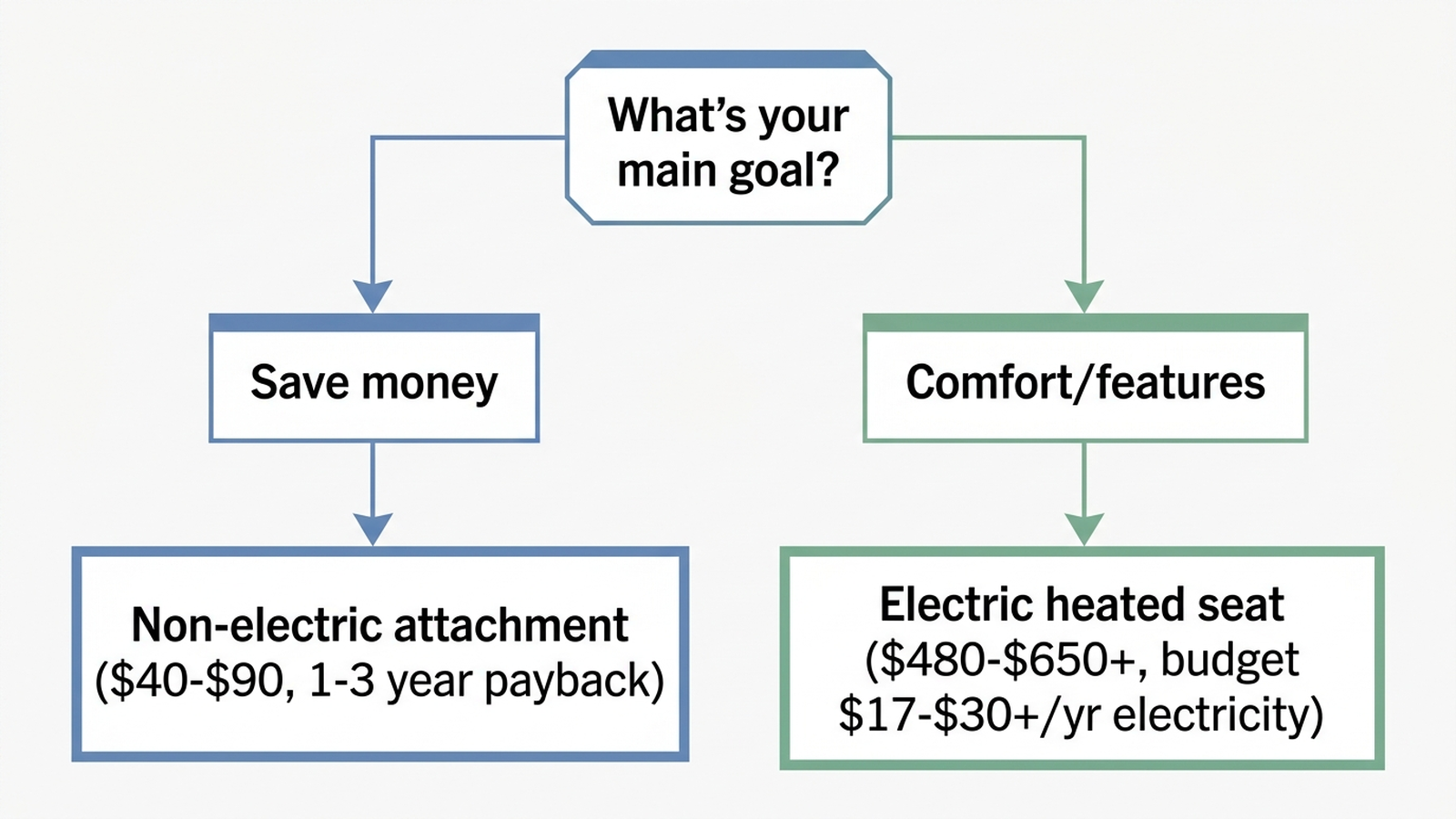
- Primary goal is reducing toilet paper spending: A non-electric attachment in the $40–$90 range is the only category where the math reliably pays back, typically within one to three years at current toilet paper prices.
- Primary goal is comfort or accessibility (heated seat, warm-air dry, limited mobility): An electric seat like the Swash 1400 makes sense on its own terms, but budget for $17–$30+ a year in added electricity rather than expecting it to offset its own purchase price through paper savings.
- Renting or need a quick, reversible install: Non-electric attachments install in under an hour without permanent modification and are the easier category to take with you or remove before moving out.
- Buying a used or budget electric seat: Confirm whether the model uses a tankless or tank-style heater before assuming the ~$17/year efficient-model figure applies — older or cheaper tank-style units can run several times higher.
Warranty Coverage
According to each manufacturer’s published support pages, non-electric attachments typically carry shorter coverage than electric seats: TUSHY and LUXE Bidet both publish standard 1-year limited warranties on their non-electric attachment lines, while Brondell’s SimpleSpa attachments also carry a 1-year limited warranty. Brondell’s electric Swash 1400, by contrast, carries a longer 3-year limited manufacturer’s warranty, reflecting the more complex electronics and heating components inside — and a cost worth weighing against the device’s higher purchase price and ongoing electricity draw.
Editorial Recommendation
For buyers whose main interest is cutting toilet paper costs, the data favors a non-electric attachment: the LUXE Bidet NEO 320 Plus and Brondell SimpleSpa Thinline SS-250 both post strong aggregated ratings at the lower end of the price range (~$40–$66), putting their payback period at roughly one to two years. The TUSHY Classic 3.0, at around $90, takes longer to pay back but remains within the same basic math since it also avoids any electricity draw. Buyers who want an electric seat like the Brondell Swash 1400 should go in expecting comfort and hygiene features, not a toilet-paper-cost payback — the added electricity cost, especially on tank-style heaters, can offset most or all of the paper savings this article set out to measure.
As an Amazon Associate, Arekore earns from qualifying purchases. The Amazon product links in this article include our affiliate tracking ID and may earn us a commission if you buy through them, at no additional cost to you. See our Links Policy for details on how we select products and how commissions do not influence our recommendations.
- LUXE Bidet NEO 320 Plus Bidet Attachment
- Brondell SimpleSpa Thinline SS-250 Bidet Attachment
- TUSHY Classic 3.0 Bidet Toilet Seat Attachment
- Brondell Swash 1400 Luxury Bidet Toilet Seat
Limitations
The 75–80% toilet paper reduction figure comes from industry and manufacturer sources rather than a controlled, peer-reviewed usage study, and actual reduction varies by individual habits — some users continue using more paper to pat dry than others. The 141-roll-per-year baseline is a national average that can differ significantly by household size and existing paper brand. Electricity-cost estimates for heated seats are drawn from third-party cost-of-ownership research rather than direct testing of the specific Swash 1400 model, and actual draw depends on local electricity rates, seat-heater usage settings, and ambient bathroom temperature. We were unable to locate a manufacturer-published wattage figure specific to the Swash 1400’s heater type, so our electric-seat cost range reflects the broader electric-bidet-seat category rather than this model in isolation.
Visit Arekore to verify current pricing, ASINs, and availability before buying any product mentioned here.