Do Air Purifiers Actually Remove Wildfire Smoke? We Checked

The U.S. air purifier market is on track to hit roughly $2.6 billion in 2026, according to market researcher Grand View Research, and wildfire-smoke exposure is one of the categories’ most-cited growth drivers. “Removes wildfire smoke” is printed on nearly every HEPA air purifier box sold on amazon.com. We checked what EPA testing, a 2026 field study from an actual Los Angeles wildfire, and independent buying-guide labs actually found — and what a HEPA filter cannot do no matter how good it is.
As an Amazon Associate, Arekore earns from qualifying purchases. The Amazon product links in this article include our affiliate tracking ID and may earn us a commission if you buy through them, at no additional cost to you. See our Links Policy for details on how we select products and how commissions do not influence our recommendations.
TL;DR / Quick Verdict
- Yes, for particles — with real numbers behind it. Independent lab testing found a top-performing HEPA purifier cut a heavy smoke load by 99.9% within the first hour on high, and the EPA cites HEPA filtration reducing indoor smoke particle concentration by as much as 85% under normal use.
- No, not for smoke smell or gases, on its own. A plain HEPA filter captures particulate matter (PM2.5) but does not meaningfully reduce the gaseous combustion byproducts that cause the smoky odor — that requires an activated carbon stage.
- Real-world performance is lower than lab numbers. A 2025 field study during the Eaton Fire in Los Angeles found HEPA-equipped homes had indoor PM2.5 levels only about 15% lower than non-HEPA homes — far below the 85–99% lab figures — because of door openings, imperfect sealing, and units running on lower fan speeds.
- Sizing matters more than brand. EPA and AHAM guidance call for matching the purifier’s smoke-specific Clean Air Delivery Rate (CADR) to the room’s square footage during an active wildfire smoke event — double the “normal” sizing rule of two-thirds room size.
- Fair summary: a correctly sized HEPA-plus-carbon purifier, run on high, in a sealed room meaningfully reduces what you breathe during a smoke event — but it is a harm-reduction tool, not a seal against smoke, and the gap between lab claims and your living room is real.
How We Reached These Conclusions (Methodology)
This is an editorial analysis, not a hands-on test; we did not personally test the products covered here. This guide synthesizes: (a) a 2025 peer-reviewed field study published in npj Clean Air measuring fine particulate matter levels in Los Angeles homes with and without HEPA filtration during the January 2025 Eaton Fire; (b) EPA publications on indoor air filtration and DIY air cleaners for wildfire smoke, including EPA’s cited 85% smoke-particle reduction figure for HEPA filtration under normal conditions; (c) EPA and AHAM Verifide sizing guidance on matching Clean Air Delivery Rate (CADR) to room size during wildfire smoke events; (d) independent lab testing data on HEPA purifier smoke-clearance performance (a unit reducing a heavy smoke load by 99.9% within one hour on high, sustained for two additional hours on medium); (e) California Air Resources Board (CARB) certification requirements for portable indoor air cleaning devices sold in California, in effect since 2010; (f) manufacturer specifications for three widely sold amazon.com air purifiers; and (g) aggregated amazon.com customer review sentiment, sampled in October 2026. We did not run our own particle-counter test in a real wildfire smoke event — we are summarizing and citing existing published data. Where a figure comes from lab conditions rather than real-world field data, we say so explicitly, since that gap turned out to be one of the most important findings here. Prices are amazon.com figures at the time of writing and fluctuate.
What HEPA Filtration Actually Does to Smoke
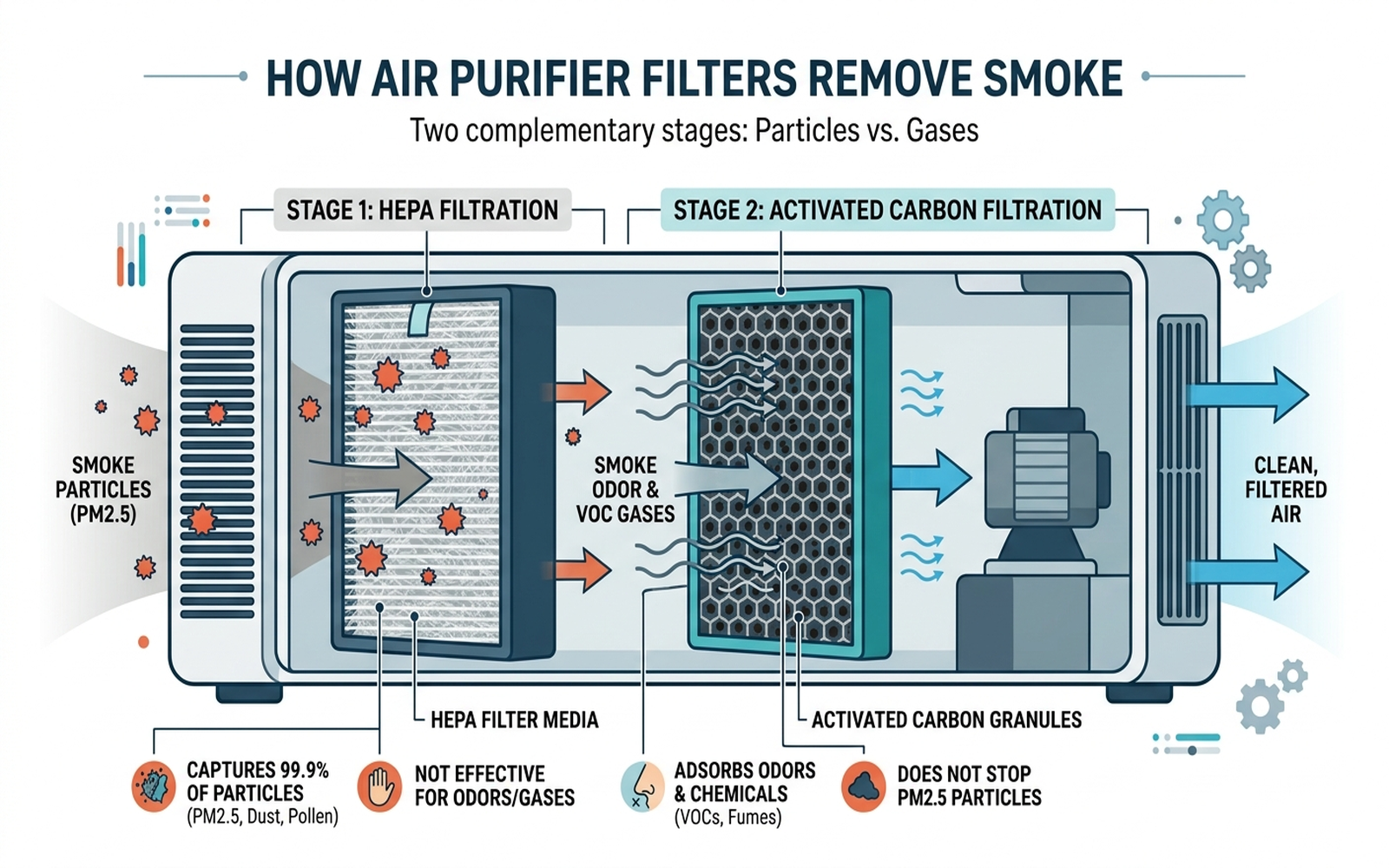
Wildfire smoke is not one thing — it’s a mix of solid and liquid particles (PM2.5, the fine particulate matter small enough to reach deep into lungs) plus gaseous combustion byproducts, including volatile organic compounds (VOCs) that carry the characteristic smoky smell. A HEPA (High-Efficiency Particulate Air) filter is a mechanical sieve: a dense mat of fibers that physically traps particles as air passes through. It is extremely good at that one job. It does essentially nothing against gas-phase pollutants, because gas molecules pass straight through the fiber mat that stops particles.
That split matters because it’s the source of most of the confusion in marketing claims:
- Particle removal is the well-documented, high-confidence claim. The EPA states HEPA filtration can reduce indoor particle concentrations from smoke by as much as 85% under typical conditions. Independent buying-guide lab testing found one top-rated unit cut a deliberately heavy indoor smoke load by 99.9% within the first hour running on its highest fan speed, and held that reduction for two further hours on medium — numbers that track with the EPA’s figure once you account for test conditions being closer to ideal than a real home.
- Odor and gas removal requires a second filter stage: activated carbon. Activated carbon works by adsorption — gas molecules stick to the enormous internal surface area of activated carbon granules — which is a completely different mechanism from HEPA’s mechanical trapping. A purifier with HEPA only will visibly clear haze from a room while the smoky smell lingers, because the smell comes from gas-phase VOCs that the HEPA stage never touches. Manufacturer and buying-guide sources are consistent on this point: a HEPA-only unit is not a smoke-odor solution.
- Neither stage removes carbon monoxide or formaldehyde at meaningful rates. These are small, non-reactive gas molecules that pass through standard carbon filters far more easily than the larger VOCs most activated carbon media is optimized for. If you’re in a location with a working carbon monoxide detector going off, that is a ventilation and evacuation problem, not an air-purifier problem — no air purifier marketed for wildfire smoke is designed or certified to handle that.
Manufacturer-published performance figures for HEPA and CADR ratings should be read as manufacturer claims verified by third-party certification bodies (like AHAM), not independently re-measured by us in this article — we’re citing the certification standard, not re-running the test.
The Gap Between Lab Numbers and Your Living Room
The single most important finding in researching this topic is that lab performance and real-world performance are not the same number. A 2025 study published in npj Clean Air measured indoor PM2.5 in Los Angeles homes during the January 2025 Eaton Fire — a real, not simulated, wildfire-urban-interface smoke event. Homes with HEPA filtration in use had indoor PM2.5 levels only about 15% lower than homes without HEPA filtration. That is far below the 85–99% figures from controlled lab tests, and the researchers were explicit that HEPA intervention alone was insufficient to fully shield residents from the smoke event.
The gap isn’t a sign HEPA filtration doesn’t work — the mechanical capture rate per pass of air through the filter is the same physics in a lab or a living room. The gap comes from everything a lab test controls for and a real home doesn’t: doors opening for people and pets, imperfect window and door seals letting smoke-laden air infiltrate continuously, units running on quieter (and much less effective) low or medium settings instead of high, undersized units relative to the room, and homes with more square footage of leaky envelope than the sealed test chamber a lab rates CADR in. The EPA’s own wildfire smoke guidance implicitly acknowledges this by recommending a “clean room” strategy — pick one small, low-infiltration room (ideally a bedroom with an attached bathroom, few windows, no fireplace) and concentrate filtration there — rather than expecting a single purifier to clean an entire leaky house to lab-test standards.
Sizing: The Step Most People Skip
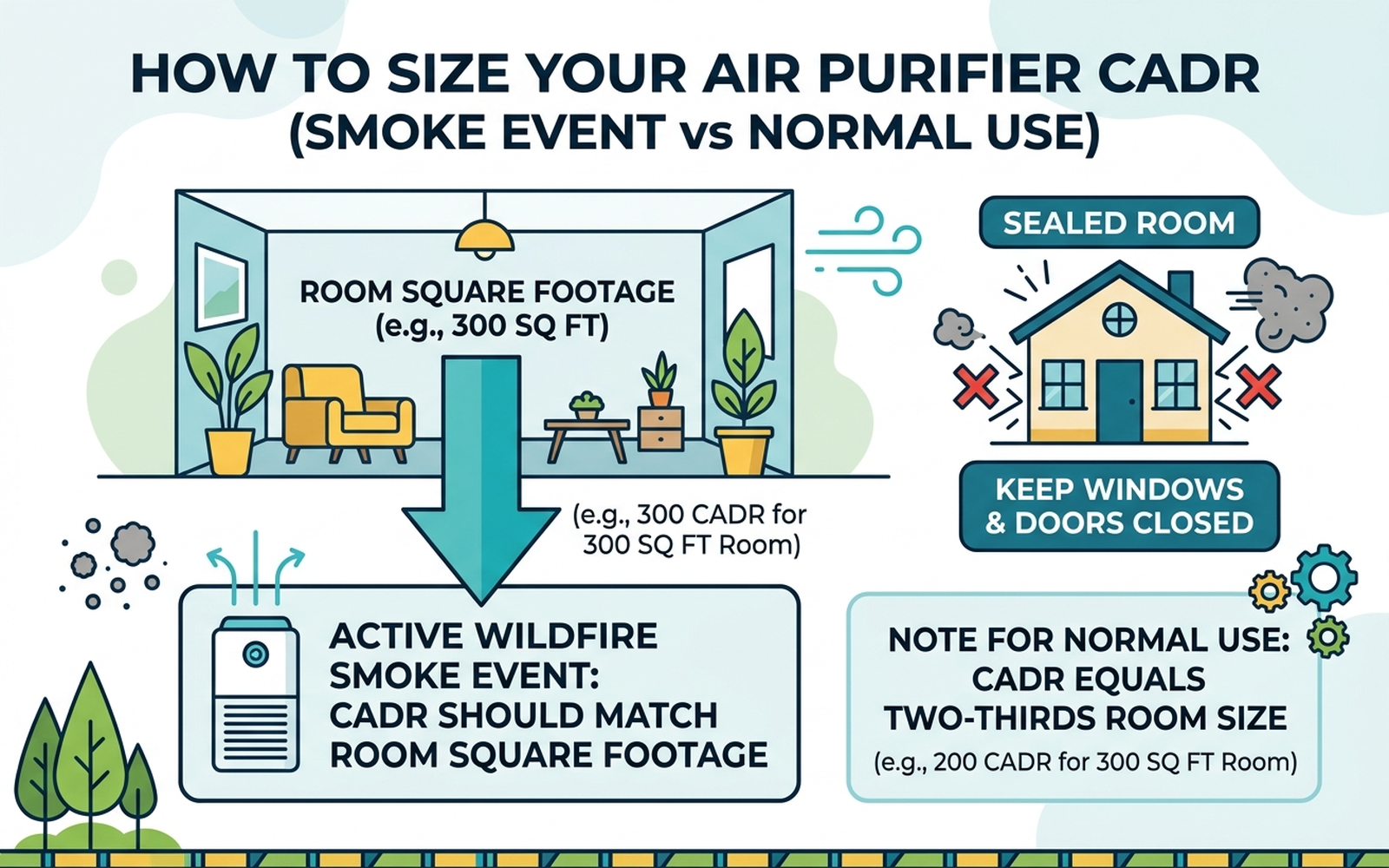
AHAM Verifide and EPA guidance both tie performance claims to a specific sizing rule, and it’s stricter during an active wildfire smoke event than it is day to day:
- Normal, non-smoke-event use: choose a purifier with a smoke CADR at least two-thirds of the room’s square footage. A 120 sq ft room (10 ft x 12 ft) needs a smoke CADR of at least 80.
- Active wildfire smoke event: EPA guidance tightens that to a 1:1 ratio — smoke CADR should match the room’s square footage, not just two-thirds of it — because outdoor particle concentrations during a smoke event run far higher than the everyday indoor sources (cooking, dust) CADR ratings are calibrated against.
- CADR figures assume an 8-foot ceiling. Higher ceilings need a proportionally higher CADR than the room’s floor area alone would suggest.
- Run the unit on its highest fan setting during a smoke event. CADR is tested and rated at the highest setting — the same unit on low or medium delivers meaningfully less than its rated number, which is part of why the LA field study found real-world results below lab figures.
An undersized, correctly-brand-name purifier will underperform an correctly-sized budget one. Checking CADR against square footage before buying matters more than which of the well-reviewed brands you pick.
Three Products, Three Approaches
Levoit Core 600S-P (ASIN B0HLSKB6VW) pairs a true HEPA filter with a higher-volume activated carbon layer than comparable mid-range competitors, which several buying guides point to as its advantage specifically for smoke odor, not just particles — relevant given the odor gap described above. Buying-guide coverage lists it at roughly a 410 CFM smoke CADR, rating it for large rooms, at a street price generally under $300.
Check the Levoit Core 600S-P on Amazon
Coway Airmega AP-1512HH Mighty (ASIN B01728NLRG) is the unit behind the 99.9%-in-one-hour smoke-clearance lab result cited above, and it has one of the longest independent testing track records in the category, having been a repeated pick across multiple buying-guide cycles. It’s rated for mid-size rooms (roughly 360 sq ft), which under the 1:1 wildfire-event sizing rule means it’s best matched to a bedroom or den rather than an open-plan living area.
Check the Coway Airmega AP-1512HH on Amazon
BLUEAIR Blue Pure 211+ (ASIN B073WJL99W) uses Blueair’s HEPASilent technology — a combination of mechanical and electrostatic filtration — and is rated by the manufacturer for rooms up to roughly 2,587 sq ft, making it the pick here best suited to large or open-plan spaces where a single smaller unit would be undersized under the stricter wildfire-event CADR rule.
Check the BLUEAIR Blue Pure 211+ on Amazon
Comparison Table
Prices are approximate amazon.com figures at the time of writing (October 2026) and fluctuate.
| Product | Filter stages | Approx. smoke CADR | Manufacturer room rating | Approx. price |
|---|---|---|---|---|
| Levoit Core 600S-P | True HEPA + high-volume activated carbon | ~410 CFM | Large room | $220–$280 |
| Coway Airmega AP-1512HH | True HEPA + activated carbon pre-filter | Tested at 99.9% smoke clearance in 1 hr (lab) | ~360 sq ft | $200–$250 |
| BLUEAIR Blue Pure 211+ | HEPASilent (mechanical + electrostatic) + carbon | High (manufacturer-rated for large spaces) | Up to ~2,587 sq ft | $280–$330 |
| Evidence source | Setting | Finding |
|---|---|---|
| EPA | Normal indoor HEPA filtration | Up to 85% reduction in smoke particle concentration |
| Independent lab test | Heavy smoke load, unit on high | 99.9% reduction within 1 hour, held for 2 more hours on medium |
| npj Clean Air, 2025 field study (Eaton Fire) | Real homes, real wildfire event | ~15% lower indoor PM2.5 in HEPA-equipped homes vs. non-HEPA homes |
Decision Flowchart
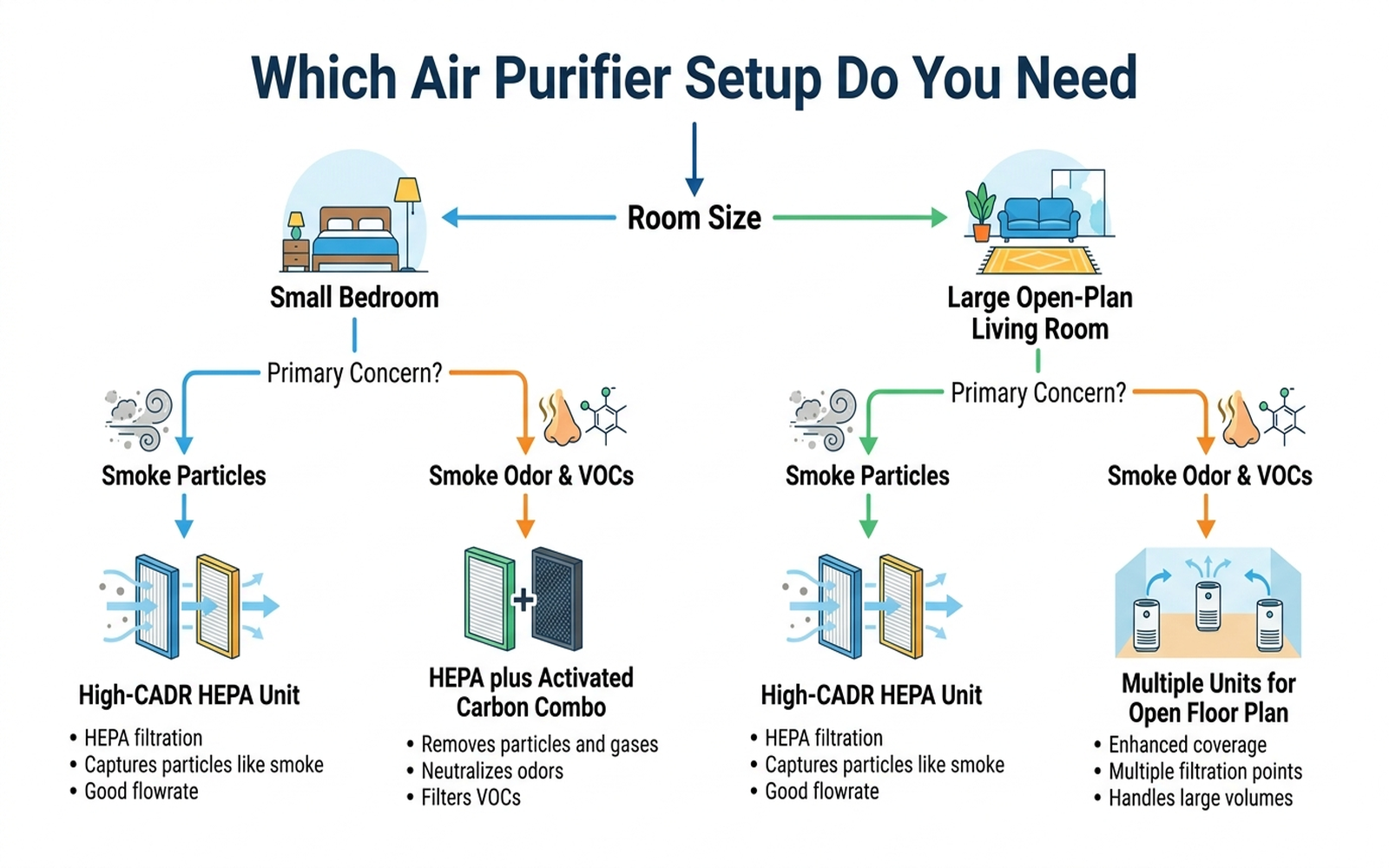
Start with the room you’re actually trying to protect, not your whole house — the field-study gap above is largely a sealing and room-size problem, and the EPA’s own guidance is to concentrate on one low-infiltration room rather than the entire floor plan. If that room is a single bedroom under roughly 350 sq ft, a unit like the Coway Airmega AP-1512HH sized under the 1:1 wildfire-event CADR rule is reasonable. If your primary complaint is lingering smoke smell rather than visible haze, prioritize activated carbon volume — the Levoit Core 600S-P’s higher-carbon-volume design is built for that case specifically. If you’re trying to cover a large open-plan living area, a single unit is more likely to be undersized relative to the stricter wildfire-event CADR target; either choose a high-CADR large-room unit like the Blue Pure 211+ or plan on multiple smaller units. In every case, close windows and doors, run the unit on high during the active smoke event, and don’t expect lab-test percentages to fully translate to a real, imperfectly sealed home.
Limitations
This analysis relies on EPA and AHAM published guidance, one peer-reviewed field study, independent lab testing data, and manufacturer specifications rather than our own particle-counter measurements. The npj Clean Air field study covered one wildfire event (the January 2025 Eaton Fire) in one metro area; its 15% real-world reduction figure may not generalize to every home’s sealing quality, fan-speed habits, or smoke intensity, and a single field study is a smaller evidence base than a meta-analysis would be. The 99.9% lab smoke-clearance figure comes from a controlled test environment, not a leaky real-world home, and should not be read as the reduction you’ll see in your own living room. CADR and HEPA efficiency figures are manufacturer-published, certified by AHAM’s testing standard, but not independently re-measured by us. None of the sources cited here address carbon monoxide or formaldehyde removal, which standard HEPA-plus-carbon consumer purifiers are not designed to handle. Prices fluctuate on amazon.com and should be verified on the current product page before buying.
Bottom Line
HEPA air purifiers genuinely reduce wildfire smoke particle levels — the physics and the lab data both back that up, with figures from 85% to 99.9% depending on conditions. What the marketing usually leaves out is the gap between those lab numbers and a real home: a 2025 field study during an actual Los Angeles wildfire found only about a 15% real-world reduction, mostly because real houses leak air and real purifiers often run on quieter settings than “high.” Close the gap by sizing correctly (CADR matching room square footage during an active smoke event, not just two-thirds), picking activated carbon capacity if odor is your main complaint, running the unit on high, and concentrating on one sealed room rather than expecting whole-house protection. A well-sized HEPA-plus-carbon purifier is a meaningful harm-reduction tool during a smoke event — it is not a guarantee of smoke-free air.
Before you buy, paste the product link into Arekore — our AI assistant checks review authenticity, surfaces what the one-star reviews actually complain about, and compares prices, free, in about five minutes.