Cordless Vacuum Losing Suction? 5 Real Causes (2026)
TL;DR. A cordless vacuum that loses suction almost never has a broken motor — the motor keeps spinning at full speed while something downstream chokes the airflow it’s trying to move. The five most commonly documented causes are a clogged filter, a full dustbin, a blocked hose or brush roll, an air leak from a loose seal or cover, and a degraded battery that can no longer power the motor at full draw. Clearing the airway and cleaning the filter resolves the large majority of documented cases; a genuinely worn-out battery is the one cause cleaning won’t fix.
A note on links and methodology
As an Amazon Associate, Arekore earns from qualifying purchases. The Amazon product links in this article include our affiliate tracking ID and may earn us a commission if you buy through them, at no additional cost to you. See our Links Policy for details on how we select products and how commissions do not influence our recommendations.
We also did not personally test the specific machines named below. Every cause and fix in this article is an editorial synthesis of manufacturer support documentation, independent lab test findings, and aggregated public troubleshooting reports, cited inline.
Methodology
This is an editorial analysis based on publicly available data collected in October 2026. We did not run a controlled airflow test ourselves; instead we synthesized:
- Manufacturer troubleshooting documentation — Dyson’s official vacuum battery-care and filter-care support guidance, Shark’s “Low Suction in Your Shark Vacuum: A Practical Guide” support articles (published for Shark’s UK-market Anti Hair Wrap and Stratos DuoClean lines; we cite these because the underlying filter, dustbin, and seal mechanics match Shark’s equivalent US-market DuoClean and Stratos cordless models sold on amazon.com, even where model numbers differ by region), and Tineco’s official troubleshooting page for cordless vacuums with no or low suction.
- Independent lab test and explainer sourcing — RTINGS.com’s cordless vacuum test bench (Methodology v1.4, updated March 2026), which benchmarks suction and pickup performance across current models including the Dyson V15 Detect, and repair-focused explainers from iFixit and vacuum-repair guide sites (VacuumMentor, TheHowToLab) that catalog documented failure points — filters, dustbin seals, hose blockages, and battery cells.
- Aggregated owner troubleshooting reports — JustAnswer small-appliance threads specific to cordless stick vacuums losing suction, and consumer-guide aggregation sites (bestcordlessvacuumguide.com, hometechtool.com) that compile the most frequently reported fixes across brands.
- Battery-chemistry research — published lithium-ion degradation findings on calendar aging (capacity loss from prolonged storage at 100% charge) and cycle-based wear, summarized by chargie.org and cross-referenced against Dyson’s own battery-care guidance.
- Market and category data — per Coherent Market Insights’ 2026 stick vacuum cleaner market report, cordless models are projected to capture roughly 68.5% of the stick vacuum category by 2026, underscoring how common this troubleshooting question is likely to be.
We deliberately do not simulate a specific personal repair story or invent a fake reviewer persona. The guidance below is a synthesis of manufacturer documentation, independent lab testing, and aggregated troubleshooting patterns — treat it as a starting framework, not a substitute for your specific model’s manual.
1. Five reasons a cordless vacuum loses suction
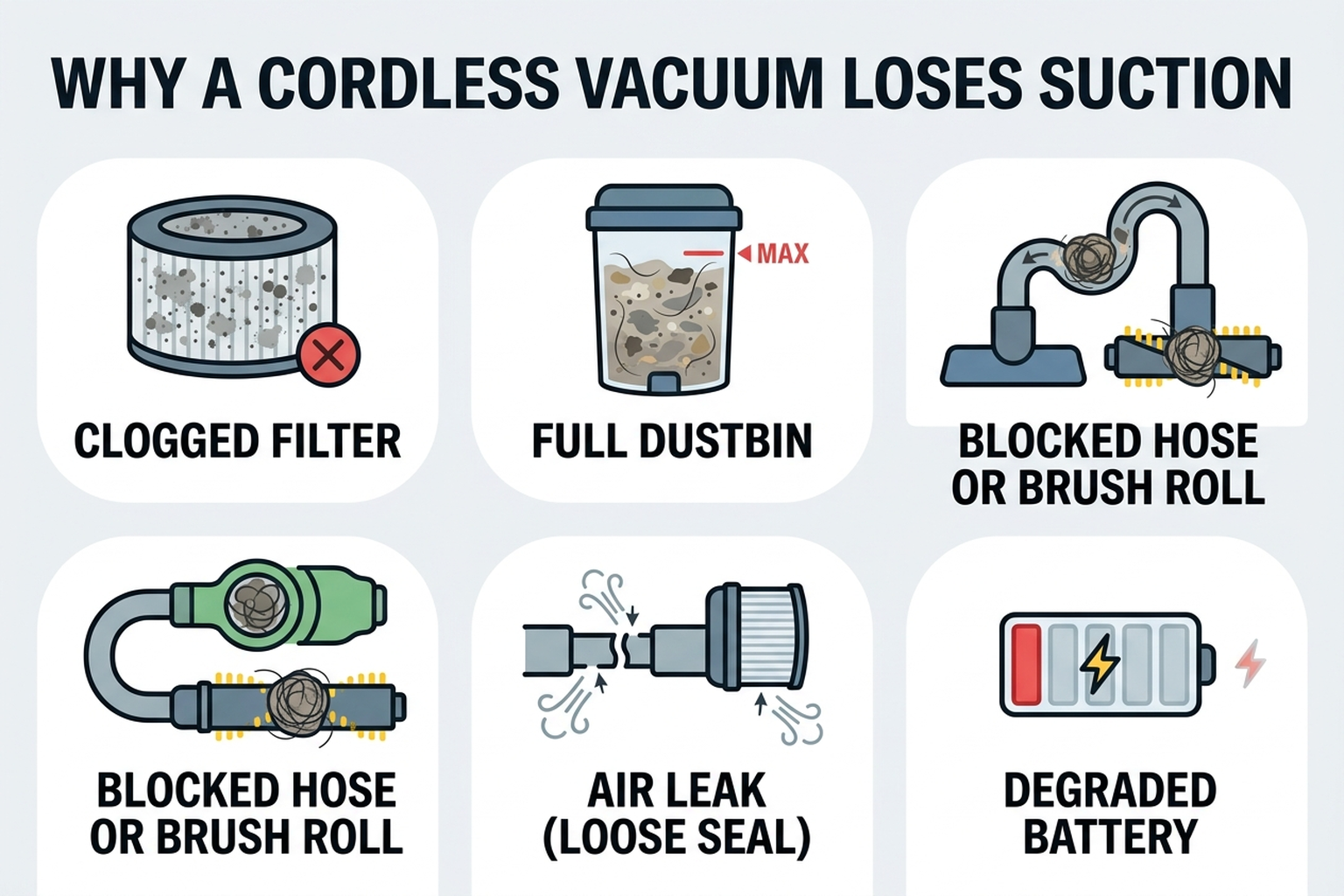
If suction drops gradually or all at once but the motor still sounds like it’s running at normal speed, the cause is almost always something restricting airflow rather than a failing motor:
| Cause | What it looks like | Fixable at home? |
|---|---|---|
| Clogged filter | Suction weak across every attachment and surface; motor sounds normal or slightly strained | Yes — usually |
| Full or jammed dustbin | Gradual suction drop that improves right after emptying | Yes — immediately |
| Blocked hose, wand, or brush roll | Suction drops suddenly, often after picking up a larger object; brush roll may stop spinning | Yes — usually |
| Air leak from a loose seal or cover | Suction weak from the moment the vacuum turns on, even with a clean filter and empty bin | Yes, with reassembly |
| Degraded battery | Suction and runtime both decline together over months; power mode feels capped even at “max” | No — usually requires battery replacement |
A clogged filter alone can cut airflow by more than 14%, according to vacuum-repair guide aggregation at vacuumwars.com, while the motor keeps running at the same RPM — which is why a filter problem is so often mistaken for a dying motor. An overfilled dustbin produces a similar but distinct symptom: Shark’s own support documentation notes that a full dust cup restricts airflow enough to make suction “low or none at all,” and the fix is as simple as emptying it.
2. Why the motor sounds fine but suction still drops
Suction is a function of airflow, not raw motor speed. A cordless vacuum’s motor can spin at full RPM while delivering a fraction of its rated suction if anything downstream — the filter, the dustbin inlet, the hose, or the brush chamber — restricts how much air can actually move through the system. That’s why owners frequently describe the motor as “sounding completely normal” even as pickup performance collapses; the motor isn’t underperforming, it’s just moving far less air than it’s designed to.
Air leaks produce the opposite-looking but equally damaging effect: instead of restricting airflow, a cracked hose, a poorly seated dustbin, or a loose filter cover lets outside air into the system before it reaches the nozzle, diluting the vacuum the motor is generating at the point where it actually needs to lift dirt off the floor. Tineco’s official troubleshooting guidance specifically calls out checking “the seal rings of motor air inlet/dustbin cover/mesh filter” as a first-line step for exactly this reason.
Battery degradation is the one cause on this list that isn’t a blockage or a leak — it’s the motor genuinely not getting enough power to spin at its rated speed. Lithium-ion vacuum battery packs typically last 300–500 charge cycles, and research on calendar aging shows that storing a pack at 100% charge for extended periods accelerates capacity loss by roughly 2–4x compared to storing it at a partial charge — which is why a vacuum left permanently on its charging dock can lose meaningful capacity well before its cycle count would predict.
3. Brand-specific patterns worth knowing
Dyson. Dyson’s official battery-care guidance recommends washing the pre-filter with cold water (not hot, which damages the electrostatic properties that trap fine particles) and letting it air-dry fully — Dyson specifically warns that reinstalling a damp filter is a common, avoidable cause of weak suction and odor. Models with both a washable pre-filter and a HEPA filter require cleaning both, since the pre-filter’s job is to catch larger debris before it reaches and prematurely clogs the HEPA stage.
Shark. Shark’s own support articles for the Anti Hair Wrap and Stratos DuoClean lines — published for Shark’s UK product naming, but describing the same filter, dustbin, and seal design used in Shark’s equivalent US-market DuoClean and Stratos cordless models — walk through the same core sequence — empty the dust cup, rinse the filters with water only, and let them air-dry for at least 48 hours before reinstalling. Shark support content also flags improper reassembly as a distinct cause: if the dustbin or filter cover isn’t fully clicked into place, air leaks out of the gap instead of being pulled in through the nozzle, which can look identical to a clog even though nothing is actually blocked.
Tineco. Tineco’s troubleshooting page breaks the airflow path into three checkpoints — the dustbin and its air inlet, the power brush and tube, and the main body’s motor air inlet — and recommends checking all three in sequence rather than assuming the filter is always the culprit. Tineco’s newer self-cleaning Station models address a specific recurring complaint in owner troubleshooting threads: suction that drops intermittently because debris builds up inside the tube and brush chamber between manual cleanings, not just in the visible dustbin.
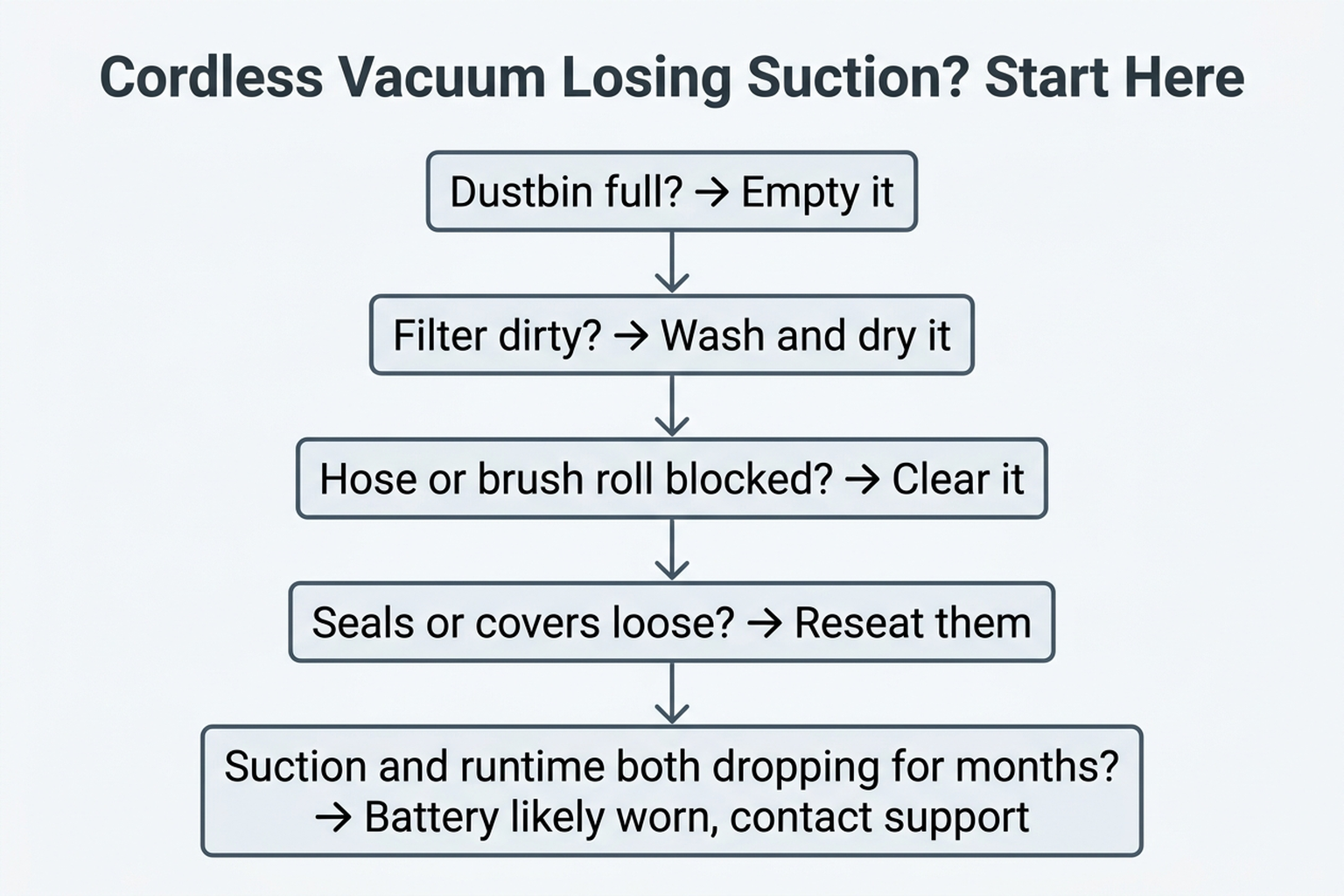
Cross-brand. Across every brand surveyed, manufacturer support content converges on the same troubleshooting order: clear the dustbin and filter first, check the hose and brush roll for blockages second, and only consider a battery or motor fault third.
4. What to actually do, in order
- Empty the dustbin, even if it looks only partly full — manufacturer guidance across Shark, Dyson, and Tineco treats this as the single fastest fix, since a full bin restricts airflow at the first stage of the system.
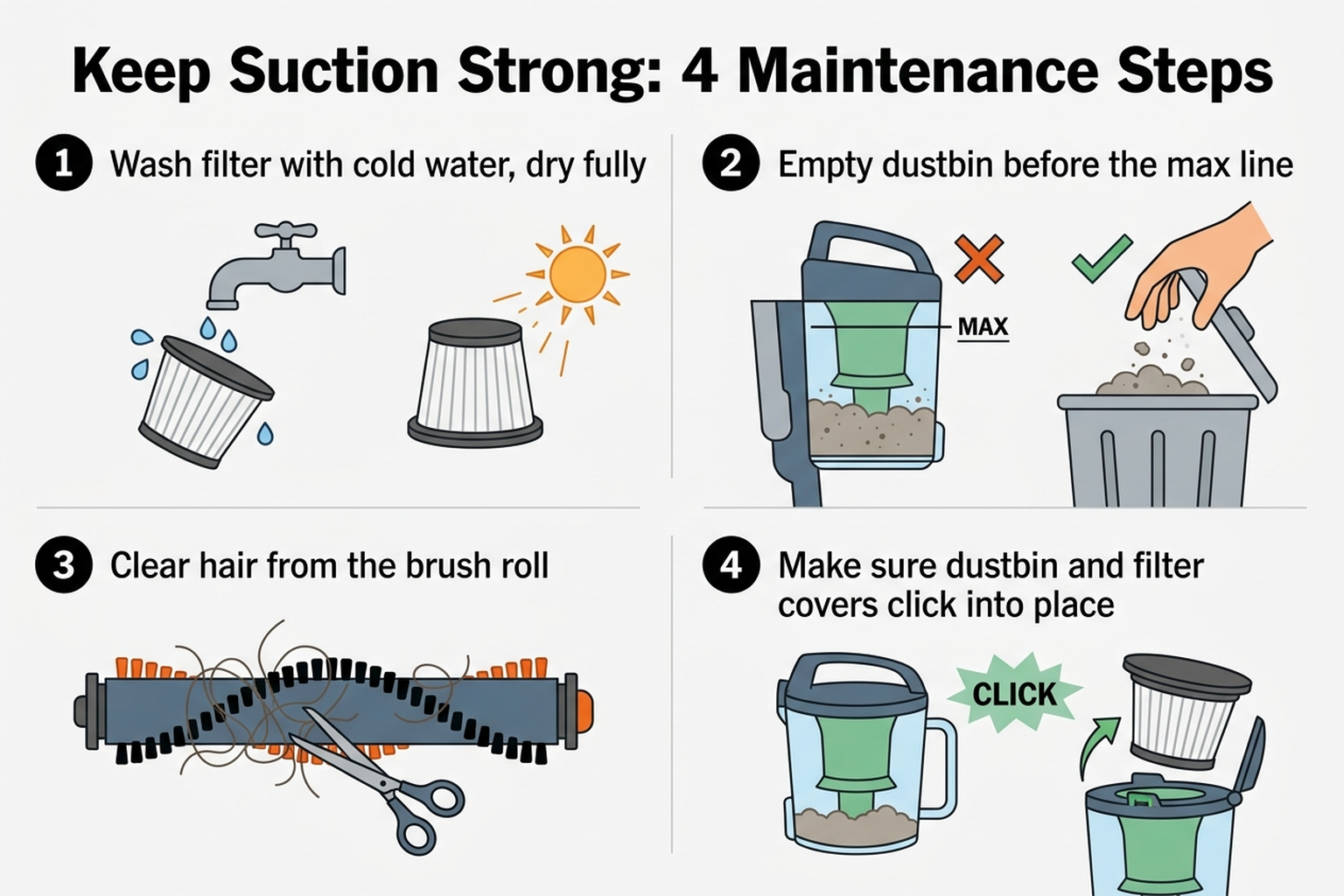
- Remove and wash the filter(s) with cold water only, then let them air-dry completely — Dyson specifically recommends at least 24 hours, Shark recommends up to 48 hours. Reinstalling a damp filter is a documented, avoidable cause of continued weak suction.
- Check the hose, wand, and brush roll for blockages. Detach the wand and look through it toward a light source; remove any hair wrapped around the brush roll, which can also stop it from spinning entirely.
- Check that the dustbin lid and filter cover are fully seated and clicked into place. An air leak at either point can produce suction loss that looks identical to a clog, according to Shark’s own support guidance.
- Charge the battery fully and test on the lowest power mode. If suction and runtime have both been declining together over months rather than appearing suddenly, battery degradation — not a blockage — is the likely cause, and cleaning won’t fix it.
- Contact manufacturer support or consider a battery replacement if suction stays weak after a clean filter, empty bin, clear airway, and a full charge — at that point a genuinely worn battery or a motor-seal issue is a realistic possibility.
5. If the fix is a maintenance accessory
Editorial recommendation, not personal testing. These address the most commonly documented causes above — a clogged filter and a brush roll tangled with hair — rather than a hardware upgrade.
- Dyson V15 Filter, 3-Pack Premium True HEPA Replacement Filters (compatible with V15 Detect, V15 Detect Absolute, V15 Submarine, V11 Animal) — a direct, lower-cost way to rule out a clogged filter as the cause without waiting on a wash-and-dry cycle.
- Pikk-it Vacuum Hairbrush Cleaner Tool — a faceplate-release design built specifically for clearing hair tangled around a brush roll, the blockage point manufacturer guidance most frequently names as a suction-loss cause.
6. If the suction loss means it’s time for better hardware
If cleaning, clearing blockages, and a full charge haven’t resolved the problem and the unit is already several years old, two current approaches are independently documented to reduce how often this problem recurs in the first place.
- Dyson V15 Detect Cordless Vacuum Cleaner — RTINGS rates this as its top-tested cordless vacuum for 2026; Dyson’s own spec sheet lists the motor at up to 230AW of suction, paired with a surface-detection system that adjusts suction power to the floor type automatically.
- Tineco Pure ONE Station 5 Pro, Automatic Dust Collection with Full-Path Self-Cleaning — this model’s self-cleaning dock is built to address the specific intermittent-suction-loss pattern described in Tineco’s own troubleshooting content, by rinsing residual debris out of the internal tubing after each use rather than relying solely on manual filter washing.
7. The decision flowchart
8. The bottom line
A cordless vacuum losing suction is almost always a specific, fixable restriction somewhere between the nozzle and the motor — a clogged filter, a full bin, a blocked hose or brush roll, or a leaking seal — rather than a failing motor. Emptying the bin, washing and fully drying the filter, and clearing the airway resolves the large majority of documented cases. If suction and runtime have been declining together for months even after a full charge, battery degradation is the realistic exception, and that’s the point where a battery replacement or a newer unit makes more sense than continuing to clean the same parts.
Limitations of this analysis
To be explicit about what this article does not establish:
- We did not personally reproduce this issue on the specific machines named here. The causes and fixes described are drawn from manufacturer support documentation, independent lab test findings, and aggregated troubleshooting-thread patterns, not from a controlled airflow test we ran ourselves.
- The filter airflow-drop and dustbin-capacity figures cited come from specific documented examples in repair-guide aggregation sources and may not generalize to every model’s exact filter media or bin design.
- RTINGS’ suction rating reflects its own lab test bench and methodology version, and may not predict performance differences between every model combination or every real-world floor surface.
- Battery degradation figures (300–500 cycles, 2–4x calendar-aging acceleration) are drawn from general lithium-ion research, not from testing the specific vacuum battery packs named in this article, and actual degradation varies with heat, usage pattern, and charging habits.
- Market share and category-value figures are current industry estimates that vary somewhat across research firms; we cite them as directional context, not a precise figure.