Compression Socks 2026: Do They Really Help on Flights?
Every travel gear list published ahead of summer and holiday flight season repeats the same advice: pack compression socks. The claim usually stops there, without saying what “help” actually means, how much risk it reduces, or who the advice is really for. We went to the clinical research directly — a Cochrane systematic review covering nearly 3,000 travelers — to see what compression socks demonstrably do on a long flight, and what they do not.
As an Amazon Associate, Arekore earns from qualifying purchases. The Amazon product links in this article may include our affiliate tracking ID and may earn us a commission if you buy through them, at no additional cost to you. See our Links Policy for details on how we select products and how commissions do not influence our recommendations.
TL;DR / Quick Verdict
- The evidence for reducing symptomless DVT is strong. A Cochrane review of 2,918 travelers across 12 randomized trials, all on flights of five hours or longer, found high-certainty evidence that graduated compression stockings cut symptomless deep vein thrombosis — 3 cases out of 2,637 wearers versus 47 cases among non-wearers.
- The evidence for reducing symptomatic clots, pulmonary embolism, or death is inconclusive, not because socks failed, but because zero participants in any reviewed trial developed those more serious outcomes — the studies were not statistically powered to answer that question.
- 15–20 mmHg graduated compression is the level recommended for general air travel; medical-grade 20-30 mmHg is typically reserved for people with a doctor-identified higher clot risk.
- Fit matters more than brand. Reviewers and clinicians agree a sock that is the wrong size for your calf and ankle measurements underperforms a correctly-sized cheaper pair.
How We Reached These Conclusions (Methodology)
This is an editorial analysis, not a hands-on test. We did not personally test the products covered here. This guide synthesizes: (a) the Cochrane systematic review “Compression stockings for preventing deep vein thrombosis (DVT) in airline passengers” (Clarke et al., 2021 update), which pooled data from 2,918 participants across 12 randomized controlled trials, all using flights of five hours or longer; (b) the American Heart Association’s 2024 patient-education article on flight-related clot risk; (c) Consumer Reports’ hands-on testing of compression sock brands including Bombas and Comrad; (d) manufacturer compression-level specifications (mmHg) for Physix Gear Sport, Sockwell, Comrad, and CEP; and (e) aggregated amazon.com customer-review sentiment on best-selling compression sock listings, sampled in August 2026. Sample sizes are reported where the retail listing discloses a specific review count; ratings without a disclosed count are labeled “aggregated” rather than assigned an invented N. Prices are amazon.com figures at the time of writing and fluctuate.
What the Clinical Data Actually Shows
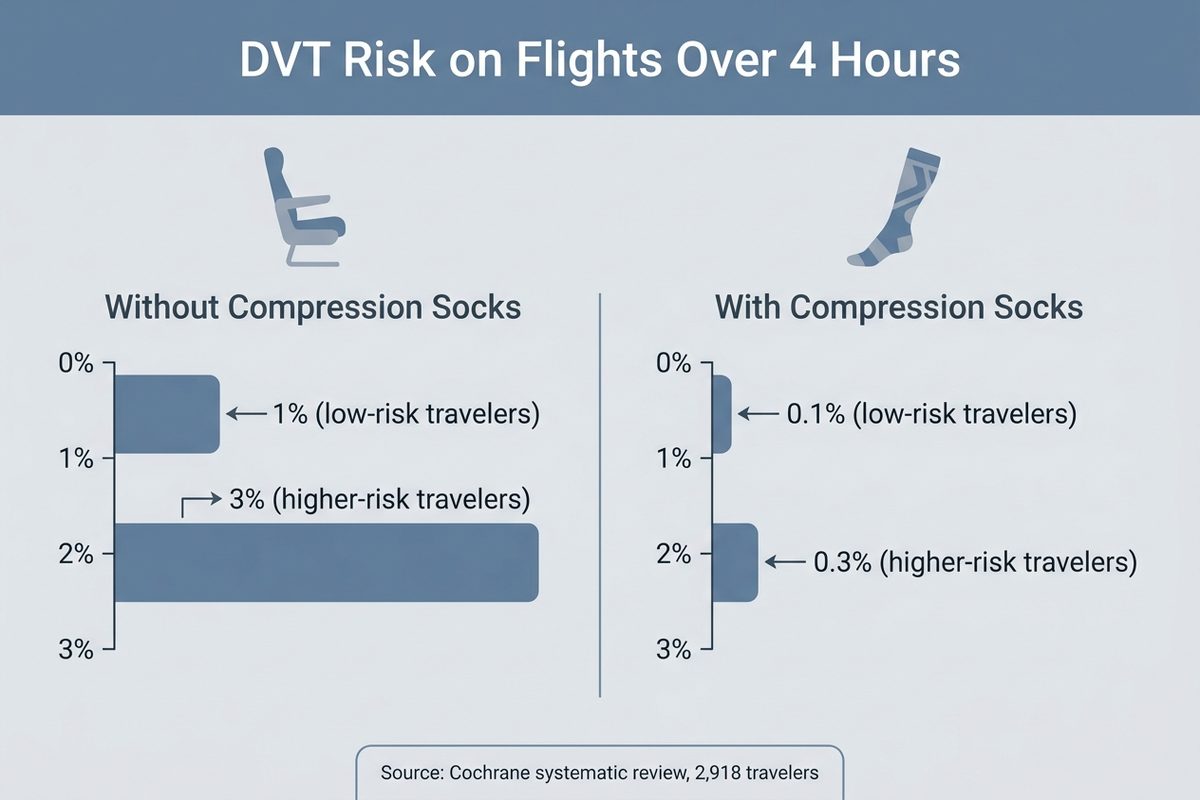
The strength of the evidence depends entirely on which outcome you’re asking about, and travel-gear marketing rarely draws this distinction.
- Symptomless DVT (clots detected by ultrasound, with no symptoms) has the strongest evidence. The Cochrane review found high-certainty evidence of a large effect: an odds ratio of 0.10, meaning wearers of compression stockings on both legs were roughly 90% less likely to develop symptomless clots than non-wearers in the same trials. Translated to absolute risk, that is a drop from about 1% to 0.1% for low-risk travelers, and from about 3% to 0.3% for travelers the review classified as higher-risk.
- Symptomatic DVT, pulmonary embolism, and death could not be evaluated, because no participant in any of the 12 pooled trials developed those outcomes, symptomatic or fatal. The American Heart Association’s 2024 patient-education article on this topic is explicit that this is a data gap, not a null result — the trials were designed and sized to detect symptomless clots, not the much rarer serious events.
- Risk stratification changes the recommendation. The American Society of Hematology advises against routine compression-sock use for low-risk travelers, citing cost and uncertain marginal benefit at that risk level. The UK’s NICE clinical guidance takes the opposite position for higher-risk travelers — people with a personal or family clotting history, recent surgery, pregnancy, obesity, or flights over four hours — recommending stockings for that group specifically.
- Tolerability was consistently good across trials. None of the pooled studies reported meaningful adverse effects from wearing the stockings, which is a separate finding from whether they demonstrably prevent serious clots.
The honest summary: compression socks have solid trial evidence for reducing a measurable but often silent circulatory outcome, and an unresolved evidence gap for the more serious outcomes people actually worry about. Both things are true at once.
Brand-by-Brand: What the Specs and Reviews Show
Budget athletic: Physix Gear Sport
Physix Gear Sport’s 20-30 mmHg compression sock is Amazon’s best-selling entry in the category, with more than 40,000 aggregated reviews and a 4.5-star average. Aggregated amazon.com reviewer sentiment consistently highlights the toe-seam comfort and the fact that the compression level runs firmer than the “everyday” 15-20 mmHg tier most air-travel guidance recommends — a detail some reviewers note only after checking the box on arrival.
Check Physix Gear Sport Compression Socks on Amazon
Everyday lifestyle: Sockwell
Sockwell builds its socks around a merino wool and rayon-from-bamboo blend rather than pure synthetic knit, positioning the product as an everyday sock a traveler would also wear at a desk, not just a medical accessory pulled out for flights. Its Elevation and Stabilizer lines are offered in both a 15-20 mmHg “moderate” and a 20-30 mmHg “firm” compression tier, letting a buyer match the general air-travel recommendation without stepping up to medical-grade compression.
Check Sockwell Elevation Firm Compression Socks on Amazon
Medical-grade travel: Comrad
Comrad markets its Nylon Knee-High line at 20-30 mmHg firm compression, positioned above the 15-20 mmHg general-travel tier and closer to the compression level used in higher-risk clinical contexts. The brand’s own site lists a single pair around $36–$39, noticeably above the budget tier, and aggregated amazon.com reviewer sentiment credits the tighter compression and knit construction for feeling more like a purpose-built product than a general-purpose athletic sock — a tradeoff some reviewers flag as too firm for all-day comfort on the ground.
Check Comrad Nylon Knee-High Compression Socks on Amazon
Premium travel-specific: CEP Flight
CEP, a German sports-compression brand, sells a Flight-specific 20-30 mmHg sock priced around $45–$55 per pair — the highest price point in this comparison. Aggregated amazon.com reviewer sentiment and travel-press coverage (Matador Network’s hands-on writeup) both single out the fabric’s lighter, more breathable knit compared to running-oriented CEP lines, aimed specifically at sitting for hours rather than athletic movement, though at a per-pair price several times the budget tier.
Check CEP Flight Compression Socks (Men’s) on Amazon
How to Pick the Right Compression Level and Size
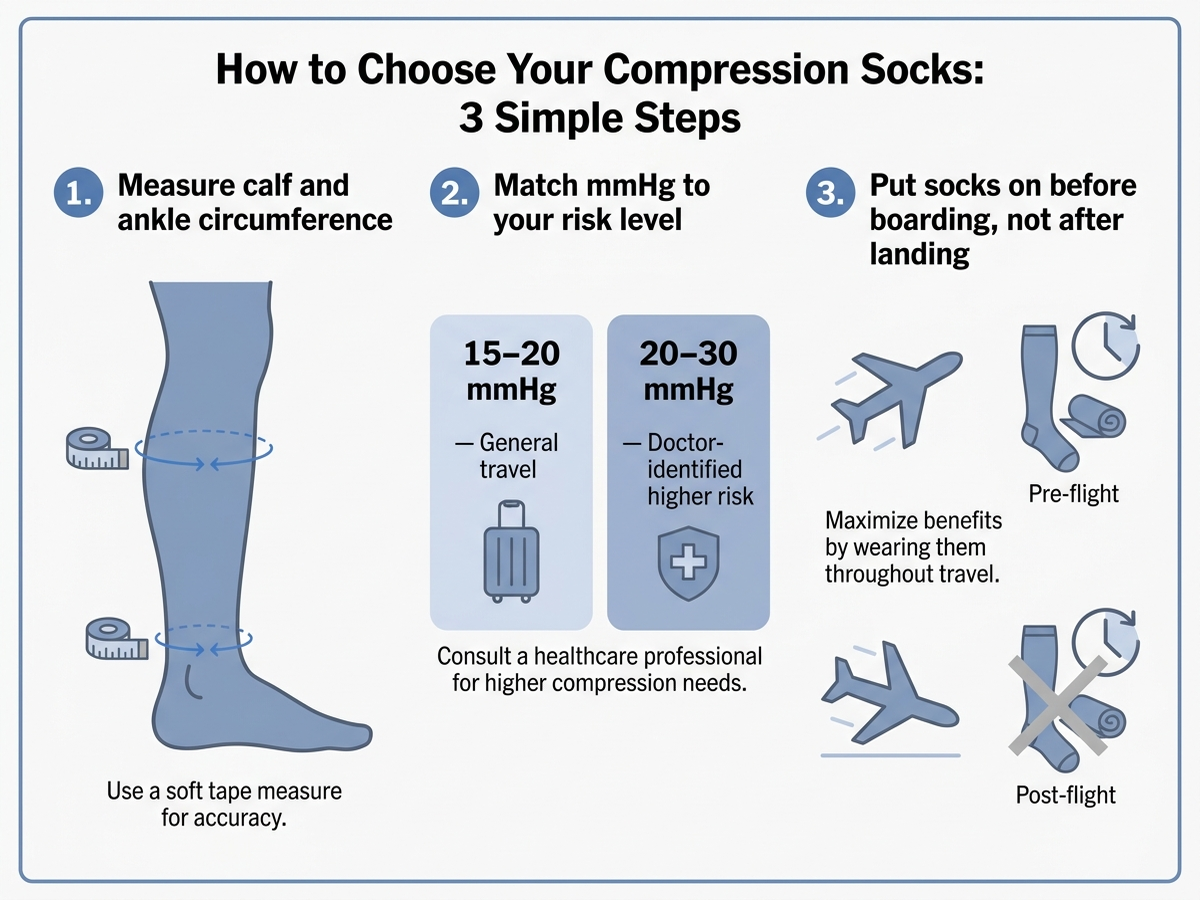
- Measure before you buy. Compression socks are sized by calf and ankle circumference, not shoe size. Every brand in this comparison publishes a size chart; a too-loose sock delivers little of the graduated pressure the trials tested, and a too-tight sock can be uncomfortable enough that a traveler stops wearing it mid-flight.
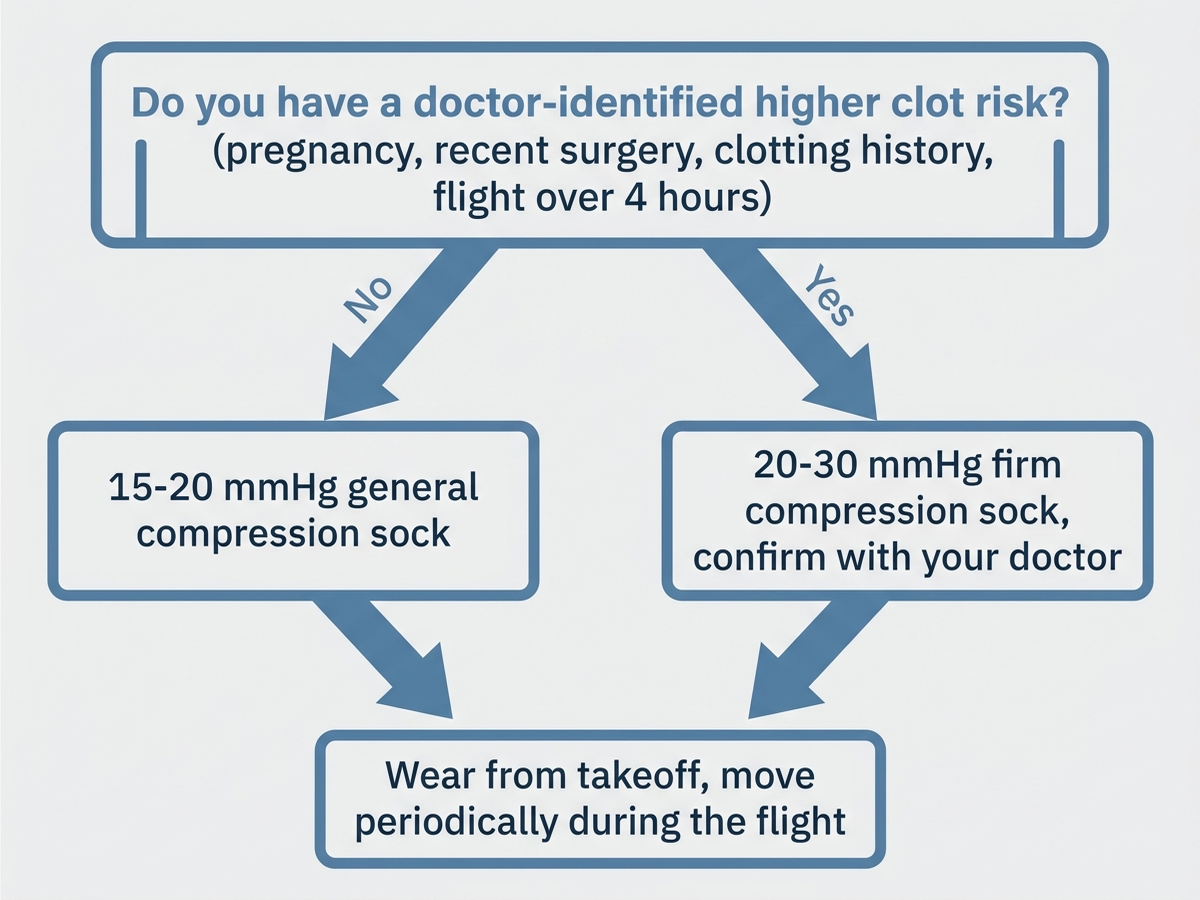
- Match the mmHg to your actual risk, not the strongest number on the shelf. 15-20 mmHg matches the general air-travel guidance most public-health sources cite. Step up to 20-30 mmHg only if a doctor has flagged a higher personal clot risk — pregnancy, recent surgery, a clotting history, or a flight well over four hours combined with other risk factors.
- Put them on before boarding, not after landing. The trials measured continuous wear during the flight; compression socks put on after symptoms of swelling have already started are working from a different baseline than the studies describe.
- Combine with movement, not instead of it. None of the underlying trials treated compression socks as a substitute for periodic walking and ankle exercises during a long flight — both were standard advice alongside the socks in the source studies.
Editorial Recommendation by Use Case
- Best for occasional flyers on a budget: Physix Gear Sport. The lowest per-pair cost in this comparison and the largest review base on amazon.com, though buyers should confirm they’re choosing the 15-20 mmHg version if they want the general-travel level rather than the firmer 20-30 mmHg default listing.
- Best for travelers who also want an everyday sock: Sockwell. The merino-blend construction and dual compression-tier options make it the pick for someone who doesn’t want a sock that only comes out for flights.
- Best for travelers with a doctor-flagged higher risk: Comrad’s 20-30 mmHg Nylon Knee-High, at a price and compression level closer to the medical-grade tier the higher-risk trial arms used, though a doctor’s specific guidance should override any general recommendation here.
- Best for long-haul frequent flyers who want a dedicated travel product: CEP Flight, at a premium price point but built specifically around hours of sitting rather than adapted from an athletic or medical line.
Comparison Table
Prices are approximate amazon.com figures at the time of writing (August 2026) and fluctuate.
| Product | Compression level | Material | Rating (amazon.com) | Typical cost |
|---|---|---|---|---|
| Physix Gear Sport | 20-30 mmHg (15-20 mmHg version also sold) | Nylon/spandex knit | 4.5★ (40,000+ reviews) | ~$16–$20/pair |
| Sockwell Elevation | 15-20 mmHg or 20-30 mmHg | Merino wool/rayon-from-bamboo blend | 4.5★ (aggregated) | ~$22–$26/pair |
| Comrad Nylon Knee-High | 20-30 mmHg | Nylon/spandex knit | 4.6★ (aggregated) | ~$36–$39/pair |
| CEP Flight | 20-30 mmHg | Nylon/elastane compression knit | 4.4★ (aggregated) | ~$45–$55/pair |
Decision Flowchart
Returns and Fit Guarantees
Fit is the single most common reason compression socks get returned, since the graduated pressure that makes them effective is also what makes an incorrect size uncomfortable. Bombas — not covered in the head-to-head above but frequently cited in return-policy comparisons — backs its socks with an open-ended “Happiness Guarantee” covering free returns and exchanges with no fixed time limit, a policy structure that several competing DTC sock brands have adopted in some form. Amazon’s own standard return window applies to the four brands compared here when purchased through Amazon rather than direct from the brand’s own site; always check the specific listing’s return eligibility before buying multiple sizes to test fit, since some multi-pack listings restrict returns once a pack has been opened.
Limitations
This analysis relies on the Cochrane systematic review, American Heart Association and NICE public-health guidance, Consumer Reports’ published testing, manufacturer specification sheets, and aggregated amazon.com review sentiment, rather than our own side-by-side test of any specific sock. The underlying clinical trials were not statistically powered to detect effects on symptomatic DVT, pulmonary embolism, or death, so the strong evidence described here applies specifically to symptomless DVT and should not be read as proof of protection against the rarer, more serious outcomes. Individual clot risk depends on personal medical history that only a doctor can assess; this article is not medical advice. Compression sock pricing on amazon.com fluctuates with sales events and stock levels.
Bottom Line
Compression socks have real, high-certainty trial evidence behind them — but for a narrower outcome than most packing-list articles imply. They measurably reduce symptomless DVT on flights over four hours, with an effect size large enough that public-health bodies recommend them for higher-risk travelers. Whether they measurably reduce the rarer, more serious clotting events remains an open question the existing trials weren’t built to answer. For most travelers, correctly-sized 15-20 mmHg socks worn from takeoff, paired with periodic movement, matches what the evidence actually supports — no need to reach for the most expensive medical-grade pair on the shelf unless a doctor has identified a specific higher risk.
Before you buy, paste the product link into Arekore — our AI assistant checks review authenticity, surfaces what the one-star reviews actually complain about, and compares prices, free, in about five minutes.