How to Clean a Tower Fan Without Breaking the Blades

TL;DR
Most tower fan damage doesn’t come from dust buildup — it comes from trying to get at the dust. Lasko and Vornado, two of the best-selling tower fan brands on Amazon US, both instruct owners never to open the housing at all; their official routine is vacuum with a brush attachment, blast stuck dust with compressed air from the outside, and wipe the body with a soft cloth, done. Reviewers and repair communities who ignore that and force the case open report stripped screws, cracked clips, and warped internal fins — plus a voided warranty, since both manufacturers explicitly treat user disassembly as out-of-warranty damage. The exception is Dyson’s bladeless tower fans, which have no fins to warp at all but do have a washable foam filter that needs a full day to air-dry before it goes back in. With the US residential tower fan category now a multi-hundred-million-dollar-a-year segment of the cooling market, “how do I actually clean this thing” is a question a lot of households are asking every summer.
Methodology
This analysis synthesizes manufacturer cleaning instructions published by Lasko, Vornado, and Dyson for their respective tower fan and bladeless fan lines, an iFixit community repair guide documenting a Honeywell HYF260 tower fan teardown, Tom’s Guide’s published fan-cleaning methodology, Wirecutter’s (NYT) current tower fan testing and pick, aggregated Amazon customer-review and product-listing data for cleaning accessories and detachable-design tower fans, and current US residential tower fan market-size estimates. We did not run a controlled teardown-and-rebuild test ourselves; this is an editorial synthesis of publicly available manufacturer, repair-community, independent-review, and market data, not first-hand testing.
Why Tower Fan Blades Get Damaged During Cleaning (Two Different Fan Designs)
“I broke my fan trying to clean it” usually traces back to one of two very different situations, and the cleaning advice that’s right for one can wreck the other.
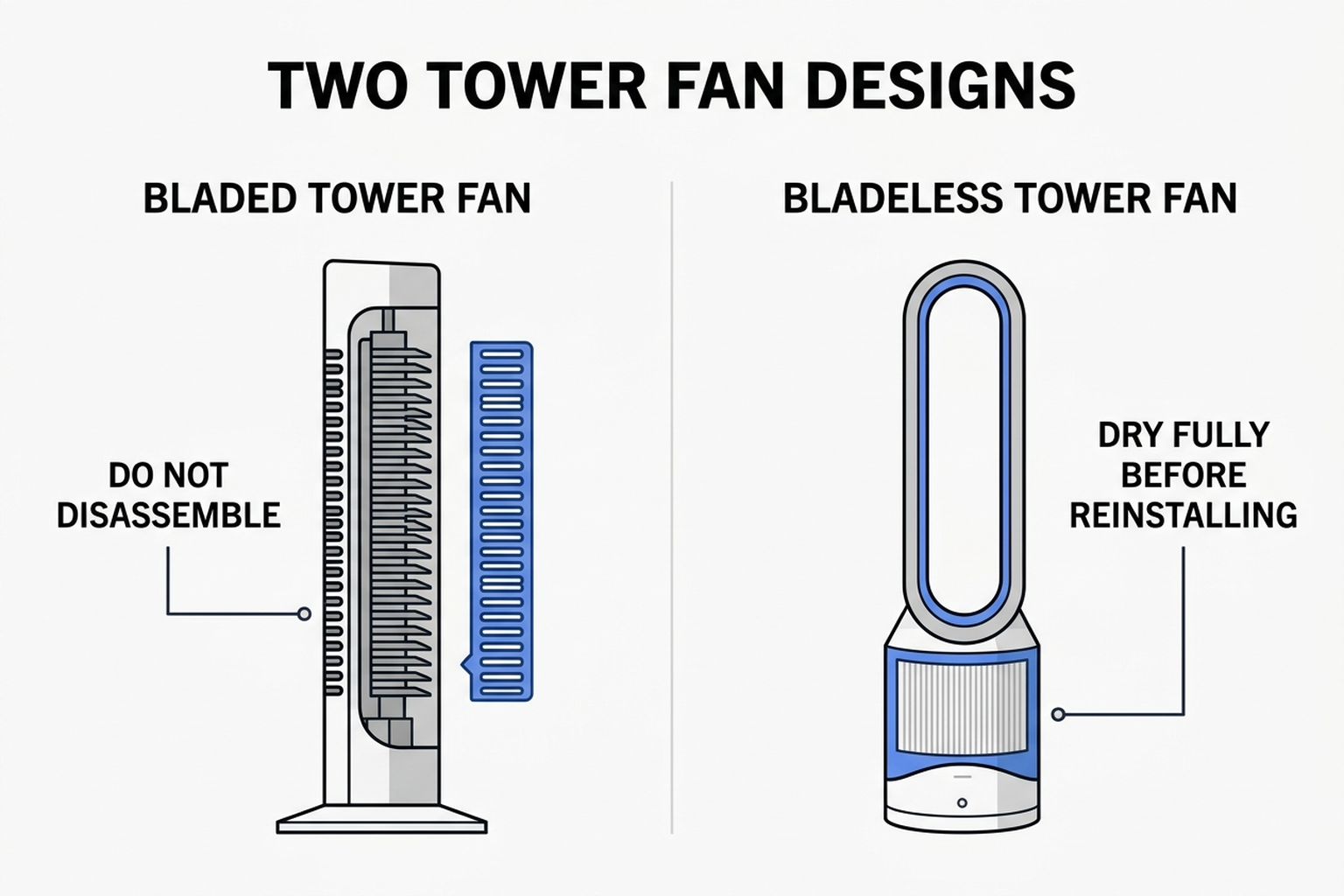
Bladed tower fans — the Lasko and Vornado style that most US households own — hide a stack of internal plastic fins or blades behind a narrow-slot grille. Both manufacturers’ owner’s guides are explicit that the unit has no user-serviceable parts inside: Lasko’s published guidance says the fan should never be opened once assembled, and Vornado’s manual states the tower “has no user-serviceable parts,” warns that disassembly voids the warranty, and limits cleaning to a vacuum brush attachment and a soft cloth on the outside. The fins themselves are thin, sometimes brittle plastic that can warp from shipping heat or bend if someone pries at them with a screwdriver trying to reach dust that’s visible through the grille but not actually reachable by hand.
Bladeless tower fans, led by Dyson’s Air Multiplier line, have no fins at all — air is pulled through a base and amplified through a loop, so there’s nothing to crack or bend in the airflow path. The tradeoff is a washable foam filter inside the base that does need periodic attention, and the failure mode there is different: reinstalling a filter that hasn’t fully dried can short the motor or grow mold inside a sealed housing, which is arguably worse than a cracked fin because it’s invisible until the fan stops working.
Community repair guides on iFixit show what happens when someone tackles a bladed fan that wasn’t designed to come apart: a documented teardown of a Honeywell HYF260 tower fan describes screws in the top section that were awkward to access and a back panel that required significant force to pop off — exactly the kind of disassembly both Lasko and Vornado tell owners to avoid in their own manuals.
What Manufacturers Actually Recommend
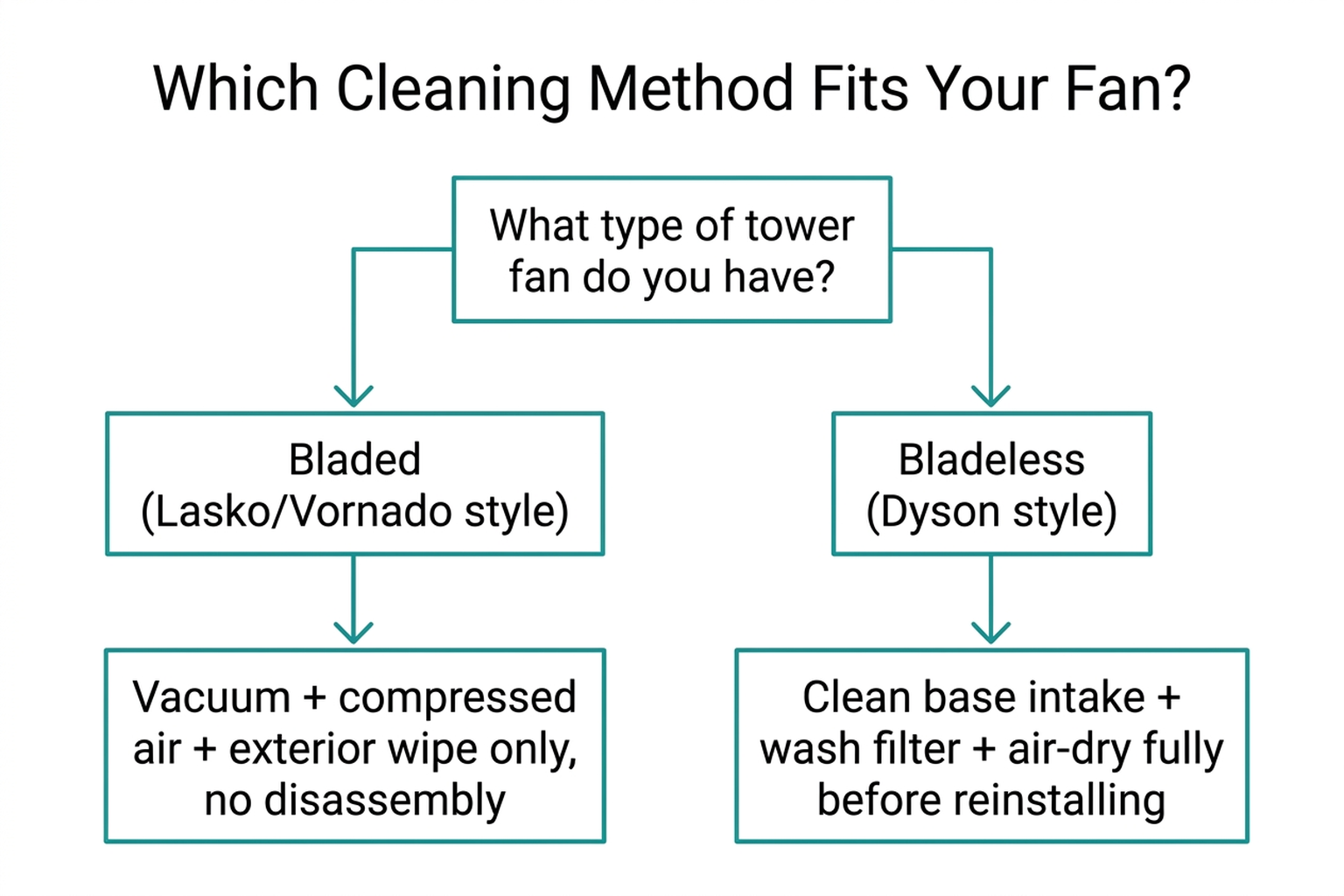
Lasko’s published cleaning guidance is built entirely around not opening the fan. The recommended method is a vacuum fitted with a brush attachment, run over the front and rear grilles from the outside to pull lint and dust out through the slats. If that isn’t enough, a can of compressed air blown into the front of the unit, followed by vacuuming the rear vents to catch what gets dislodged, handles most remaining buildup. The body itself gets wiped with a soft cloth only — no liquid cleaners, and no attempt to access the fins behind the grille.
Vornado’s owner’s guides for its tower circulator line are structurally identical: unplug the unit first, vacuum the accumulated dust off the tower using a brush attachment, then wipe the whole housing down with a soft cloth. Vornado’s manual adds an explicit warning against gasoline, thinners, solvents, or other chemical cleaners, and notes the motor is permanently lubricated and needs no oiling — there’s nothing inside a user is meant to reach, ever.
Dyson’s bladeless models split the routine in two. The exterior loop gets wiped with a dry microfiber cloth, and the air intake holes around the base get cleared with a soft brush or vacuum crevice tool — short, one-second bursts of compressed air handle deeper clogs in those vent holes. The washable foam filter, present on models like the AM07, is a separate task: light dust gets vacuumed or brushed off with a soft toothbrush, while heavier buildup calls for rinsing under warm (not hot) water with gentle squeezing, no scrubbing and no detergent, until the water runs clear.
The Cleaning Process, Step by Step
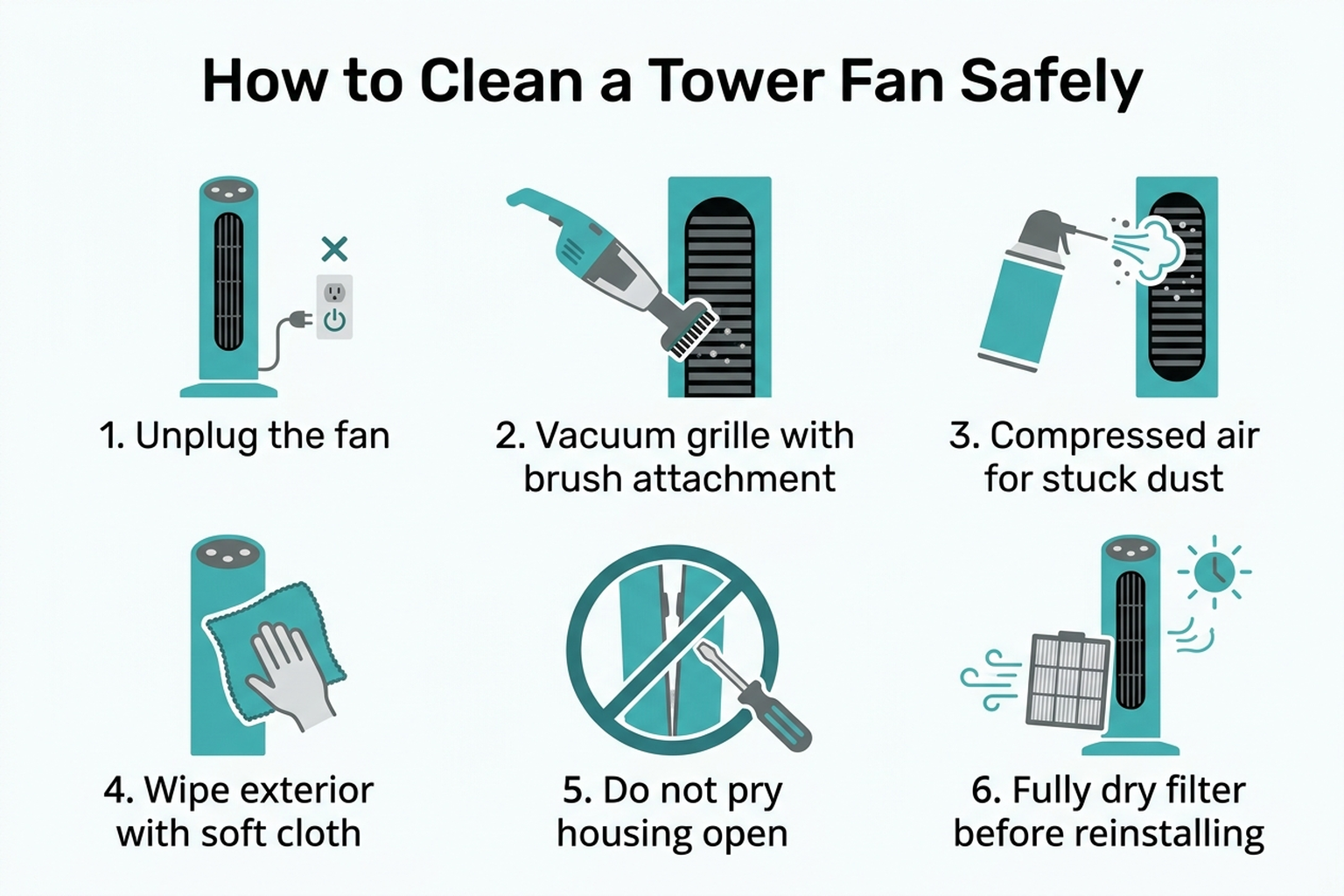
- Unplug the fan before doing anything else. Both Lasko and Vornado list this as the first step in their own instructions, and it removes any risk of contact with a powered motor while you’re vacuuming near the grille.
- Vacuum the front and rear grilles with a brush attachment, from the outside. This is the primary cleaning method both major bladed-fan manufacturers recommend, and it handles the large majority of dust without ever touching the fins behind the slats.
- For dust the vacuum can’t reach, use short bursts of compressed air aimed into the grille from outside the unit, then vacuum again immediately to catch what gets knocked loose rather than letting it resettle inside the housing.
- Wipe the exterior body with a soft, dry cloth — or a cloth lightly dampened with water for stuck grime. Never spray liquid directly onto the unit, and never use alcohol, ammonia, or solvent-based cleaners; manufacturers call these out by name as causes of surface damage, the same category of warning LG and Samsung give for OLED TV coatings.
- Do not pry the housing open unless your specific model’s manual says it’s designed to be opened. Tom’s Guide’s own fan-cleaning advice notes that some tower fans use a back panel held on with just a few screws and are meant to be opened for a deeper clean — but that only applies to models built that way. Most Lasko and Vornado models are not, and forcing a case that wasn’t designed to separate is what cracks clips and strips screws.
- If you own a bladeless Dyson model, clean the base air intake and the washable foam filter separately. Vacuum or rinse the filter per the model’s instructions, then air-dry it fully — Dyson’s own guidance allows up to 24 hours in a ventilated area, or a hairdryer on low heat held 12 inches away — before reinstalling it.
- Never reinstall a damp filter. This is the bladeless-fan equivalent of forcing a bladed fan’s housing open: the fix that looks faster in the moment is the one most likely to cause a failure that isn’t visible until later, in this case a short in the motor or mold growth inside a sealed compartment.
Cleaning Tools and Easier-to-Clean Fans Compared
Prices as of 2026-10-27. Ratings and review counts are Amazon customer data at time of research, not independently verified by Arekore.
| Product | Type | Price (approx.) | Amazon rating | Notes |
|---|---|---|---|---|
| Falcon Dust-Off Compressed Gas Duster, 12 oz (2-pack) | Compressed air duster | ~$15 | 4.7 / 5 | For dislodging dust stuck in grille slats |
| Universal Vacuum Brush Attachment Kit | Brush/crevice attachment set for standard household vacuums | ~$13 | 4.5 / 5 | The primary tool both Lasko and Vornado recommend |
| FIXSMITH Microfiber Cleaning Cloth, 8-Pack (12”x16”) | Dry/lightly damp wipe cloth | ~$10 | 4.6 / 5 | For the exterior housing only — never the inside |
| DREO Tower Fan with Removable Rear Grille (28 ft/s, 9 Speeds) | Tower fan with detachable grille and impeller for cleaning | ~$100 | 4.5 / 5 | Built for owners who want to replace a fan that can’t be cleaned without disassembly |
A brush-attachment vacuum and a can of compressed air cover routine maintenance on almost any bladed tower fan without opening the case at all. The detachable-design fan in the table isn’t a cleaning accessory — it’s an option for anyone replacing a fan that’s accumulated enough internal dust that exterior cleaning alone no longer helps, without taking on the disassembly risk a non-removable housing carries.
Editorial Recommendation by Use Case
- If you own a Lasko, Vornado, or similar bladed tower fan with no removable back panel: stick to the manufacturer routine — vacuum with a brush attachment, compressed air for stuck dust, soft cloth on the exterior. Don’t pry at the grille to reach the fins behind it.
- If you own a bladeless Dyson model: the fins aren’t a concern, but treat the washable filter’s dry time as non-negotiable — reinstalling it damp is the equivalent risk to forcing a bladed fan’s case open.
- If your current fan collects visible dust behind the grille faster than a vacuum and compressed air can keep up: that’s a sign to replace it with a model built for disassembly rather than repeatedly forcing a case that wasn’t designed to open.
- If you’re shopping new and cleaning ease matters to you: look specifically for “detachable back grille” or “removable filter” in the listing — it’s increasingly common on newer models and directly addresses the problem this article is about.
Warranty Considerations
Lasko’s and Vornado’s warranties cover manufacturing defects, not damage from opening a unit the manual says has no user-serviceable parts — Vornado’s guide states plainly that disassembly voids the warranty, and Lasko’s guidance treats any opening of the case the same way. That makes the vacuum-and-compressed-air routine both manufacturers recommend doubly important: it’s not just the safest way to avoid cracking a fin, it’s also the only cleaning method that keeps a warranty claim intact if something else goes wrong with the fan later. Dyson’s warranty terms are more forgiving of filter maintenance specifically, since that task is built into the product’s design, but installing a filter before it’s dry is still treated as user-caused damage rather than a covered defect.
Limitations
This analysis relies on manufacturer-published care instructions from Lasko, Vornado, and Dyson, a community-documented iFixit teardown of a Honeywell model (not a manufacturer-endorsed process), Tom’s Guide’s published fan-cleaning methodology, Wirecutter’s current tower fan testing, and Amazon customer-review and listing data, rather than a controlled teardown-and-rebuild test Arekore ran itself. Disassembly difficulty and whether a given model is designed to open at all varies significantly by brand and even by model year within the same brand — always check your specific unit’s manual before deviating from the vacuum-and-compressed-air baseline. Market-size estimates for the US residential tower fan category vary noticeably between research firms, from roughly $1.0 billion to several times that depending on scope and methodology; we cite this only to show the category is a meaningful and recurring purchase for US households, not as a precise figure. Pricing and review data on Amazon change frequently, so treat the table above as directional rather than current-to-the-minute.
As an Amazon Associate, Arekore earns from qualifying purchases. The Amazon product links in this article include our affiliate tracking ID and may earn us a commission if you buy through them, at no additional cost to you. See our Links Policy for details on how we select products and how commissions do not influence our recommendations.
Cleaning Supplies We Found on Amazon
- Falcon Dust-Off Compressed Gas Duster for Electronics, 12 oz Cans (2-Pack)
- Universal Vacuum Brush Attachment Kit for Household Vacuum Cleaners
- FIXSMITH Microfiber Cleaning Cloth, 8-Pack, 12”x16”
- DREO Tower Fan for Bedroom with Removable Rear Grille, 28 ft/s, 9 Speeds
Before trying to deep-clean a fan that’s never been opened before, check whether your specific model’s manual mentions a removable panel at all — for most bladed tower fans, the manufacturer’s own answer is that there isn’t one.