How to Clean an OLED TV Screen Without Streaking or Damage
TL;DR
Most OLED screen damage isn’t from normal dusting — it’s from reaching for the wrong bottle. Window cleaner, alcohol wipes, and paper towels strip the anti-glare coating on an OLED panel, and once that coating is gone it does not come back; manufacturers classify it as customer-induced damage outside the standard warranty. The safe routine is simple: power off the TV, dust first with a clean dry microfiber cloth, and for smudges use only distilled water on the cloth (never sprayed directly on the screen), applying light pressure in gentle circular motions. OLED now accounts for a meaningful and growing share of the US smart TV market, which is exactly why “how do I clean this without ruining it” has become one of the most common new-TV questions.
Methodology
This analysis synthesizes manufacturer cleaning instructions published by LG and Samsung for their OLED TV lines, RTINGS.com’s published screen-cleaning test methodology, home-theater community troubleshooting discussion on anti-glare coating damage (including a documented Samsung OLED coating-removal case), aggregated Amazon customer-review sentiment for leading screen-cleaning kits, and current US smart TV and OLED market-share data. We did not run a controlled coating-degradation test ourselves; this is an editorial synthesis of publicly available manufacturer, independent-lab, and market data, not first-hand testing.
Why OLED Screens Get Streaked or Damaged (Two Different Problems)
“Ruined my TV screen” usually means one of two very different failures, and the product that causes one is often marketed as the fix for the other.
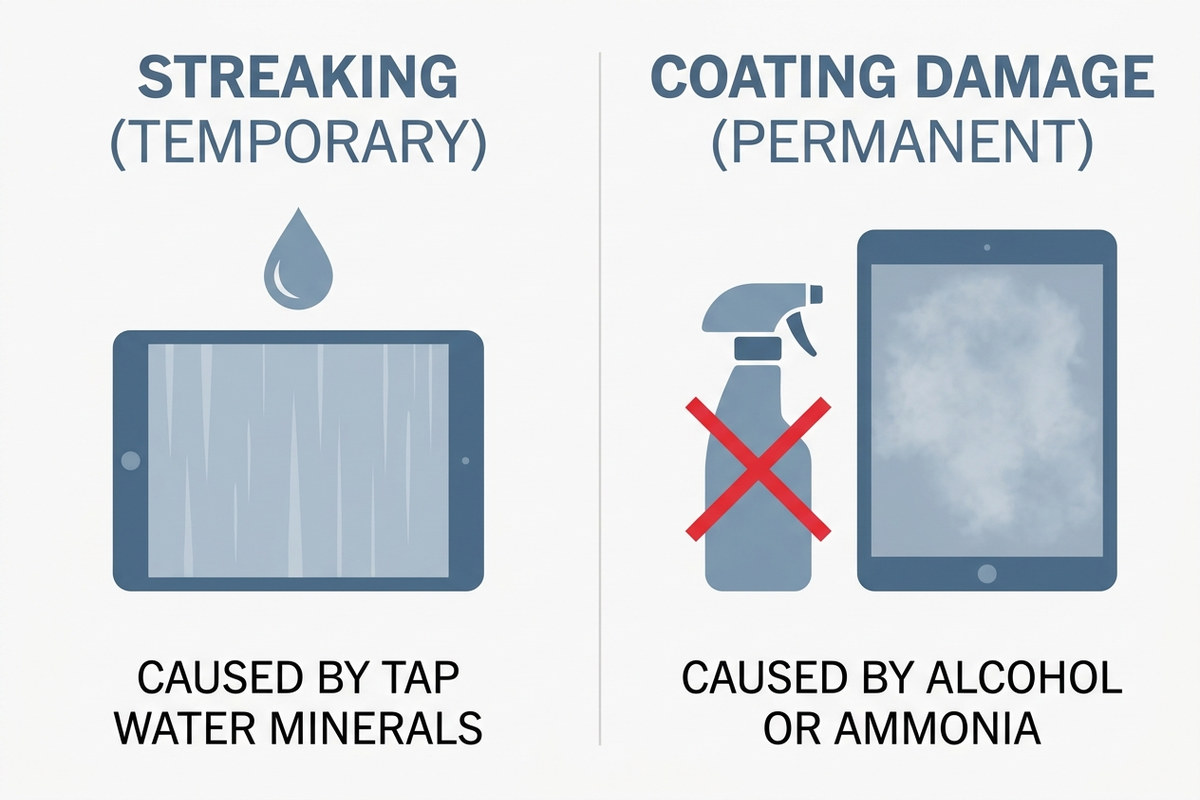
Streaking is mostly about water quality and technique. Tap water carries dissolved minerals that leave faint streaks or a hazy film as it dries, which is why RTINGS and manufacturer guidance both point to distilled water instead of tap water for any TV screen, OLED or not. Wiping with a dirty or lint-filled cloth, or pressing hard enough to drag trapped grit across the panel, is the other common streaking cause — the fix is a clean microfiber cloth and light pressure, not a stronger cleaner.
Coating damage is permanent and chemical. Most OLED TVs ship with an anti-glare or anti-reflective coating bonded to the glass. Ammonia-based glass cleaner, alcohol wipes, and other solvent-based products dissolve that coating — home-theater community threads document a Samsung OLED owner who stripped the anti-glare layer off a 2026-model panel, leaving a permanently hazy patch that no cleaning afterward could fix. Samsung’s own published guidance tells owners not to use soap, wax, benzene, alcohol, ammonia, or solvent-based cleaners on the panel, and LG’s instructions list the same category of products — automotive polish, benzene, alcohol, and industrial gloss agents — as causes of surface deformation or corrosion. Once a coating is stripped, there is no at-home fix; it is a one-way failure, unlike the streaking problem above.
What Manufacturers Actually Recommend
LG’s published instructions for its OLED TV line direct owners to first power off and unplug the TV, then wipe the screen with a soft, dry microfiber cloth using gentle circular motions. For marks a dry cloth won’t lift, LG’s guidance allows a cloth lightly dampened with water — not a direct spray on the panel — followed immediately by a dry cloth to remove any remaining moisture, and explicitly warns against letting water run down the screen. Samsung’s guidance is structurally identical: power down first, use a soft microfiber cloth, and if needed, lightly dampen it with water rather than applying liquid to the screen directly. Both brands converge on the same prohibited list — no alcohol, no ammonia, no solvents, no abrasive pads, and no paper towels, which are coarse enough at the fiber level to create fine scratches invisible until they catch the light at certain angles.
RTINGS’ published testing methodology for TV screen cleaning reaches the same conclusion from an independent angle: a clean, dry microfiber cloth handles routine dust, and when liquid is genuinely needed, distilled water applied to the cloth (never the screen) is the only liquid RTINGS recommends across the panel types it tests, specifically because tap-water minerals can leave scratches as they dry and evaporate.
The Cleaning Process, Step by Step
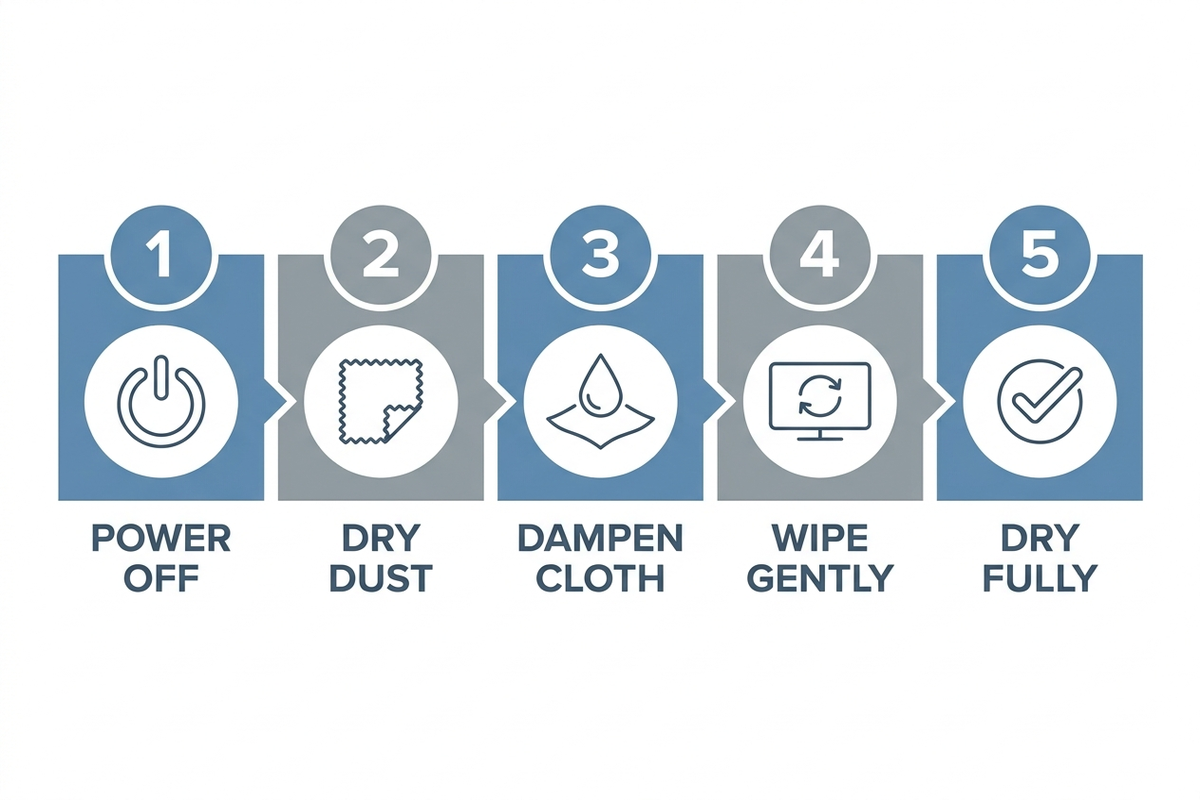
- Power off and unplug the TV before cleaning. A dark, cool screen shows smudges and dust more clearly than an active, lit panel, and it removes any risk of liquid contacting a powered display.
- Dust first with a clean, dry microfiber cloth. Use gentle circular motions and let the cloth’s texture lift dust rather than pushing it around; a cloth that’s picked up grit from another surface can scratch the panel, so keep a cloth dedicated to screens only.
- For smudges or fingerprints, dampen the cloth — not the screen — with distilled water. Apply a few drops to the cloth, wring or blot until it’s barely damp, and never spray liquid directly onto the panel or let water run down the glass.
- Wipe in gentle circular motions with light pressure. Pressing hard to force a stubborn mark off is more likely to create a fine scratch than to remove the mark; a second light pass after the cloth has lifted some residue works better than one hard pass.
- Dry immediately with a separate dry microfiber cloth. Leaving any moisture to air-dry on its own risks the same mineral-streak outcome that using tap water causes in the first place.
- Never use glass cleaner, alcohol wipes, ammonia products, wax, or paper towels. This is the step most responsible for permanent coating damage — manufacturers list these by name as the products that cause corrosion, deformation, or irreversible coating loss.
- Let the screen air-dry fully before powering the TV back on, confirming no moisture remains in the bezel edges where the panel meets the frame.
Cleaning Products Compared
Prices as of 2026-10-22. Ratings and review counts are Amazon customer data at time of research, not independently verified by Arekore.
| Product | Type | Price (approx.) | Amazon rating | Review count |
|---|---|---|---|---|
| WHOOSH! Screen Shine Pro, 16.9 fl oz Refillable Kit | Alcohol/ammonia-free spray + 14x14” microfiber cloth | ~$20 | 4.6 / 5 | — |
| Screen Mom Ultimate Screen Cleaning Kit | 2x16oz alcohol/ammonia-free spray + 6 microfiber cloths | ~$18 | 4.7 / 5 | — |
| MagicFiber Extra Large Microfiber Cleaning Cloth for TV Screens | Dry microfiber cloth, no spray | ~$9 | 4.7 / 5 | — |
| Distilled water (grocery or drugstore, any brand) | Liquid for dampening a cloth only | ~$1–2/gallon | — | — |
The distinction that matters most: the spray kits above are formulated specifically without alcohol or ammonia for exactly this reason, and even they are meant to be applied to the cloth, not sprayed directly onto an OLED panel. A plain microfiber cloth plus distilled water handles the large majority of routine cleaning without buying a spray at all.
Editorial Recommendation by Use Case
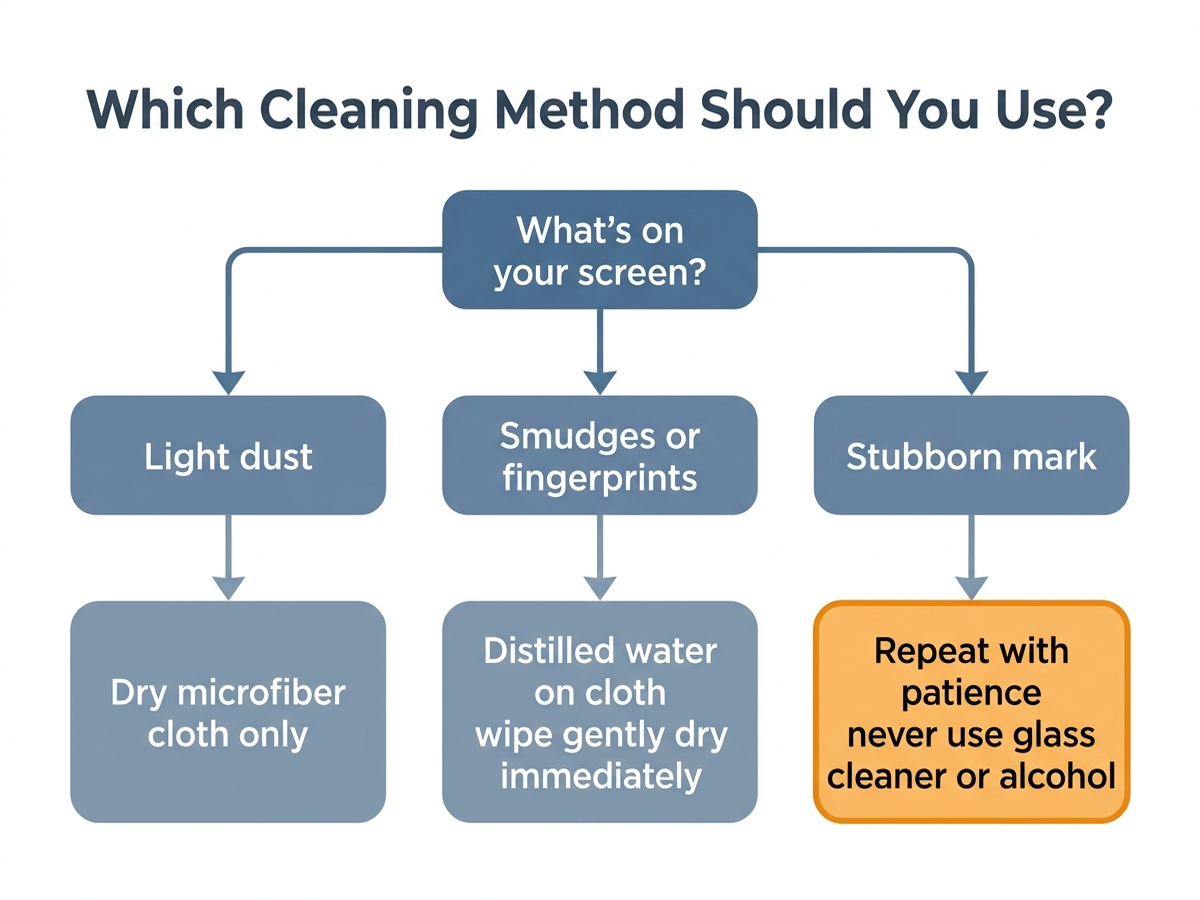
- If you’re just dusting a screen that gets light fingerprints: a dry microfiber cloth alone, used weekly, covers most routine maintenance — no liquid needed.
- If you have visible smudges or “peanut butter” handprints from kids: dampen a microfiber cloth with distilled water, wipe gently, then dry with a second cloth immediately.
- If you’re tempted to reach for glass cleaner because a smudge won’t budge: don’t — a longer, more patient pass with a barely-damp distilled-water cloth removes marks that ammonia-based cleaner would otherwise fix permanently by stripping the coating.
- If you’re not sure whether your TV has an anti-glare coating: treat every OLED TV as coated by default. Both major OLED manufacturers warn against the same chemical list regardless of specific model, and the conservative routine (dry cloth, distilled water only) is safe across the board.
Warranty Considerations
Manufacturer warranties on OLED TVs (commonly one year, sometimes longer on the panel itself) cover defects in materials and workmanship, not damage caused by cleaning products the manufacturer explicitly warns against. Samsung and LG both document alcohol-, ammonia-, and solvent-based cleaning as a cause of surface damage, and that kind of damage is generally treated as customer-induced rather than a covered defect. Sticking to a dry microfiber cloth and distilled water only is the maintenance habit most directly tied to keeping cosmetic coating damage out of a warranty dispute in the first place.
Limitations
This analysis relies on manufacturer-published care instructions from LG and Samsung, RTINGS’ published screen-cleaning testing methodology, home-theater community troubleshooting discussion, and current Amazon customer-review and market data, rather than a controlled side-by-side coating-degradation test Arekore ran itself. Actual coating sensitivity varies by panel generation and specific model — some newer OLED TVs use more chemical-resistant coatings than others, and manufacturers update formulations between model years. Pricing and review counts on Amazon change frequently, so treat the figures above as directional rather than current-to-the-minute. Market-research estimates put OLED at a growing, though still minority, share of the roughly 52-million-unit US smart TV market in 2026 — a scale note on how widely this cleaning question applies, not a claim about any individual model’s coating durability.
As an Amazon Associate, Arekore earns from qualifying purchases. The Amazon product links in this article include our affiliate tracking ID and may earn us a commission if you buy through them, at no additional cost to you. See our Links Policy for details on how we select products and how commissions do not influence our recommendations.
Cleaning Supplies We Found on Amazon
- WHOOSH! Screen Shine Pro, 16.9 fl oz Refillable Screen Cleaner Kit with 14x14” Microfiber Cloth
- Screen Mom Ultimate Screen Cleaning Kit, 2x16oz Spray + 6 Microfiber Cloths
- MagicFiber Extra Large Microfiber Cleaning Cloth for TV Screens & Monitors
Before buying a spray kit, check the label for “alcohol-free” and “ammonia-free” explicitly — plenty of general-purpose glass and electronics cleaners on store shelves contain one or both, and the label rarely leads with what’s missing.