How to Clean a Humidifier Without Growing Mold
TL;DR
Most humidifier mold problems come from two habits: refilling the tank with standing water instead of emptying it daily, and skipping the weekly disinfecting step. The EPA and Consumer Reports both point to the same fix — empty and dry the tank every day, disinfect weekly with vinegar, hydrogen peroxide, or a mild bleach dilution, and use distilled water to slow mineral buildup that shelters bacteria. Which humidifier type you own matters more than most buyers realize: Consumer Reports testing found evaporative wick models emitted zero bacteria into the mist, while ultrasonic and steam models did not fare as well.
Methodology
This analysis synthesizes (a) published guidance from the EPA and CDC on humidifier maintenance and indoor humidity control, (b) Consumer Reports’ bacteria-emission testing across 34 humidifiers spanning ultrasonic, evaporative, and steam-vaporizer designs, (c) aggregated Amazon US customer review sentiment for humidifier cleaning tablets, descalers, and brush sets sampled in August 2026 — we did not track an exact review count for this synthesis, and describe sentiment only in directional terms rather than citing a specific N — and (d) manufacturer maintenance instructions from Honeywell and other major brands. We did not personally test the cleaning products or humidifiers covered here.
Why Humidifiers Grow Mold in the First Place
A humidifier tank is a closed container of standing water sitting at room temperature — close to ideal conditions for mold and bacteria to multiply. The EPA’s guidance on home humidifiers is explicit that tap water minerals accelerate the problem: dissolved minerals build up on interior surfaces and create a rougher, more porous film that both bacteria and mold can cling to more easily than a clean plastic surface. Left unaddressed, that film also gets aerosolized into the mist the machine produces, which is why the CDC recommends emptying and drying the tank daily rather than just topping it off.
Relative humidity matters too. The EPA recommends keeping indoor humidity between 30% and 50%; anything consistently above 60% raises the risk of condensation on windows and walls, which can seed mold growth in the room itself, separate from anything happening inside the machine. A humidifier with a built-in humidistat that holds a target in the 40–45% range removes the guesswork.
Cleaning Methods, Compared
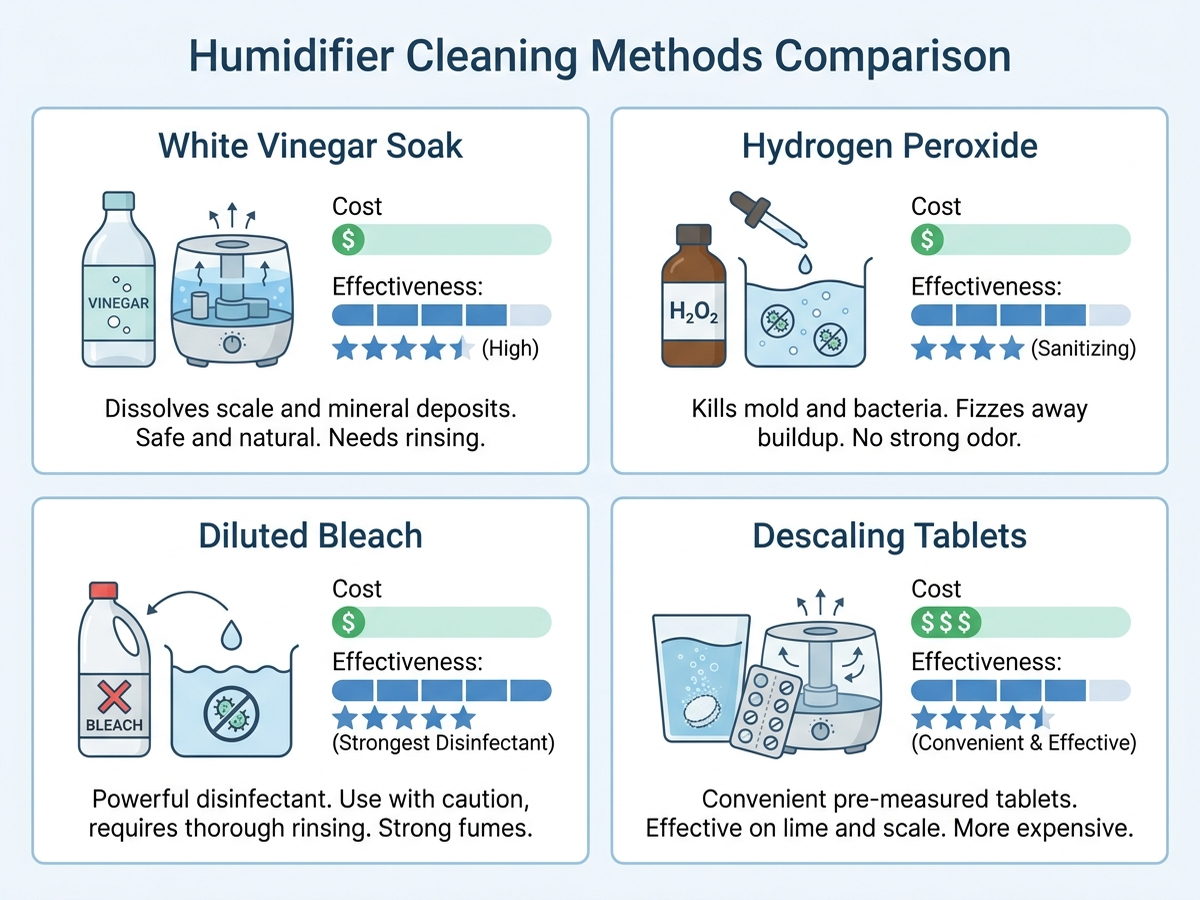
| Method | Cost (approx., as of 2026-08-27) | Effectiveness | Time |
|---|---|---|---|
| White vinegar soak (equal parts vinegar and water) | Under $1 per cleaning, pantry staple | Removes mineral film and odor; EPA-cited household method | 30-minute soak, then rinse |
| 3% hydrogen peroxide | Under $1 per cleaning | Disinfects without the vinegar smell; CDC-listed alternative | 30-minute soak, then rinse |
| Diluted household bleach (per manufacturer ratio) | Under $1 per cleaning | Strong disinfectant; requires a thorough rinse to avoid residue | Short soak (per manufacturer instructions), then multiple rinses |
| Commercial descaling tablets (e.g., effervescent humidifier tablets) | Roughly $12–$15 for a 24-tablet pack, about $0.50–$0.65 per use | Convenient, no measuring; aggregated reviewers report similar mineral removal to vinegar | 15–20 minute soak, then rinse |
Which Humidifier Type You Own Changes the Stakes
Consumer Reports’ testing is the most directly relevant independent data point here: across three days of monitoring microbial growth in the tank, and a second test that seeded bacteria into each unit to see whether it came out in the mist, evaporative wick humidifiers were the standout — none of the ten evaporative models tested emitted any bacteria into the air. Ultrasonic units, which use a vibrating plate to atomize water into a fine mist, and steam vaporizers both emitted bacteria in the same testing. Consumer Reports also found that humidifiers marketed with antimicrobial claims were not reliably better performers; several claimed-antimicrobial units still harbored bacteria in the tank.
That doesn’t mean ultrasonic humidifiers are unsafe — it means they need more disciplined maintenance to reach the same baseline an evaporative model gets closer to by design. An evaporative model like the Honeywell HCM350, which pulls air through a wet wicking filter rather than atomizing standing water, has become a recurring pick in independent buying guides for exactly this reason, though its filter still needs monthly replacement to keep performing as tested.
Daily and Weekly Cleaning Steps
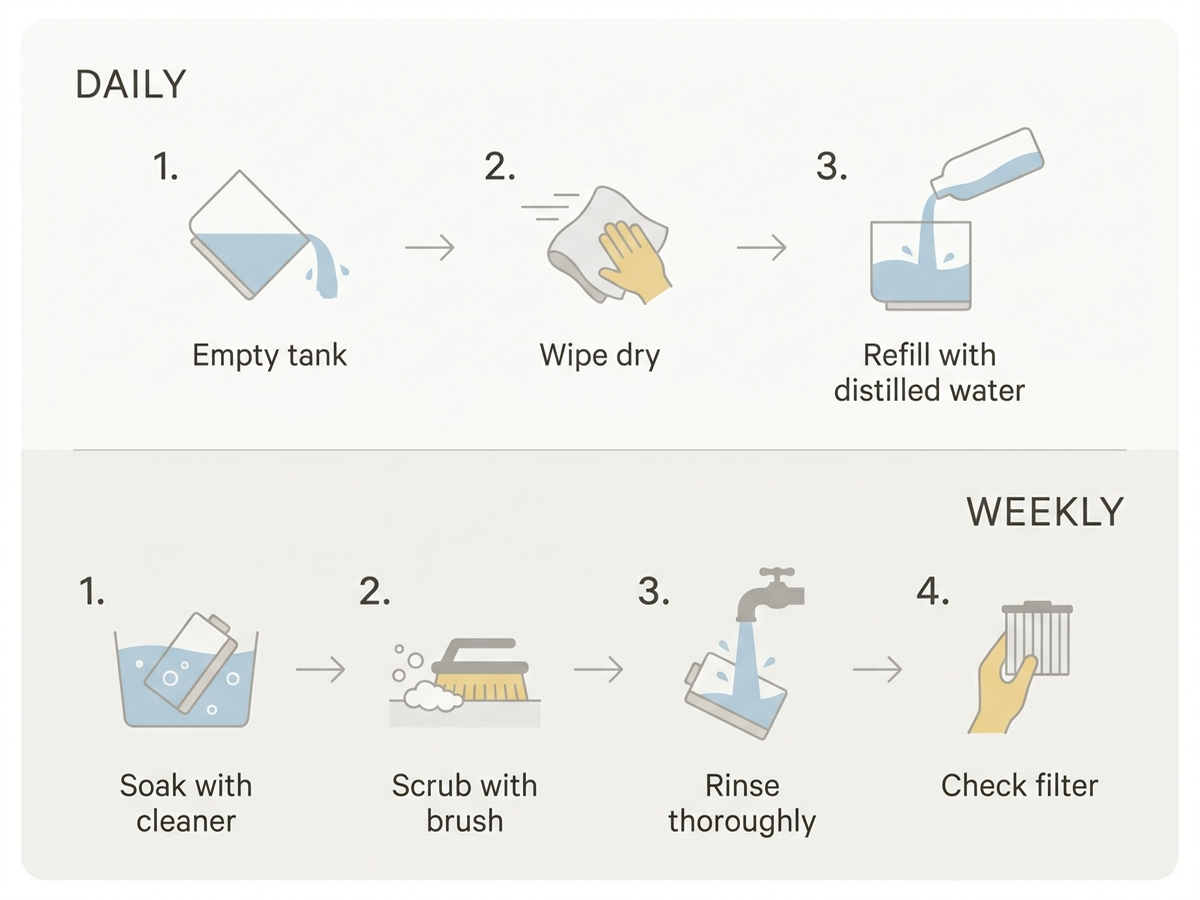
Daily:
- Empty any water left in the tank — don’t just top it off.
- Wipe all interior surfaces dry with a clean cloth.
- Refill with distilled or demineralized water rather than tap water, which the EPA notes reduces mineral buildup that harbors bacteria.
Weekly:
- Fill the tank with a vinegar-water mix (or hydrogen peroxide, or a manufacturer-approved descaling tablet) and let it sit for the time specified for that method.
- Use a small brush to scrub corners and seams where a cloth can’t reach — reviewers of dedicated humidifier brush sets consistently cite tight tank corners and filter housings as the spots plain wiping misses.
- Rinse thoroughly — bleach and some tablet formulas leave a residue that should not be aerosolized if not fully rinsed.
- If the unit has a filter, check it against the manufacturer’s replacement schedule; a moldy filter re-seeds a freshly cleaned tank within days.
What Aggregated Reviews Say About Cleaning Products
Customer sentiment for effervescent humidifier cleaning tablets on Amazon skews positive, with reviewers most often praising the no-measuring convenience over a vinegar soak and reporting that white mineral “dust” on furniture near the humidifier decreased noticeably after switching to distilled water plus regular tablet use. The most common complaint in this category is a lingering scent from certain tablet formulas that some reviewers find stronger than a plain vinegar rinse.
Reviews of humidifier-specific brush sets are also broadly positive, with buyers frequently noting that a curved or angled brush tip reaches base corners a bottle brush cannot, though several reviewers mention the bristles on budget sets can be too stiff for softer plastic tanks and recommend a lighter touch.
Which Cleaning Routine Fits Your Setup
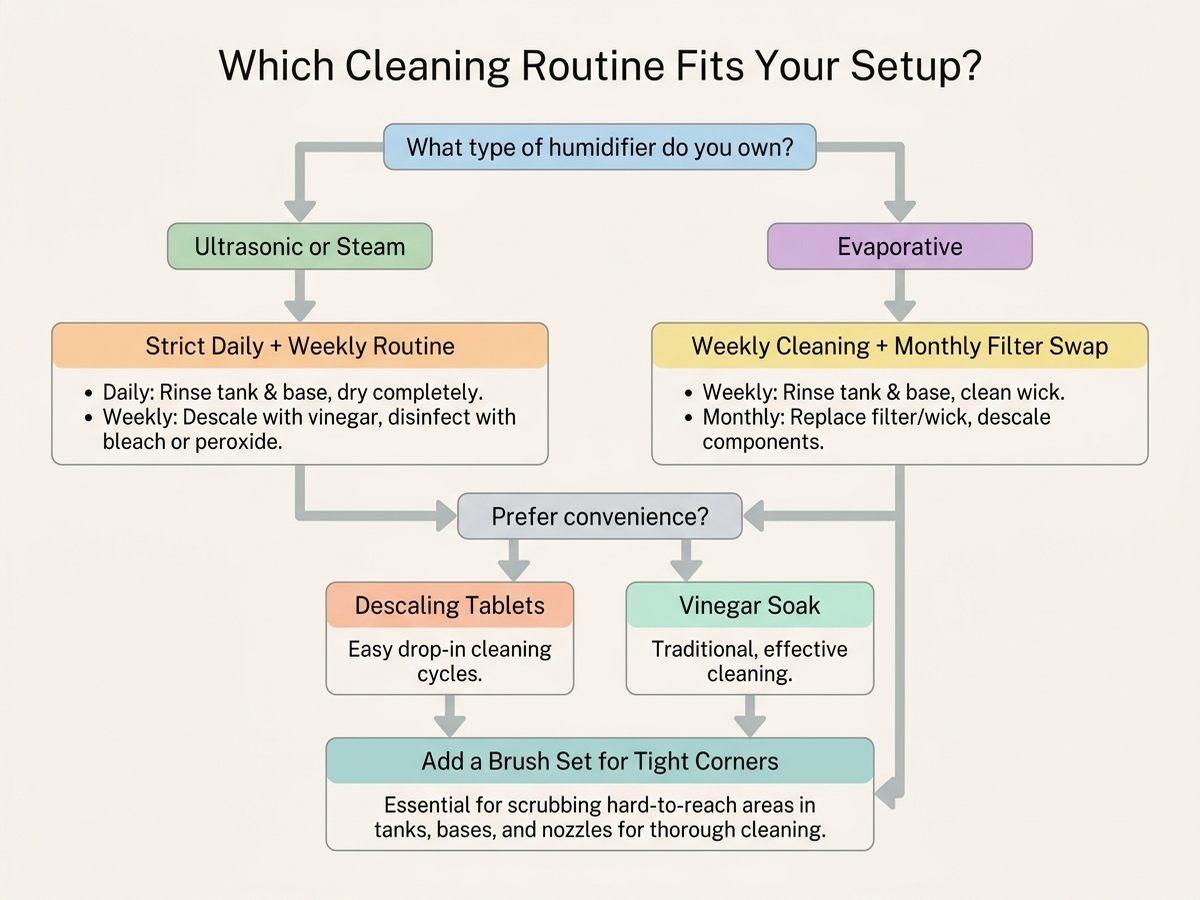
Best for households already using an ultrasonic or steam humidifier: Commit to the daily-empty, weekly-disinfect routine without exception — this is the type Consumer Reports found emitting bacteria in testing, so consistency matters more here than for evaporative models.
Best for lowest ongoing maintenance: An evaporative model with a replaceable wick filter, run on distilled water. It was the only category with zero bacteria emission in Consumer Reports’ testing, though the filter itself still needs monthly replacement.
Best for buyers who won’t remember a vinegar ratio: Commercial descaling tablets. Aggregated review sentiment suggests the convenience meaningfully increases how consistently people actually clean the tank, which matters more than which specific descaling agent is marginally more effective.
Best for tight tank corners and filter housings: A dedicated small-brush set, used alongside whichever descaling method above is already in place — a cloth alone tends to miss the seams where film and mold accumulate first.
Limitations
This analysis relies on EPA and CDC public guidance, Consumer Reports’ published testing methodology, and aggregated Amazon customer reviews rather than hands-on testing of specific cleaning products by our editorial team. Bacteria and mold growth also depend on local water hardness, room humidity, and how consistently a household actually follows a cleaning schedule, so individual results will vary from the patterns described here. Always follow the specific manufacturer instructions for your humidifier model, since some materials and filters are not compatible with bleach or certain descaling chemicals.
Shop the Category
As an Amazon Associate, Arekore earns from qualifying purchases — see the notice at the bottom of this page for details.
Humidifier cleaning tablets, 24-pack — effervescent descaler compatible with most ultrasonic, cool-mist, and warm-mist humidifier tanks. View on Amazon
Honeywell HCM350 evaporative humidifier — wick-filter design that Consumer Reports’ bacteria testing found did not emit bacteria into the mist. View on Amazon
Humidifier cleaning brush set — angled and crevice brushes for tank corners and filter housings a cloth can’t reach. View on Amazon
Visit Arekore to compare current prices and verify any product before buying.