How to Clean an Espresso Portafilter Without Scratching It

TL;DR
Most portafilter damage isn’t caused by normal use — it’s caused by the wrong cleaner or the wrong tool. Citric acid descaler left on a chrome-plated portafilter can strip the plating and leave a pink stain within minutes, and prying a stuck basket out with a butter knife or metal pick is the single most common cause of a scratched rim. The safe routine is simple: rinse after every use, soak weekly in an alkaline espresso-cleaner tablet (not citric acid) for 15–20 minutes, brush only with soft nylon bristles, and backflush weekly if your machine has a three-way valve. Espresso machines are the fastest-growing category in the US home coffee-machine market, which is exactly why portafilter and basket maintenance questions have become so common.
Methodology
This analysis synthesizes manufacturer cleaning instructions from Breville, published home-barista community troubleshooting threads on chrome and chemical compatibility, Tom’s Guide’s published descaling guide for Breville-style machines, aggregated Amazon customer-review sentiment for leading espresso-cleaning tablets and portafilter brushes, and current US home-espresso-machine market-size data. We did not run a controlled side-by-side material-degradation test ourselves; this is an editorial synthesis of publicly available manufacturer, community, and market data, not first-hand testing.
Why Portafilters Get Scratched or Stripped (Two Different Problems)
“Damage” to a portafilter usually means one of two very different things, and the fix for one can cause the other.
Scratching is physical: a metal utensil, an abrasive scrubbing pad, or a stiff wire brush dragged across a basket rim or spout removes the polished or plated surface layer. Most home-barista guidance is blunt about the most common cause — prying a stuck filter basket out with a butter knife is how rims get scratched, rather than using the basket’s own retaining clip or a plastic tool.
Chemical stripping is different: it’s what happens when an acidic descaler sits on a plated surface too long. Most prosumer and home portafilters are cast brass that’s then chrome- or nickel-plated, and citric acid — the most common home descaler — can eat through that plating in concentrated form, and leftover residue can even turn the surface a visible pink, caused by copper being chemically stripped from internal tubing and redeposited on the chrome. Community troubleshooting threads on this are consistent: wipe descaling solution off chromed parts promptly, and prefer a dedicated alkaline espresso-machine cleaner over acid-based descaler for anything chrome-plated you can’t fully submerge and rinse immediately.
Stainless steel portafilters (common on higher-end prosumer machines) are more acid-tolerant than chrome-plated brass, but neither material benefits from abrasive pads, steel wool, or wire brushes — nylon is the only bristle material worth using on either.
What Manufacturers Actually Recommend
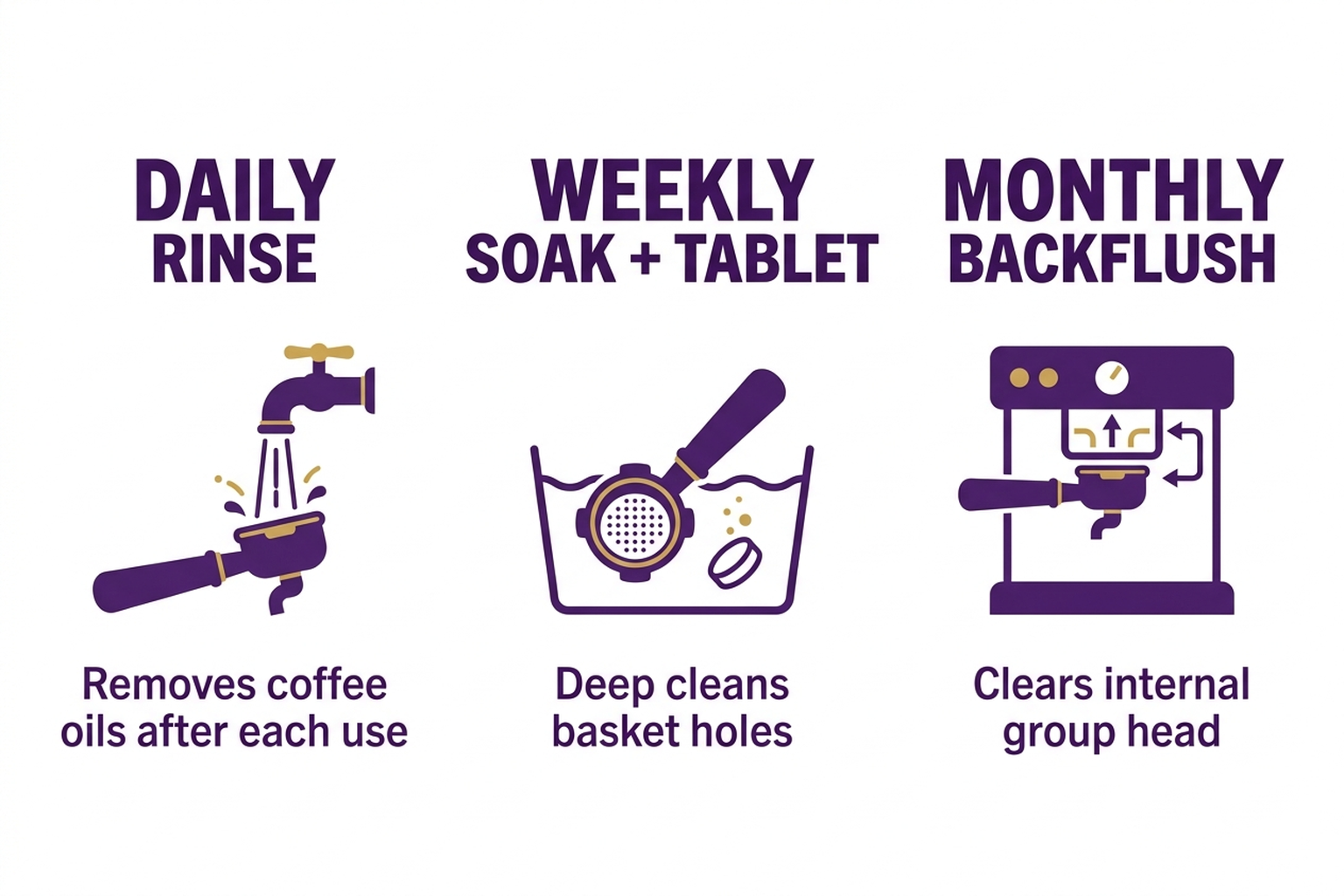
Breville’s published instructions for its Barista Express line direct owners to rinse the portafilter and basket under hot water after every use, and for stuck basket holes, to dissolve a cleaning tablet in hot water and soak the basket and portafilter for about 20 minutes rather than scraping at it. Breville’s machines also run a dedicated cleaning cycle: insert the basket, the supplied blind cleaning disc, and one tablet, lock in the portafilter, and the machine runs a roughly five-minute cleaning cycle on its own. Tom’s Guide’s descaling walkthrough for Breville machines covers the boiler-and-water-lines side of maintenance — running descaling solution through the group head and steam wand, then flushing with fresh water — which is a distinct routine from portafilter and basket cleaning. In our reading of home-barista community discussion, conflating the two (using a boiler descaler as a general-purpose portafilter soak) is where most chrome-damage reports concentrate, rather than from descaling or portafilter cleaning done on their own correct schedules.
Across brands, the guidance converges on using the manufacturer’s own cleaning tablet for portafilter and group-head soaking, and a separate, water-filter-forward approach to reduce how often full-machine descaling is even needed — Breville recommends replacing its water filter every two months, more often in hard-water areas, specifically to cut down on how often an acid-based descale is necessary at all.
The Cleaning Process, Step by Step
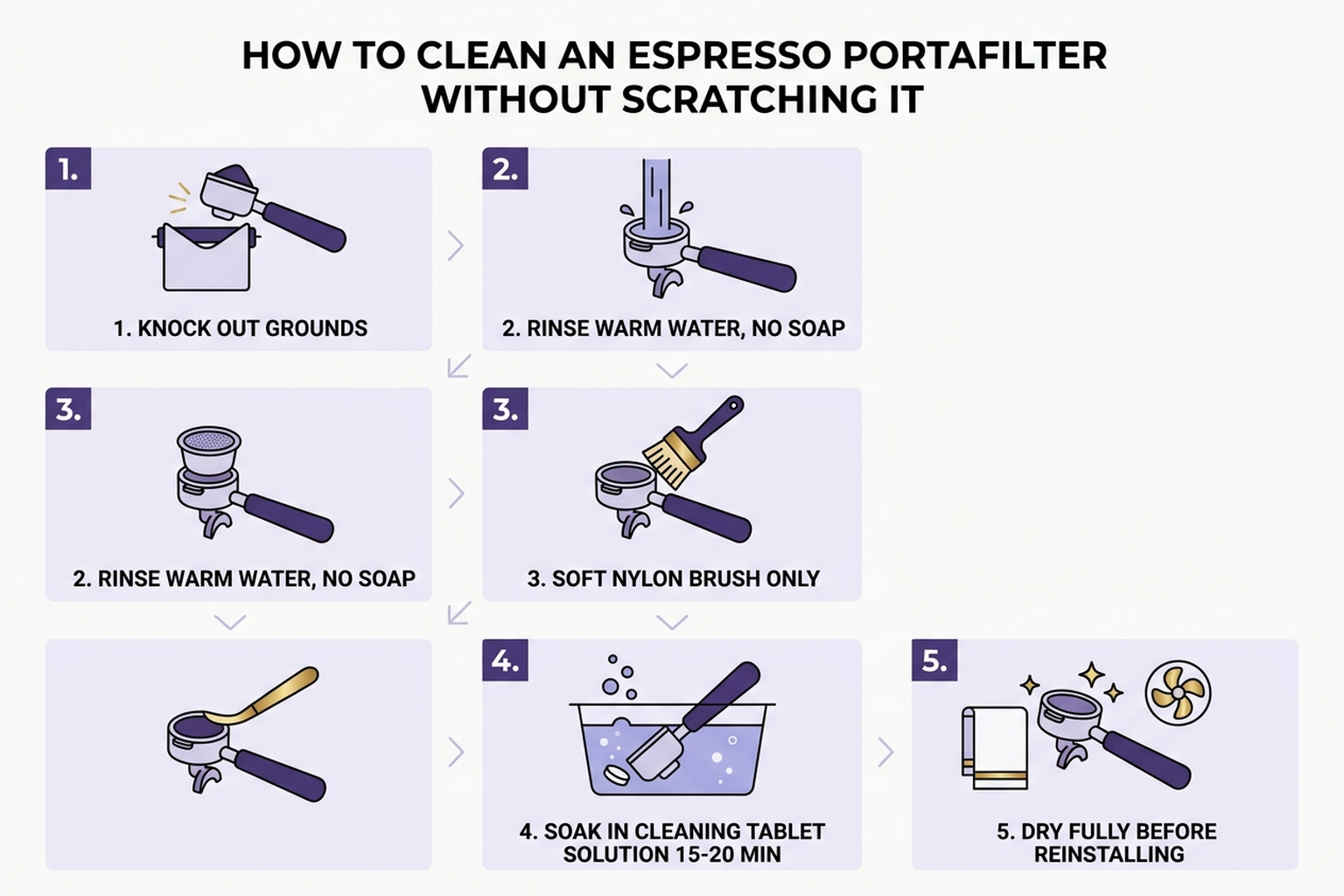
- Knock out spent grounds immediately after pulling a shot. Grounds left to dry in the basket are harder to dislodge later and more likely to need scraping, which is itself a scratch risk.
- Rinse under hot water, no soap, after every use. Soap residue in basket holes can affect the next shot’s flavor and is unnecessary for daily maintenance.
- Use a soft nylon brush only — never metal, never an abrasive pad. A curved 51mm or 58mm brush matches the basket’s radius so two circular passes clear the floor without pushing grounds deeper into the holes; a flat or wire brush doesn’t match the curve and tends to scrub harder at the rim edges.
- Soak weekly in a dissolved alkaline cleaning tablet, not citric acid descaler, for 15–20 minutes. This is the step most likely to be done with the wrong product — citric acid is formulated for mineral scale inside a boiler, not for soaking a plated portafilter.
- Never pry a stuck basket out with a knife, screwdriver, or metal pick. Use the basket’s retaining clip, a plastic pick, or firm finger pressure from underneath; this single habit is the most commonly cited cause of rim scratches in home-barista troubleshooting discussions.
- Dry fully before reassembling and storing. Standing water in a basket’s holes between uses accelerates any mineral buildup that eventually needs a harder soak to remove.
- Backflush weekly if your machine has a three-way valve and a blind basket. Run 10 seconds pump-on, 10 seconds pump-off with a dissolved tablet in the blind basket, repeated five times, then five more cycles with plain water to rinse — this clears internal group-head passages that a basket soak never reaches.
Cleaning Products Compared
Prices as of 2026-10-16. Ratings and review counts are Amazon customer data at time of research, not independently verified by Arekore.
| Product | Type | Price (approx.) | Amazon rating | Review count |
|---|---|---|---|---|
| Urnex Cafiza Cleaning Tablets, 100-count | Alkaline tablet (soak + backflush) | ~$20 | 4.7 / 5 | ~3,295 |
| Urnex Dezcal Activated Descaler, 100-pack packets | Citric-based descaler (boiler/water lines only) | ~$25 | 4.6 / 5 | — |
| Normcore Barista Brush (walnut handle) | General bench/grinder/portafilter brush | ~$15 | 4.7 / 5 | — |
| CAFEMASY 58mm Group Head Cleaning Disc Brush | Curved nylon basket-matched brush | ~$10 | 4.5 / 5 | — |
The distinction that matters most: Cafiza-style tablets are formulated for coffee oil and residue and are safe for soaking plated portafilters per manufacturer and community guidance, while Dezcal-style descalers are formulated for mineral scale inside the machine’s internal plumbing and should be rinsed off plated surfaces promptly rather than used as a soak.
Editorial Recommendation by Use Case
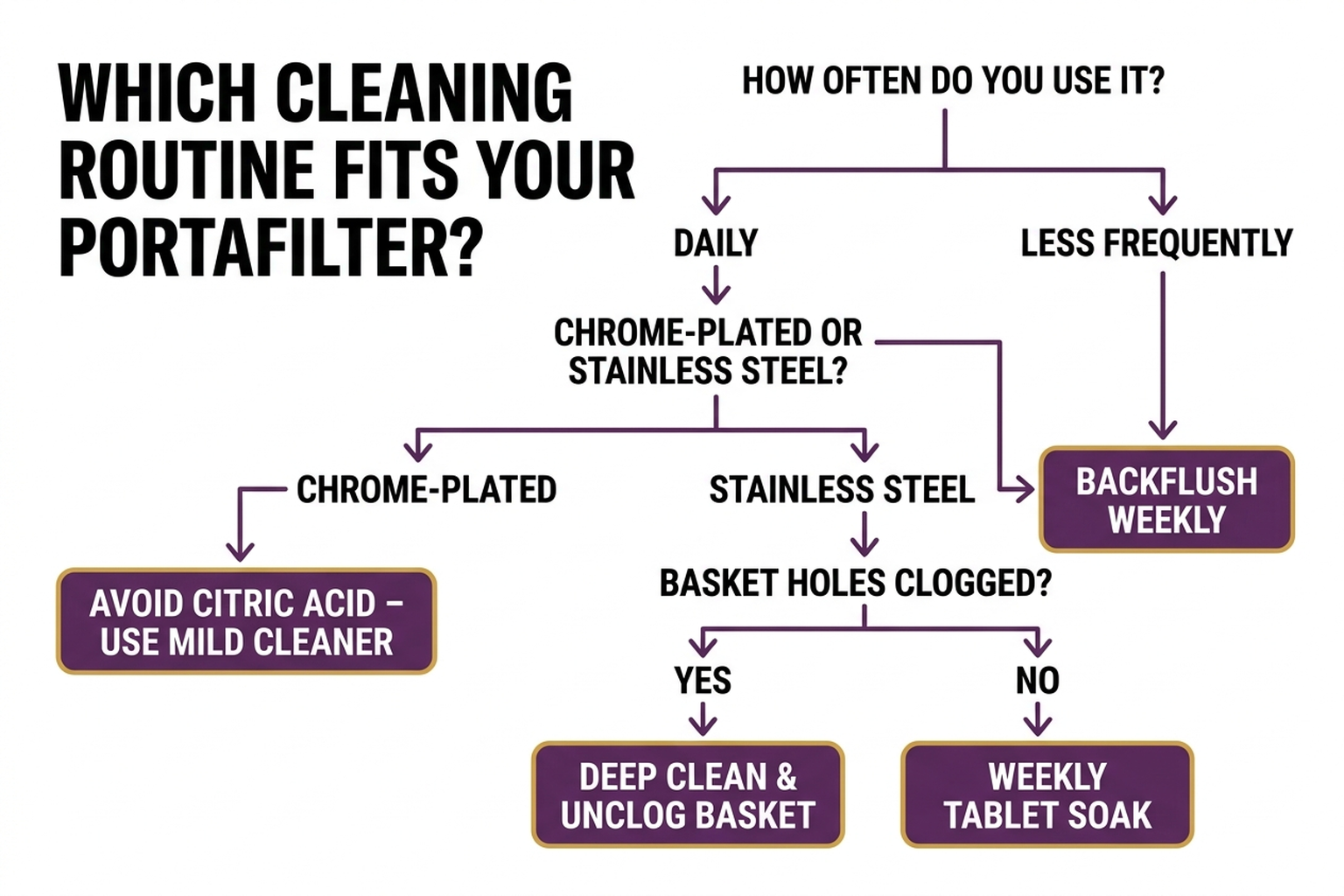
- If your portafilter is chrome-plated and used daily: stick to a weekly tablet soak, never citric acid descaler as a soak, and backflush weekly if your machine supports it.
- If your portafilter is stainless steel: it tolerates occasional brief acid contact better than chrome-plated brass, but a weekly alkaline tablet soak is still the lower-risk default — reserve any acid-based product for its intended internal-descaling use.
- If basket holes are visibly clogged with dried coffee oil: soak longer (up to 20 minutes) with a cleaning tablet before reaching for a brush, and never resort to a knife or pick to dig out the holes.
- If you’re not sure what your portafilter is made of: treat it as chrome-plated brass by default — it’s the more common and more acid-sensitive material on home machines, and the conservative routine (tablet soak, no citric acid, nylon brush only) is safe for stainless steel too.
Warranty Considerations
Manufacturer warranties on home espresso machines (commonly one to two years) typically cover defects in materials and workmanship, not damage caused by using an unapproved cleaning chemical or abrasive tool on a plated component. Using the manufacturer’s specified cleaning tablet, replacing the water filter on the recommended schedule, and avoiding acid-based soaks on plated parts are the maintenance habits most directly tied to keeping cosmetic and function-related damage out of warranty disputes in the first place.
Limitations
This analysis relies on manufacturer-published care instructions, aggregated home-barista community troubleshooting discussion, Tom’s Guide’s published descaling methodology, and current Amazon customer-review and market data rather than a controlled side-by-side chrome-degradation test Arekore ran itself. Actual scratch and chrome-stripping risk varies by the specific plating quality and thickness used by different manufacturers, water hardness in your area, and how long a descaling solution is left in contact with plated surfaces. Pricing and review counts on Amazon change frequently, so treat the figures above as directional rather than current-to-the-minute. Market-research estimates put the US home espresso machine market at roughly $1.3–1.4 billion in 2026, projected to be the fastest-growing segment of the broader home coffee-machine category through 2031 — a scale note on how widely this maintenance question applies, not a claim about any individual product’s durability.
As an Amazon Associate, Arekore earns from qualifying purchases. The Amazon product links in this article include our affiliate tracking ID and may earn us a commission if you buy through them, at no additional cost to you. See our Links Policy for details on how we select products and how commissions do not influence our recommendations.
Cleaning Supplies We Found on Amazon
- Urnex Cafiza Professional Espresso Machine Cleaning Tablets, 100 Count
- Urnex Dezcal Activated Descaler, 100-Pack (1 Ounce Packets)
- Normcore Barista Brush, American Walnut Wood Handle
- CAFEMASY Espresso Machine Group Head Cleaning Brush, 58mm Nylon Bristles
- 51mm Portafilter Cleaning Brush, Curved Nylon Bristles (2-Pack)
Before buying a replacement brush, check your basket’s diameter (51mm or 58mm are the two most common home sizes) — a mismatched curve won’t seat properly against the basket floor.