Best Christmas Tree Lights in 2026: Safety and Setup Guide

TL;DR
Christmas tree fires are rare but not evenly distributed — they cluster around a specific, preventable cause: electrical distribution and lighting equipment, not the tree itself. NFPA data for 2020–2024 shows an average of 143 home Christmas tree fires a year, and electrical failure or malfunction was a factor in roughly a third of them. The fix isn’t a more expensive light set; it’s matching the lights to UL/ETL certification, not daisy-chaining more than three strings per outlet, and putting the whole display on a timer or GFCI-protected outlet so a short circuit trips a breaker instead of starting a fire. This guide covers what actually reduces that risk, based on NFPA and CPSC data, one third-party product test, and current Amazon listings.
Methodology
This analysis synthesizes (a) National Fire Protection Association (NFPA) data on home Christmas tree fire causes and frequency, (b) U.S. Consumer Product Safety Commission (CPSC) holiday decoration and extension-cord safety guidance, (c) a Consumer Reports test of Govee’s permanent outdoor lighting system, and (d) current manufacturer certification data and Amazon customer review sentiment for timers, extension cords, and LED string lights sold on amazon.com. We did not personally test the products covered here; all figures were cross-checked against current manufacturer and agency documentation as of October 2026.
Why Christmas Tree Fires Actually Start
It’s tempting to assume a dry tree is the main hazard, and dryness does make a fire spread faster once it starts — controlled burn demonstrations (commonly cited by NFPA and fire-safety agencies) show a dry, unwatered tree can be fully engulfed in under 10 seconds. But dryness is an accelerant, not an ignition source. The ignition source, in the large majority of cases, is electrical:
- Lighting and electrical equipment was involved in 44% of home Christmas tree fires between 2020–2024, according to NFPA’s Christmas Tree Fires report, broken into lamps/bulbs/lighting (19%), wiring or related equipment (19%), and cords or plugs (6%).
- Electrical failure or malfunction was a factor in 34% of these fires, and heat sources placed too close to the tree were a factor in another 20%, per the same NFPA report — together accounting for more than half.
- 35% of Christmas tree fires happen in January, after the tree has dried out for weeks but is often still plugged in nightly — which is why NFPA specifically recommends prompt disposal after the holiday, not just careful setup before it.
Separately, CPSC data puts the broader picture in context: roughly 2,000 residential fires a year are linked to electric cords or plugs generally (not tree-specific), killing about 60 people, usually from short circuits, overloaded cords, or damaged wiring — the same three failure modes that show up in the Christmas-tree-specific NFPA breakdown.
As an Amazon Associate, Arekore earns from qualifying purchases. The Amazon product links in this article include our affiliate tracking ID and may earn us a commission if you buy through them, at no additional cost to you. See our Links Policy for details on how we select products and how commissions do not influence our recommendations.
Technical Approaches Compared
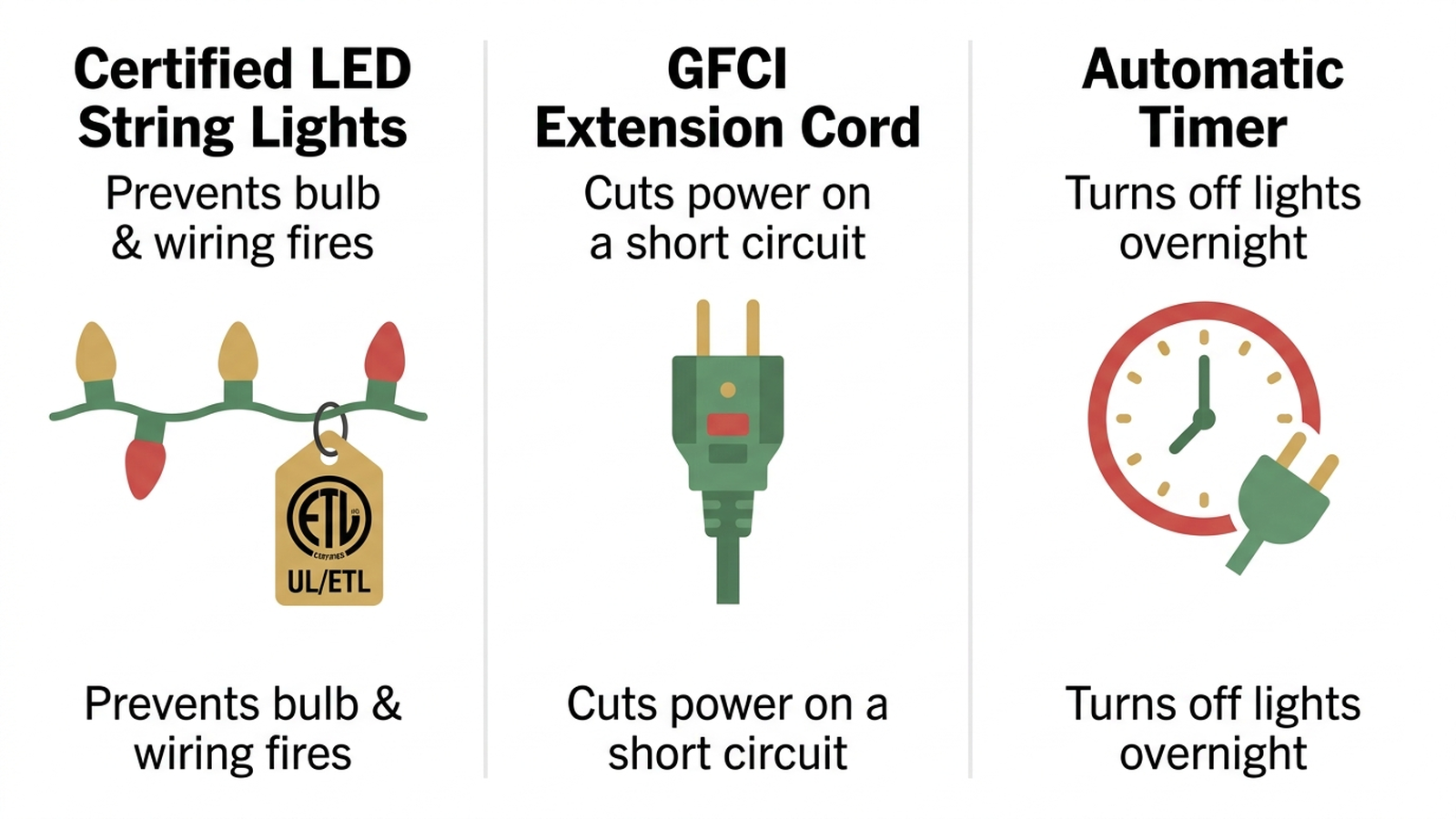
There isn’t one “safe” product — safety comes from three layers working together, and each layer addresses a different failure mode from the NFPA breakdown above:
- Certified LED string lights address the “lamps/bulbs/lighting” and “wiring” categories (38% combined). LEDs run cooler than legacy incandescent mini-lights, which reduces the “heat source too close to tree” risk, and UL or ETL certification means the string has passed independent testing for insulation, strain relief, and overcurrent protection — uncertified imports sold through third-party marketplace listings frequently skip this step.
- GFCI-protected outlets or extension cords address the “cords or plugs” and “electrical failure” categories. A ground-fault circuit interrupter interrupts power quickly if current starts leaking to ground — the exact failure mode behind most short-circuit fires — rather than waiting for a full dead short to trip a standard breaker.
- Automatic timers address the human-error side of the data: CPSC explicitly recommends turning lights off overnight and when leaving the house, because an undetected short is far more dangerous in an empty, sleeping house than one where someone is awake to smell smoke early. A timer makes “lights off when no one’s watching” the default instead of something that depends on remembering.
None of these three layers is optional if you’re trying to actually move the needle on the NFPA numbers — a $40 certified light set on an uncovered, non-GFCI extension cord left on overnight is not meaningfully safer than a cheaper set used more carefully.
Product Options by Category
The table below groups current Amazon listings by which layer of the safety stack they cover, using each manufacturer’s own certification and spec data.
| Product | Category | Certification | Key spec | Price (as of 2026-10-24) |
|---|---|---|---|---|
| Novelty Lights C9 Diamond Faceted LED String Lights, 25ct | LED string lights | UL Listed, indoor/outdoor | Connectable end-to-end, full-wave rectification for flicker-free glow | $24.99 |
| Govee Christmas Lights 2, 164ft / 500 LEDs | Smart LED string lights | IP65 waterproof rating (manufacturer-stated) | App-controlled, 130+ scene modes, shape-mapping for tree outlines | $89.99 |
| DEWENWILS 3FT Manual Reset GFCI Extension Cord, Outdoor | GFCI extension cord | UL Listed | 15A/125V, lighted plug indicates live power | $19.99 |
| BN-LINK Outdoor Power Stake Timer, 6 Outlets | Outdoor timer | ETL Listed | Dusk-to-dawn sensor + 100ft wireless remote, 1875W/15A max | $39.99 |
| BN-LINK 24-Hour Mechanical Timer, 2-Pack | Indoor/outdoor timer | ETL Listed | 30-minute interval settings, 2 grounded outlets per unit | $21.99 |
| Kasa Smart Plug HS103 | Indoor smart plug | UL Certified | App or voice scheduling, no hub required, 15A | $14.99 |
A pattern in the certification marks: the outdoor-rated products here carry ETL (Intertek) rather than UL, which is a common and equally valid independent testing mark in the US market — the two labs test to the same core safety standards, and either one indicates third-party verification rather than self-certification.
Manufacturer Notes
- Novelty Lights is a specialty Christmas-lighting brand (not a general electronics company), and its C9-style sets are aimed at buyers replicating the traditional large-bulb look with LED internals. The connectable, end-to-end design matters for the “don’t daisy-chain more than three sets” rule below — check the specific product’s max-connect spec before assuming it’s unlimited.
- Govee has drawn third-party attention mainly for its app-controlled “permanent” outdoor lighting systems; Consumer Reports’ review of Govee’s permanent outdoor lights noted ease of one-time installation as the main appeal, while cautioning that app-dependent systems add a software layer (and a subscription nudge, in some Govee product lines) that a mechanical timer doesn’t have.
- BN-LINK is a lighting-controls brand whose outdoor timers show up repeatedly in Amazon’s Christmas-lighting accessory category; the dusk-to-dawn sensor variant removes the need to reset the timer as sunset times shift through November and December.
- DEWENWILS and similar GFCI-cord brands exist specifically to retrofit GFCI protection onto outdoor outlets that predate 2008 National Electrical Code requirements (many older homes don’t have GFCI-protected exterior outlets built in).
- Kasa (TP-Link) is a mainstream smart-home brand; its basic single-outlet smart plug is the simplest way to add scheduled on/off control to an indoor tree that’s plugged into a standard (non-GFCI) interior outlet.
How to Set Up a Tree Safely
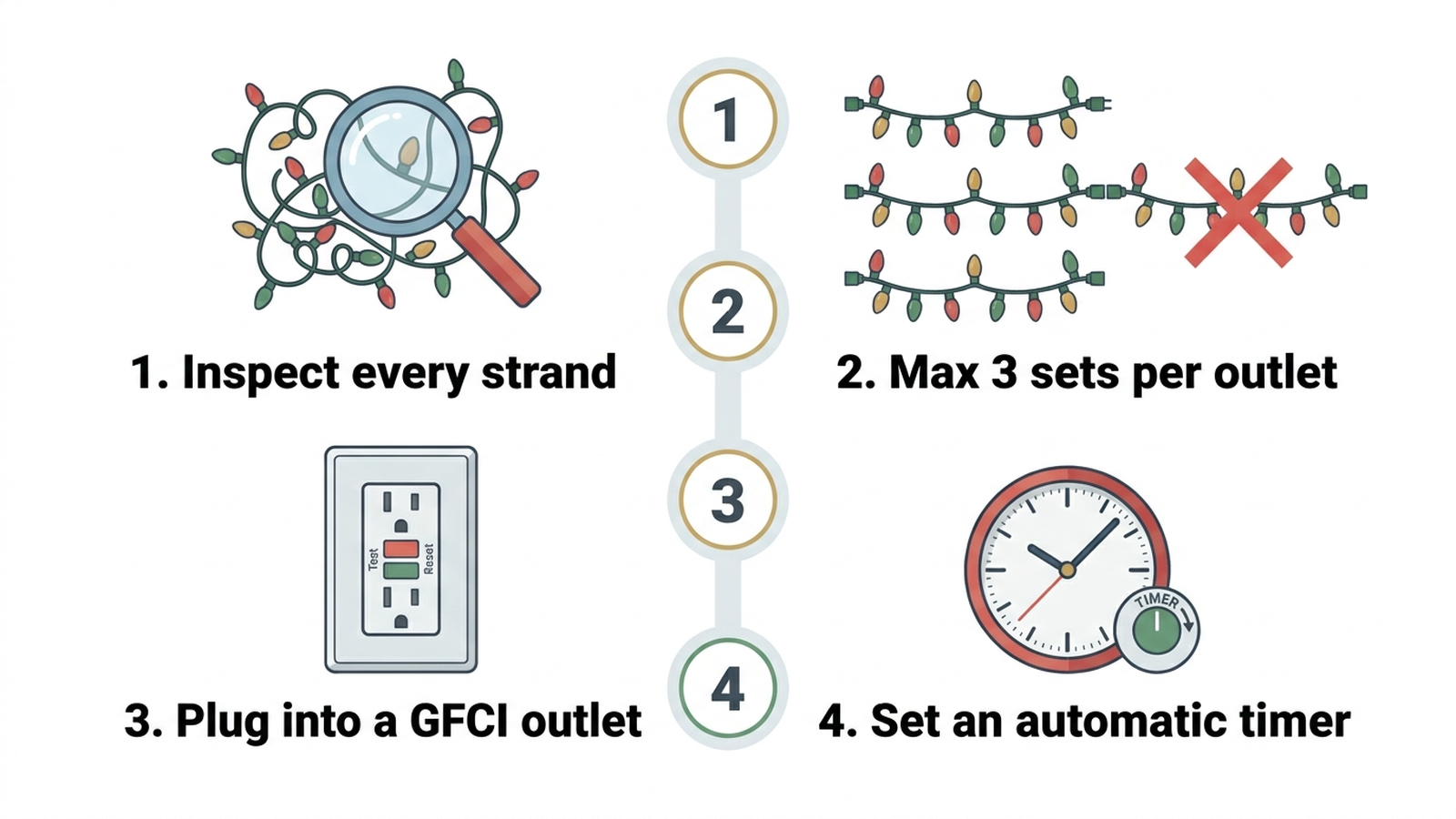
- Inspect every strand before hanging it, new or reused. CPSC guidance specifically calls out checking for cracked sockets, frayed or bare wire, and loose connections — damaged sets should be discarded, not patched with electrical tape and reused.
- Never connect more than three standard-size light sets end-to-end on one extension cord or outlet. This is a direct CPSC recommendation, and it applies per circuit, not per room — multiple decorations sharing one outlet still count toward the limit.
- Plug into a GFCI-protected outlet or cord, especially for anything outdoors or near water (a wet tree stand counts). If the outlet isn’t already GFCI-protected, a GFCI extension cord adds that protection without an electrician visit.
- Set a timer rather than relying on memory. CPSC recommends turning tree and decoration lights off overnight and whenever the house is empty — a mechanical or app-based timer makes this automatic instead of dependent on remembering at 11pm.
- Keep the tree watered and the lights away from heat sources. NFPA attributes 20% of tree fires to heat sources placed too close to the tree — this includes the lights’ own bulbs if sockets are cracked or not rated for outdoor/high-heat-adjacent use, not just space heaters or fireplaces.
- Never plug multiple power strips into each other. CPSC flags daisy-chained power strips as one of the most common overload patterns during the holidays — plug decorations directly into a wall outlet, a single surge protector, or a single timer, not a chain of them.
Which Setup Fits Your Situation
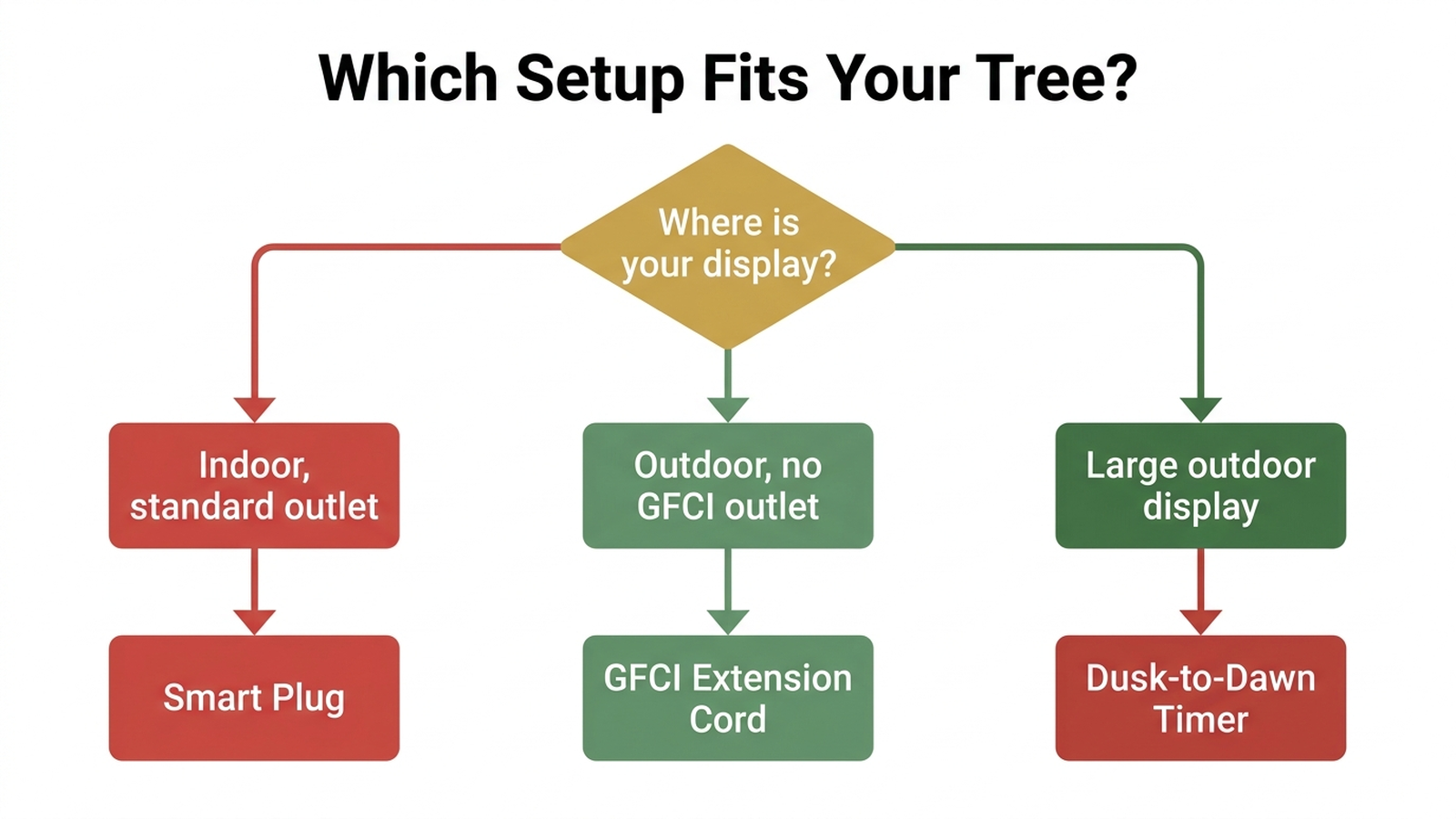
- Indoor tree, standard wall outlet: A basic UL-certified LED set plus an indoor smart plug or simple mechanical outlet timer covers the main risk (lights left on overnight) without needing GFCI hardware, since most interior living-room outlets aren’t required to be GFCI by code.
- Outdoor display, no existing GFCI outlet: Start with a GFCI extension cord before buying more lights — it’s the cheapest single item that addresses the “cords or plugs” failure category, and it protects whatever is plugged into it regardless of brand.
- Large multi-strand outdoor display (roofline, bushes, multiple zones): A dusk-to-dawn outdoor timer stake with multiple outlets both enforces the “off when no one’s watching” rule and reduces the temptation to daisy-chain power strips to reach every zone from one source.
Warranty and Replacement
Most LED string-light sets in this category carry a 1–2 year manufacturer warranty against defects, not damage from outdoor weather exposure beyond the stated IP rating — read the specific listing before assuming full weather coverage. Smart plugs and timers from established brands (Kasa, BN-LINK) typically carry 12–18 month warranties, and Amazon’s own return window is separate from and usually shorter than either. Because certification (UL/ETL) rather than warranty length is what the fire-risk data actually tracks, prioritize the certification mark first and treat warranty length as a secondary factor.
Editorial Recommendation
- Best for most households: Pair a UL-listed LED set like the Novelty Lights C9 string with a basic mechanical timer — this covers both major NFPA risk categories (lighting/wiring and electrical failure from being left on) for under $50 combined.
- Best for outdoor displays without existing GFCI outlets: Buy the GFCI extension cord before anything else; it’s the single item that most directly targets CPSC’s cords-and-plugs fire category regardless of which lights you already own.
- Best for larger or app-managed displays: The Govee smart string plus a BN-LINK dusk-to-dawn timer stake reduces manual setup each evening, though the Consumer Reports review noted app-dependent systems add a software layer worth testing before committing a whole display to it.
Limitations
This analysis relies on aggregate NFPA and CPSC statistics covering all U.S. households, not controlled testing of the specific products listed here, and on a single third-party test (Consumer Reports’ Govee review) rather than side-by-side testing across all brands mentioned. Certification marks (UL/ETL) indicate the product passed standardized safety testing, not that misuse (overloading circuits, leaving damaged strands in service) is prevented by the product itself. Individual fire risk also depends on home wiring age, tree dryness, and local electrical code, which this analysis cannot account for at an individual-home level.
Recommended Products
| Product | Use case | Price (as of 2026-10-24) |
|---|---|---|
| Novelty Lights C9 Diamond Faceted LED String Lights, 25ct | UL-listed traditional-look LED tree lights | $24.99 |
| DEWENWILS 3FT Manual Reset GFCI Extension Cord, Outdoor | Adds GFCI protection to any outdoor outlet | $19.99 |
| BN-LINK Outdoor Power Stake Timer, 6 Outlets | Dusk-to-dawn automatic shutoff for larger outdoor displays | $39.99 |
| Kasa Smart Plug HS103 | Scheduled on/off for a single indoor tree outlet | $14.99 |
Before You Buy
Specs, certifications, and prices change, and the right setup depends on your specific tree location and home wiring. Visit Arekore to check current Amazon pricing and verify any product mentioned here before you buy.