Breville Barista Express Review 2026: Worth It?
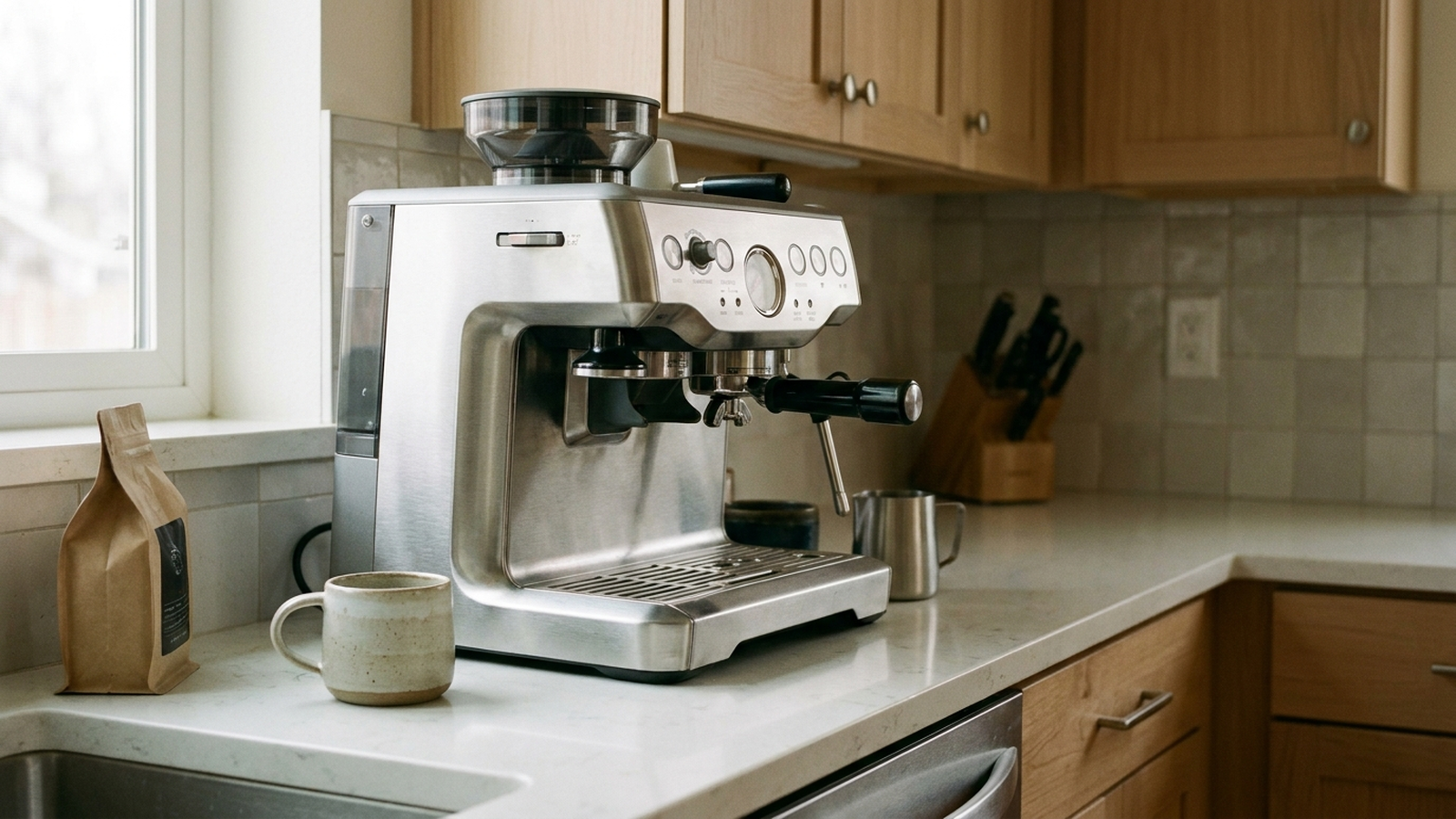
The Breville Barista Express (BES870XL) has been the best-selling espresso machine in North America for roughly ten years, and it still shows up as a top pick on independent testing sites in 2026. But “best-selling” and “easiest to use” are not the same claim. The Barista Express asks a first-time buyer to grind, dose, tamp, and pull a shot by hand — a workflow with a real learning curve, which is exactly why Breville later released an automatic-tamping sibling, the Barista Express Impress. We pulled apart manufacturer specs, independent lab tests, and aggregated owner sentiment to answer a narrower question than “is it good”: is the manual workflow still worth learning in 2026, or should a beginner default to the Impress instead.
As an Amazon Associate, Arekore earns from qualifying purchases. The Amazon product links in this article include our affiliate tracking ID and may earn us a commission if you buy through them, at no additional cost to you. See our Links Policy for details on how we select products and how commissions do not influence our recommendations.
TL;DR / Quick Verdict
- The Barista Express has genuinely held up. Independent testers at Tom’s Guide and TechGearLab both still rank it among the best all-in-one home espresso machines in 2026, roughly a decade after its original release, citing consistent shot quality and a capable steam wand.
- The learning curve is real, not marketing spin. Manual dosing and tamping — the two steps most beginners get wrong first — are the main source of inconsistent shots in aggregated owner reviews, and Breville built an entire second model, the Barista Express Impress, specifically to remove them.
- The Impress costs more for less manual skill-building. At roughly $50–$100 more than the base Express depending on finish, the Impress adds automatic tamping and a dosing gauge but does not out-perform the Express on raw espresso quality in third-party testing.
- Aggregated Amazon sentiment is strong but not universal. The Barista Express carries an average rating in the mid-4-star range across tens of thousands of ratings, with the most common complaints centered on the learning curve and a missing low-water warning rather than build quality.
How We Reached These Conclusions (Methodology)
This is an editorial analysis, not a hands-on review; we did not personally test the products covered here. It synthesizes three kinds of public information: (a) manufacturer specifications published by Breville for the Barista Express and Barista Express Impress; (b) independent third-party lab testing and long-form reviews from Tom’s Guide and TechGearLab, both of which have separately tested the Barista Express and rated it among the top home espresso machines; and (c) aggregated sentiment from Amazon customer reviews, which we describe directionally (e.g., “mid-4-star average”) rather than citing an exact review count, since totals fluctuate. Manufacturer-published figures (wattage, bar pressure, grind settings) are labeled as such. Prices are amazon.com list prices at the time of writing and change frequently, especially around sales events like Prime Day and Black Friday.
Does the Learning Curve Still Matter in 2026?
The Barista Express’s core design has not changed much since its original release: a built-in conical burr grinder feeds ground coffee directly into a 54mm portafilter, which the user then levels and tamps by hand before locking it into the group head. That manual step — dosing the right amount of grounds and tamping them evenly — is the single most common point where new users produce an inconsistent shot, whether too fast (under-extracted, sour) or too slow (over-extracted, bitter). Independent testers at TechGearLab, who rank the Barista Express #1 of 11 espresso machines tested and gave it an Editors’ Choice award, describe it as capable of some of the best espresso quality in their test pool, but note it “requires a bit of study and practice to master” — the machine’s ceiling is high, but so is the initial skill requirement compared to a fully automatic machine.
Breville’s own answer to this problem is the Barista Express Impress, released as a follow-up model rather than a replacement. The Impress keeps the same 54mm portafilter, conical burr grinder, and 67-ounce water tank as the original Express, but adds an automatic tamping mechanism and a “smiley face” dosing gauge that shows the user, in real time, whether they’ve added the right amount of coffee before the machine tamps it automatically. This removes the two steps most responsible for inconsistent beginner shots. It does not, per third-party testing, produce meaningfully better espresso than the Express in the hands of someone who already knows how to dose and tamp manually — the Impress trades some manual-skill-building for consistency, not for a higher performance ceiling.
Technical Approach: Manual Tamping vs. Automatic Dosing

- Breville Barista Express (BES870XL): 15-bar pump, thermocoil heating with PID temperature control, integrated conical burr grinder with 16 grind settings, 54mm portafilter, dual- and single-wall filter baskets included, 67-ounce water tank, 1600 watts. Grinding, dosing, and tamping are entirely manual.
- Breville Barista Express Impress (BES876): Shares the same conical burr grinder, 54mm portafilter, and 67-ounce water tank as the original, but adds 25 grind settings, an automatic tamping mechanism, and a real-time dosing gauge. The unit is roughly half an inch larger in height and width to accommodate the tamping hardware.
- Practical distinction: a buyer who wants to learn the traditional espresso workflow — and who is willing to waste a few shots getting the grind and tamp dialed in — gains little from paying more for the Impress. A buyer who wants consistent shots from day one, with less hands-on technique to learn, is the target market for the step-up model.
How to Use the Barista Express

- Grind directly into the portafilter, using the built-in dial to select a grind size — finer for espresso than drip coffee, adjusted using the machine’s 16 settings. Manufacturer guidance recommends starting in the middle of the range and adjusting based on shot timing.
- Level and tamp the grounds using the included tamper, applying firm and even pressure. Uneven tamping is the most frequently cited cause of “channeling” (water finding a path of least resistance through the puck) in aggregated owner reviews and third-party troubleshooting guides.
- Lock the portafilter into the group head and start the shot, targeting roughly 25–30 seconds for a double shot, per manufacturer and independent-tester guidance. The integrated pressure gauge — which TechGearLab notes “lets you easily tell if you’ve messed something up in the prep process and aren’t reaching a good brewing pressure” — gives a visual read on whether the pressure is in the correct range as the shot pulls.
- Purge the steam wand before and after frothing milk, then wipe it down immediately. Manufacturer guidance and aggregated owner tips both flag milk residue left on the wand as the most common maintenance oversight, since dried milk can clog the steam tip over time.
Comparison Table
Prices as of 2026-09-13. These are list prices seen on amazon.com; actual selling prices fluctuate frequently and are commonly discounted below list, especially around Prime Day and Black Friday — always check the current price on the product page.
| Model | ASIN | List price | Grind settings | Tamping | Best for |
|---|---|---|---|---|---|
| Breville Barista Express (Brushed Stainless Steel) | B00CH9QWOU | ~$699.95 | 16 | Manual | Buyers who want to learn the traditional workflow |
| Breville Barista Express Impress (Brushed Stainless Steel) | B0BBYNPV33 | ~$649.95–$719.95 | 25 | Automatic | Buyers who want consistency without the tamping learning curve |
| Breville Barista Express Impress (Black Stainless Steel) | B0DFX7FHYS | ~$719.95 | 25 | Automatic | Buyers who prefer the darker finish, same mechanism as above |
Editorial Recommendations by Use Case
- Best for buyers who want to actually learn espresso technique: the original Barista Express — manual dosing and tamping are extra steps, but they’re also the skill that transfers to any future espresso machine, and independent testers still rate its shot quality among the best in its price class. Check the Breville Barista Express on Amazon
- Best for buyers who want consistent shots with minimal technique: the Barista Express Impress — the automatic tamping and dosing gauge remove the two steps most likely to produce a bad first month of shots. Check the Breville Barista Express Impress (Brushed Stainless) on Amazon
- Best for buyers who want the Impress mechanism in a darker finish: the Impress in Black Stainless Steel — identical internals to the brushed-steel Impress, priced similarly. Check the Breville Barista Express Impress (Black Stainless) on Amazon
- If counter space or budget is the deciding factor: Tom’s Guide’s own review notes that buyers on a tighter budget or with limited counter space may prefer the smaller Breville Bambino Plus, which trades the built-in grinder for a more compact footprint — worth cross-shopping if grinding beans yourself isn’t a priority.

Durability and Warranty
Breville backs the Barista Express with a 1-year limited manufacturer warranty covering defects in materials and workmanship, which does not cover wear items like filter baskets or gaskets degraded through normal use. Independent testers and aggregated owner reviews both describe the Barista Express as having one of the stronger longevity track records in the home-espresso category, with many units reported to remain functional for five to eight years under regular use and basic descaling maintenance — though this figure comes from aggregated review commentary rather than a formal manufacturer reliability study, so it should be read as directional rather than a guaranteed service life. The most frequently cited maintenance issue in owner reviews is mineral buildup from skipped descaling cycles, not a manufacturing defect. Confirm current warranty terms on the product page, as coverage details are occasionally updated.
Limitations of This Analysis
This analysis relies on manufacturer specifications, third-party testing from Tom’s Guide and TechGearLab, and aggregated Amazon customer sentiment; we did not personally test either machine, and individual experience varies with bean freshness, grind calibration, and unit-to-unit variance. We did not find a published Consumer Reports score specific to the Barista Express in our research and have not cited one. The “5–8 years” longevity figure and the mid-4-star aggregated rating both come from review-site synthesis rather than a controlled reliability study, and complaint patterns on public review platforms tend to skew toward dissatisfied buyers who sought out a place to post, so read both figures as directional rather than precise. The home espresso machine market itself is estimated in the low single-digit billions of dollars globally in 2026 by industry research firms, with mid-single-digit-percent annual growth projected through the early 2030s — these figures come from third-party market-research firms whose methodologies differ from each other, so we present them as general market context rather than a precise number specific to either Breville model. Prices, ASIN availability, and warranty terms change frequently — always confirm current details on the product page before buying.
The Bottom Line
Ten years after its release, the Breville Barista Express still earns “one of the best espresso machines around” from independent testers in 2026 — but that verdict comes with an asterisk about the manual tamping and dosing steps that trip up first-time buyers. If you want to learn the traditional workflow and don’t mind a few inconsistent shots while you calibrate, the original Express remains a strong, well-tested choice at its price point. If consistency from day one matters more than learning the manual technique, the Barista Express Impress removes the two hardest steps for roughly $50–$100 more, without sacrificing the shot quality that made the original popular. Whichever you lean toward, check the current price and read the most recent reviews before buying — and if you want a second opinion on a specific listing, paste the URL into Arekore and let the AI scan the reviews and price history for you in about five minutes.