Bought and Regretted 2026: 7 One-Star Review Patterns

The five-star average on a product page is doing less work than most shoppers assume. A tumbler, a robot vacuum, and a pair of earbuds can all sit at 4.6 stars and still carry the same handful of complaints buried in the one- and two-star tail — complaints that don’t show up until month three, not day one. We went looking for the patterns underneath those low-star reviews across several of Amazon’s best-selling gadget categories, cross-checked against independent test data and manufacturer documentation, and found the same seven structural issues recurring across product types that otherwise have nothing in common.
As an Amazon Associate, Arekore earns from qualifying purchases. The Amazon product links in this article may include our affiliate tracking ID and may earn us a commission if you buy through them, at no additional cost to you. See our Links Policy for details on how we select products and how commissions do not influence our recommendations.
TL;DR / Quick Verdict
- Most regret isn’t about the product failing outright — it’s a gap between what the listing implies and what the fine print or the fifth month of ownership actually delivers.
- Wireless earbuds degrade asymmetrically. One earbud (typically the one worn more, or the primary mic side) loses usable battery life well before the other, months before either is “dead” by the case’s charge indicator.
- “Pay-to-remember” smart cameras and doorbells work as live-view peepholes without a subscription — recording, event history, and person alerts are typically gated behind a monthly fee not obvious at checkout.
- Nonstick-coated air fryer baskets commonly show visible coating wear within 6–18 months of regular use, according to multiple independent product-care assessments, even with careful cleaning.
- Robot vacuums account for two distinct complaint clusters: navigation failures (stuck on cords, thresholds, pet waste) and a reliability cliff where units stop turning on entirely within weeks to a year of purchase.
- Ergonomic design choices that look good in marketing photos — a wide comfort-grip handle, a built-in straw — can create real daily friction (hand fatigue, extra cleaning steps) that reviewers only report after weeks of use.
How We Reached These Conclusions (Methodology)
This is an editorial analysis, not a hands-on test of every product named here. This guide synthesizes: (a) aggregated amazon.com customer-review sentiment and reviewer-reported patterns for best-selling wireless earbuds, robot vacuums, air fryers, security cameras/doorbells, and insulated tumblers, sampled in July 2026; (b) independent product testing and consumer-advice coverage from BGR, Forbes, Tom’s Guide, TechRadar, Family Handyman, and Consumer Reports; (c) a University of Texas battery-degradation study on asymmetric earbud wear reported by Axios; (d) manufacturer support documentation on subscription-gated features (Ring, Wyze); and (e) Consumer Reports’ published appliance-reliability survey data. We did not personally own or test every unit discussed. Manufacturer-published figures are labeled as such rather than presented as independently verified; percentages and figures are attributed to their original source below.
The Seven Patterns, Ranked by How Often They Recur
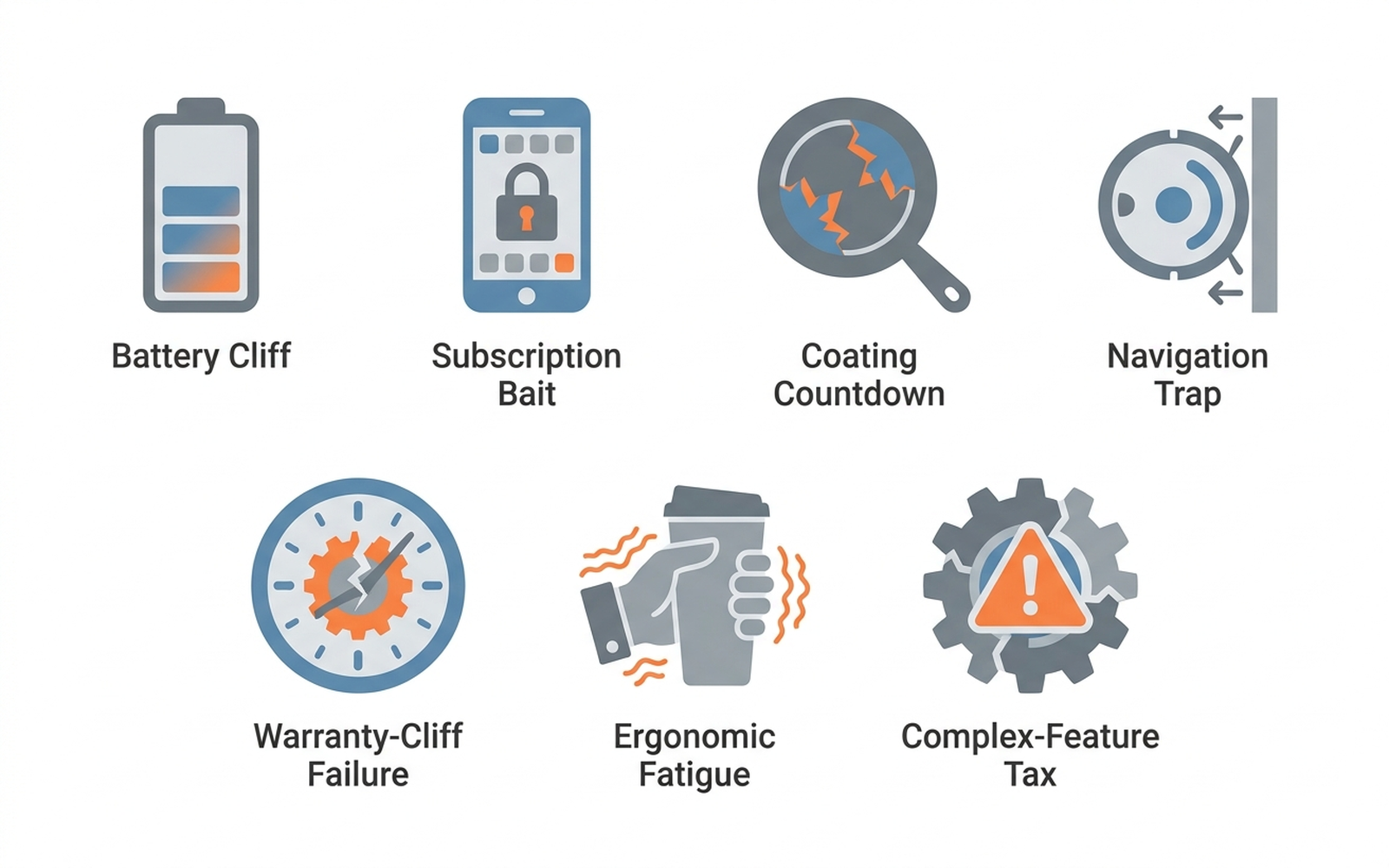
1. The Battery Cliff — wireless earbuds
Bluetooth earbud reviews consistently describe a battery that “used to last all day” starting to disconnect or die within an hour, long before the case’s indicator suggests either bud is out of charge. A University of Texas researcher’s own real-world case, reported by Axios, found that after roughly two years of typical use — wearing only one earbud consistently more than the other — the more-used bud’s battery had degraded so much further than its twin that the two were no longer functionally matched, even though both showed similar “cycles” on paper. Reviewer complaints across the wireless-earbud category echo this: connections that were rock solid at 80% charge become unreliable at 15%, well before the battery reads as depleted. TechRadar’s own reporting on earbud battery health notes this degradation curve is a known, structural issue with small lithium-ion cells run through frequent full-discharge cycles in the compact case format most true wireless earbuds use — not a defect specific to one brand.
2. The Subscription Bait — smart cameras and video doorbells
Ring’s video doorbells and cameras function largely as a live-view-only peephole without an active Ring Protect subscription: no recorded video history, no event playback, and no motion or person-detection notifications, according to Ring’s own plan documentation and consumer comparisons from outlets like Forbes and Alarm Reviews. Reviewers describe the discovery moment consistently — “what good is a camera if you can’t review anything without a subscription,” as one commonly cited complaint pattern puts it. Wyze cameras, by contrast, are frequently praised in the same review threads for supporting free local microSD recording without a mandatory plan, which reviewers explicitly credit as a purchase-influencing feature even when they don’t use it.
3. The Coating Countdown — nonstick air fryer baskets
Ceramic sol-gel nonstick coatings used in many mid-range air fryer baskets — the same coating type used across popular Ninja and Cosori lines — commonly show scratching, chipping, or reduced nonstick performance within roughly 6 to 18 months of regular use, according to multiple independent product-care assessments, even when users avoid metal utensils. Reviewer reports on Ninja’s Dual Zone line describe basket coating loss within about 10 months of typical use; some reviewers separately note that low-fat cooking sprays — widely recommended in recipe content for air fryers — leave a residue that accelerates coating wear, a mechanism confirmed in air fryer maintenance guides. Fully stainless-steel baskets, offered on some Instant Pot multi-cooker air-fry configurations, avoid the coating-wear complaint entirely, at the cost of more manual scrubbing.
4. The Navigation Trap — robot vacuums
Across Roomba and Shark reviews, the most consistently reported frustration is a robot that gets physically stuck — behind toilets, on cords, in tight corners between furniture legs, or on pet waste it fails to identify and instead drags across a floor. BGR’s own review roundup on robot vacuum brands to avoid cites recurring navigation complaints as a primary driver of buyer dissatisfaction, and Forbes’ Shark-vs-Roomba comparison notes navigation-system mapping errors as an ongoing pain point even on premium-tier units with obstacle-avoidance marketing claims.
5. The Warranty-Cliff Reliability Failure — premium robot vacuums
Distinct from navigation issues, a second and arguably more serious complaint cluster describes units that simply stop turning on — anywhere from a few weeks to about a year after purchase — on higher-priced Shark models, some priced above $500, an issue BGR’s reporting flags as a recurring reason to steer clear of certain robot-vacuum models. Reviewer threads on retailer and consumer-advocacy sites separately describe warranty and replacement-process frustration on top of the outright failures, though the specifics of any individual claims process vary by retailer and are not independently verified here.
6. The Ergonomic Fatigue Design — insulated tumblers
The Stanley Quencher’s wide comfort-grip handle photographs well and is frequently cited as a design strength in early reviews, though owner write-ups on forums and retailer Q&A sections describe a more mixed experience in practice: carrying a full 40-oz tumbler by the handle for extended periods leads some owners to set it down and pick it back up periodically rather than carry it continuously. This qualitative pattern hasn’t been quantified in a controlled test we could locate, so treat it as a reported tendency rather than a measured figure. A second, separate complaint cluster centers on the built-in straw: it doesn’t seal completely against tipping, causing leaks in cup holders and bags, and its narrow bore requires daily cleaning with a dedicated brush to avoid the bacterial buildup that microbiologists note is a general risk with reusable straws left unclean.
7. The Complex-Feature Tax — appliances with premium add-ons
The broadest pattern, and the one Consumer Reports has quantified most directly: optional convenience features are consistently the first component to fail on any appliance. Consumer Reports’ appliance reliability data finds an estimated 31% of refrigerators with an icemaker develop an icemaker- or dispenser-specific problem by the end of the fifth year of ownership — a failure rate specific to that added feature, not the refrigerator’s core cooling function. The same logic recurs informally across smart-gadget reviews: the more optional, marketing-forward a feature is (auto-empty docks, app-connected sensors, secondary displays), the more likely it is to be the specific part named in a low-star review, even when the product’s core function keeps working.
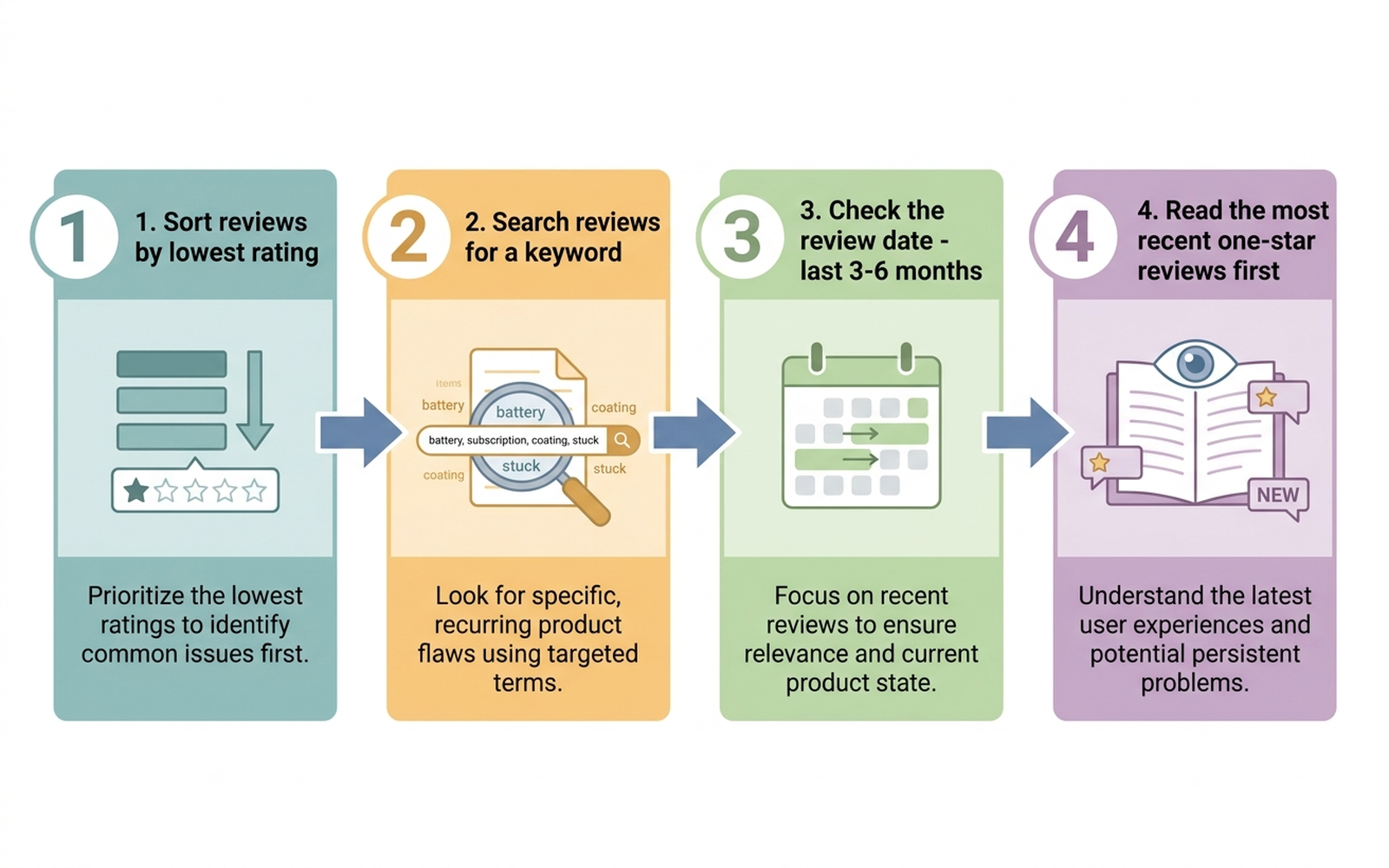
Finding these patterns yourself takes about the same amount of time as reading the product description: sort a listing’s reviews by lowest rating first, then search within reviews for a keyword tied to the category’s known failure point (battery, subscription, coating, stuck, handle), and prioritize reviews from the last three to six months over the review count as a whole, since older reviews may predate a design revision.
Customer Sentiment Synthesis
Reading across categories, two threads recur regardless of product type. First, the complaint is rarely “it doesn’t work” — it’s “it stopped being as good as it was on day one,” and reviewers consistently note that this shows up weeks or months after the return window closes. Second, reviewers who avoided a pattern often credit the same design choice that frustrated other buyers — a subscription-free camera, a stainless basket, a simpler feature set — as the reason they’d buy that product again, suggesting the fix is rarely “avoid the category” and usually “buy the version of the category that skips the specific failure point.”
Where Each Pattern Shows Up: A Comparison
| Pattern | Product category | What reviewers report | Source |
|---|---|---|---|
| Battery Cliff | Wireless earbuds | Asymmetric battery drain well before “dead” | University of Texas study via Axios; TechRadar |
| Subscription Bait | Smart cameras/doorbells | No recording/alerts without paid plan | Ring plan docs; Forbes |
| Coating Countdown | Air fryers | Nonstick wear within 6–18 months | Tom’s Guide; product-care assessments |
| Navigation Trap | Robot vacuums | Stuck on cords, corners, pet waste | BGR; Forbes |
| Warranty-Cliff Failure | Premium robot vacuums | Unit stops turning on within weeks–1 year | BGR |
| Ergonomic Fatigue | Insulated tumblers | Handle fatigue on extended carry; straw leaks/hygiene | Family Handyman; owner/retailer reviews |
| Complex-Feature Tax | Appliances w/ add-ons | Optional feature (icemaker, etc.) fails first | Consumer Reports |
Should You Worry About This One? A Quick Check
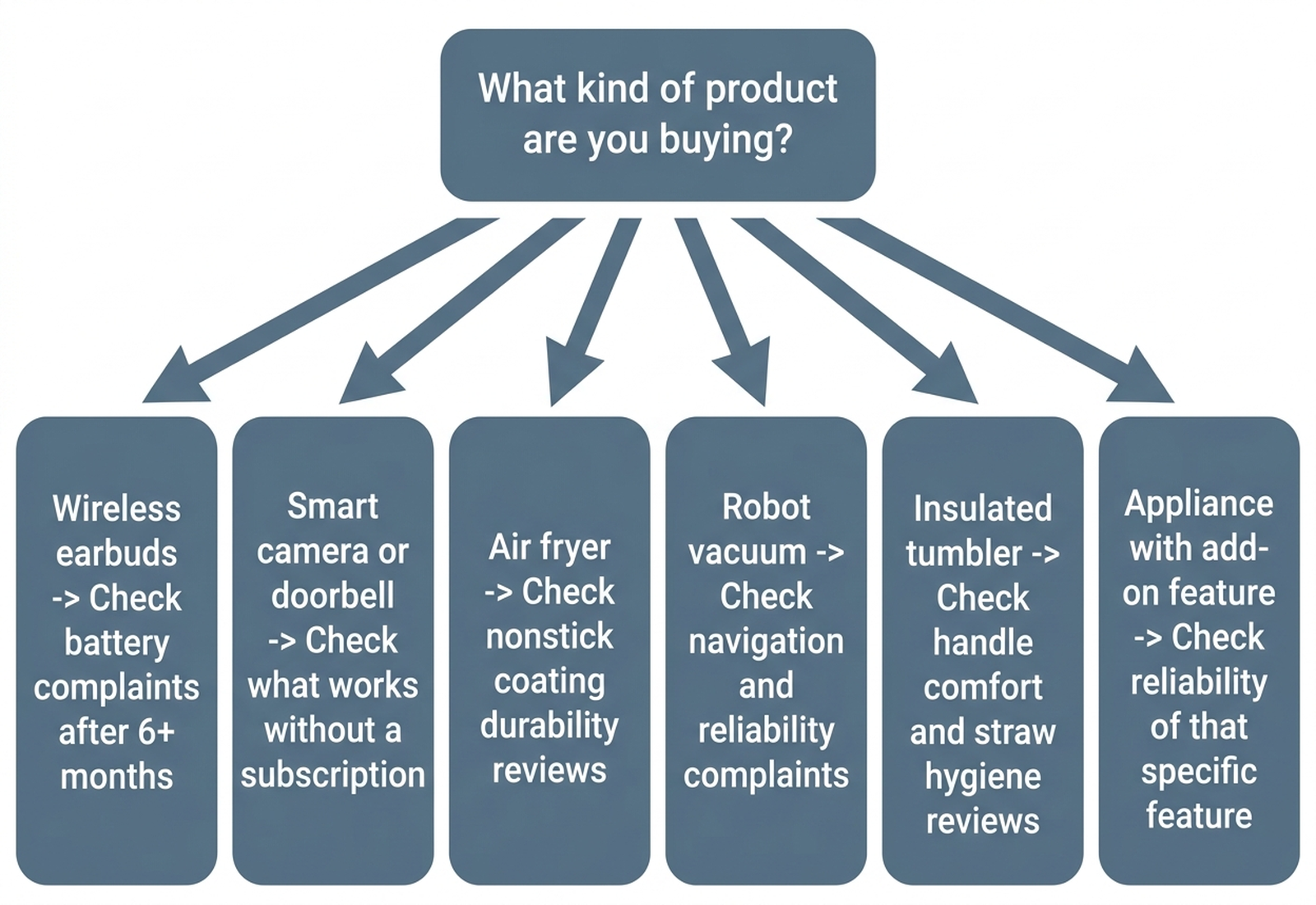
Before buying into any of these categories, the fastest check is searching the product’s own review page for the specific failure mode above — “battery,” “subscription,” “coating,” “stuck,” “won’t turn on,” or “handle” — rather than relying on the star average, since these complaints cluster in the one- and two-star tail that most shoppers never scroll to.
What the Data Says to Do About It
None of these seven patterns are reasons to avoid the underlying product category — robot vacuums, earbuds, air fryers, smart cameras, and insulated tumblers are all reasonably rated overall across the reviews we looked at. The pattern is narrower: each category has a specific, well-documented failure point that shows up consistently enough in low-star reviews and independent testing to be worth checking before checkout, not after. Reading the one- and two-star reviews for the specific model — not just the overall average — surfaces almost all seven patterns above in a few minutes.
Limitations
This analysis relies on aggregated amazon.com review sentiment, independent testing coverage from outlets including BGR, Forbes, Tom’s Guide, TechRadar, Family Handyman, and Consumer Reports, and manufacturer support documentation, rather than a hands-on test of every specific unit named. Review sentiment is not a controlled study; complaint frequency in review sections can be influenced by review volume, product age, and how prominently a platform surfaces critical reviews. Figures such as coating-wear timelines and battery-degradation curves vary by individual unit, usage pattern, and climate. Individual experience may differ from the aggregated patterns described here.
Bottom Line
The one-star tail of a product’s reviews is where the real due diligence lives — not because the average rating is wrong, but because it averages away exactly the failure mode that matters most to someone about to buy that specific item. Across earbuds, cameras, air fryers, robot vacuums, and tumblers, the same seven structural patterns keep resurfacing in different packaging: batteries that fade unevenly, features locked behind subscriptions, coatings that wear out, navigation that gets stuck, reliability that cliffs after warranty windows close, ergonomics that fatigue with use, and optional add-ons that fail first. Checking for the specific pattern that applies to a category — before buying, not after the return window closes — is the difference between an accurate expectation and a review titled “bought and regretted.”
Before you buy, paste the product link into Arekore — our AI assistant checks review authenticity, surfaces what the one-star reviews actually complain about, and compares prices, free, in about five minutes.