Do Blackout Curtains Actually Lower Your Cooling Bill?
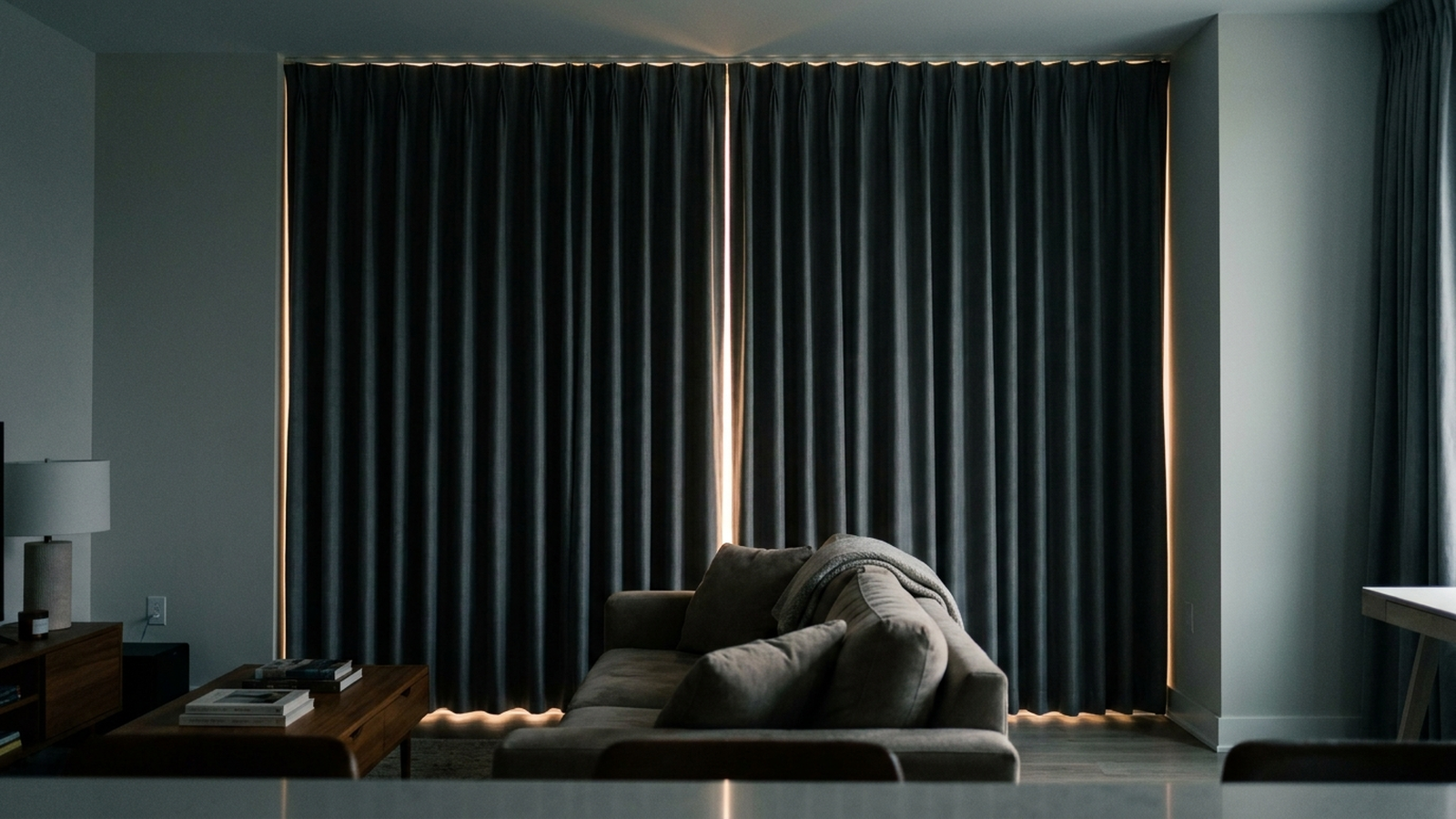
Type “blackout curtains” into any search engine and the marketing writes itself: “cut your energy bill by 25%,” “block 99% of heat,” “pay for themselves in one summer.” With the U.S. Energy Information Administration’s most recent summer forecast putting average residential electric bills at $178 per month (June–September 2025, up from $173 the prior summer), that pitch lands on a lot of anxious households. The window coverings business is not small, either — Grand View Research projects the U.S. market to reach roughly $11.8 billion by 2030, growing 6.9% a year.
So we checked the claim against the least glamorous sources available: Department of Energy guidance, Pacific Northwest National Laboratory (PNNL) instrumented-home experiments, and EIA consumption data. The short answer: blackout curtains genuinely reduce cooling load, but the number on your bill is smaller than the number in the ads — and it depends far more on how you hang them, which windows you cover, and what is behind the fabric than on the word “blackout” on the box.
This article is provided by Arekore, an AI shopping assistant. Paste a product URL and our AI checks review authenticity, digs into low-star feedback, and compares prices in about five minutes.
TL;DR / Quick Verdict
- Yes, they work — modestly. The Department of Energy’s own figure: medium-colored draperies with a white plastic backing reduce solar heat gain through the covered window by about 33%. That is heat gain through the window, not 33% off your bill.
- The realistic bill impact is single digits. Windows account for roughly 25–30% of residential heating and cooling energy use (DOE). In PNNL’s instrumented lab homes, even top-performing cellular shades cut cooling-season HVAC energy by 10.4 ±6.5% versus ordinary vinyl blinds. Fabric curtains sit at or below that range.
- Cellular shades beat blackout curtains on physics. DOE credits tightly installed insulated cellular shades with reducing unwanted solar heat by up to 60%, against about 33% for backed draperies. Curtains win on price, looks, and dark bedrooms.
- Installation is the multiplier. A dark, unlined curtain hung on a decorative rod six inches off the wall gives most of the savings back to convection. Ceiling-to-floor, wall-tight mounting with a reflective backing is where the published numbers come from.
How We Reached These Conclusions (Methodology)
This is an editorial analysis, not a hands-on test. We did not personally test the products covered here. This guide synthesizes three kinds of public information: (a) published energy data and guidance from the U.S. Department of Energy’s Energy Saver program, PNNL Lab Homes experiments, the EIA, and ENERGY STAR; (b) independent product testing from Consumer Reports (which lab-tested nine blackout-curtain brands with a 5,000-lumen flashlight test and separate thermal-insulation measurements), Wirecutter (The New York Times), and CNN Underscored; and (c) aggregated amazon.com customer-review sentiment across best-selling blackout curtain and cellular shade listings, sampled in July 2026, plus manufacturer specifications. Light-blocking percentages and insulation figures quoted from product listings are manufacturer claims unless attributed to an independent source. Prices are amazon.com figures at the time of writing and fluctuate, especially in summer.
The Physics: Where Summer Heat Actually Enters
A standard double-pane window lets roughly 75% of the sun’s heat into the room, per DOE-affiliated building-science guidance. Once that radiation passes the glass and hits your floor, it is heat, and your air conditioner has to pump it back out. Window heat gain and loss together account for roughly 25–30% of residential heating and cooling energy use — which is exactly why window treatments are worth discussing and also why no interior fabric can cut your total bill by 25%. The theoretical ceiling is bounded by the window share itself.
An interior curtain plays defense one step too late: the sunlight is already through the glass. What a good blackout curtain does is intercept that radiation and reflect part of it back out the window before it soaks into the room — which is why the backing color matters more than the room-facing color, and why DOE’s guidance specifies draperies with white plastic backings for its 33% heat-gain figure. A stylish charcoal panel with no reflective backing absorbs the radiation instead, warms up, and re-radiates a good share of it into the room.
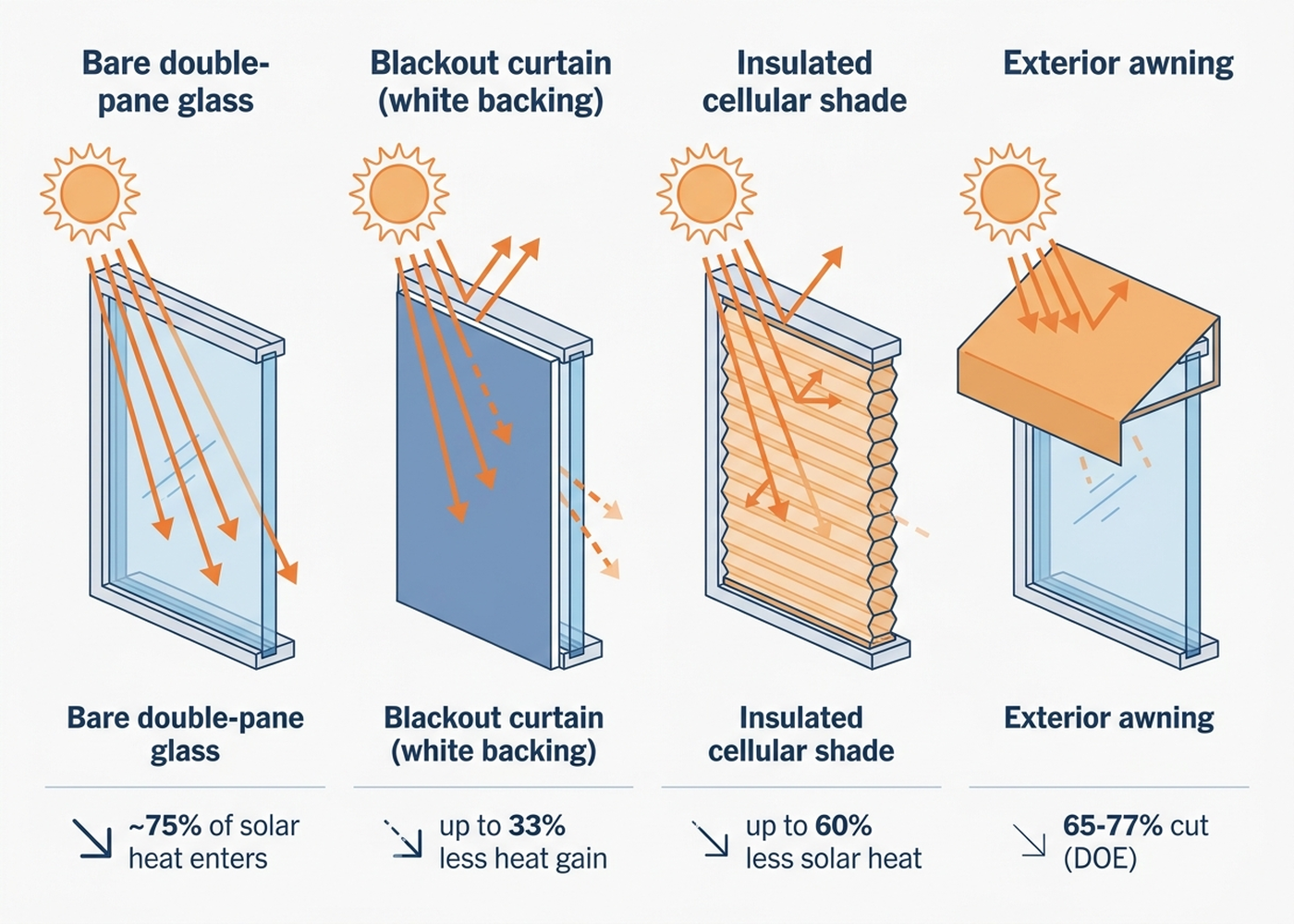
Three tiers emerge from DOE’s published figures, in ascending order of effectiveness:
- Blackout / thermal curtains (white-backed): about 33% less heat gain through the covered window. Cheapest, easiest, renter-proof, and the only option that also gives you a pitch-dark bedroom.
- Insulated cellular (honeycomb) shades: up to 60% less unwanted solar heat in cooling season, and 40%+ less heat loss in winter, when tightly installed. The honeycomb cells trap air against the glass. DOE calls them the highest-R-value window covering, and Minnesota became the first state to list them as a recognized energy-saving measure.
- Exterior shading (awnings, exterior shades): 65% reduction on south-facing and 77% on west-facing windows (DOE) — because they stop the sun before the glass. Unbeatable, but usually not an option for renters.
What the Instrumented Tests Found — Not the Ads
The most honest numbers in this category come from PNNL’s Lab Homes in Richland, Washington: two identical, instrumented houses run side by side, one with the product under test. In those experiments, insulated cellular shades reduced cooling-season HVAC energy by 10.4 ±6.5% compared with ordinary vinyl horizontal blinds, and heating-season HVAC energy by 17.6 ±8.1%. A follow-up measurement-and-simulation study put high-efficiency cellular shades at up to ~25% cooling HVAC savings under favorable operating conditions — automated operation, hot climate, full coverage.
Read those error bars carefully. The best-measured window attachment, in a controlled experiment, delivered roughly 4–17% cooling savings depending on conditions. Fabric blackout curtains — with looser edges, no honeycomb air layer, and highly variable installation — should be expected to land at or below the bottom of that band. That is the gap between “reduce heat gain through the window by 33%” (true, DOE) and “cut your energy bill by 25%” (marketing arithmetic that quietly swaps the window for the whole house).
There is also a warm-room paradox worth knowing: because interior curtains trap a layer of hot air between fabric and glass, a poorly sealed dark curtain can leave the room air marginally warmer than a reflective, tightly sealed one, even while both darken the room. This is an editorial inference from DOE’s convection guidance rather than a measured result, but aggregated one- and two-star reviews on best-selling blackout listings echo it: “room stayed hot” complaints cluster around dark colors, narrow panels, and rods mounted well off the wall.
The Dollar Math, Honestly
EIA data pins air conditioning at about 19% of U.S. home electricity use (254 billion kWh in 2020) and analyses of EIA data put cooling costs for homes with central AC at roughly $490 across June–September. Take a realistic middle: if well-hung blackout curtains on your sun-struck windows trim overall cooling load by 5–10% — consistent with the PNNL band and DOE’s window-share arithmetic — that is roughly $25–$50 per summer for a central-AC household, more in hot-humid regions where cooling reaches 27% of home energy spending (EIA), less in mild ones. This is our editorial estimate from the cited public data, not a lab measurement of any specific product.
Against that: a two-panel set of best-selling blackout curtains costs about $20–$35 and a lined 100%-blackout set about $45–$70 at the time of writing. The payback period is one to two summers for curtains you probably also wanted for sleep and privacy. As pure energy investments they are unspectacular; as $30 purchases that also darken a bedroom, block UV fading, and dampen street noise, the aggregated review sentiment is easy to understand.
The Products the Independent Testers Actually Liked
“Blackout” is an unregulated word. Consumer Reports lab-tested nine widely sold blackout-curtain lines — including Amazon Basics, Ikea, Nicetown, Pottery Barn, and Target’s Threshold — by holding each against a 5,000-lumen flashlight and separately measuring thermal insulation. Its conclusion: most curtains sold as “blackout” do not deliver blackout, and darker colorways within the same product line usually block more light than lighter ones. Only two of the nine lines earned a full recommendation. Wirecutter’s testing reached the same shape of conclusion: only two curtains in its test pool blocked essentially all light through the fabric.
With that filter applied, four products dominate the value discussion on amazon.com:
NICETOWN Thermal Insulated Grommet Blackout Curtains — the default
The best-selling blackout curtain on Amazon, with an aggregated review base in the hundreds of thousands across colorways. Triple-weave polyester, no separate liner; the manufacturer claims 85–99% light blocking depending on color — an unusually honest spec, and consistent with Consumer Reports’ finding that darker shades block more. Aggregated sentiment praises the price-to-darkness ratio and noise softening; recurring critiques are that lighter colors let a glow through and that panels arrive with shipping creases. About $20–$35 for a two-panel set at the time of writing.
Check the NICETOWN Thermal Insulated Blackout Curtains on Amazon
NICETOWN 100% Blackout with Black Liner — for true darkness in light colors
The engineering fix for “I want white curtains that actually black out”: a sewn-in black fabric liner behind a light face fabric. This lined line is the one CNN Underscored named its top overall pick, after it was the only curtain in that test to fully pass a flashlight test. The manufacturer claims 100% light blocking through the fabric regardless of face color, plus stronger thermal insulation from the double layer — the layer of still air between face and liner is doing quiet thermal work. Reviewers confirm the fabric itself passes light-leak tests, with edge leakage (a mounting issue, not a fabric issue) the main residual complaint. About $45–$70 for a two-panel set at the time of writing.
Check the NICETOWN 100% Blackout Lined Curtains on Amazon
Sun Zero Easton Energy-Saving Blackout — the budget single panel
A long-running “energy efficient” line sold per panel, often around $10–$20 at the time of writing, making it the cheapest way to cover a single problem window — a west-facing kitchen, a stairwell. The manufacturer claims third-party lab testing showing 25% less outside noise and up to 25% less energy lost through the window — hard numbers we could not independently verify, and worth reading against the window-share arithmetic earlier in this article. Aggregated sentiment is positive at the price, with the caveat that single panels sized 40 inches wide need doubling for real windows if you want overlap — see the hanging rules below.
Check the Sun Zero Easton Blackout Panel on Amazon
Redi Shade Easy Lift Cordless Cellular Blackout Shade — the physics pick
If the goal is the cooling bill first and decor second, the DOE data points here rather than at any curtain. This trim-at-home honeycomb shade installs inside the window frame with adhesive backing — no drill, no brackets, and cordless (relevant if you have kids). Sized for windows 19–36 inches wide at about $30–$45 at the time of writing; wider sizes exist. Blackout honeycomb fabric traps an air layer directly against the glass, the geometry behind DOE’s up-to-60% solar-heat figure for tightly installed cellular shades. Aggregated sentiment praises the fit and light blocking; the recurring critique is the adhesive’s long-term grip on textured frames. Pair one with curtains on the same window and you approach the “shade + drapery” layering DOE recommends.
Check the Redi Shade Cordless Cellular Blackout Shade on Amazon
How You Hang Them Is Half the Savings
DOE’s numbers assume a tight installation, and this is where most real-world setups quietly give the savings back. Convection is the enemy: if room air can circulate freely behind the curtain — over the top, around the sides, under the hem — the fabric becomes a decorative light filter. Five rules, all from DOE hanging guidance:
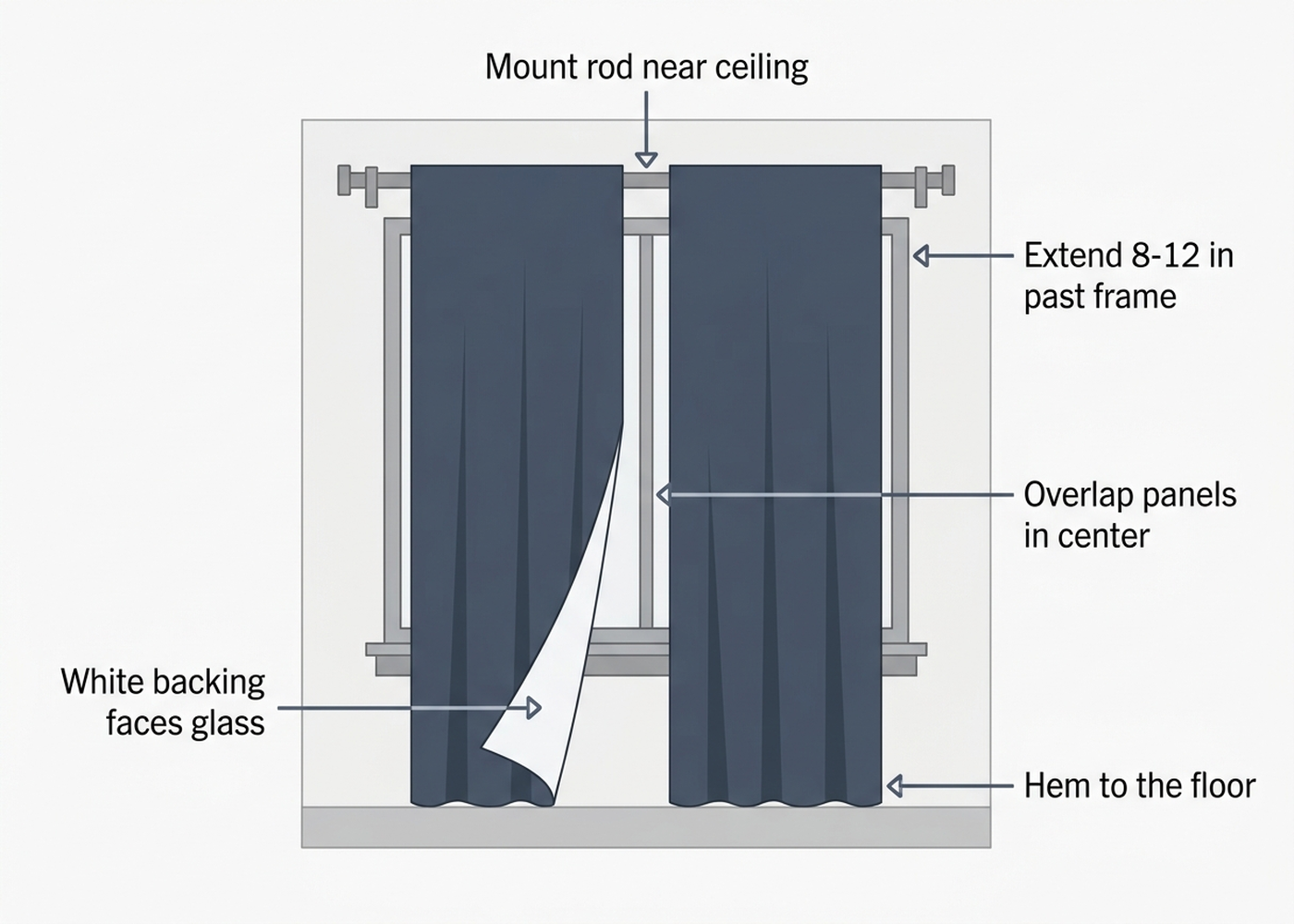
- Mount high and wide. Rod at or near the ceiling, extending 8–12 inches past the frame each side, so the panels seal past the window on all edges.
- Keep the fabric close to the wall. A deep decorative rod creates an air channel; the closer the panel hangs to the wall and glass, the smaller the convection loop.
- Overlap in the middle. Two panels should overlap a few inches when closed — center gaps are the leak reviewers photograph most.
- Go to the floor. A hem that stops at the sill leaves the bottom of the loop open. Floor-length panels (or a sill-sealing shade) close it.
- Reflective side out. White or light backing faces the glass. This single choice is what separates DOE’s 33% figure from a heat-absorbing dark panel.
For maximum effect, DOE endorses layering: a cellular shade inside the frame doing the insulation, a curtain over it sealing the perimeter. And the timing matters as much as the hardware — closed before the sun hits the window, especially on south- and west-facing glass in the afternoon. A curtain closed at 6 p.m. has already lost the fight.
Comparison Table
Prices are approximate amazon.com figures at the time of writing (July 2026) and fluctuate. Light-blocking and insulation figures are manufacturer claims unless noted.
| Product | ASIN | Approx. price | Type | Light blocking (claim) | Cooling-relevant strength |
|---|---|---|---|---|---|
| NICETOWN Thermal Insulated Grommet (2 panels) | B01CS31NV6 | ~$20–$35 | Triple-weave curtain | 85–99% by color | Cheapest broad coverage; pick light colors + tight hang |
| NICETOWN 100% Blackout, Black Liner (2 panels) | B077RPXSF3 | ~$45–$70 | Lined curtain | 100% through fabric | Double layer insulates; light face still reflects |
| Sun Zero Easton Energy-Saving (1 panel) | B00N3K47EY | ~$10–$20 | Woven blackout curtain | Room-darkening | Budget fix for one hot window |
| Redi Shade Easy Lift Cellular (19–36” windows) | B0126EWZTG | ~$30–$45 | Cordless honeycomb shade | Blackout fabric | Best physics per DOE (up to 60% solar-heat cut, tightly installed) |
Which Setup Fits Your Situation?
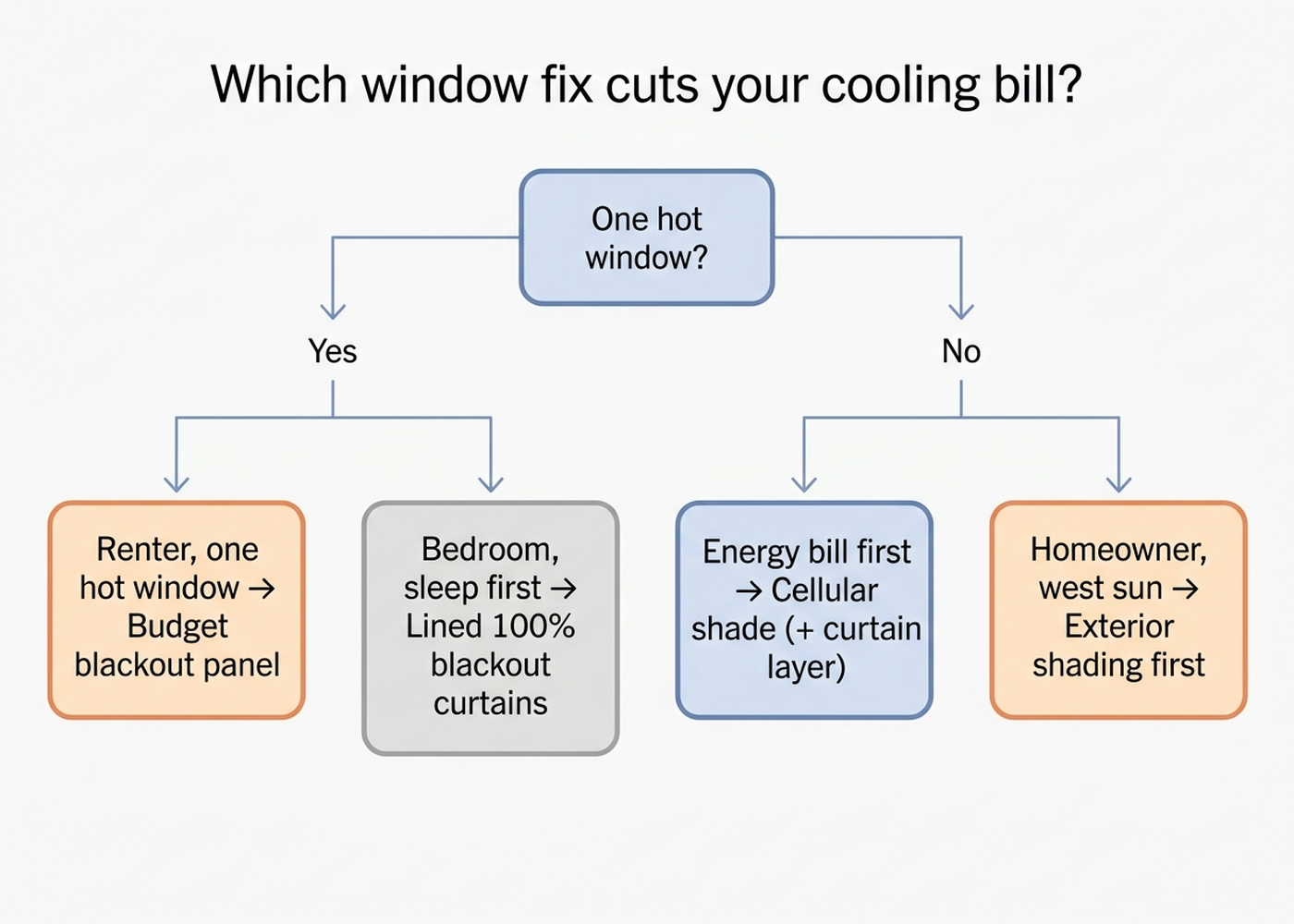
- Renter with one brutal west-facing window: a Sun Zero panel (doubled) or NICETOWN pair, hung high, wide, and wall-tight. Under $40, fully reversible at move-out.
- Bedroom where sleep is the real goal: the lined NICETOWN 100% blackout set. You get the darkness the plain “blackout” label rarely delivers, and the thermal layer comes free.
- Energy bill is the explicit target: the Redi Shade cellular shade inside the frame — or shade plus curtain layered, which is the DOE-endorsed maximum for interior treatments.
- Homeowner with afternoon sun: put the budget outside first. DOE’s 65–77% figures for awnings and exterior shading beat anything hung indoors; interior fabric then becomes the finishing layer.
- Whole-home, hot-humid region: prioritize south- and west-facing rooms rather than buying for every window. EIA’s regional data says that is where the 27%-of-energy-spend pressure concentrates.
Warranty, Care, and Renter Notes
Blackout coatings are the failure point to protect. Most triple-weave and coated fabrics are machine-washable cold, gentle, no bleach, no high-heat drying — high heat can craze acrylic-foam backings, and aggregated reviews of many brands attribute flaking liners to hot dryers. Manufacturer warranties in this category are short and retailer-driven; Amazon’s 30-day return window is the practical guarantee, so run your flashlight test the week the curtains arrive. For renters, everything recommended here installs without drilling into anything a lease covers: tension or bracket rods use standard hardware, and the Redi Shade’s adhesive mount removes cleanly from smooth frames — reviewers flag painted or textured frames as the surface to test in a corner first.
Limitations
This analysis relies on publicly available data — DOE and PNNL published figures, EIA consumption statistics, independent editorial tests, and aggregated amazon.com reviews — rather than our own instrumented testing. PNNL’s savings bands were measured on cellular shades in specific lab-home conditions in Washington State; your climate, window orientation, glazing, AC efficiency, and discipline about closing curtains before peak sun will move the result materially in either direction. The dollar estimates above are editorial arithmetic from cited averages, not a measurement of any specific product, and manufacturer light-blocking percentages have not been independently verified except where a named third-party test is cited. Individual experience may vary.
Bottom Line
Do blackout curtains lower your cooling bill? Yes — by an honest single-digit percentage when hung correctly on the right windows, not by the quarter of your bill the marketing implies. The cheapest real gains in this category come from decisions that cost nothing: white backing toward the glass, rod high and wide, panels overlapping and floor-length, closed before the afternoon sun. Spend $30 on the curtain, but spend the five minutes on the installation — the data says the second purchase matters more.
Before you buy, paste the product link into Arekore — our AI assistant checks review authenticity, surfaces what the one-star reviews actually complain about, and compares prices, free, in about five minutes.