Best Water Filter Pitchers 2026: Brita vs PUR vs ZeroWater
TL;DR
For most households that just want cheaper, better-tasting water without a big ongoing cost, the Brita Everyday Elite is the easiest recommendation — its Elite filter is NSF/ANSI 53 certified to reduce lead and roughly 30 other contaminants, and at an estimated $0.15 per gallon it’s the cheapest of the three to keep running. Households in an area with known PFAS (“forever chemicals”) contamination, or anyone who wants the broadest certified contaminant list, should look at the ZeroWater Ready-Pour, whose 5-stage ion-exchange filter is independently tested to remove 99.6% of dissolved solids — but its filters clog fast (roughly 20–40 gallons) and can push the annual cost well above $200 for a busy household. The PUR Plus sits in between: NSF-certified under three separate standards (42, 53, and 401) with lead reduction just behind Brita Elite, at a mid-range filter cost.
Methodology
This analysis synthesizes (a) aggregated Amazon US customer reviews for the Brita Everyday Elite, PUR Plus, and ZeroWater Ready-Pour pitchers, sampled in September 2026 — Amazon does not expose a fixed review count per product, so we cannot report a precise N, but each listing had several thousand ratings visible at the time of sampling — (b) NSF/ANSI and WQA/IAPMO certification documentation published by each manufacturer, (c) independent reporting and comparative testing referenced by Consumer Reports’ water filter pitcher coverage, and (d) water-filtration market data on PFAS prevalence and category growth. We did not personally test the products covered here.
Technical Approach: Three Different Filtration Strategies
The three brands are not interchangeable technologies wearing different logos — each uses a distinct filtration approach that produces real trade-offs in cost, speed, and what gets removed.
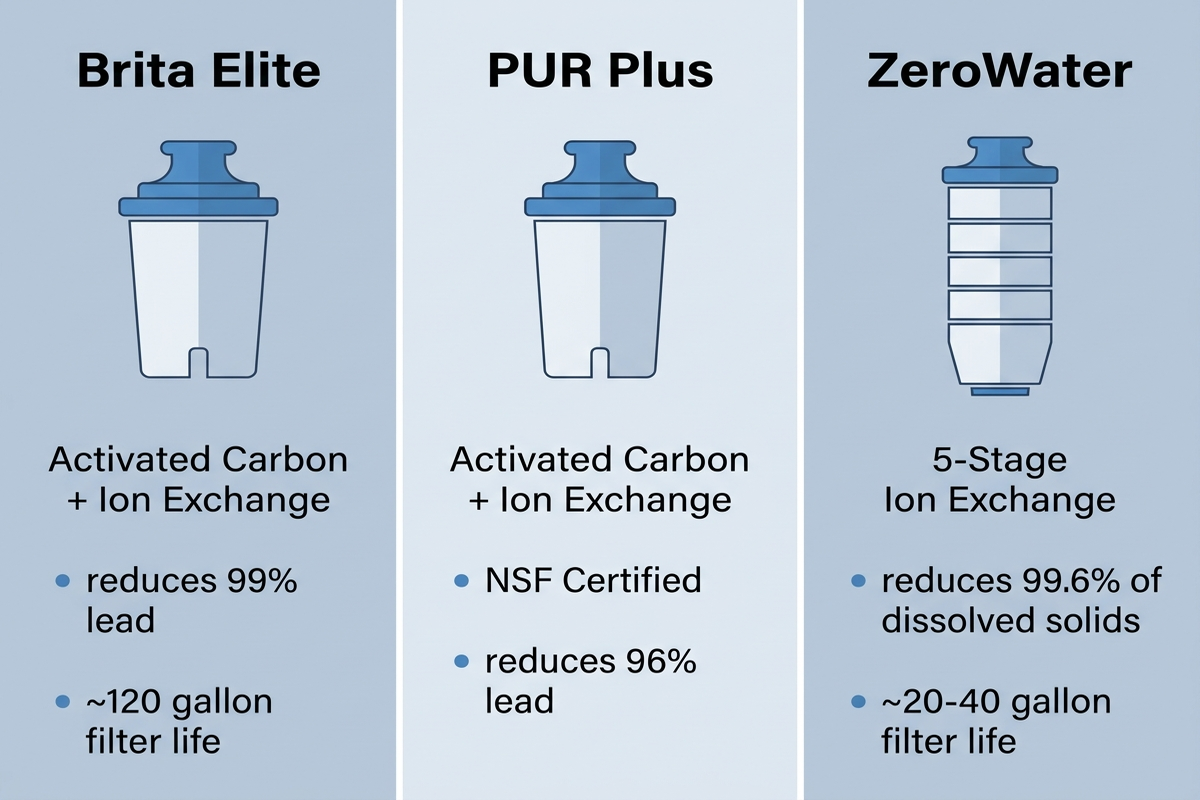
- Brita Everyday Elite (activated carbon + ion exchange): The Elite filter is Brita’s upgraded cartridge, positioned above its “Standard” taste-and-odor-only filter. It’s NSF/ANSI Standard 53 certified to reduce lead by up to 99%, along with mercury, cadmium, and roughly 30 total contaminants, while lasting an estimated 120 gallons (about 6 months) before replacement.
- PUR Plus (activated carbon + ion exchange): PUR’s filters carry NSF certification across three standards — 42 (taste/odor), 53 (health-related contaminants), and 401 (emerging contaminants) — and are independently reported to reduce lead by about 96%, slightly behind Brita Elite’s certified figure.
- ZeroWater Ready-Pour (5-stage ion exchange): ZeroWater takes a fundamentally different approach, using a five-stage ion-exchange resin designed to strip out nearly all dissolved solids rather than targeting specific contaminants. It’s IAPMO certified to reduce lead, chromium, and PFOA/PFOS, and independent reporting credits it with reducing roughly 99.6% of total dissolved solids (TDS) — the most aggressive reduction of the three, at the cost of a much shorter filter lifespan.
Manufacturer Details
Brita markets the Everyday Elite as a 10-cup pitcher pairing with its Elite filter, which the company states is WQA and NSF/ANSI certified to reduce 99% of lead and microplastics along with over 30 other contaminants — a manufacturer-stated contaminant count rather than an independently re-verified list for every substance named. Brita positions the Elite filter as a roughly 6-month replacement cycle under typical household use, longer than its base “Standard” filter, which is rated closer to 2 months and only certified for chlorine taste and odor rather than health-related contaminants.
PUR markets its Plus line (available in 7-cup and 11-cup pitcher sizes) around a “LockFit” cap design intended to prevent unfiltered water from bypassing the cartridge, along with a filter-change light indicator. PUR states its Plus filters are NSF certified to reduce lead, mercury, and 401-listed emerging contaminants including certain pharmaceuticals and pesticides — claims tied to the NSF standard numbers rather than a single unified “removes everything” claim.
ZeroWater frames its Ready-Pour pitcher around a built-in TDS (total dissolved solids) meter that ships with the unit, letting households measure their own water’s purity rather than relying only on a time-based replacement schedule. The company states its 5-stage filter is IAPMO certified to reduce PFOA/PFOS, lead, chromium, and mercury, and separately reports 99.6% TDS reduction — a figure ZeroWater uses as its primary marketing claim, distinct from the certified-contaminant list.
Customer Sentiment Synthesis
Aggregated Amazon customer reviews and cross-referenced independent coverage point to a few consistent patterns:
- Brita Everyday Elite: The dominant praise theme is value — reviewers frequently describe it as “good enough” filtration at the lowest ongoing cost of the three, with the SmartLight filter-change indicator cited as a helpful, low-friction feature. The most common complaint is flow rate slowing noticeably in the final weeks before a filter change, and some reviewers report the reservoir capacity feels small for larger households.
- PUR Plus: Reviewers commonly cite the LockFit cap and filter-change light as reassurance that the filter is actually working, and several describe taste improvement as comparable to Brita at a similar price point. The recurring complaint cluster is pitcher durability — cracked lids and reservoir seams appear repeatedly in one-star reviews, more often than with the other two brands.
- ZeroWater Ready-Pour: The standout praise theme is the built-in TDS meter, which reviewers describe as reassuring because it gives a visible, testable number rather than a “trust the calendar” replacement schedule. The dominant complaint, echoed across independent reporting as well as reviews, is how quickly filters clog in hard-water areas — some reviewers report replacing filters every 2–3 weeks rather than the 20–40 gallon estimate, which sharply raises the real-world cost per gallon.
Comparison Table
| Model | Price (as of 2026-09-04) | Certification | Lead Reduction (mfr./independent) | Filter Life | Est. Cost per Gallon |
|---|---|---|---|---|---|
| Brita Everyday Elite (10-Cup) | $34.99 | NSF/ANSI 53, WQA | 99% | ~120 gallons | ~$0.15 |
| PUR Plus (11-Cup) | $39.99 | NSF 42, 53, 401 | 96% | ~40 gallons | ~$0.30–$0.40 |
| ZeroWater Ready-Pour (10-Cup) | $44.99 | IAPMO (Lead, Cr, PFOA/PFOS) | 99.6% TDS reduction | ~20–40 gallons | ~$0.60–$0.90 |
Prices shown are manufacturer list prices as of the stated date; Amazon frequently discounts these SKUs through lightning deals and multi-packs with bonus filters, so the checkout price may differ from list. Filter life and cost-per-gallon figures are independently reported estimates and vary significantly by local water hardness.
How to Use: Getting Accurate Readings and Replacement Timing
Regardless of which pitcher a household buys, independent testers and manufacturer guides converge on the same maintenance habits — most complaints about “the filter stopped working” in aggregated reviews trace back to skipped soak/flush steps or ignoring the replacement schedule, not defective filters.
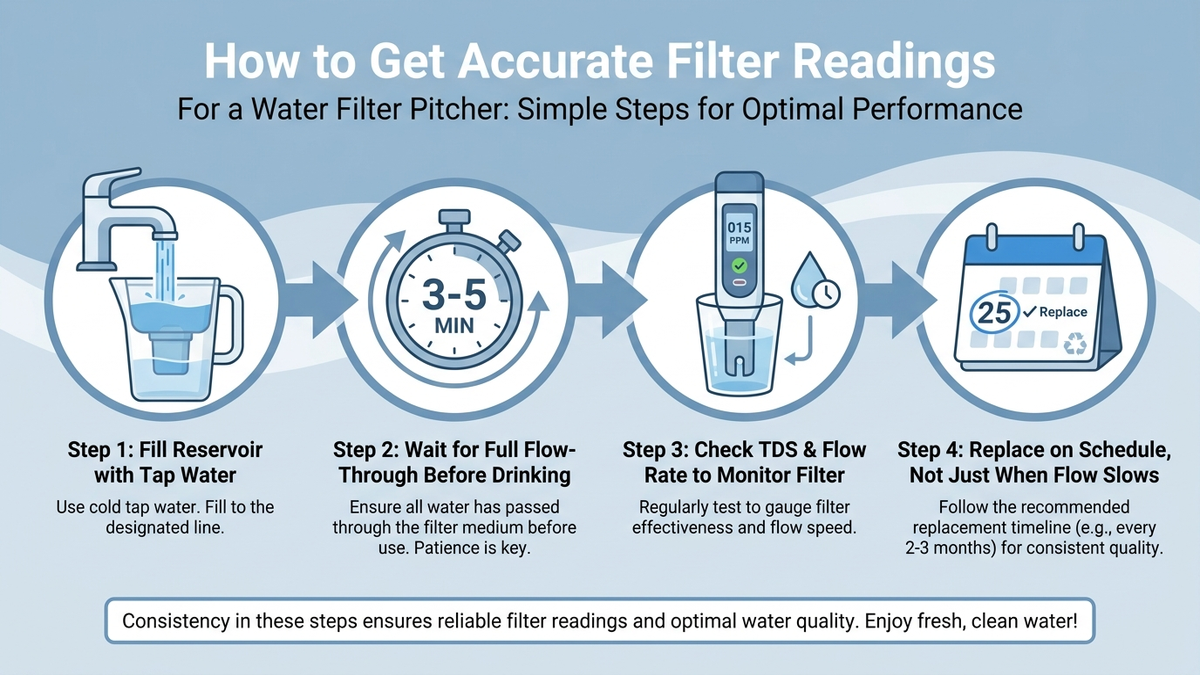
New cartridges should be soaked and flushed per the manufacturer instructions before first use — carbon fines can otherwise cloud the first pitcher or two, which some reviewers mistake for a defective unit. For ZeroWater specifically, use the included TDS meter regularly rather than waiting for a visible slowdown in flow, since the resin can exhaust before the flow rate changes noticeably. For Brita and PUR, replace on the stated time or gallon schedule even if the pitcher still pours at a normal speed — flow rate is not a reliable proxy for contaminant-reduction capacity once a carbon filter is past its rated life.
Which One Should You Buy?
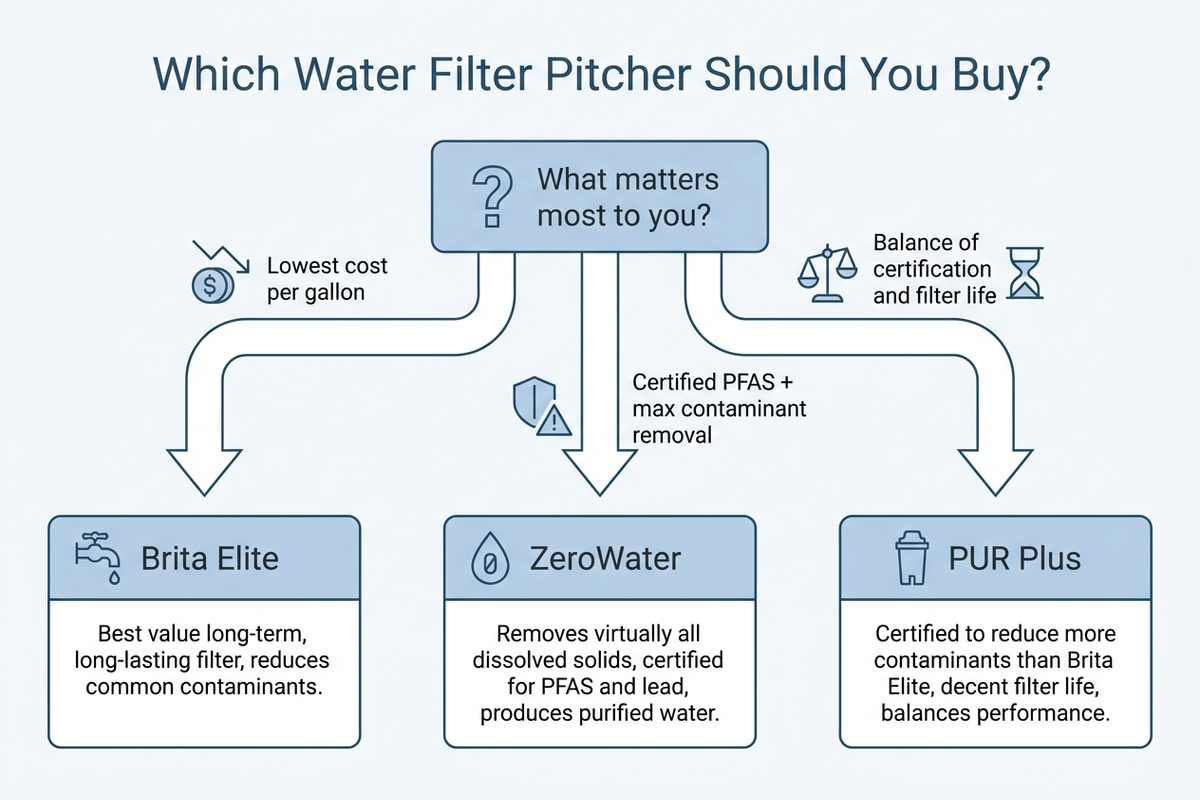
- Best value for most households: Brita Everyday Elite — the lowest cost per gallon of the three, with a certified 99% lead-reduction figure that covers the contaminant most households are actually worried about.
- Best for confirmed PFAS or hard-water concerns: ZeroWater Ready-Pour — the broadest dissolved-solids reduction and a built-in TDS meter for households that want to verify their water rather than trust a calendar, if they’re willing to accept a much higher filter cost.
- Best middle ground: PUR Plus — certified under three separate NSF standards with lead reduction close behind Brita’s, at a filter cost between the other two.
Limitations
This analysis relies on manufacturer-published certification data, aggregated Amazon customer reviews, and independent reporting on filter life and cost-per-gallon, including figures referenced by Consumer Reports’ water filter pitcher coverage. Actual filter lifespan and cost per gallon vary significantly by local water hardness and household usage volume — the ranges reported here assume typical municipal tap water and will differ for well water or unusually hard water. Individual experience may also vary based on unit-to-unit manufacturing variance.
As an Amazon Associate, Arekore earns from qualifying purchases. The Amazon product links in this article include our affiliate tracking ID and may earn us a commission if you buy through them, at no additional cost to you. See our Links Policy for details on how we select products and how commissions do not influence our recommendations.
Products Mentioned
- Brita Everyday Elite Water Filter Pitcher, 10-Cup, Black
- PUR Plus 11-Cup Water Filter Pitcher
- ZeroWater 10-Cup Ready-Pour 5-Stage Water Filter Pitcher
Verify current pricing, availability, and specifications on the Amazon product page before purchasing — we do not guarantee prices stay current after publication.