Best Home Treadmills 2026: NordicTrack vs Sole vs Peloton
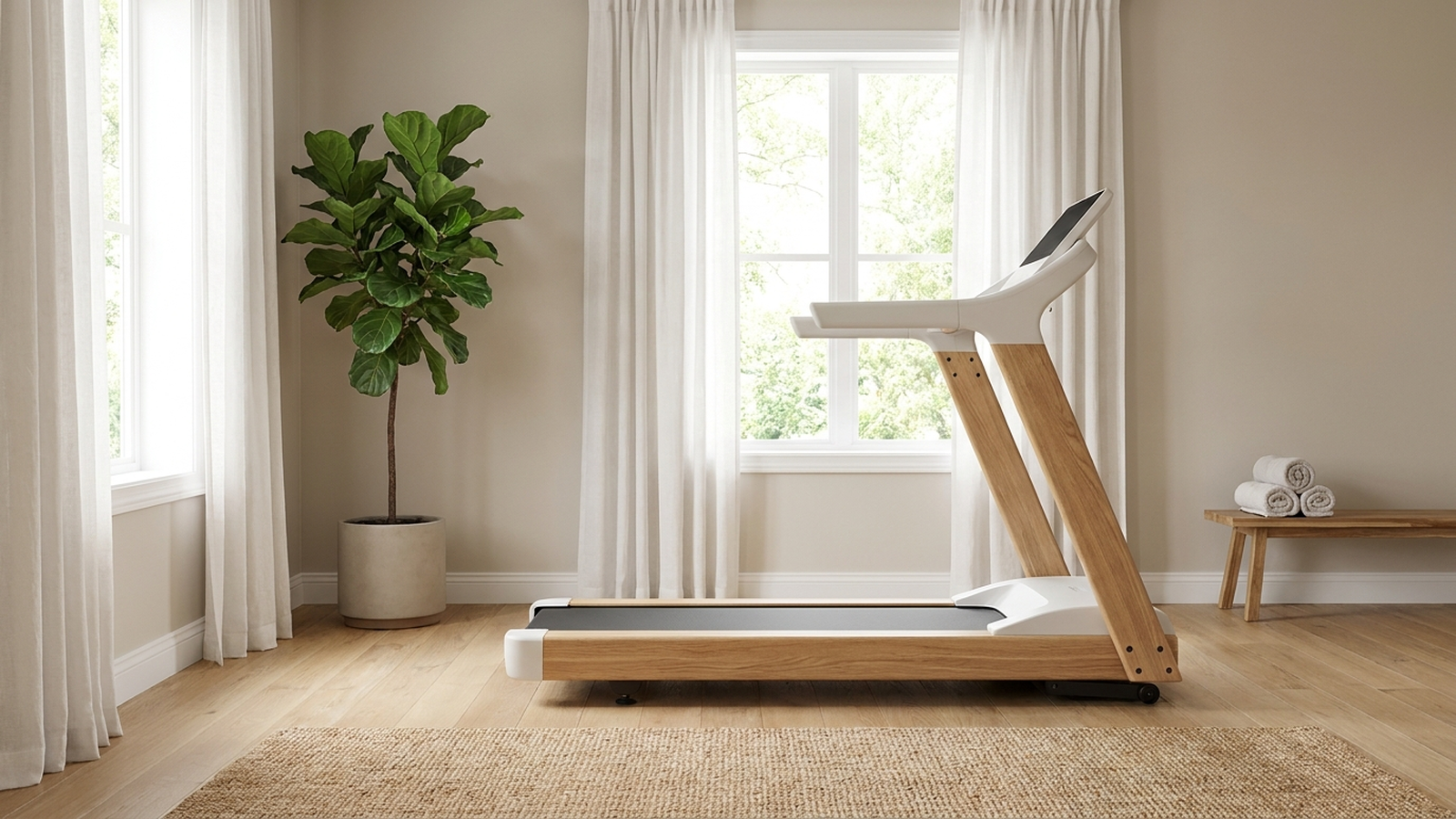
TL;DR / Quick Verdict
- Best for guided workouts and streaming classes: Peloton Tread — a slat-belt deck, a 23.8” swivel touchscreen, and Peloton’s class library, but the $2,995 machine effectively requires a separate $44/month All-Access Membership to use most of its features.
- Best all-around value with no required subscription: Sole F80 — a lifetime frame-and-motor warranty, a 3.5 continuous-horsepower (CHP) motor, and a standalone console that doesn’t lock core functions behind a monthly fee.
- Best for incline-based training on a budget: NordicTrack Commercial 1750 — the lowest starting price of the three and strong incline/decline range, offset by a shorter frame warranty and a pattern of iFit-subscription and customer-service complaints in owner reviews.
Methodology
This analysis synthesizes (a) aggregated Amazon US customer reviews for the NordicTrack Commercial 1750, Sole F80, and Peloton Tread, (b) manufacturer-published specifications and warranty documentation from NordicTrack, Sole Fitness, and Peloton, (c) independent long-term testing and comparison coverage from Garage Gym Reviews, BarBend, TreadmillReviews.net, and Forbes Vetted, and (d) market-size data on the US treadmill and connected-fitness-equipment category from Mordor Intelligence and Statista. We did not personally test the products covered here. Where a specification (decibel level, assembly time) comes from a single reviewer’s test rather than a manufacturer datasheet, it is labeled as such below.
Technical Approach: Slat Belt vs. Continuous Loop Belt
The single biggest design difference between these three machines is how the running surface itself is built. Treadmills remain the largest single category within the roughly $11.8 billion US home fitness equipment market in 2026, per Mordor Intelligence, and North America accounts for close to 40% of global treadmill sales — context for why the segment has room for three fairly different approaches (subscription-driven, warranty-driven, and content-driven) to all find a sizable audience.
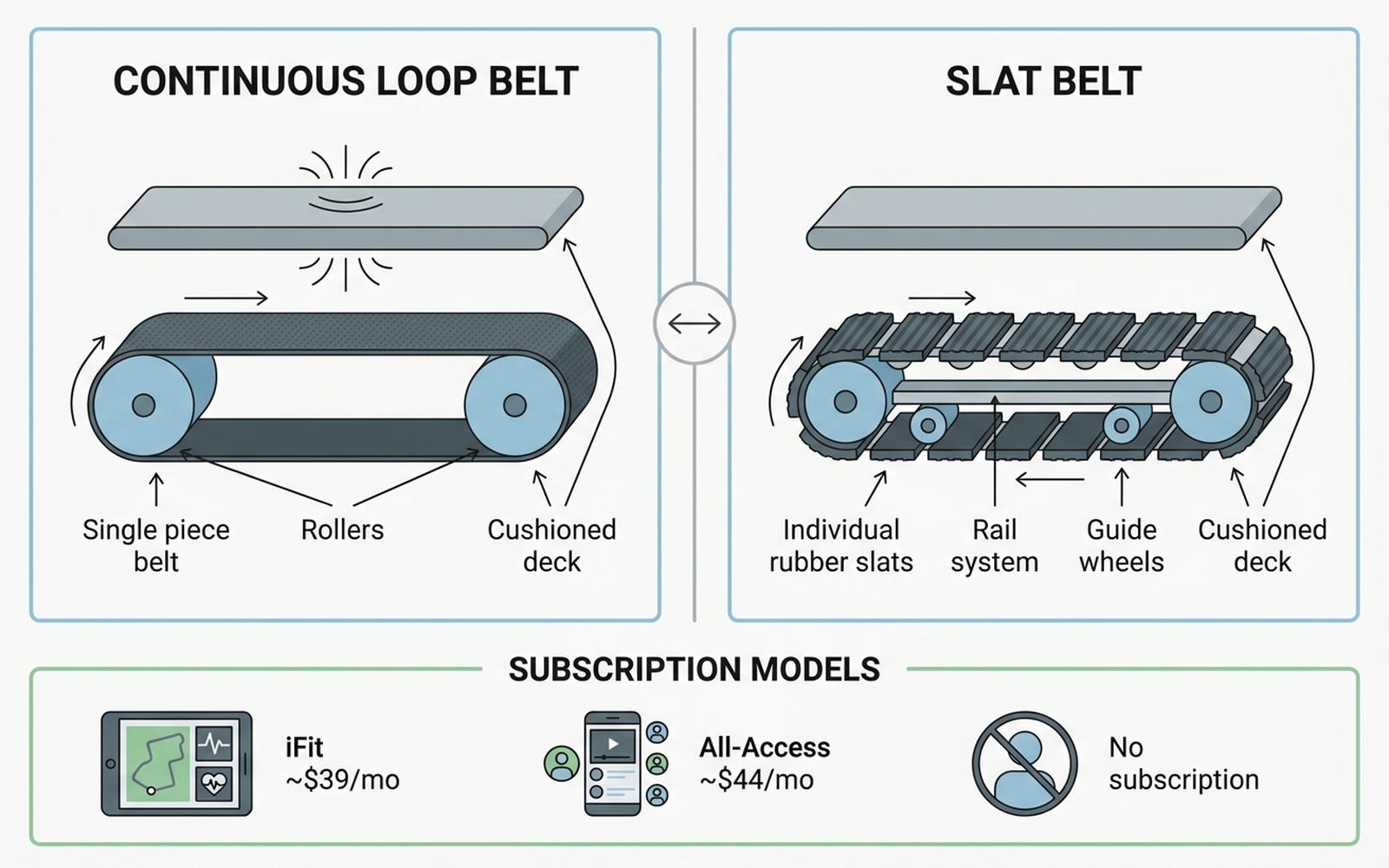
- Continuous loop belt — used by both the NordicTrack Commercial 1750 and the Sole F80. A single rubber-and-fabric belt loops around the deck and rollers, the design used by the overwhelming majority of home treadmills for decades. It’s simpler to manufacture and service, and both machines here pair it with a cushioned deck — NordicTrack’s RunFlex cushioning and Sole’s CushionFlex Whisper Deck — engineered to absorb impact more than a bare loop belt alone would.
- Slat belt — used by the Peloton Tread. Instead of one continuous loop, individual rubber slats are mounted on a rail system, closer in feel to a commercial-gym treadmill or an indoor running track than a traditional home belt. Reviewers at Garage Gym Reviews and BarBend consistently describe the resulting ride as firmer and more “road-like” than either the NordicTrack or Sole deck, which some runners prefer for run specificity and others find harder on the joints during long, easy-paced sessions.
- Software and content ecosystem — a separate axis. NordicTrack ties most interactive features to an iFit subscription (commonly $39/month), Peloton ties its class library and most screen functions to an All-Access Membership ($44/month), and Sole’s console runs pre-loaded programs with no subscription requirement for core functions. This distinction matters more for total cost of ownership than the sticker price of the machine itself.
Manufacturer Deep Dive
NordicTrack Commercial 1750
The NordicTrack Commercial 1750 pairs a manufacturer-rated 3.5 CHP motor with a 60” x 22” running surface and NordicTrack’s RunFlex cushioning, plus an incline range up to 12% and decline down to -3%, a feature neither of the other two machines here offers. It ships with a 14” pivoting HD touchscreen built around iFit, NordicTrack’s subscription workout platform, and includes a 30-day iFit trial before the recurring fee (commonly around $39/month) applies. Amazon customer reviews and long-term test coverage from TreadmillReviews.net describe the hardware itself as sturdy with responsive speed and incline changes, but a recurring complaint theme across owner reviews centers on NordicTrack/iFit customer service and technical support, plus reports of the console losing function during internet or power interruptions until manually rebooted. Warranty coverage is a lifetime on the motor, 10 years on the frame, and 2 years on parts with 1 year of labor — the shortest frame and parts coverage of the three machines. At a typical street price in the $1,599–$1,999 range on Amazon, it is the least expensive of the three, though the ongoing iFit subscription (optional for the standalone console, but required for most interactive content) adds meaningfully to its total cost over a few years of use.
Sole F80
The Sole F80 is built around a comparable 3.5 CHP motor and the same 60” x 22” running-surface footprint as the NordicTrack, using Sole’s own CushionFlex Whisper Deck cushioning system and a manufacturer-rated incline range up to 15% (no decline) — a wider incline range than either the NordicTrack or the Peloton offers, though it’s the only one of the three without a decline setting. Sole backs the F80 with a warranty structure independent reviewers repeatedly flag as the strongest in this price tier: lifetime coverage on the frame and motor, 3 years on the deck, parts, and wear items, 1 year of labor, and 90 days on cosmetic items. The console runs pre-loaded workout programs and does not require an ongoing subscription for core treadmill functions, which independent test coverage from Garage Gym Reviews and BarBend cites as a meaningful total-cost-of-ownership advantage over the NordicTrack. Long-term test coverage from TreadmillReviews.net describes decibel readings around 35 dB at 3 mph and roughly 61 dB at 12 mph, a manufacturer-independent test result rather than a Sole-published spec. Amazon customer reviews are broadly positive on quietness and build quality, though a minority of reviewers report a rear-roller bearing issue emerging after roughly 50 hours of use that produced a rhythmic thumping noise, resolved for those owners through Sole’s warranty service. At a typical street price in the $1,999–$2,299 range, it sits between the other two on price while carrying the strongest warranty of the group.
Peloton Cross Training Tread
Peloton renamed its treadmill lineup the “Cross Training Series” in late 2025, so the machine sold today as the Peloton Cross Training Tread (still commonly called just “the Tread” in reviews and on Peloton’s own site) is the same product line covered here. It is the only slat-belt machine of the three, with a 59” running surface, a speed range of 0–12.5 mph, an incline range of 0–12.5% (no decline), and a 23.8” HD swivel touchscreen built around Peloton’s class-streaming platform. Peloton’s own warranty documentation covers the touchscreen and most original components for 12 months, the drive motor and walking belt for 3 years, and the frame for 5 years — the shortest frame warranty of the three machines, notably shorter than either NordicTrack’s 10-year or Sole’s lifetime frame coverage. The Tread itself functions in a basic mode without a subscription, but the class library, structured training programs, and most of the screen’s interactive features require a separate Peloton All-Access Membership (commonly $44/month), a cost independent reviewers at BarBend and Forbes Vetted note substantially raises the effective price over the $2,995 hardware cost. At the time of writing, the Tread is sold both directly through Peloton and through Amazon at the same $2,995 list price, making it the most expensive of the three by a wide margin even before subscription costs.
How to Choose: Matching a Treadmill to How You’ll Actually Use It
The deciding factor for most buyers isn’t horsepower or touchscreen size — it’s whether you want structured, coached content or a simple, subscription-free machine, and whether incline/decline training or a road-like belt feel matters more to your routine.
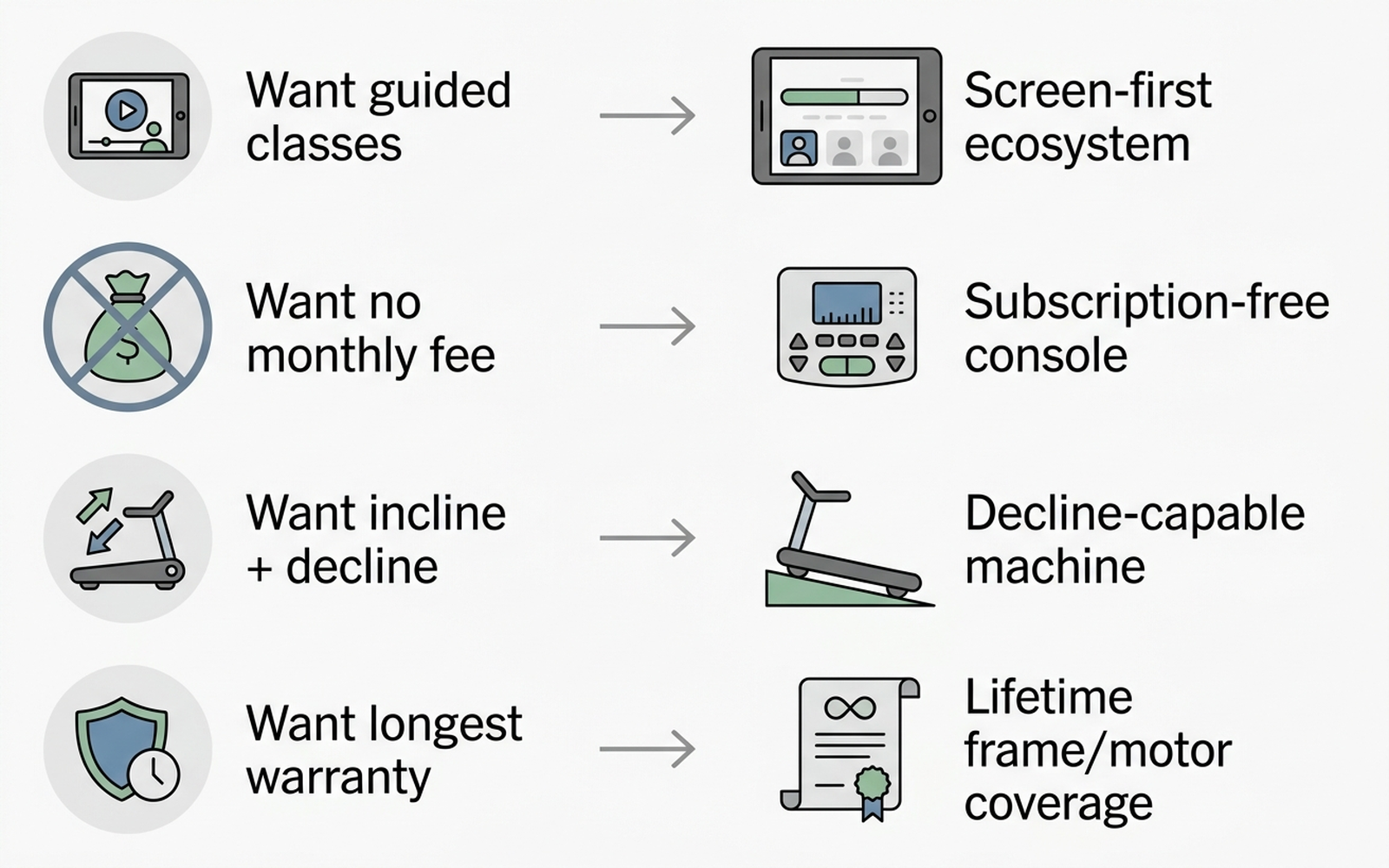
- Want guided classes and structured training programs: the Peloton Tread’s content library is the most developed of the three, but budget for the required $44/month membership on top of the $2,995 hardware price.
- Want to avoid a recurring subscription entirely: the Sole F80’s console runs without a required monthly fee, the strongest fit for buyers who just want a treadmill.
- Want incline and decline for hill or trail-race training: the NordicTrack Commercial 1750 is the only one of the three offering decline in addition to incline.
- Prioritize warranty coverage above all else: Sole’s lifetime frame-and-motor warranty is the strongest of the three; NordicTrack’s 10-year frame coverage is second; Peloton’s 5-year frame warranty is the shortest.
Comparison Table
Prices as of 2026-09-17 — Amazon and manufacturer sites frequently run short-term discounts on all three brands; check the live listing before buying.
| Product | Motor | Deck / Belt | Incline/Decline | Subscription | Frame Warranty | Price |
|---|---|---|---|---|---|---|
| NordicTrack Commercial 1750 | 3.5 CHP | 60”x22”, continuous loop, RunFlex | 12% / -3% | iFit, ~$39/mo (optional for basic use) | 10 years | ~$1,599–$1,999 |
| Sole F80 | 3.5 CHP | 60”x22”, continuous loop, CushionFlex | 15% / none | None required | Lifetime | ~$1,999–$2,299 |
| Peloton Tread | N/A (manufacturer doesn’t publish CHP) | 59”, slat belt | 12.5% / none | All-Access, ~$44/mo (required for classes) | 5 years | ~$2,995 |
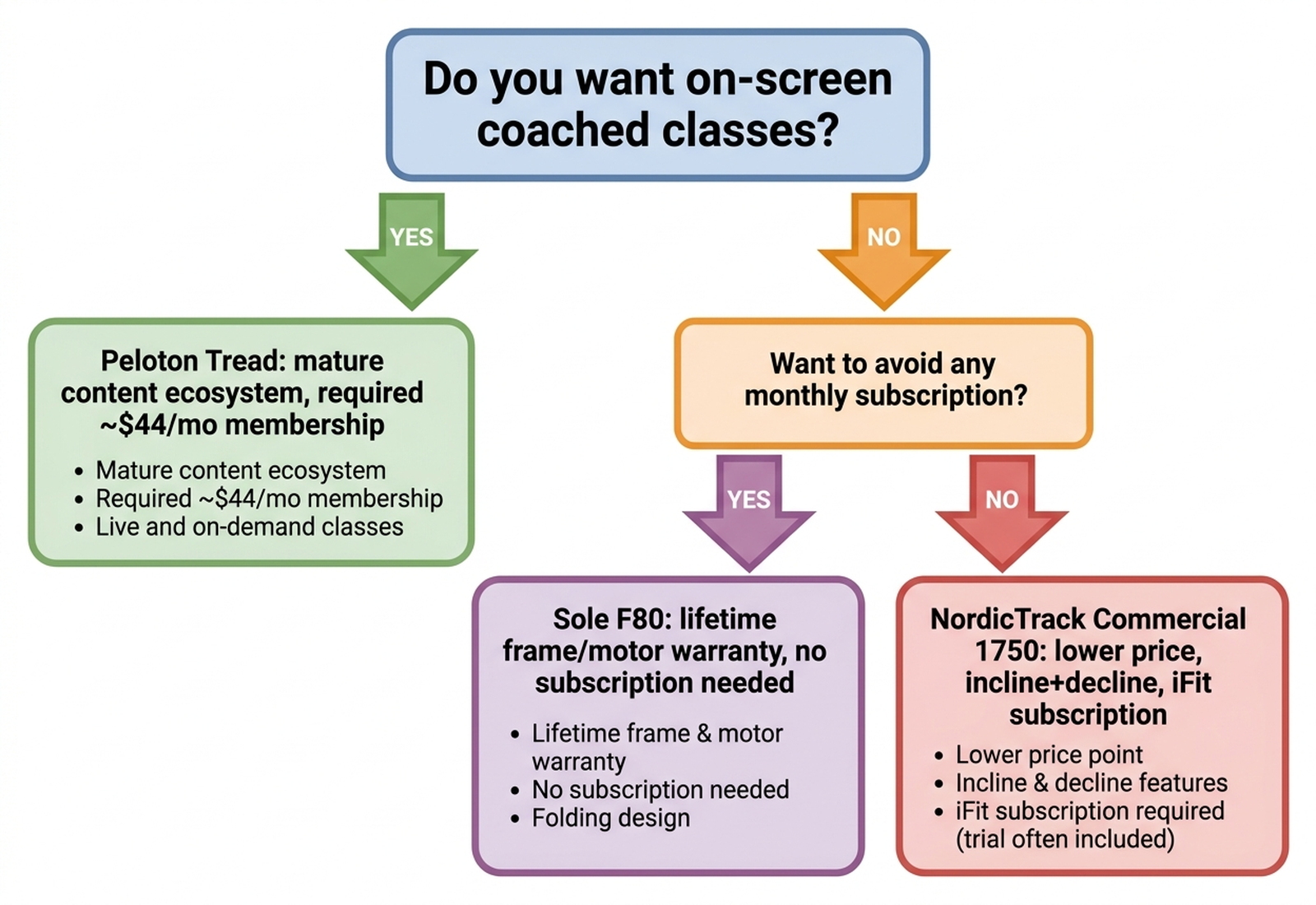
Decision Flowchart: Content Needs vs. Total Cost of Ownership
Start with whether you actually want on-screen coached classes. If yes, the Peloton Tread’s ecosystem is the most mature of the three, but its $44/month membership needs to be budgeted alongside the $2,995 hardware price for the life of the machine. If you’d rather avoid a recurring fee altogether, the Sole F80’s subscription-free console and lifetime frame-and-motor warranty make it the more defensible long-term purchase, at a mid-range price. If incline/decline hill training matters more than content or warranty length, and budget is the primary constraint, the NordicTrack Commercial 1750’s lower starting price is the trade-off — accepting a shorter frame warranty and a recurring pattern of iFit and customer-service complaints in owner reviews.
Warranty and Support
Warranty length diverges sharply across these three machines, and it’s one of the clearest differentiators in owner-review sentiment. Sole’s lifetime frame-and-motor coverage, backed by 3 years on the deck, parts, and wear items, is the strongest of the group; independent long-term test coverage and Amazon reviews describe occasional delays in scheduling service but generally successful resolution of covered issues (including the rear-roller bearing noise some owners reported). NordicTrack’s warranty (lifetime motor, 10-year frame, 2-year parts, 1-year labor) is solid on paper, but a recurring theme in Amazon reviews and forum discussion is frustration with iFit/NordicTrack customer support responsiveness rather than the warranty terms themselves. Peloton’s warranty (12 months on the touchscreen and most components, 3 years on the motor and belt, 5 years on the frame) is the shortest frame coverage of the three, though Peloton’s direct-service model (as opposed to third-party parts distribution) is generally rated favorably by owners who have used it. None of the three warranties typically cover normal wear items like belts or lubrication beyond their specified terms, and assembly — commonly reported by owners as taking several hours for two people on all three machines — is not covered by any of these warranties if damage occurs during setup.
Editorial Recommendation
- Best for guided workouts and streaming classes: Peloton Tread — the most developed content ecosystem of the three, at the highest hardware price and a required ongoing membership fee.
- Best all-around value with no required subscription: Sole F80 — the strongest warranty of the three and a console that doesn’t lock core function behind a monthly fee, at a mid-range price.
- Best for incline/decline training on a tighter budget: NordicTrack Commercial 1750 — the lowest starting price and the only one of the three with decline, offset by the shortest-of-the-group parts warranty and a recurring pattern of customer-service complaints.
Limitations
This analysis relies on manufacturer specifications, published warranty documentation, aggregated Amazon customer reviews, and independent long-term test coverage from outlets including Garage Gym Reviews, BarBend, TreadmillReviews.net, and Forbes Vetted; we did not independently test motor output, decibel levels, or belt durability under controlled conditions. Noise and durability figures cited from a single reviewer’s long-term test are labeled as such and may vary by unit and usage pattern. Complaint patterns drawn from Amazon and owner-forum reviews reflect a self-selected group of people motivated to post about problems or successes, not a statistically representative sample of all buyers. Prices and subscription fees listed reflect approximate figures at the time of writing and change frequently, including short-term promotional discounts and subscription-tier changes not reflected in the table above. Treadmill model years and revisions change often; confirm the current specification sheet on the manufacturer’s site before buying.
As an Amazon Associate, Arekore earns from qualifying purchases. The Amazon product links in this article include our affiliate tracking ID and may earn us a commission if you buy through them, at no additional cost to you. See our Links Policy for details on how we select products and how commissions do not influence our recommendations.
Visit Arekore to verify current pricing and subscription requirements on any product mentioned here before buying.