Best Storefront Tech for Small Businesses in 2026
A storefront owner doesn’t get an IT department. When the card reader drops a sale, the Wi-Fi cuts out mid-checkout, or a shoplifting incident has no camera footage to review, there’s no ticket to file — it’s lost revenue, out of the owner’s own pocket, on the spot. The US has roughly 36.2 million small businesses (SBA Office of Advocacy’s 2026 count), and among the several million of those that have paid employees rather than operating solo, a large share run a physical storefront where these failures happen in front of paying customers, not in a back-office spreadsheet. This guide focuses on the five recurring tech gaps that show up across aggregated reviews and small-business operator forums, rather than a general “gadgets for your shop” list.
As an Amazon Associate, Arekore earns from qualifying purchases. The Amazon product links in this article include our affiliate tracking ID and may earn us a commission if you buy through them, at no additional cost to you. See our Links Policy for details on how we select products and how commissions do not influence our recommendations.
TL;DR / Quick Verdict
- The payments gap that creates fraud liability: the Square Reader for contactless and chip (2nd Gen) — accepts chip and tap payments at a low upfront cost, closing the counterfeit-card liability gap that swipe-only readers leave open.
- The professionalism and returns-tracking fix: the Star Micronics TSP143IVUE receipt printer — a dedicated thermal printer that produces a scannable, itemized receipt for exchanges and returns, instead of a smartphone-screen confirmation.
- The shrinkage fix that costs less than one stolen item: the Wyze Cam v3 (3-Pack) — budget-friendly coverage of the register, the entrance, and the stockroom, which independent reviewers rate as strong value despite its low price.
- The inventory fix that ends manual recounts: the NETUM NT-1228BL Bluetooth 2D barcode scanner — connects to a phone, tablet, or POS terminal to speed up receiving and cycle counts.
- The one owners forget until a Saturday afternoon outage: the TP-Link Deco M4 (3-Pack) mesh Wi-Fi system — keeps card processing and cloud POS software online across a full retail floor, not just near the router.
How We Reached These Conclusions (Methodology)
This is an editorial analysis, not a hands-on review. We did not personally test the products covered here. This guide synthesizes (a) aggregated amazon.com customer ratings and the substance of both positive and low-star reviews, sampled the week of 2026-09-22; (b) independent test and comparison coverage from Tom’s Guide, Forbes Advisor, and Business.org; (c) manufacturer specifications and published warranty terms; and (d) 2026 US small-business and retail-shrinkage data from the SBA Office of Advocacy and the National Retail Federation’s Impact of Theft and Violence report. Where we cite a manufacturer figure — coverage area, battery life, print speed — we label it as a manufacturer claim rather than an independently verified result. Prices as of 2026-09-25 are approximate amazon.com figures and fluctuate.
Why Storefront Tech Decisions Differ From a Home-Office Setup
A freelancer’s gear failure costs them an afternoon of billable time. A storefront’s tech failure happens in front of a customer who is standing at the register, mid-transaction, deciding whether to come back. That difference changes what “essential tech” means for a small shop. Card-present fraud liability rules put the loss on the merchant, not the customer, when a store doesn’t support chip transactions on a counterfeit card. The NRF’s most recent Impact of Theft and Violence data shows retailers reported an 18% increase in average shoplifting incidents in 2024 versus 2023. Separately, aggregated shrink-tracking industry research puts external theft at roughly 36% of total inventory shrinkage and internal theft at another 29% — a combined 65% of the loss that industry-wide reached an estimated $132 billion in 2024. None of that risk shows up on a home-office desk.
At the same time, a storefront doesn’t need an enterprise security contract or a full point-of-sale terminal system to close most of these gaps. The five items below are the ones that repeatedly show up in aggregated small-business reviews as the difference between a shop that loses a sale to a dead Wi-Fi connection or an unrecorded theft, and one that doesn’t.
The Five Gaps That Actually Cost Storefront Owners Money
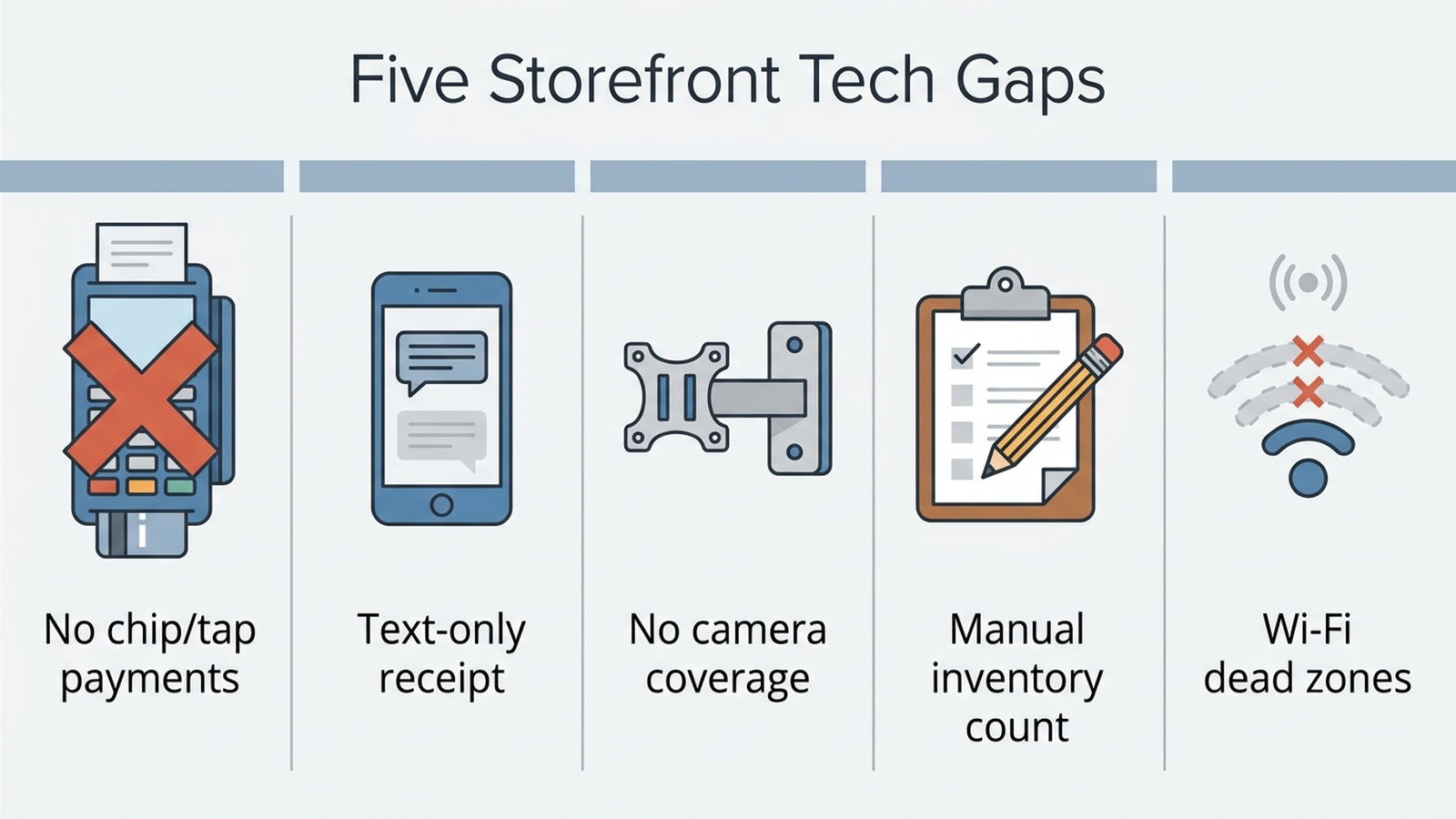
- No chip or tap payment acceptance. Swipe-only or cash-only setups push counterfeit-card fraud liability onto the merchant and turn away the growing share of shoppers who tap to pay by default.
- No dedicated printed receipt. A texted or emailed receipt is fine for many shoppers, but a scannable paper receipt is still what most return policies and in-person exchanges expect — and what protects the owner in a dispute.
- No camera coverage of the register or entrance. With external and internal theft together accounting for roughly two-thirds of retail shrinkage, an uncovered register or stockroom is the single most common gap aggregated small-business reviews point to.
- Manual, clipboard-based inventory counts. Counting stock by hand is slow and error-prone at any real product count, and it’s the most common reason a shop finds out it’s out of a popular item only after a customer asks.
- Wi-Fi that doesn’t reach the whole sales floor. A cloud-based POS or card reader that loses connection mid-transaction doesn’t fail quietly — it fails in front of the customer paying at that moment.
Comparison Table
Prices as of 2026-09-25 are approximate amazon.com figures and fluctuate.
| Item | ASIN | Approx. price | Key spec | Warranty (manufacturer) | Fixes this problem |
|---|---|---|---|---|---|
| Square Reader for contactless and chip (2nd Gen) | B0C29GRRCZ | ~$49.00 | EMV chip + NFC tap, Bluetooth LE, 2.6% + $0.10 per tap/dip | 1-year limited | No chip/tap payment acceptance |
| Star Micronics TSP143IVUE Thermal Receipt Printer | B0C34TK5D1 | ~$289.00 | USB/Ethernet, 250mm/sec, Android Open Accessory (AOA), auto-cutter | 2-year limited | No dedicated printed receipt |
| Wyze Cam v3 (3-Pack) | B0CGMM8QJS | ~$89.99 | 1080p, color night vision, 2-way audio, IP65-rated w/ outdoor adapter | 1-year limited | No camera coverage of register/entrance |
| NETUM NT-1228BL Bluetooth 2D Barcode Scanner | B07CBS52KJ | ~$39.99 | 2.4G wireless / Bluetooth / USB wired, reads 1D/2D/QR/PDF417 | 12-month limited | Manual, clipboard-based inventory counts |
| TP-Link Deco M4 Mesh Wi-Fi System (3-Pack) | B07NF6V8SC | ~$149.99 | Up to 5,500 sq. ft. coverage, Gigabit ports, seamless roaming | 2-year limited | Wi-Fi that doesn’t reach the sales floor |
1. Square Reader for Contactless and Chip — Closing the Fraud-Liability Gap
A card reader that only accepts swipes leaves a small business exposed: under the industry-standard EMV liability framework, a merchant that can’t process a chip transaction generally absorbs the loss if a counterfeit chip card is swiped instead of dipped or tapped. The Square Reader for contactless and chip (2nd Gen) closes that gap for about $49 upfront, no monthly software fee required, accepting EMV chip cards, Apple Pay, Google Pay, and other NFC tap payments over a Bluetooth LE connection to a phone or tablet running the Square app.
Aggregated reviews and small-business comparison coverage from Forbes Advisor and Business.org consistently point to Square as the fastest, lowest-friction setup for a shop just getting its first real card-payment system running, with transparent flat-rate pricing (2.6% + $0.10 per tap or dip) rather than a tiered fee schedule that’s hard to audit. The tradeoff, per the same comparison coverage, is that Square’s flat rate costs more per transaction than a negotiated-rate processor once a shop is doing significant volume — worth revisiting once monthly card revenue passes roughly $10,000, per multiple small-business finance guides. Square backs the Reader hardware with a 1-year limited warranty.
Check the Square Reader for contactless and chip on Amazon
2. Star Micronics TSP143IVUE — A Real Receipt, Not Just a Text Message
Digital receipts are convenient, but many return and exchange policies — a shop’s own or a manufacturer’s — still expect a printed, itemized receipt as proof of purchase, and a printed copy protects the owner in a chargeback or in-person dispute in a way a texted link doesn’t always hold up. The Star Micronics TSP143IVUE is a dedicated USB/Ethernet thermal receipt printer built for exactly that job: a 250mm/sec print speed, Android Open Accessory (AOA) support for tablet-based POS apps, CloudPRNT for cloud POS integrations, and a built-in auto-cutter.
Star Micronics has built its reputation specifically in the POS hardware space rather than general-purpose office printing, and its TSP100-series printers are widely cited in point-of-sale comparison coverage as a standard choice for small retail counters. Aggregated Amazon reviews are strongest on reliability and print speed for high-transaction-volume shops; the most common low-star complaint concerns driver setup being less plug-and-play than a Square-branded printer bundle, which matters most for owners without any IT background. Star Micronics backs the unit with a 2-year limited warranty, longer than most consumer-grade printers.
Check the Star Micronics TSP143IVUE on Amazon
3. Wyze Cam v3 (3-Pack) — Shrinkage Coverage That Costs Less Than One Stolen Item
External and internal theft together account for roughly two-thirds of the estimated $132 billion in US retail shrinkage in 2024, per aggregated industry shrink-tracking data, and an uncovered register or entrance is the single most commonly cited gap in small-business security reviews. The Wyze Cam v3 (3-Pack) covers three points — register, entrance, stockroom — for well under $100, with 1080p resolution, color night vision, and two-way audio, wired for constant power rather than relying on a battery that can die during business hours.
Wyze built its brand on being dramatically cheaper than Ring, Arlo, or Lorex business-camera lineups while covering the same core use case, and aggregated Amazon reviews consistently praise the price-to-feature ratio for buyers who just need reliable footage rather than a professional monitored security contract. The honest caveat from independent security-camera reviewers: Wyze’s cloud storage plans and app-based alerts are less robust than pricier business-focused systems, and outdoor placement requires a separate weatherproof power adapter sold apart from the base 3-pack. For a storefront’s first camera deployment, though, reviewer consensus and aggregated sentiment agree it closes the biggest gap at the lowest cost. Wyze backs the cameras with a 1-year limited warranty.
Check the Wyze Cam v3 (3-Pack) on Amazon
4. NETUM NT-1228BL — Ending the Clipboard Inventory Count
Counting stock by hand doesn’t scale past a small handful of SKUs before it becomes slow and error-prone, and aggregated small-business reviews consistently cite manual recounts as the reason a shop discovers it’s sold out of a popular item only when a customer asks for it. The NETUM NT-1228BL is a Bluetooth 2D barcode scanner that connects over 2.4G wireless, Bluetooth, or USB to a phone, tablet, or POS terminal, reading 1D barcodes as well as 2D formats like QR codes and PDF417 — covering both shelf-tag barcodes and the QR codes increasingly used on newer packaging and supplier paperwork.
NETUM has built a budget-hardware niche specifically around small-business and warehouse scanning rather than enterprise retail chains, and aggregated Amazon reviews are strongly positive on ease of pairing and scan accuracy for the price. The most common low-star complaint centers on battery life under continuous all-day scanning, which matters most for a shop doing a full inventory recount in one sitting rather than routine point-of-sale scanning spread across a shift. NETUM backs the scanner with a 12-month limited warranty.
Check the NETUM NT-1228BL on Amazon
5. TP-Link Deco M4 (3-Pack) — Keeping the POS Online Across the Whole Floor
A cloud-based POS system, a Square Reader, and a security camera app all depend on Wi-Fi that actually reaches where they’re used — not just near the router at the back counter. A single router often leaves dead zones at the front window or in a stockroom, which is exactly where a card reader is most likely to drop a transaction mid-sale. The TP-Link Deco M4 (3-Pack) is a mesh Wi-Fi system rated by the manufacturer to cover up to 5,500 square feet, with Gigabit ports and seamless roaming between nodes so a tablet-based POS doesn’t need to reconnect as staff move around the floor.
Tom’s Guide’s mesh Wi-Fi coverage names the TP-Link Deco line among its top picks for eliminating dead zones in larger spaces, citing its combination of affordable pricing and straightforward setup relative to enterprise-grade access points. Aggregated Amazon reviews back that up, with the most common praise centered on eliminating dead zones in oddly-shaped retail spaces; the most common low-star complaint concerns the app-based management interface offering fewer advanced controls than a dedicated business router, which matters most for shops running a larger number of connected devices. TP-Link backs the system with a 2-year limited warranty.
Check the TP-Link Deco M4 (3-Pack) on Amazon
Making the Setup Actually Work on the Sales Floor
Buying the hardware solves half the problem; a storefront’s tech only helps if it survives daily foot traffic and staff turnover.
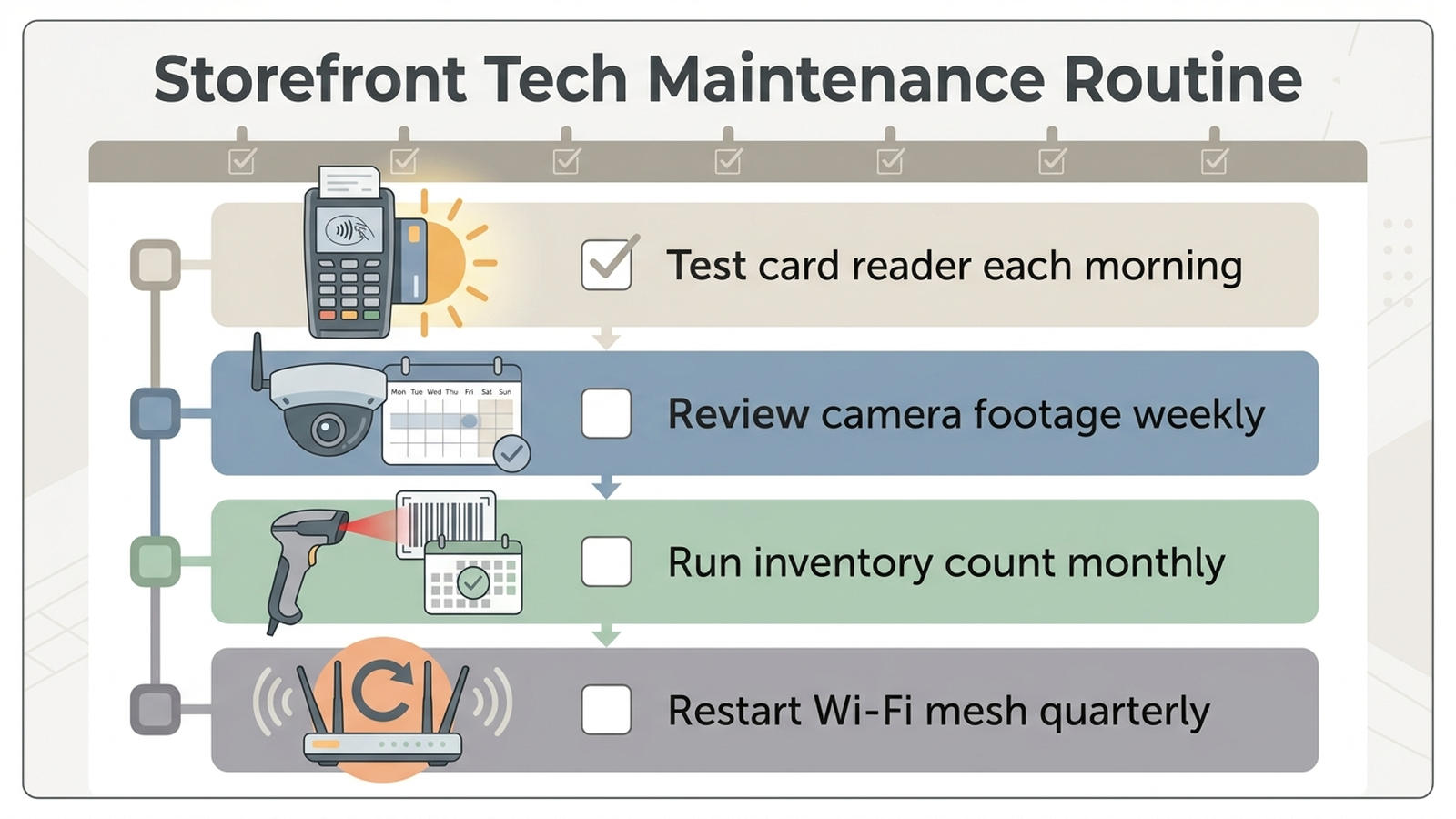
- Test the card reader’s connection before opening, not after the first customer. A dead Bluetooth pairing or an app that needs an update is the most common cause of a failed first sale, per aggregated small-business forum reports, and it’s a two-minute check before the doors open.
- Review camera footage on a set weekly schedule, not only after an incident. Reviewers consistently note that owners who only check footage reactively miss the early signs of a repeat shoplifter or an employee-theft pattern that a weekly spot-check would catch.
- Run a full barcode inventory count on a fixed monthly cadence. A scanner only ends the clipboard-count problem if it’s used on a routine, not just during an annual audit.
- Restart the mesh Wi-Fi system quarterly, and after any firmware update. Networking gear that runs continuously for months without a restart is a common source of the connectivity drops that show up as a dropped POS transaction.
How to Prioritize: A Budget Flowchart
Few new storefronts need all five items on day one. This is the order that addresses the costliest, most customer-visible gaps first on a limited opening budget.
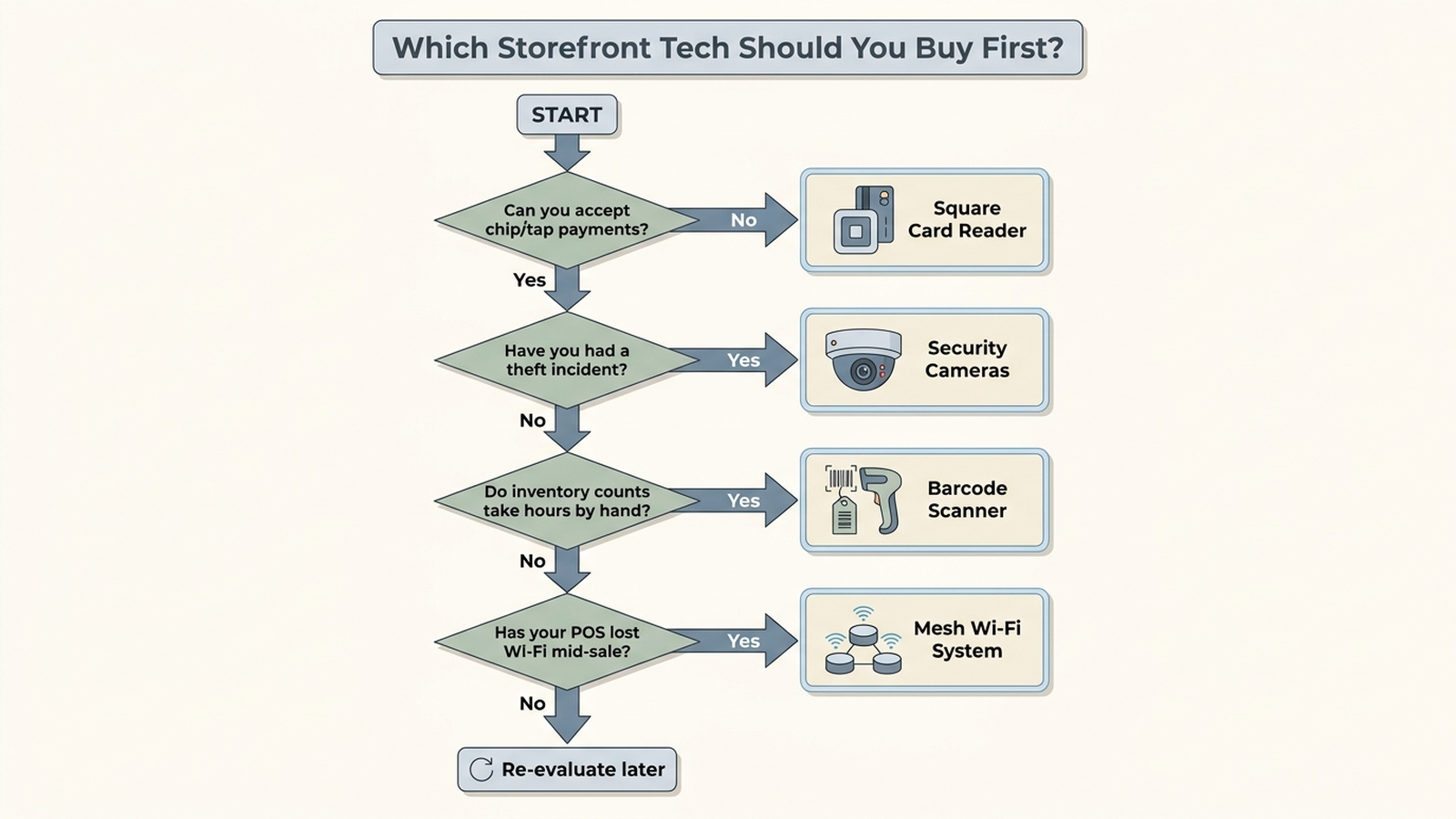
- Start with the card reader if you can’t accept chip or tap payments yet (about $49). This is both the cheapest item here and the one carrying real fraud-liability exposure — it should be the first purchase for any new storefront.
- Add the receipt printer next once return or exchange disputes come up (about $289). Worth confirming your return policy actually requires a printed receipt before spending here — some shop models run entirely on digital receipts.
- Add the security cameras next if the shop has had any theft incident, or none has been documented yet (about $90). With theft accounting for roughly two-thirds of retail shrinkage industry-wide, this is cheap insurance relative to the cost of a single unrecorded loss.
- Add the barcode scanner once inventory counts are taking hours by hand (about $40). Skip this early on for a very small SKU count — it earns its keep once manual counting becomes a real weekly time cost.
- Add the mesh Wi-Fi system if the POS has ever lost connection mid-sale, or the space has a dead zone (about $150). This is the one item worth installing proactively before opening in an oddly-shaped or larger retail space, rather than waiting for a dropped transaction to prove the need.
Editorial Recommendations by Use Case
- Best single purchase for any new storefront: the Square Reader for contactless and chip — the cheapest item here and the one that closes a real fraud-liability gap on day one.
- Best for shops handling frequent returns or exchanges: the Star Micronics TSP143IVUE, backed by a 2-year warranty and built specifically for POS-integrated receipt printing rather than general office use.
- Best for a shop that has never had camera coverage: the Wyze Cam v3 (3-Pack) — aggregated reviews and independent coverage agree it delivers the core shrinkage-coverage use case at a fraction of the cost of a professional system.
- Best for shops moving past clipboard inventory counts: the NETUM NT-1228BL — budget-friendly and versatile enough to read both barcode and QR-code formats.
- Best insurance purchase for larger or oddly-shaped retail spaces: the TP-Link Deco M4 (3-Pack) — low-visibility until the day it prevents a dropped POS transaction in front of a paying customer.
Limitations of This Analysis
This analysis relies on publicly available Amazon reviews, independent third-party comparison coverage, and manufacturer specifications; we did not personally test these products, and individual experience varies with store layout, transaction volume, and local Wi-Fi or cellular conditions. Retail shrinkage and small-business statistics are drawn from several distinct reports — the SBA Office of Advocacy, the National Retail Federation, and independent shrink-tracking research — with different methodologies and reporting years, so they should be read as directional context rather than a single unified figure. Prices, bundle configurations, and warranty terms change frequently on Amazon listings — confirm the current price and version on the product page before buying. Coverage area, print speed, and battery-life figures are manufacturer specifications rather than independently reproduced lab results unless a cited third-party source explicitly confirmed them.
The Bottom Line
A new storefront doesn’t need an enterprise POS contract or a monitored security system to close its biggest early gaps — the five items above, from a $49 card reader to a $150 mesh Wi-Fi system, are the ones that repeatedly show up in aggregated small-business reviews as the difference between a shop that loses a sale to a dead connection or an unrecorded theft, and one that doesn’t. Starting with the card reader (the cheapest item and the one carrying real fraud-liability exposure) and adding the others only once a specific gap is actually costing money keeps the total opening spend flexible, from about $49 for the first item to roughly $618 if every gap applies. Whichever items you prioritize, verify the exact current price and version before checkout — and if you want a second opinion on a specific listing, paste the URL into Arekore and let the AI scan the reviews and price history for you in about five minutes.