Best Space Heaters in 2026: Ceramic vs Oil-Filled vs Vortex
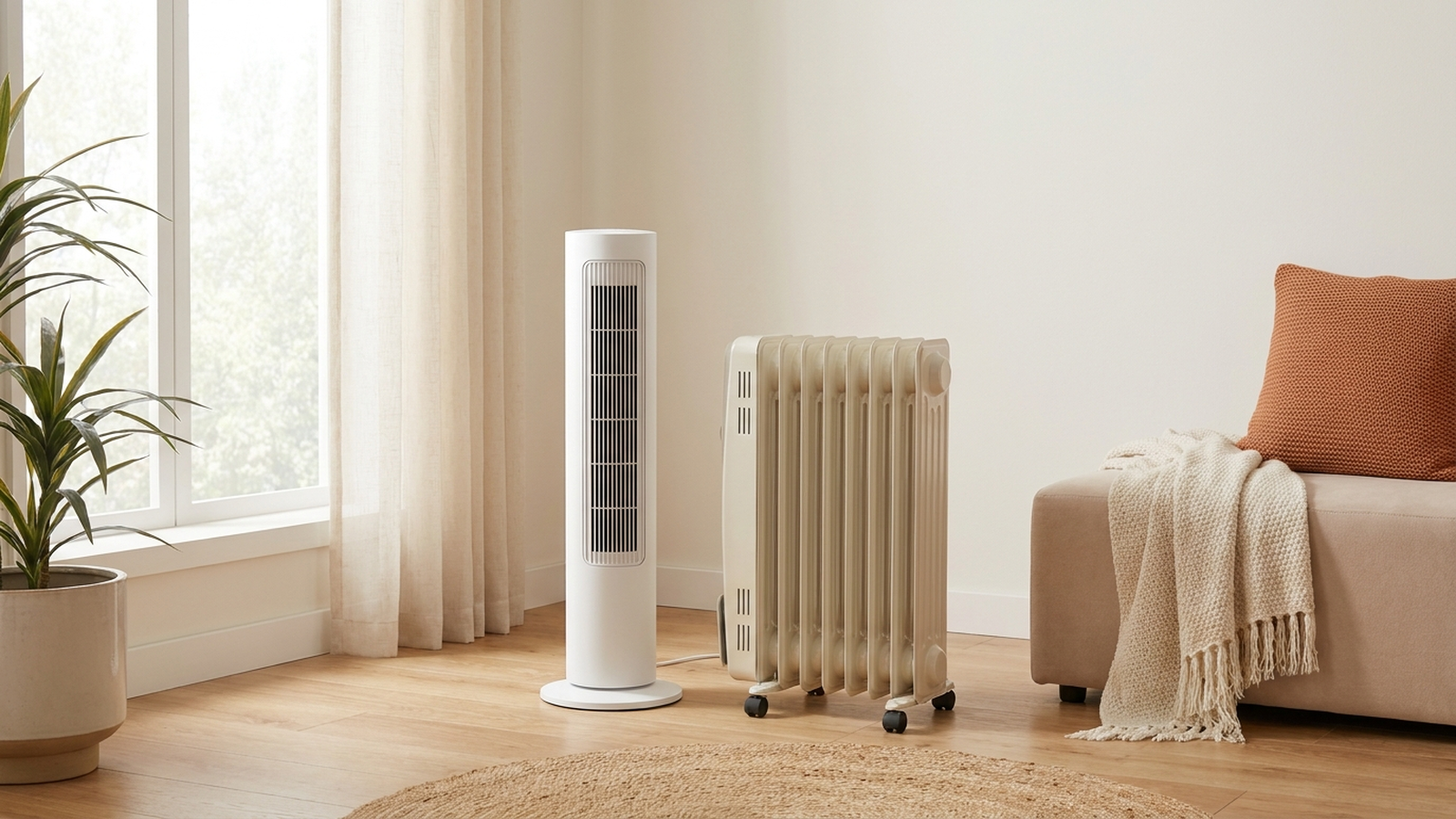
TL;DR. As fall temperatures drop, US shoppers face a real safety-vs-convenience trade-off: portable electric heaters are linked to roughly 1,600 house fires and 70 deaths per year (CPSC, 2019-2021 average), but a well-chosen, well-used heater is far safer than an old space heater pulled out of storage. Below: four heating technologies — ceramic tower (Dreo Solaris 718), ceramic fan combo (Lasko FH500, Tom’s Guide’s top overall pick), vortex convection (Vornado VH200), and oil-filled radiant (De’Longhi TRD40615E, the safest for unattended overnight use) — compared against Consumer Reports lab data, third-party reviews, and aggregated Amazon customer sentiment.
A note on links and methodology
As an Amazon Associate, Arekore earns from qualifying purchases. The Amazon product links in this article include our affiliate tracking ID and may earn us a commission if you buy through them, at no additional cost to you. See our Links Policy for details on how we select products and how commissions do not influence our recommendations.
We also did not personally test these products — every claim is an editorial synthesis of public data. The Methodology section below explains exactly which data we used.
Methodology
This article is an editorial analysis based on publicly available data collected in August 2026. We synthesized four categories of source:
- Customer reviews on amazon.com — we read the “Top reviews,” “Most recent reviews,” and the AI “Customers say” summary block on each ASIN’s product page to identify recurring positive and negative themes. We do not report a precise sample size N because Amazon’s review panels do not expose a stable count; reporting a fake precise N would be misleading.
- Independent lab and editorial tests — Consumer Reports’ 2026 space heater ratings (which lab-tests room heating, spot-heating, noise, and fire safety across more than 80 models), Tom’s Guide’s 2026 space heater test, and CNN Underscored’s 2026 space heater roundup.
- Manufacturer specifications — official Dreo Solaris 718 product page, Lasko FH500 spec sheet, and De’Longhi’s oil-filled radiator documentation.
- Safety and market data — US Consumer Product Safety Commission (CPSC) fire-incident statistics, and electric space heater market-size figures from industry research firms (360iResearch, Global Market Insights).
We deliberately do not simulate first-person product experience, fabricate reviewer personas, or invent precise data points we cannot verify. Recommendations are editorial opinions formed from the synthesis above.
0. Market context: a $7-9 billion category with a real safety record to reckon with
The global electric space heater market was estimated at roughly USD 7.5-8.8 billion in 2026 (360iResearch, Global Market Insights), and the United States accounts for approximately 26% of global unit volume, with annual US shipments exceeding 30 million units as of 2024 (industry shipment data cited by multiple market research firms). Space heaters are a genuinely high-volume, high-frequency-purchase category — most units are replaced every few years, and fall is the peak buying season as households anticipate the first cold snap before central heating gets a full workout.
The category also carries real risk that’s worth stating plainly before any product recommendation: the CPSC’s most recent detailed breakdown found portable heaters (a category that includes electric space heaters) involved in an average of about 1,600 fires, 70 deaths, and 160 injuries per year from 2019 to 2021. An older, broader CPSC figure covering all space heaters (portable and fixed, all fuel types) put the number at roughly 21,800 residential fires and 300 deaths annually — that figure is dated and mixes fuel-burning heaters in with electric ones, so we cite it only as historical context, not a current electric-heater-specific number. The takeaway for this article: heater choice and heater usage both matter, and we cover both below.
1. Four technical approaches to warming a room
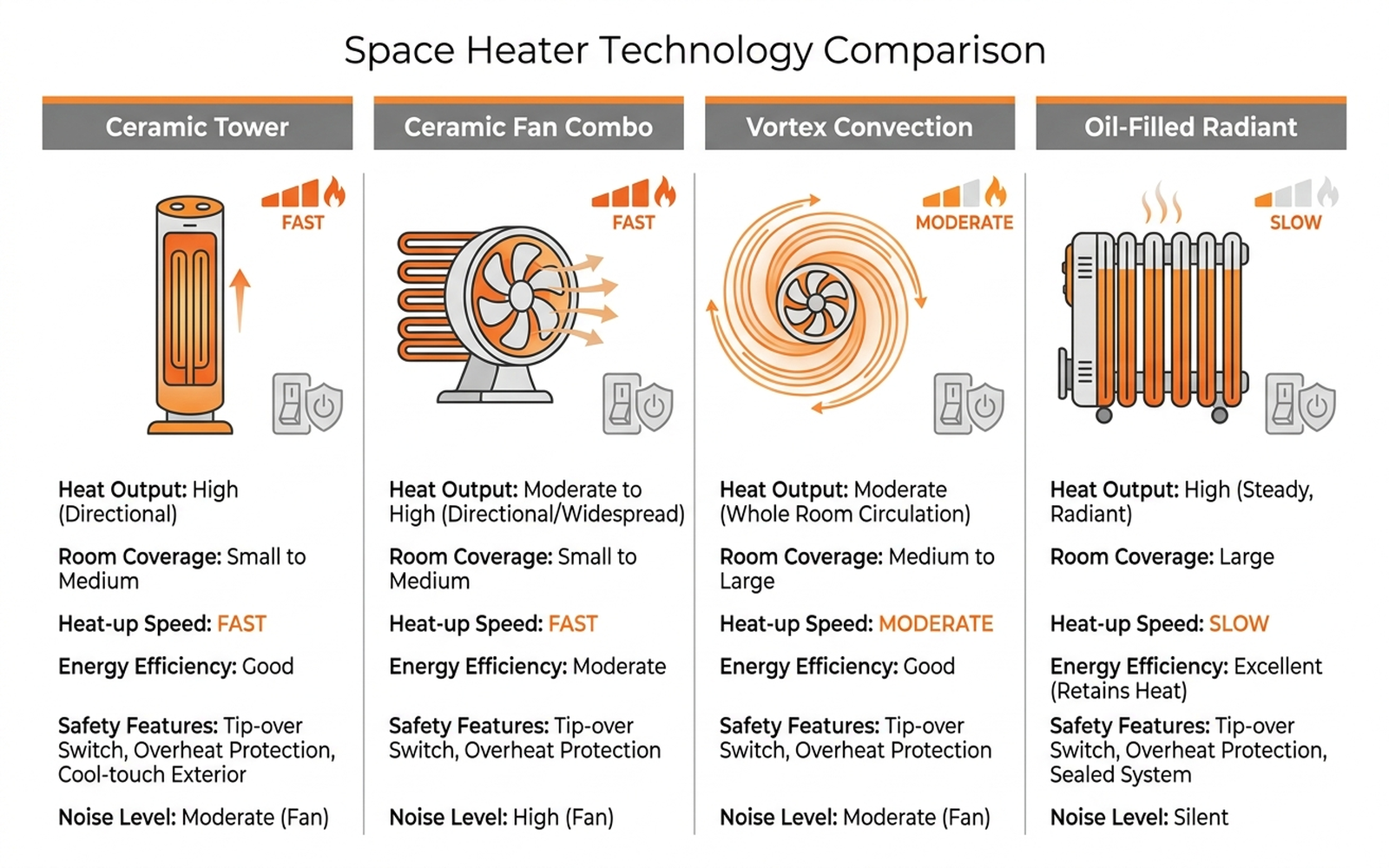
Every electric space heater converts electricity to heat at essentially 100% efficiency — a 1,500-watt ceramic heater and a 1,500-watt oil-filled radiator produce the same total heat output. What differs is how fast that heat reaches you, how it’s distributed through the room, and how safe the unit is to leave running.
| Approach | How it works | Heat-up speed | Best at | Represented by |
|---|---|---|---|---|
| Ceramic (PTC) tower | Self-regulating ceramic plates heat air blown through by an internal fan; PTC elements draw less current as they approach target temperature | Fast (warm air within seconds) | Quick spot-heating a small-to-medium room | Dreo Solaris 718 |
| Ceramic fan combo | Same PTC ceramic core, packaged as a dual-purpose tower fan that also heats | Fast | Year-round single-appliance households (fan in summer, heater in winter) | Lasko FH500 |
| Vortex convection | Vornado’s patented circulator design pushes heated air in a continuous vortex pattern to reach every corner of a room without oscillating parts | Moderate | Even whole-room warming without a rotating head | Vornado VH200 |
| Oil-filled radiant | A sealed reservoir of diathermic oil is heated internally and radiates warmth through metal fins; no fan, no exposed heating element | Slow (10-15 minutes to full output) | Sustained, quiet, low-fire-risk heating — including unattended bedroom use | De’Longhi TRD40615E |
The practical distinction that matters most: ceramic and vortex heaters have exposed or near-exposed heating elements and fans, which means faster heat-up but a higher surface temperature and more moving parts that can fail. Oil-filled radiators have no exposed element — the surface you can touch is a metal fin, not a heating coil — which is why Consumer Reports and most safety guides describe oil-filled models as the lowest-fire-risk category for scenarios like overnight bedroom use, even though they take longer to warm a room.
2. Quick comparison table (2026)
Prices captured at time of writing, August 2026. Confirm current pricing on the linked product page before purchase.
| Product | Price (USD) | Power | Room coverage | Best for |
|---|---|---|---|---|
| Dreo Solaris 718 | $129.99 | 1,500 W | Up to ~300 sq ft | Fast heat, quiet operation, modern design |
| Lasko FH500 | ~$90 | 1,500 W | Up to ~150 sq ft | One appliance for both summer fan and winter heat |
| Vornado VH200 | ~$80 | 1,500 W | Up to ~150 sq ft | Even room heating without oscillation |
| De’Longhi TRD40615E | ~$100 | 1,500 W | Up to ~150-200 sq ft | Lowest fire risk, safe for unattended overnight use |
3. Dreo Solaris 718: fast heat with the lowest measured noise
The Solaris 718 is Dreo’s flagship ceramic tower heater and a best-seller on Amazon’s Indoor Space Heaters chart. Its core pitch is speed and quiet: a PTC ceramic heating element paired with a 30-inch tower housing, 120-degree oscillation, a digital thermostat, and Dreo’s claim of 25 dB operation on low settings — quiet enough to run in a bedroom overnight, though we treat the 25 dB figure as a manufacturer claim rather than an independently lab-verified number.
CNN Underscored’s 2026 roundup named a Dreo model (the closely related Solaris 718) its top pick, praising the “elegant aesthetic, impressive heating capabilities” and noting it’s affordable relative to its build quality. The unit includes 8 layered safety protections per Dreo’s spec sheet, including tip-over shutoff and overheat protection — standard on modern ceramic heaters but worth confirming on any unit you buy.
What customer reviews tend to praise:
- Heat-up speed — warm air within seconds of power-on, consistent with the ceramic PTC category generally
- Quiet operation relative to older ceramic heaters
- Remote control and digital display, useful for adjusting from bed
Where reviews push back:
- Coverage ceiling. Reviewers consistently note it heats a bedroom-sized room well but struggles in open-plan living rooms above roughly 300 sq ft.
- Plastic housing warmth. Some reviewers note the housing itself gets warm to the touch during extended high-setting use, which is normal for ceramic towers but worth knowing if you have curious pets or small children nearby.
Best for: bedrooms and home offices where you want heat within seconds and minimal noise, and you’re comfortable with an appliance that has a fan and an internal heating element running while you sleep.
4. Lasko FH500: the fan-and-heater combo Tom’s Guide rated best overall
The FH500 takes a different value proposition: it’s a year-round appliance — a tower fan in summer, a 1,500 W ceramic heater in winter, with 4 fan speeds and 3 heat settings controlled from one remote. In Tom’s Guide’s 2026 test, the FH500 was the top overall pick, having “surpassed every other heater tested” in a 15 x 10 ft test room, raising room temperature evenly by 10°F and producing felt warmth within 12 seconds of power-on.
What customer reviews tend to praise:
- Two-appliance value — households that would otherwise buy a separate fan and heater cite this as the main reason to choose it
- Even heat distribution, credited to the tower fan’s wider airflow spread compared to a plain ceramic box heater
- Remote control range and simple dial interface
Where reviews push back:
- Noise on high fan speed. Reviewers who use it primarily as a summer fan report it’s louder than dedicated tower fans at the top speed.
- No oscillation on some units. Depending on the exact FH500 variant, oscillation may be limited or absent — check the specific listing before buying if directional spread matters to you.
Best for: renters and small-apartment dwellers who want to buy one climate appliance instead of two, and who prioritize even heat distribution over the fastest possible heat-up.
5. Vornado VH200: whole-room convection without oscillating parts
Vornado’s heaters use the company’s signature vortex circulator design — originally developed for their fans — to push air in a continuous, room-filling pattern rather than relying on a rotating head to sweep heat side to side. The VH200 is Vornado’s budget whole-room model, and Tom’s Guide’s 2026 roundup highlights it as a lower-cost pick, calling it “the quietest unit we tested” and noting it costs roughly half as much as some pricier competitors in the same lineup.
Consumer Reports’ testing of the related, higher-end Vornado VMHi600 found it among the quietest small heaters in their lab, with an excellent score for spot-heating an individual quickly — evidence that Vornado’s vortex approach performs well on the noise dimension even though the company doesn’t publish an independently verified dB figure for the VH200 specifically.
What customer reviews tend to praise:
- Even heat spread across a room without a rotating or oscillating head
- Simple, durable design with fewer moving parts than tower-style heaters
- Value — priced meaningfully below the ceramic tower category
Where reviews push back:
- No digital display or remote on the base VH200 — it’s a dial-and-switch interface, which some reviewers find dated compared to app-connected or remote-controlled competitors.
- Slower to feel warm than PTC ceramic towers in the first minute, even though total room heating time is competitive once it stabilizes.
Best for: shoppers who want even whole-room heating at a lower price and don’t need a remote, digital thermostat, or oscillation.
6. De’Longhi TRD40615E: the oil-filled radiator built for unattended, overnight heating
The TRD40615E is a sealed oil-filled radiator — there is no exposed heating coil and no fan. Diathermic oil inside the sealed reservoir is heated electrically and radiates warmth through the metal fin columns, the same basic design that’s been used in radiators for decades, updated here with a digital control panel, 24-hour programmable timer, and an ECO energy-saving mode.
This is the category Consumer Reports and fire-safety guides consistently point to when the use case is heating a bedroom overnight while sleeping, or leaving a heater running in a room with pets or small children. Because there’s no exposed element and no fan pulling in dust, the surface stays cooler to the touch than a ceramic or vortex heater at the same wattage, and there’s less mechanical wear over time. The trade-off is heat-up speed: oil-filled radiators typically take 10-15 minutes to reach full output, versus near-instant warm air from ceramic units.
What customer reviews tend to praise:
- Quiet operation — no fan noise at all, which reviewers frequently cite as the reason they switched from a ceramic heater for bedroom use
- Sustained warmth after the unit cycles off, because the oil retains heat
- Perceived safety for use around pets and children, though we note this is a directional safety advantage, not a guarantee against all heater-related fire risk
Where reviews push back:
- Slow warm-up. This is the most common complaint; reviewers who expect near-instant heat like a ceramic tower find the 10-15 minute ramp frustrating if used inconsistently.
- Weight and footprint. Oil-filled radiators are heavier and bulkier than ceramic towers, making them less practical to move between rooms.
Best for: bedrooms, nurseries, and any room where the heater will run for extended periods or overnight, and where quiet, low-surface-temperature operation matters more than fast heat-up.
7. Using any space heater safely: the CPSC’s core rules
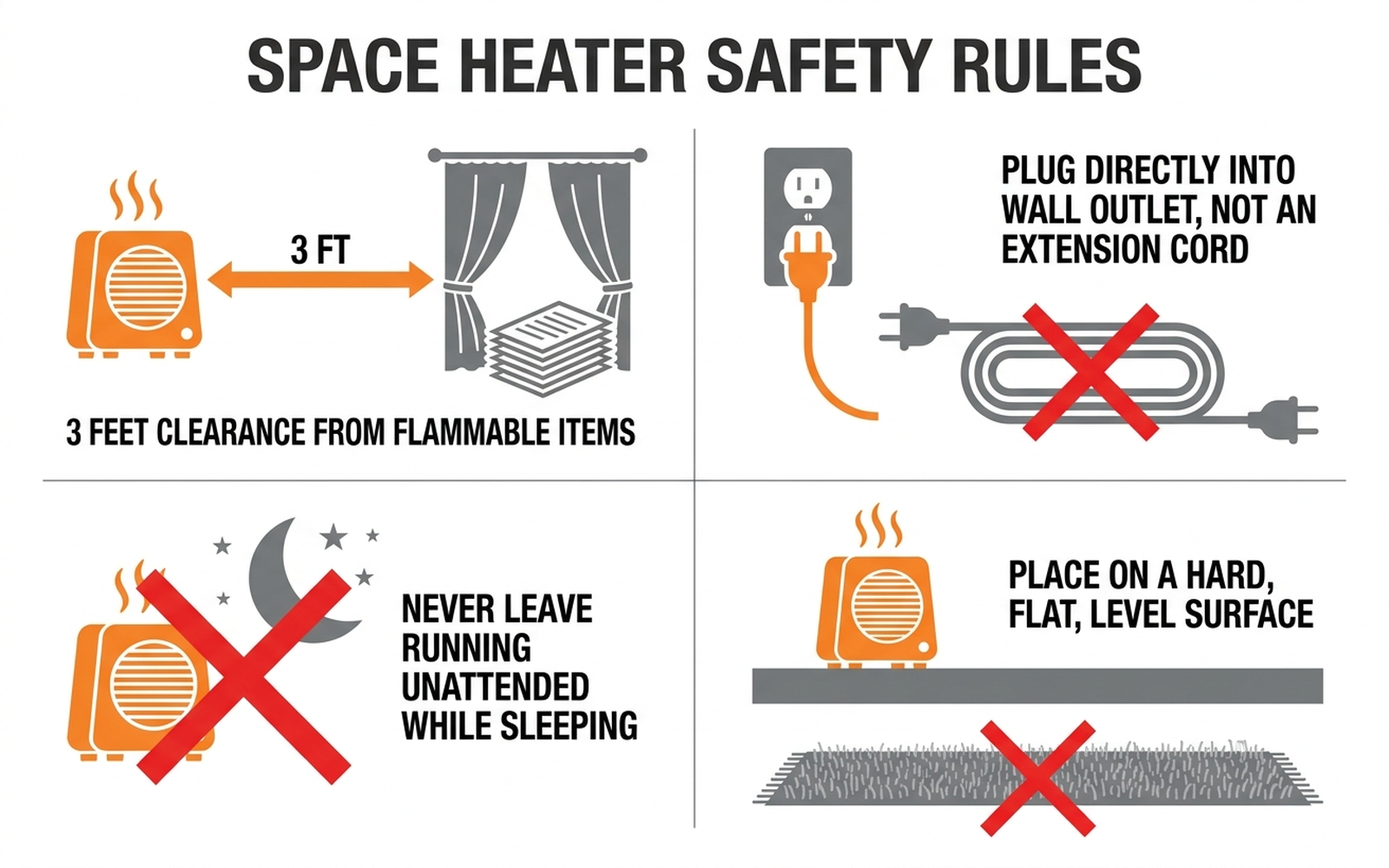
Whichever technology you choose, the CPSC’s guidance applies to all of them:
- Keep at least 3 feet of clearance from anything flammable — curtains, bedding, furniture, paper.
- Plug directly into a wall outlet. Never use an extension cord or power strip; this is one of the most common causes of heater-related electrical fires because heaters draw enough current to overheat undersized cords.
- Never leave a heater running unattended in a room you’re not in, and avoid running one while sleeping unless the model is specifically rated and marketed for that use (oil-filled radiators are the most commonly recommended category for this).
- Place on a hard, flat, level surface — not on carpet, a rug, or anything that could tip it or restrict airflow underneath.
- Look for a tip-over shutoff and overheat protection — all four products reviewed here include both, but always confirm on the specific listing before buying, since safety-feature sets vary across a manufacturer’s product line.
8. The “which one for whom” flowchart
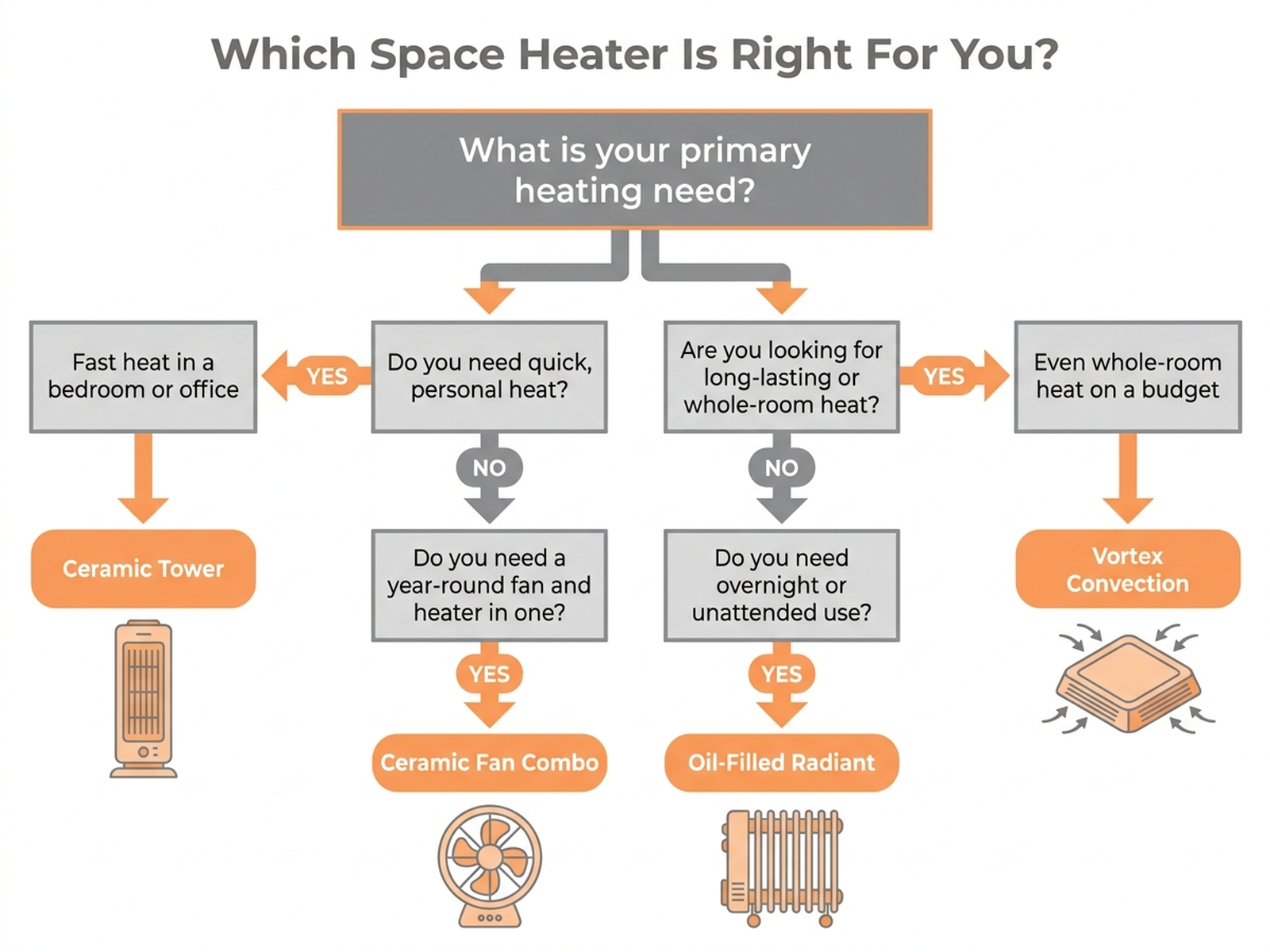
If you’re still deciding, this is the decision tree we’d use:
| Question | Answer | Pick |
|---|---|---|
| Do you want heat within seconds for a bedroom or home office, and you’ll be in the room while it runs? | Yes | Dreo Solaris 718 (B0DCBN8F6N) |
| Do you want one appliance for both summer cooling and winter heating? | Yes | Lasko FH500 (B07QHG97RZ) |
| Do you want even whole-room warming at the lowest price, without a digital display? | Yes | Vornado VH200 (B01N1MMQPC) |
| Will the heater run overnight, unattended, or in a room with pets or small children? | Yes | De’Longhi TRD40615E (B00G96S4Y8) |
| Do you need to heat a room larger than ~300 sq ft as your primary heat source? | Yes | None of the above — a portable space heater is not designed as a primary whole-room heat source for large spaces; consider a mini-split or consult an HVAC technician |
9. Warranty and after-sales support
| Brand | Manufacturer warranty | Notes |
|---|---|---|
| Dreo | 1 year (typical for Dreo small appliances) | Dreo handles support directly through its website; extended coverage sometimes available at purchase. |
| Lasko | 1 year | Lasko has sold heaters and fans in the US for decades; parts and manuals are widely available even for older models. |
| Vornado | 1 year (varies by model; some Vornado fans carry longer coverage) | Vornado is a US-based company with a long track record in the circulator-fan and heater category. |
| De’Longhi | 1 year | De’Longhi’s oil-filled radiators are a mature, low-complexity product category with a strong repair/reliability track record reported in aggregated reviews. |
Warranty length is fairly uniform across this category — a year across the board — so it’s a weaker differentiator here than in, say, premium electronics. Reliability, in this category, shows up more in aggregated review sentiment about longevity than in the warranty terms themselves.
10. The bottom line
There is no single “best space heater in 2026.” The right pick depends on how fast you need heat, how quiet you need it, and whether it will run unattended:
| Best for | Pick | Approx price | Key data point |
|---|---|---|---|
| Fastest heat, quietest ceramic tower | Dreo Solaris 718 | $129.99 | 25 dB claimed, 8 safety protections |
| One appliance, year-round | Lasko FH500 | ~$90 | Tom’s Guide top overall pick, warmth felt in 12 seconds |
| Even whole-room heat, budget | Vornado VH200 | ~$80 | Vornado vortex circulator design |
| Overnight / unattended use | De’Longhi TRD40615E | ~$100 | Sealed oil-filled, no exposed element |
If you’re choosing between two products in the same tier, weight where you’ll use it most heavily: a heater that’s great for a home office at your desk (fast heat-up, ceramic) is a poor choice for a bedroom you’ll leave running while you sleep (oil-filled is the safer bet there), and vice versa.
Limitations of this analysis
To be explicit about what this article does not establish:
- We did not personally test any of these products. Every claim is sourced from publicly available customer reviews, independent third-party publications (Consumer Reports, Tom’s Guide, CNN Underscored), manufacturer specifications, and CPSC safety data.
- Sample size. We read top reviews and the AI-summary block on each ASIN’s amazon.com page in August 2026. We do not report a precise N because Amazon does not expose a stable review count for those panels; any specific number we wrote would be misleading.
- Manufacturer claims (Dreo’s “25 dB,” “8 safety protections”) are reported as marketing claims, not independently verified by us, unless attributed to a named third-party test like Consumer Reports.
- CPSC fire statistics come from two different reporting periods and heater-type definitions (the 2019-2021 portable-heater-specific figure and an older, broader all-fuel-type figure); we flagged this distinction above rather than blending them into one number.
- Market-size figures (USD 7.5-8.8 billion, 26% US volume share) are from third-party industry research firms and vary between sources; treat them as directional, not precise.
- Pricing fluctuates with promotions and season — space heater prices in particular often rise as cold weather arrives; confirm current pricing before purchase.
- Room-coverage figures are approximate and depend on ceiling height, insulation, and climate; a heater rated for 300 sq ft in a well-insulated apartment may underperform in a drafty older home.
- Long-term durability (3+ years) is harder to assess from public reviews; we relied on aggregated sentiment from older reviews where available.