Best Smart Thermostats 2026: Nest vs Ecobee vs Honeywell
TL;DR / Quick Verdict
- Best overall / best for multi-room comfort: Ecobee Smart Thermostat Premium — the only model in this comparison that ships with a room sensor in the box, plus a built-in air quality monitor and full Matter support.
- Best for hands-off scheduling: Google Nest Learning Thermostat (4th Gen) — its adaptive-learning algorithm builds a schedule from your manual adjustments instead of requiring you to program one.
- Best budget pick for multi-stage HVAC systems: Honeywell Home T6 Pro — the lowest price of the three, with broad compatibility for 2-heat/2-cool and heat-pump systems that some competitors don’t support out of the box.
As an Amazon Associate, Arekore earns from qualifying purchases. The Amazon product links in this article include our affiliate tracking ID and may earn us a commission if you buy through them, at no additional cost to you. See our Links Policy for details on how we select products and how commissions do not influence our recommendations.
- Ecobee Smart Thermostat Premium
- Google Nest Learning Thermostat (4th Gen)
- Honeywell Home T9 Smart Thermostat
- Honeywell Home T6 Pro
Methodology
This analysis synthesizes (a) aggregated Amazon US customer reviews for the current-generation Ecobee, Nest, and Honeywell thermostat lines, (b) independent lab testing from Consumer Reports, which evaluated 8 smart thermostat models in its 2026 ratings, and (c) manufacturer-published specifications for sensor technology, HVAC compatibility, and platform support. We also reference ENERGY STAR’s independently tracked average energy-savings figures rather than manufacturer marketing claims alone. We did not personally test the products covered here.
Technical Approach: Three Ways to Solve the Same Problem
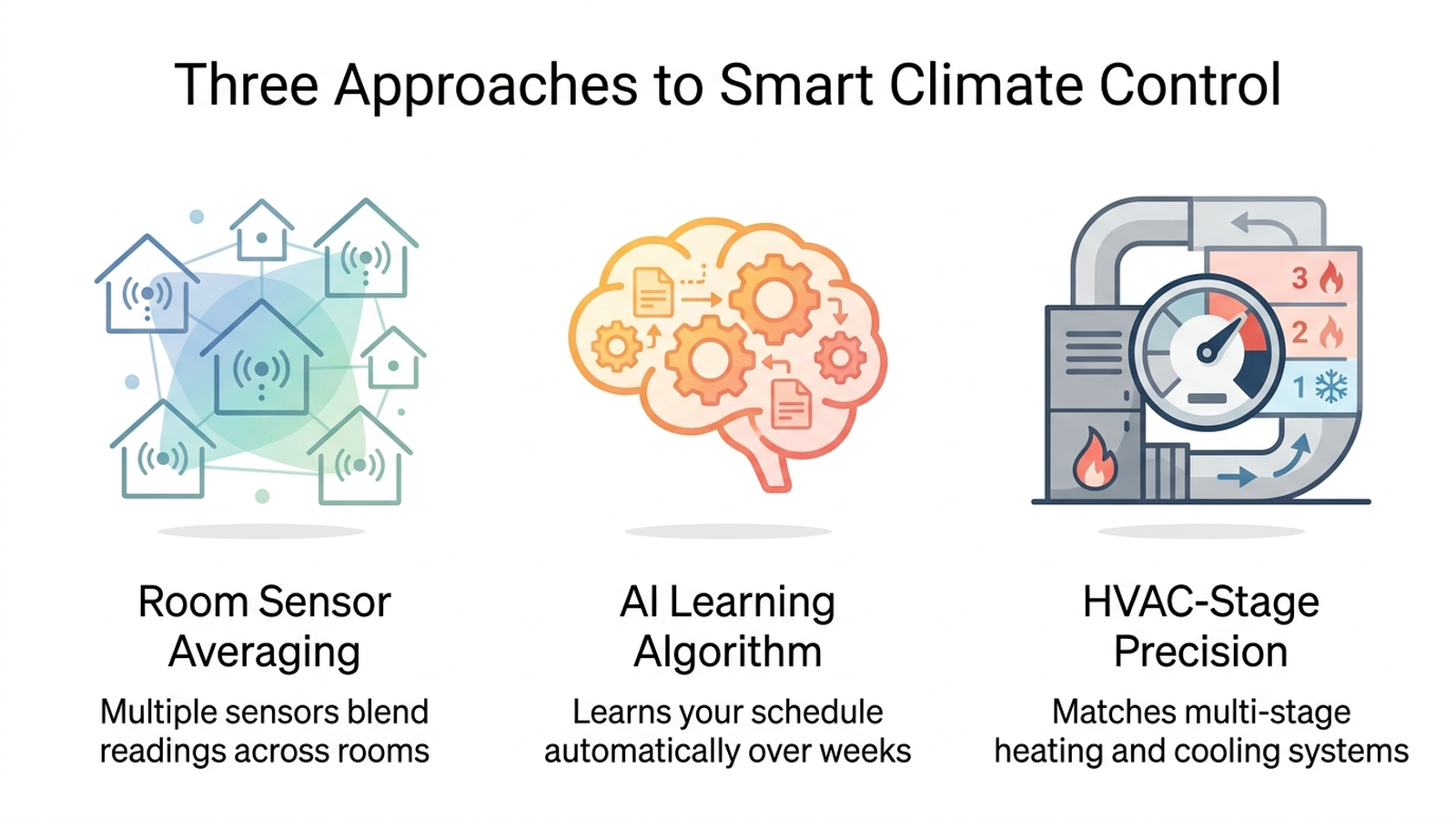
A thermostat mounted in a hallway rarely reflects the temperature in the bedroom or the home office down the hall. Ecobee, Nest, and Honeywell have converged on three different fixes for that mismatch:
- Room Sensor Averaging (Ecobee): Ecobee’s Premium and Enhanced models ship with a wireless SmartSensor that measures temperature and occupancy in a separate room, then blends that reading with the main thermostat’s reading. Consumer Reports credits this approach with the most even whole-home comfort in its 2026 lab testing, since the system can favor an occupied room over an empty hallway.
- AI Learning Algorithm (Nest): The Nest Learning Thermostat does not ask you to build a schedule. It observes when you manually raise or lower the temperature over the first one to two weeks and builds an automatic schedule from that behavior, then continues adjusting for factors like local weather and how long your specific home takes to heat or cool (a metric Google calls “Time to Temperature”). The tradeoff is that multi-room evenness depends on adding an optional separate Nest Temperature Sensor, which is not included with every bundle.
- HVAC-Stage Precision (Honeywell): Honeywell’s T6 Pro and T9 models emphasize compatibility with multi-stage heating and cooling equipment — up to 2 heat / 2 cool on the T6 Pro, or 3 heat / 2 cool on higher configurations — which matters most for homes with heat pumps or two-stage furnaces where a single-stage-only thermostat can cause the system to short-cycle. The T9 adds an optional add-on room sensor, but unlike Ecobee’s Premium, it isn’t bundled by default with the base thermostat.
Manufacturer Deep Dive
Ecobee
The Ecobee Smart Thermostat Premium is Consumer Reports’ top-rated smart thermostat in its 2026 ratings, and carries a 4.4-star rating from more than 3,400 Amazon US reviews. Its standout hardware feature is the bundled SmartSensor, which reviewers frequently cite as solving the “one room is always too hot or too cold” problem that a single-point thermostat can’t fix on its own. It also includes a built-in air quality monitor tracking particulate matter, humidity, and VOC levels, and it’s the only model of the three with native Apple HomeKit support alongside Alexa, Google Assistant, and Matter. Ecobee’s own marketing claims up to 26% in combined heating and cooling savings; independent ENERGY STAR data across the smart thermostat category as a whole shows a more modest average of roughly 8%, translating to an estimated $50–$100 per year for a typical US household — a gap worth knowing before treating any single manufacturer’s savings figure as a guarantee for your specific home.
Google Nest
The Nest Learning Thermostat (4th Gen) is Google’s flagship model and the closest competitor to Ecobee in most 2026 comparison testing, trading places with it near the top of Consumer Reports’ rankings. Its main differentiator is the adaptive-learning scheduling described above, paired with an OLED “Farsight” display that lights up and shows the temperature from across a room as you approach. It integrates most deeply with Google Home and Google Assistant, and gained Matter support in recent firmware updates, which lets it also expose basic control to Alexa or SmartThings. The bundled Nest Temperature Sensor (2nd Gen) in some retail packages addresses part of the multi-room problem, though Ecobee’s SmartSensor is included as standard on the Premium tier while Nest’s sensor bundling varies by listing.
Honeywell
Honeywell’s smart thermostat line spans a wider price range than Ecobee or Nest, from the budget-oriented T6 Pro (around $95) to the sensor-capable T9 (around $170–$200 with one room sensor). The T6 Pro’s core appeal, per Consumer Reports’ testing and aggregated Amazon reviews, is straightforward Wi-Fi scheduling and touchscreen control at roughly 40–60% of Ecobee’s or Nest’s price, with reviewers describing it as a reliable “no-frills” option for renters or homeowners who want app control without paying for room sensors or air quality monitoring they won’t use. The T9 closes part of the gap with Ecobee by supporting an optional add-on Smart Room Sensor and, following a late-2025 firmware update, Matter compatibility — a capability it lacked at launch. Honeywell’s decades of HVAC installer relationships also mean its thermostats list explicit compatibility with a broader range of multi-stage heat-pump configurations than some competitors, which matters for older US homes with non-standard wiring.
How to Choose: Placement Matters as Much as the Model
Even the most accurate sensor-based thermostat reports the wrong temperature if it’s mounted in a bad spot. Independent reviewers and manufacturer install guides converge on the same placement rules regardless of brand:
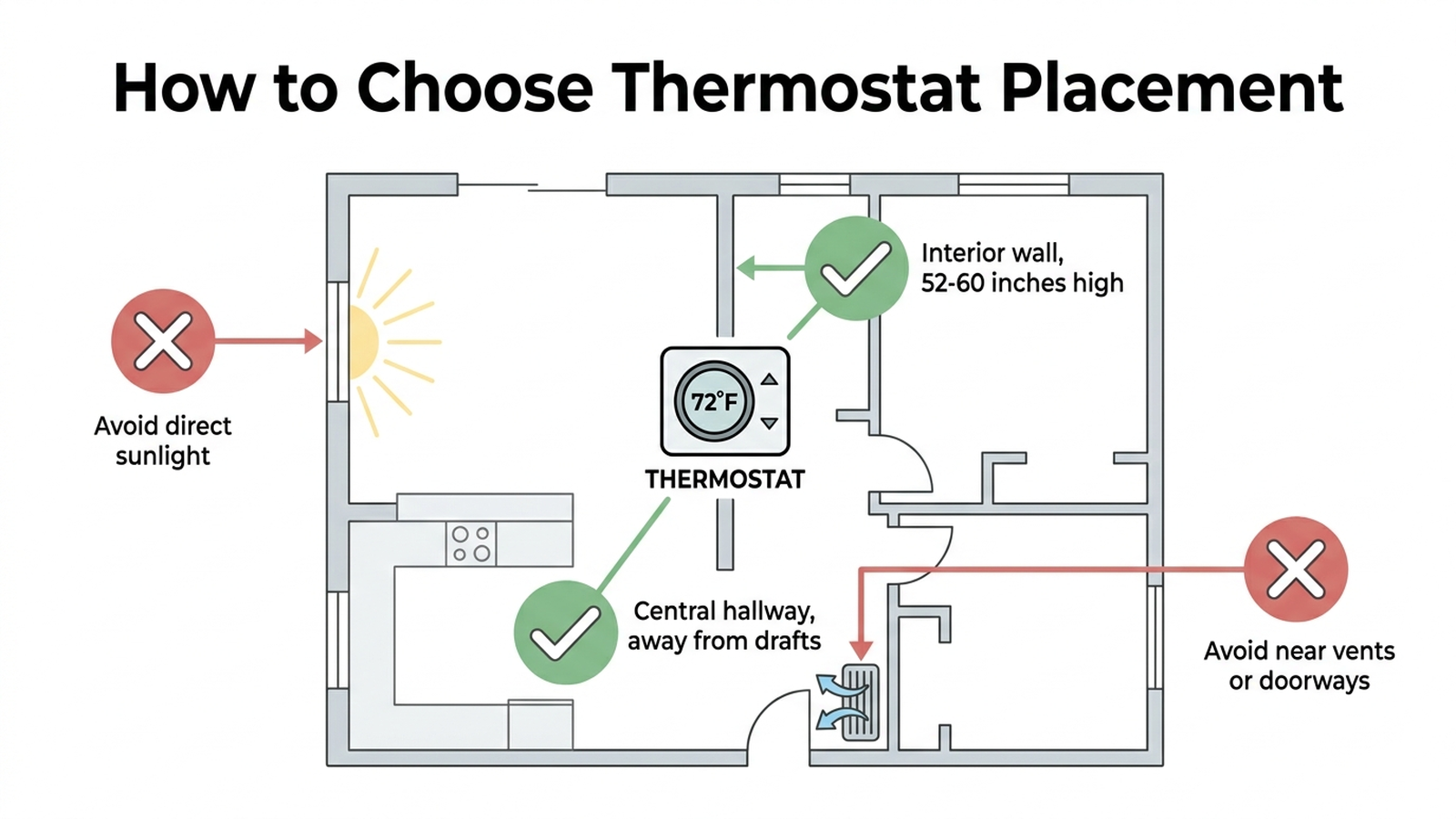
- Mount on an interior wall, roughly 52–60 inches from the floor — about chest height for most adults, and away from exterior walls that run colder or hotter than the rest of the room.
- Avoid direct sunlight through a nearby window; sun exposure can push the sensor’s reading several degrees above actual room temperature, causing the system to over-cool.
- Keep it away from air vents, doorways, and stairwells, where a passing draft or air-handler output can trigger inaccurate short-cycling.
- If your home has a persistently uneven room — an addition, a room over a garage, a converted attic — prioritize a model with a bundled or easily added room sensor (Ecobee Premium, or Honeywell T9 with its optional sensor) over a single-point-only model.
Comparison Table
Prices as of 2026-09-09 — Amazon frequently runs short-term discounts on all three brands; check the live listing before buying.
| Product | Room Sensor | HVAC Stages | Platform Support | Price |
|---|---|---|---|---|
| Ecobee Smart Thermostat Premium | Included (SmartSensor) | Up to 3 heat / 2 cool | Alexa, Google, HomeKit, Matter | ~$212–$249.99 |
| Google Nest Learning Thermostat (4th Gen) | Optional (Nest Temperature Sensor) | Up to 2 heat / 2 cool (heat pump) | Alexa (via Matter), Google Home | ~$219.99–$279.99 |
| Honeywell Home T9 | Optional add-on | Up to 3 heat / 2 cool (heat pump or multi-stage) | Alexa, Google, Matter (2025+ firmware) | ~$169.99–$199.99 |
| Honeywell Home T6 Pro | Not available | Up to 2 heat / 2 cool | Alexa, Google | ~$94.99 |
Decision Flowchart: Matching a Model to Your Home
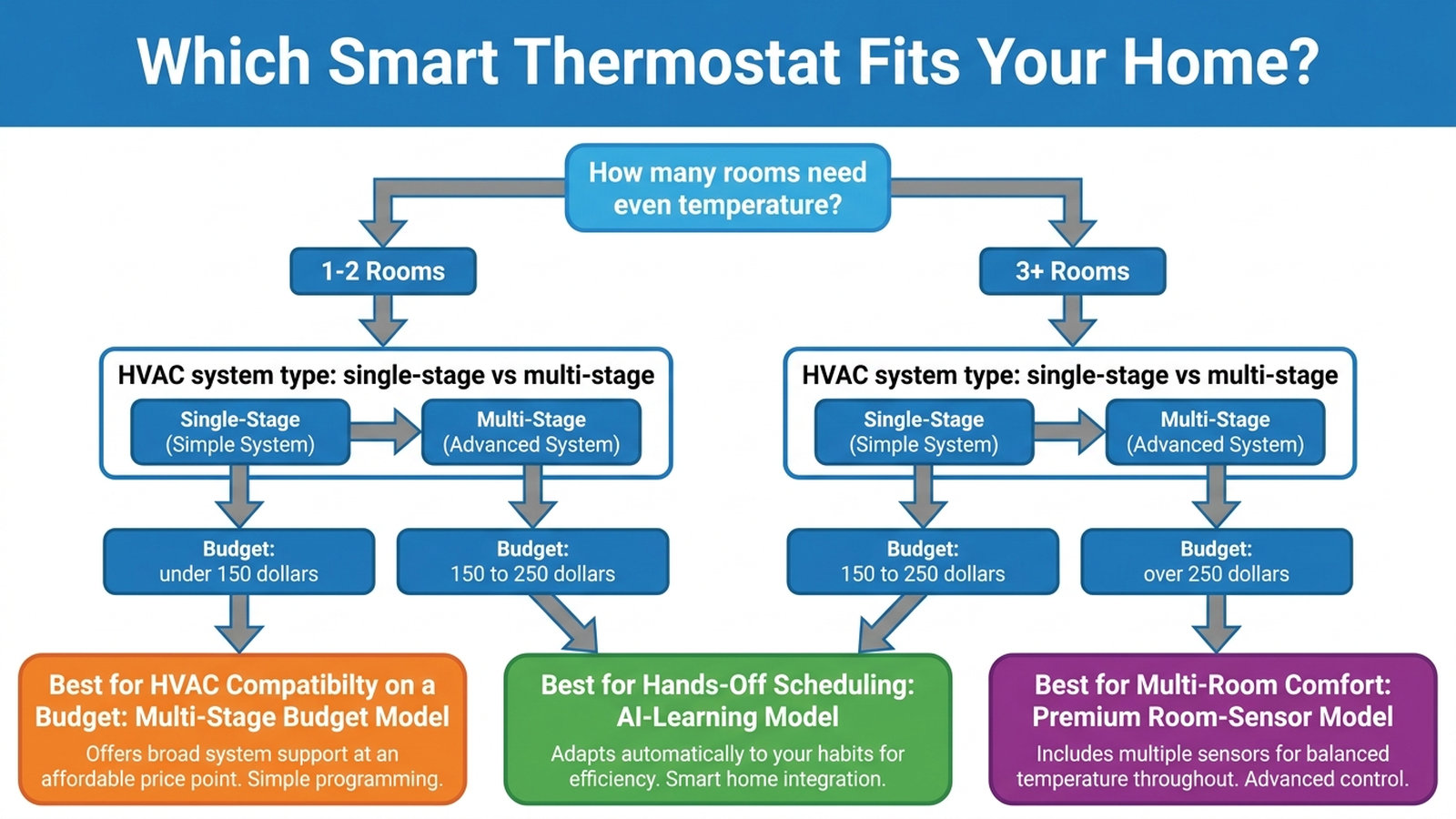
For a quick path through these four models: start with how many rooms in your home run noticeably hotter or colder than the thermostat’s location, then factor in your HVAC system’s stage count, then set a budget ceiling. A home with one or two chronically uneven rooms and a flexible budget points toward Ecobee’s bundled sensor; a home that’s fairly even overall but where you’d rather not build a manual schedule points toward Nest; a straightforward single- or two-stage system on a tight budget points toward the Honeywell T6 Pro.
Warranty and Support
Ecobee and Google Nest both offer a 3-year limited warranty on their current thermostat lines when purchased new and registered, which is longer than the industry-typical 1-year coverage; Honeywell’s T6 Pro and T9 carry a standard 1-year limited warranty. All three warranties cover manufacturing defects, not damage from improper installation or incompatible HVAC wiring — a distinction worth checking against your own system before buying, since incorrect C-wire or multi-stage wiring is a recurring theme in negative Amazon reviews across all three brands. Energy-savings percentages quoted by any manufacturer are based on internal or third-party modeling under specific usage assumptions, not a guarantee for every home’s insulation, climate, or HVAC efficiency.
Limitations
This analysis relies on publicly available Amazon customer reviews, Consumer Reports’ published 2026 lab testing, and manufacturer specifications. We did not personally install or run any of these thermostats in a controlled side-by-side test. Energy savings, sensor accuracy, and Matter interoperability can vary by home, HVAC system age, and firmware version at time of purchase; individual results may differ from the aggregated figures cited here.
Visit Arekore to verify current pricing and availability before buying, since Amazon listings and promotional pricing change frequently.